Key Takeaways
- GE Vernova jumped 8.2% on Nov. 23 and is up 16% in 2026, but it still sits 37% below its July high after data center scares that also hit Vertiv and Bloom Energy.
- The company raised its 2026 guidance with all three reports, and free cash flow guidance has more than tripled to $16-17 billion.
- Management says only about 20% of its gas demand comes from data centers, though third-quarter free cash flow leaned heavily on customer down payments.
- Analysts expect 2028 EPS of 2.4 times this year’s, while the forward multiple has more than halved since April. The late-January report is the next test.
GE Vernova (GEV) jumped 8.2% to $756.71 on Nov. 23 as Nvidia’s reinstatement of Jensen Huang as CEO lifted the whole AI trade. That left it up 16% in 2026, the remains of a much bigger run. The stock still sits 37% below its July 6 intraday high, though the company raised its guidance every time it reported.
The scares that sank it came from outside the company and hit Vertiv (VRT) and Bloom Energy (BE) too. Both also rallied on Nov. 23. The case for buying more after three raises still holds.
Three raises in three reports
GE Vernova raised its 2026 guidance on April 22, July 22 and Oct. 28, as orders grew 71%, 88% and 96% organically. Free cash flow guidance has more than tripled, from $5.0-5.5 billion to $16-17 billion. The backlog hit $197 billion at Sept. 30, and gas equipment under contract rose to 122 gigawatts from 83 at the end of 2025.
Each 2026 quarter’s free cash flow has topped all of 2025’s $3.7 billion. But working capital, mostly customer down payments, supplied $5.3 billion of the third quarter’s $5.4 billion, so a data center pullback would show up in the cash first. New gas contracts slowed to 11 gigawatts in the third quarter, from 20 in the second.
TIKR tracks 37 analysts on GE Vernova. How many say “Buy”?
See the full breakdown of Buy, Hold, and Sell ratings on GE Vernova, along with Wall Street’s revenue and earnings estimates, all in one place. More than 500,000 investors use TIKR to research stocks like this one. See GE Vernova’s Analyst Ratings
The scares came from somewhere else
The selling started in late October, when Meta reported negative free cash flow from heavy AI spending. AI power stocks fell again after the Nov. 3 midterms, which Reuters said stoked fears of tighter regulation, and again when Huang resigned as Nvidia’s CEO on Nov. 12. On Nov. 10, SoftBank took a $3.7 billion power-equipment charge and changed how it buys equipment for US data centers. A guest on CNBC’s Halftime Report answered that shift: “A procurement problem is not a power problem. An unpowered data center is just a warehouse.”
He has a point. Even if all 9.2 gigawatts of SoftBank’s Ohio plant were GE Vernova’s, they’d be under 8% of its 122 gigawatts. Management said in July that only about 20% of its gas demand comes from data centers. In Texas, Governor-elect Gina Hinojosa campaigned on a data center moratorium, and SemiAnalysis wrote on Nov. 1 that a long Texas permit freeze is now the biggest single risk to the 2028 US buildout.
Vertiv took the same hits and is up 15% in 2026, even after third-quarter sales rose 61%. Bloom is up 98% after its third 2026 revenue guidance raise, to $4.4-4.6 billion, but two customers made up 69% of its third-quarter revenue.
Half its April multiple
Analysts kept raising their numbers through the slide. Their 2027 EPS estimate is $26.24, up from $18.38 at the end of September 2025, and they expect EPS to more than double from 2026 to 2028:
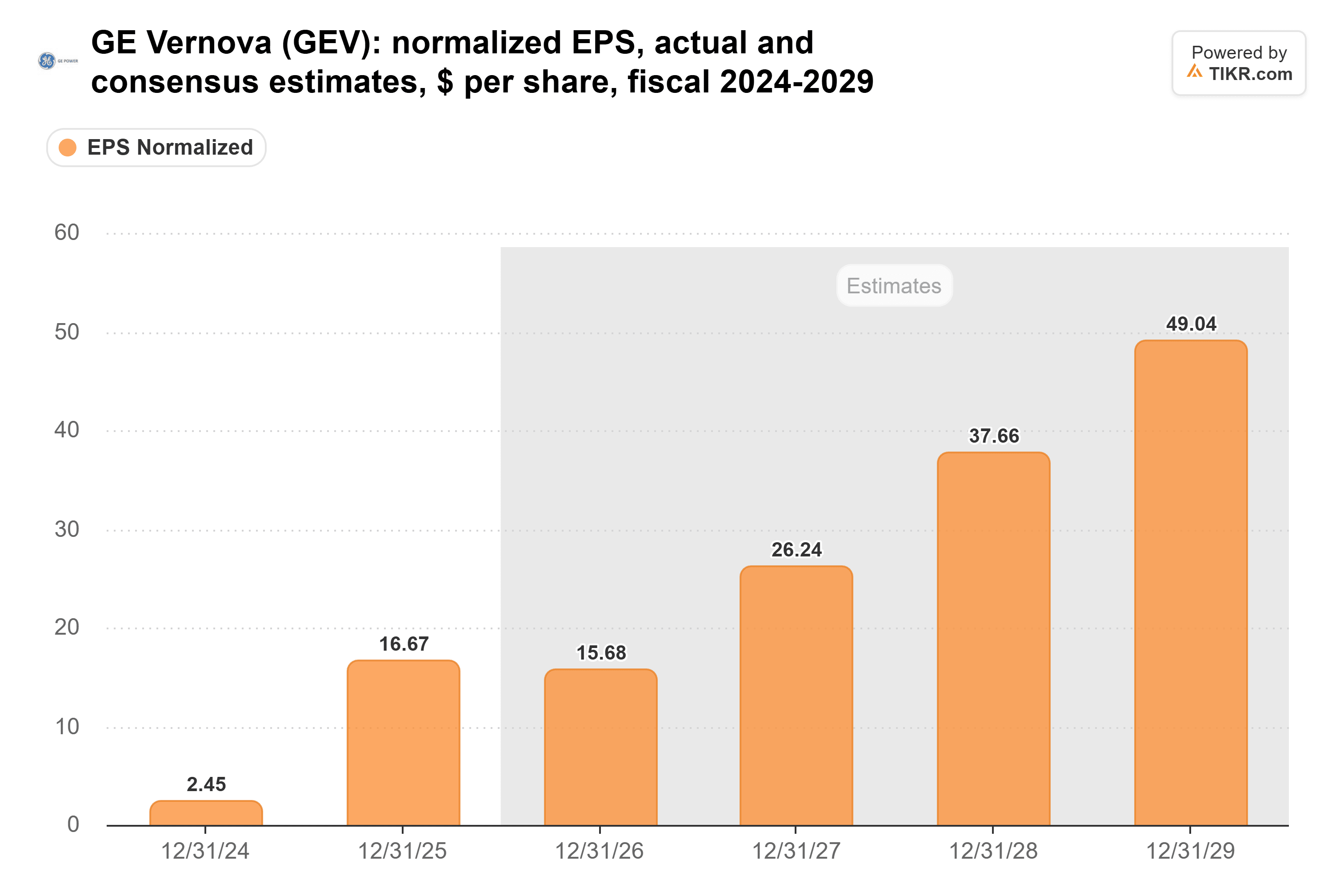
(A one-time $2.9 billion tax benefit inflated 2025, so 2026’s dip isn’t a real decline.)
Yet the forward P/E fell from about 70x in April to 30x on Nov. 20, its lowest of the past year and well under its 54x average:
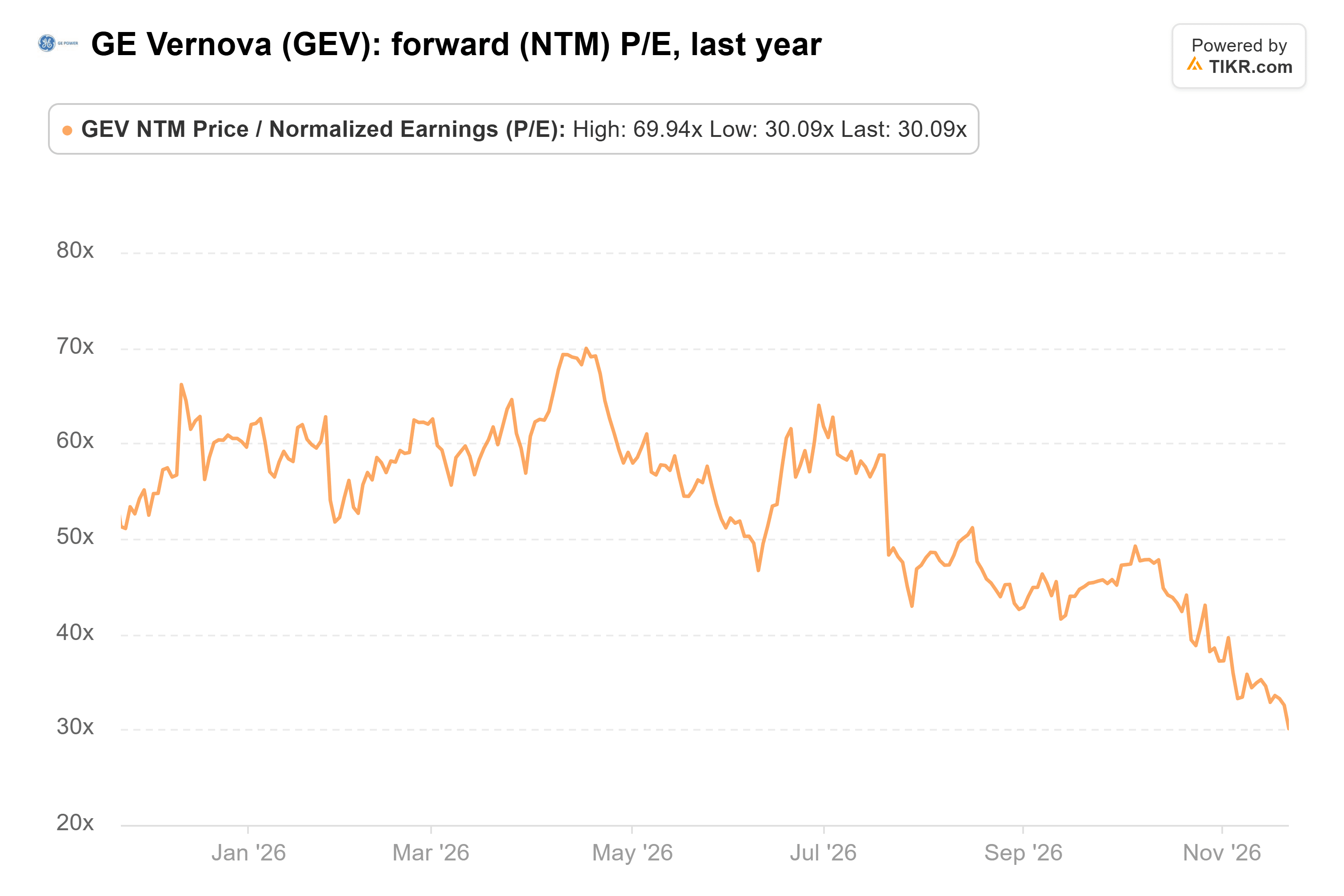
Analysts’ average price target works out to about 30x their 2028 estimate, close to today’s forward multiple, so it mainly needs the estimates to hold. Erste Group disagrees: it cut the stock to Hold on Nov. 18, expecting slower order growth in 2027.
GE Vernova looks like a buy. The business is stronger than in April, and the market has more than halved its multiple over risks tied to about a fifth of its gas demand. The late-January fourth-quarter report is the test. Management expects a backlog above $200 billion and at least 130 gigawatts under contract by year-end, and a miss on either would mean the scares have reached the order book.
So what is GE Vernova stock actually worth?
TIKR lets you forecast the future price of any stock in less than a minute. Just enter a few assumptions into TIKR’s valuation model and see what GE Vernova could be worth. Start from Wall Street consensus estimates, or adjust the inputs to reflect your own view of the business. It’s free to use.
Disclaimer:
Please note that the articles on TIKR are not intended to serve as investment or financial advice from TIKR or our content team, nor are they recommendations to buy or sell any stocks. We create our content based on TIKR Terminal’s investment data and analysts’ estimates. Our analysis might not include recent company news or important updates. TIKR has no position in any of the stocks mentioned. Thank you for reading, and happy investing!