Key Takeaways
- A hypothetical $850,000 portfolio split evenly across Verizon, NNN REIT and Enterprise Products Partners pays about $4,370 a month in dividends at today’s prices.
- All three dividends look safe, and Enterprise’s is the best covered and the fastest growing.
- NNN REIT is the least covered, paying out 69% of its fiscal 2025 AFFO, which is in line with the last decade.
- If NNN halved its dividend, the portfolio’s income would fall to about $43,700 a year. If it stopped paying, the income would fall to about $35,000.
Any retiree hunting for dividend income is going to look hard at stocks yielding around 6%. Verizon Communications (VZ), NNN REIT (NNN) and Enterprise Products Partners (EPD) all pay about that today.
So let’s take a hypothetical retiree who splits $850,000 evenly across the three. Together they pay $52,395 a year in dividends, or about $4,370 a month.
That’s a yield of just over 6% on this part of the portfolio. (Of course, no one should ever own just three stocks.) Each stock sends about a third of that income as its own dividend check:
| Stock | Shares | Cost | Income a year | Share of income | Coverage |
|---|---|---|---|---|---|
| Verizon (VZ) | 6,095 | $283,296 | $17,249 | 34% | 52% of free cash flow (TTM) |
| NNN REIT (NNN) | 7,030 | $283,309 | $17,434 | 33% | 69% of AFFO (fiscal 2025) |
| Enterprise Products (EPD) | 7,907 | $283,308 | $17,712 | 33% | 1.69x distributable cash flow (fiscal 2025) |
| Total | $52,395 | 100% |
Source: TIKR and StockAnalysis, at today’s prices, with each dividend at its current annual rate.
6 safe dividend stocks paying retirees 6%+ yields
There are over 100 stocks paying 6%+ annual dividends today.
But after an extensive investment review leveraging TIKR’s proprietary data, we now believe only six of them are truly safe for retirees.
They’re all yours as part of our new investment report. Learn more about how to get access right here.
Verizon is winning customers without buying them
Verizon’s check depends on a turnaround under CEO Dan Schulman, who has been cutting back on phone subsidies. Even so, Verizon added 406,000 postpaid phone lines in the third quarter of 2026, up more than 820% from a year earlier.
Free cash flow rose 12.1% to $7.8 billion in the quarter, and on Oct. 26, Verizon raised its 2026 guidance to free cash flow growth approaching 12%, up from 9% to 10%.
That leaves the dividend well covered. Dividends took 52% of free cash flow over the twelve months to Sept. 30, 2026, and analysts expect 53% for fiscal 2026. Free cash flow has covered the dividend in every fiscal year since 2018, after falling short in fiscal 2016 and 2017:
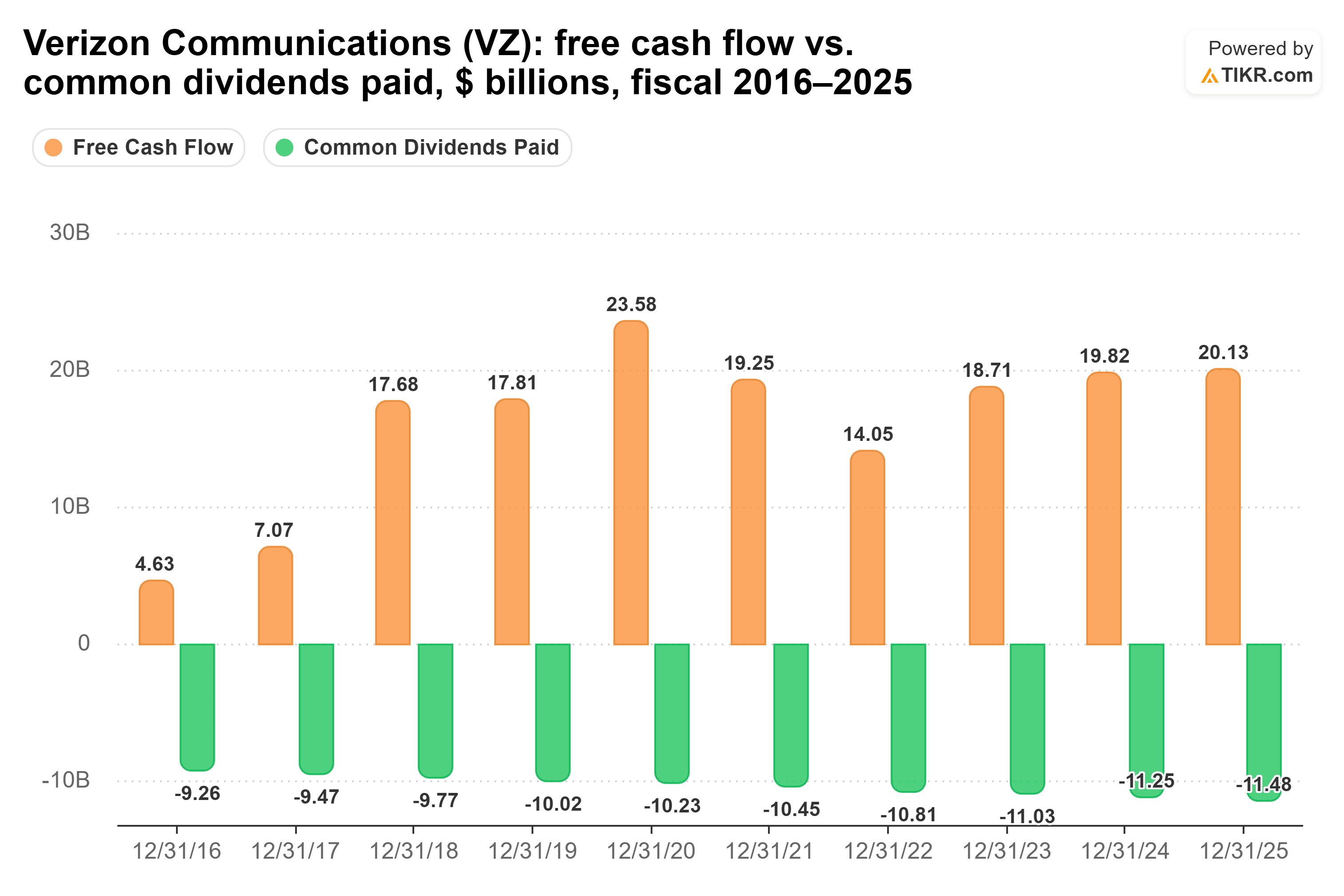
The catch is growth. Verizon’s dividend rose just 1.9% a year from fiscal 2020 to fiscal 2025, from $2.48 to $2.73 a share.
NNN has raised through worse
Occupancy reached 99.2% at the end of the third quarter of 2026, and annualized base rent rose 6.8% from a year earlier to $974.0 million. In results released Nov. 4, AFFO per share rose 5.8% to $0.91 for the quarter.
On Oct. 15, NNN raised its quarterly dividend 3.3% to $0.62 a share. The company says it’s “one of only three publicly traded real estate investment trusts to have increased its annual dividend for 37 or more consecutive years.”
The dividend took 69% of AFFO in fiscal 2025 ($2.36 against $3.44 a share), and analysts expect 68% for 2026. That payout has stayed between 67% and 74% in every fiscal year since 2016 except fiscal 2020. That year, AFFO per share fell to $2.51 and the payout hit 83%:
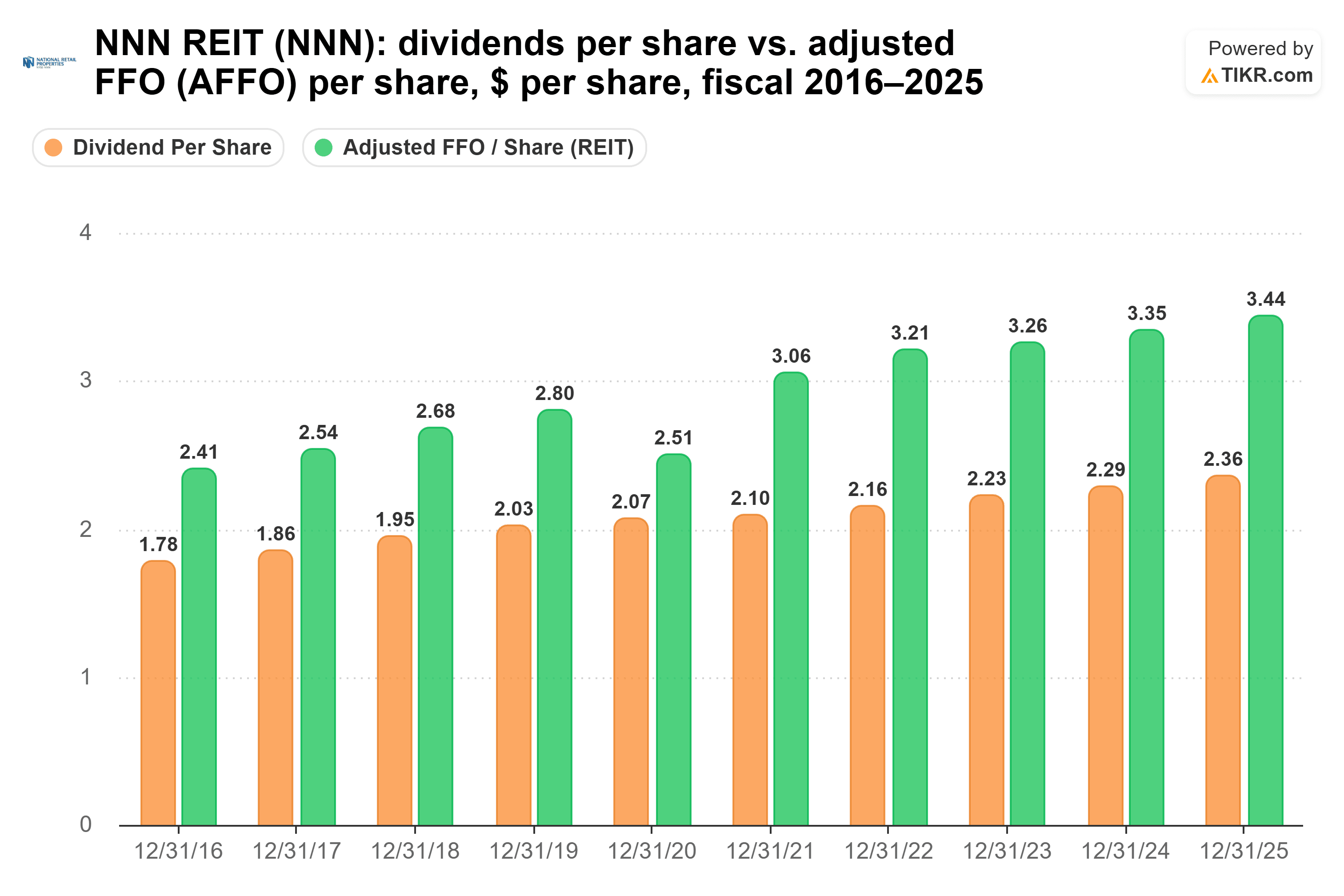
NNN raised its dividend that year anyway, from $2.03 to $2.07 a share.
The risk is the cost of money. NNN repriced its acquisition pipeline in September for higher capital costs, and it carries net debt of 5.7x EBITDA.
Enterprise has the most room to spare
Enterprise is moving record volumes out of the Permian Basin. Its Permian natural gas processing volumes reached a record 4.6 Bcf/d in the third quarter of 2026, up 12% from a year earlier. In results released Oct. 29, operational distributable cash flow rose 27% to $2.3 billion for the quarter, 1.9x the distribution it declared.
As an MLP, Enterprise pays distributions on its units, and holders get a K-1 at tax time. On Oct. 8, it raised its quarterly distribution to $0.56 a unit, 2.8% above a year earlier.
Distributable cash flow covered the distribution 1.69x in fiscal 2025 ($3.66 against $2.17 a unit). Analysts expect 1.86x for 2026, on $4.17 a unit. Coverage has stayed at 1.58x or better in every fiscal year since 2018:
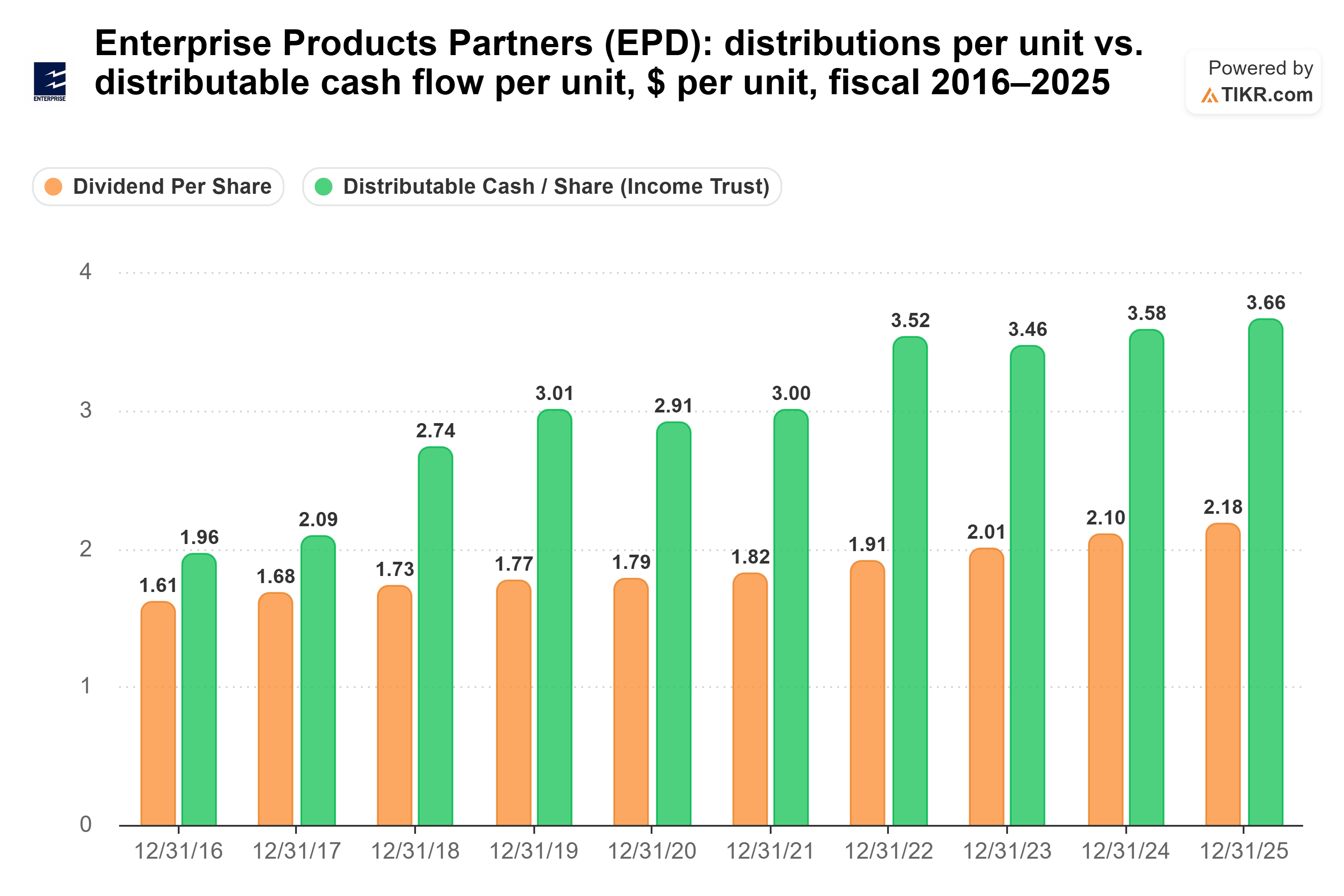
Enterprise has also grown its payout the fastest of the three, by 4.0% a year from fiscal 2020 to fiscal 2025 ($1.78 to $2.17 a unit). Management does expect 2027’s EBITDA growth to be more modest than 2026’s, so I wouldn’t count on that pace picking up.
The check I’d watch is NNN’s
NNN is the least covered of the three on its own measure, so it’s the one to test. If it halved its dividend, this portfolio’s dividend income would fall to about $43,700 a year. If it stopped paying altogether, the income would fall to about $35,000.
That said, being the least covered doesn’t make NNN truly risky. A REIT pays out most of its income by design, and NNN’s payout has barely moved in a decade.
Bottom line: I’d count on all three checks. Enterprise’s looks the safest and is growing the fastest, NNN’s is steady, and Verizon’s is safe but slow. Of course, NNN has a $350 million bond coming due in December, and the rate it refinances at will show us how much its borrowing costs are rising.
Enjoy your retirement in style with these safe 6%+ dividend yields
Dividends can hold the key to enormous wealth. But only if you buy the right ones.
Picking the right high-yield dividend stock can be the difference between a dream retirement…and scraping by every month, waiting for the next Social Security check to clear.
We’ve identified six stocks yielding 6%+ that we believe every retiree should know about right now.
Disclaimer:
Please note that the articles on TIKR are not intended to serve as investment or financial advice from TIKR or our content team, nor are they recommendations to buy or sell any stocks. We create our content based on TIKR Terminal’s investment data and analysts’ estimates. Our analysis might not include recent company news or important updates. TIKR has no position in any of the stocks mentioned. Thank you for reading, and happy investing!