


Amazon.com (AMZN) started selling its $75 Bee Frontier bracelet on Thursday, October 15, and showed a $100 Bee Eclipse that snaps magnetically onto the back of a smartphone. Both devices listen through the day and turn conversations into summaries, reminders and tasks. The Frontier is on sale in the US now. Amazon hasn’t given the Eclipse a release date.
It’s the first new Bee hardware since Amazon bought the San Francisco startup in July 2025. The bigger change is the software: the most useful features now sit behind a monthly plan.
Amazon’s $12 Question
Bee Pro costs $11.99 a month. It adds unlimited summaries, links to Amazon.com, Alexa+, Gmail and Outlook, and a desktop app that records Zoom calls. Free users keep 14 days of memory, and new buyers get 30 days of Pro.
Bee charged for its service before Amazon owned it. The original Pioneer bracelet sold for $49.99 with a $19.99 monthly plan. Amazon raised the hardware price and cut the subscription by 40%. That’s the move of a company that wants more people paying something and cares less about how much each one pays.
Sizing Bee Pro Against Amazon’s Subscriptions
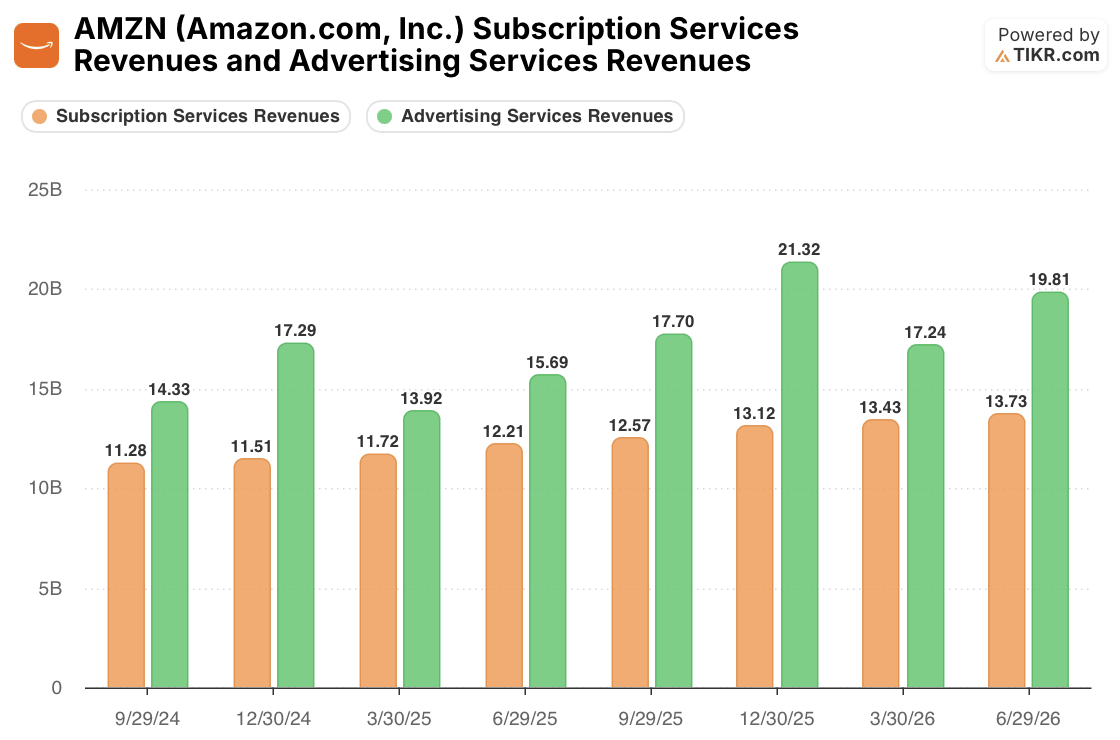
Bee Pro would sit in Amazon’s subscription services line, which includes Prime fees. That line brought in $52.85 billion over the last four reported quarters and grew 12% to $13.73 billion in the June quarter.
At $143.88 a year, 1 million Bee Pro subscribers would add about $144 million, or 0.3% of that line. Amazon would need roughly 3.7 million paying users just to move it by 1%.
The same chart shows where Amazon’s growth comes from. Advertising grew 26% to $19.81 billion in the June quarter, adding $4.12 billion year over year against $1.52 billion for subscriptions. Bee’s Amazon.com integration can turn mentioned products into shopping recommendations when users connect their accounts. That creates a potential retail benefit, but Amazon hasn’t quantified its value relative to subscription fees or disclosed an advertising contribution.
What Meta’s Reality Labs Says About Wearables

Meta Platforms (META) offers a comparison through Reality Labs, although the segment combines smart glasses, VR headsets, software and content rather than reporting wearable revenue separately. Reality Labs brought in $2.26 billion over the last four quarters, barely up from $2.20 billion a year earlier, and lost $4.62 billion in the June quarter alone. That’s an operating loss more than 10 times the segment’s $431 million in quarterly revenue.
Meta also bought Limitless, maker of a conversation-recording pendant, in December 2025, then stopped selling the pendant to new customers. Both companies are buying the same idea. Neither has shown it sells at scale.
Conclusion
Bee Pro won’t move Amazon’s numbers. Even a few million subscribers would keep it near 1% of a $53 billion subscription line. What Amazon gets is a microphone outside the home that feeds Alexa+ and the store, at a $75 price that’s cheap enough to try.
The figure that would change that read is a subscriber count, and Amazon hasn’t disclosed one. Until it does, I see Bee primarily as a retail and Alexa+ engagement bet with a subscription fee attached. Amazon’s October 29 results will show whether company-wide advertising growth holds near 26%, but that figure will not isolate Bee’s contribution.
Want to see how Amazon’s subscription and ad lines stack up quarter by quarter, or track Meta’s Reality Labs yourself? Pull up the same charts on TIKR for free. Learn more here.
So what is Amazon stock actually worth?
TIKR lets you forecast the future price of any stock in less than a minute. Just enter a few assumptions into TIKR’s valuation model and see what AMZN stock could be worth. Start from Wall Street consensus estimates, or adjust the inputs to reflect your own view of the business. It’s free to use.
Value Amazon.com, Inc. for free→
Disclaimer:
Please note that the articles on TIKR are not intended to serve as investment or financial advice from TIKR or our content team, nor are they recommendations to buy or sell any stocks. We create our content based on TIKR Terminal’s investment data and analysts’ estimates. Our analysis might not include recent company news or important updates. TIKR has no position in any of the stocks mentioned. Thank you for reading, and happy investing!


