Key Takeaways
- CoreWeave (CRWV) fell approximately 30% year to date through November 2, closing at $50.15 as investors questioned the financing costs behind its AI expansion.
- Oracle (ORCL) announced $20 billion in stock and bond offerings on November 2, highlighting the substantial capital required to build AI data centers.
- IREN (IREN) fell approximately 41% year to date through November 2, while Applied Digital (APLD) faced financing requirements for roughly 800 MW of planned data center capacity.
- CoreWeave traded near 1.5x forward sales on October 30, but third-quarter interest expense guidance of $860 million to $940 million highlighted the risks surrounding its expansion.
What Happened?
CoreWeave (CRWV) stock declined approximately 30% year to date through November 2, closing at $50.15 after ending September with a 22% gain, as investors questioned how AI infrastructure companies would finance rapid expansion.
Concerns intensified when Oracle announced $20 billion in stock and bond offerings on November 2, highlighting the capital required for AI data centers.
Oracle shares were down approximately 39% year to date, while IREN and Applied Digital had declined roughly 41% and 33%, respectively, through November 2.
Applied Digital CEO Wes Cummins indicated that approximately 800 MW of planned capacity still required financing over the following year, according to November 2 reporting.
During the November 2 episode of Prof G Markets, co-host Ed Elson warned, “if there’s an AI bubble, it’s already popping for CoreWeave.”
CoreWeave faces similar funding pressures. In September, it completed a $4.2 billion convertible notes offering carrying a 2.875% coupon, while its outstanding 9.625% notes due 2032 reportedly yielded nearly 15% during October.
However, its underlying business continues to expand rapidly.
According to CoreWeave’s second-quarter earnings report, revenue increased 112% year over year to $2.58 billion, while its revenue backlog reached approximately $104 billion at June 30, before more than $25 billion in additional commitments secured early in the third quarter.
CEO Michael Intrator emphasized the demand outlook, stating, “Customer demand is accelerating.”
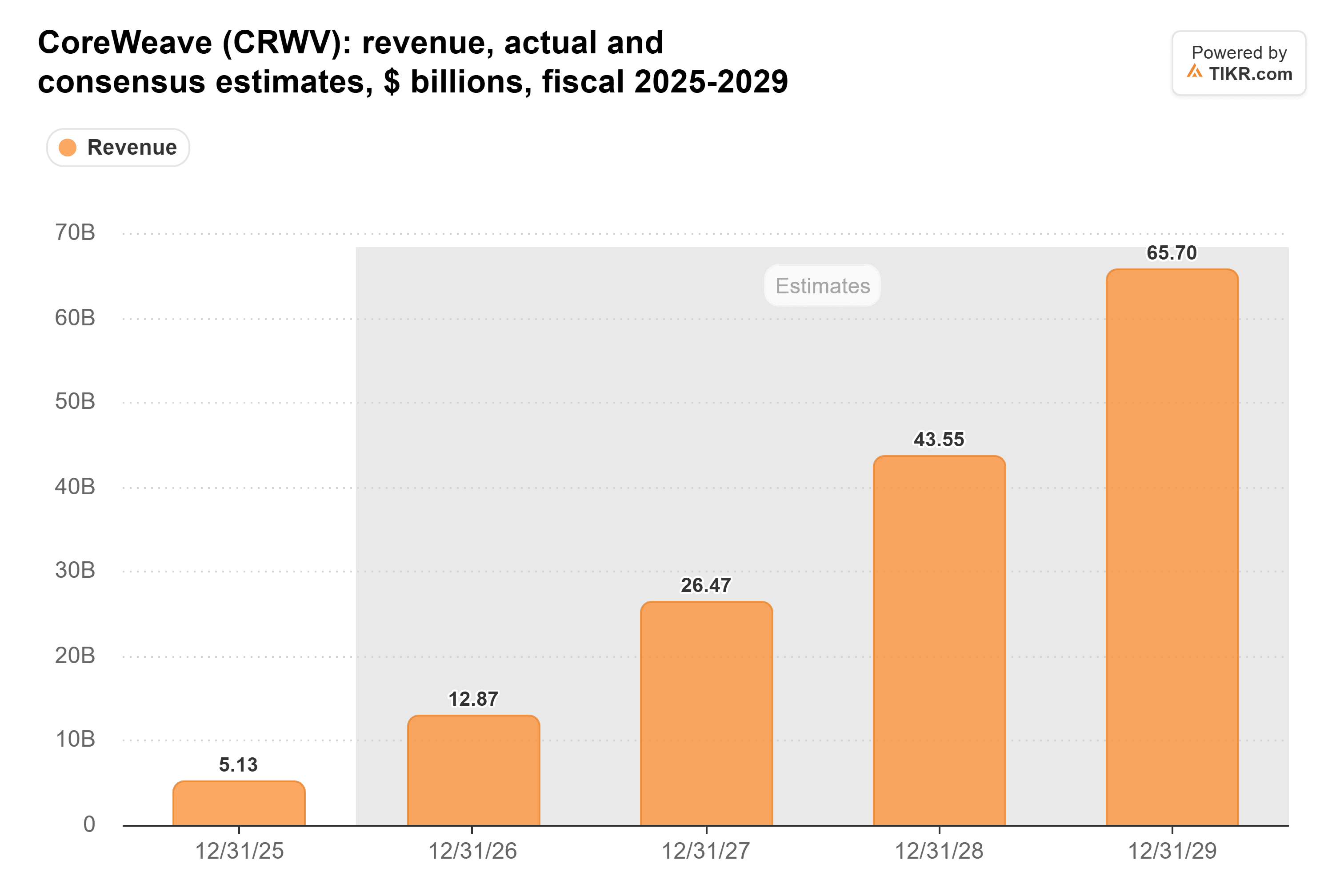
TIKR’s October 27 consensus estimates projected revenue increasing from $5.13 billion in 2025 to approximately $43.6 billion in 2028, representing more than eightfold growth.
Still, the company’s 2025 annual filing showed that committed contracts accounted for more than 98% of revenue, with a weighted-average duration of approximately five years.
These agreements provide revenue visibility but can limit how quickly CoreWeave benefits from rising GPU rental prices on existing capacity.
The Interest Bill Is the Bigger Problem
CoreWeave’s annual interest expense increased from $28 million in 2023 to approximately $1.23 billion in 2025, reflecting substantial borrowing to fund infrastructure expansion.
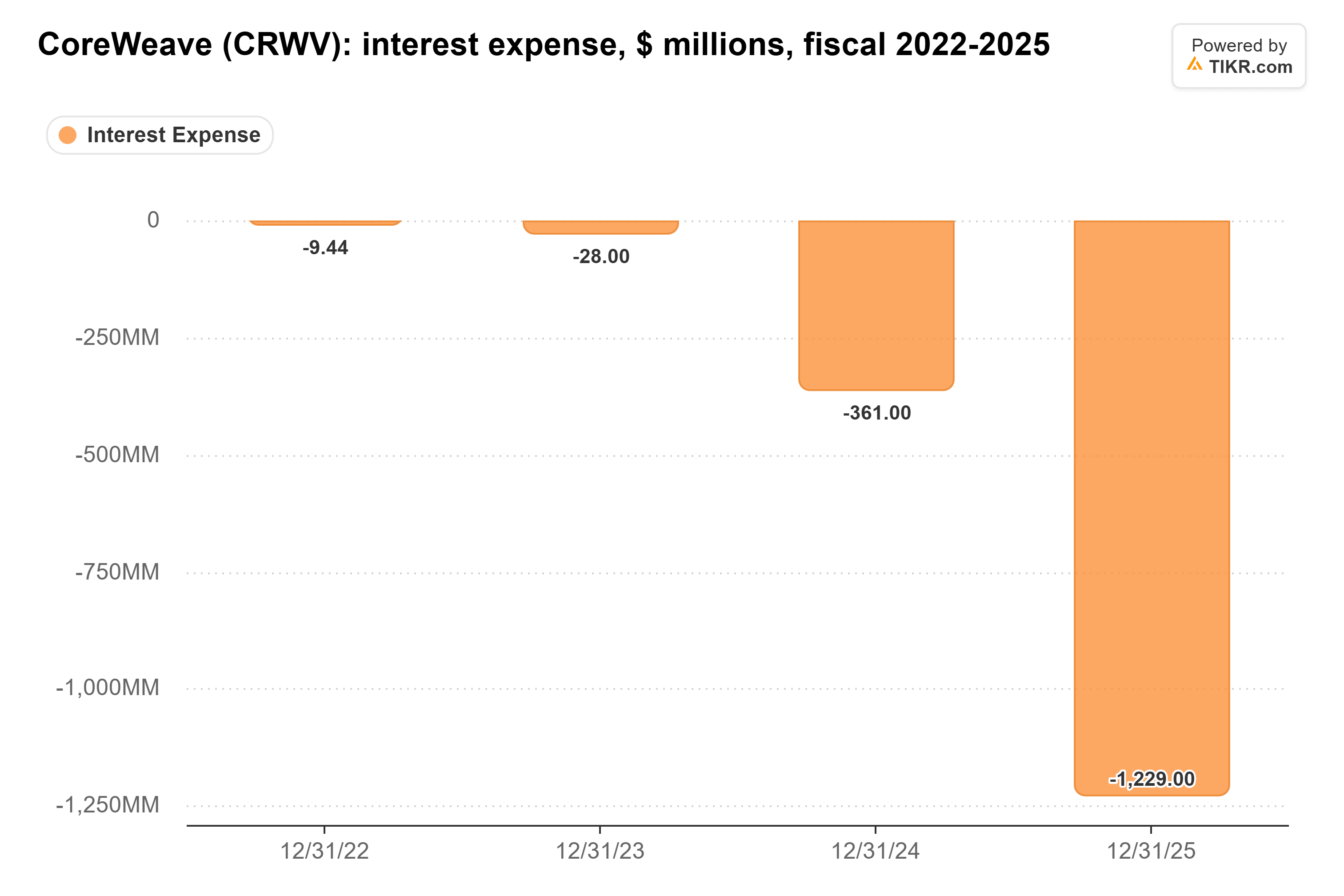
Second-quarter 2026 net interest expense reached $640 million, compared with $267 million a year earlier, according to its quarterly financial results.
Management’s third-quarter guidance projected interest expense of $860 million to $940 million against adjusted operating income of $200 million to $260 million.
Although these are different accounting measures, the gap illustrates the financing burden accompanying CoreWeave’s expansion.
TIKR’s October consensus estimates suggested that EBIT would not exceed interest expense until 2028, making profitability and sustainable cash generation critical to the investment case.
Cheap for a Reason, for Now
Based on its November 2 valuation and financing outlook, CoreWeave appears fairly valued despite its discounted forward sales multiple.
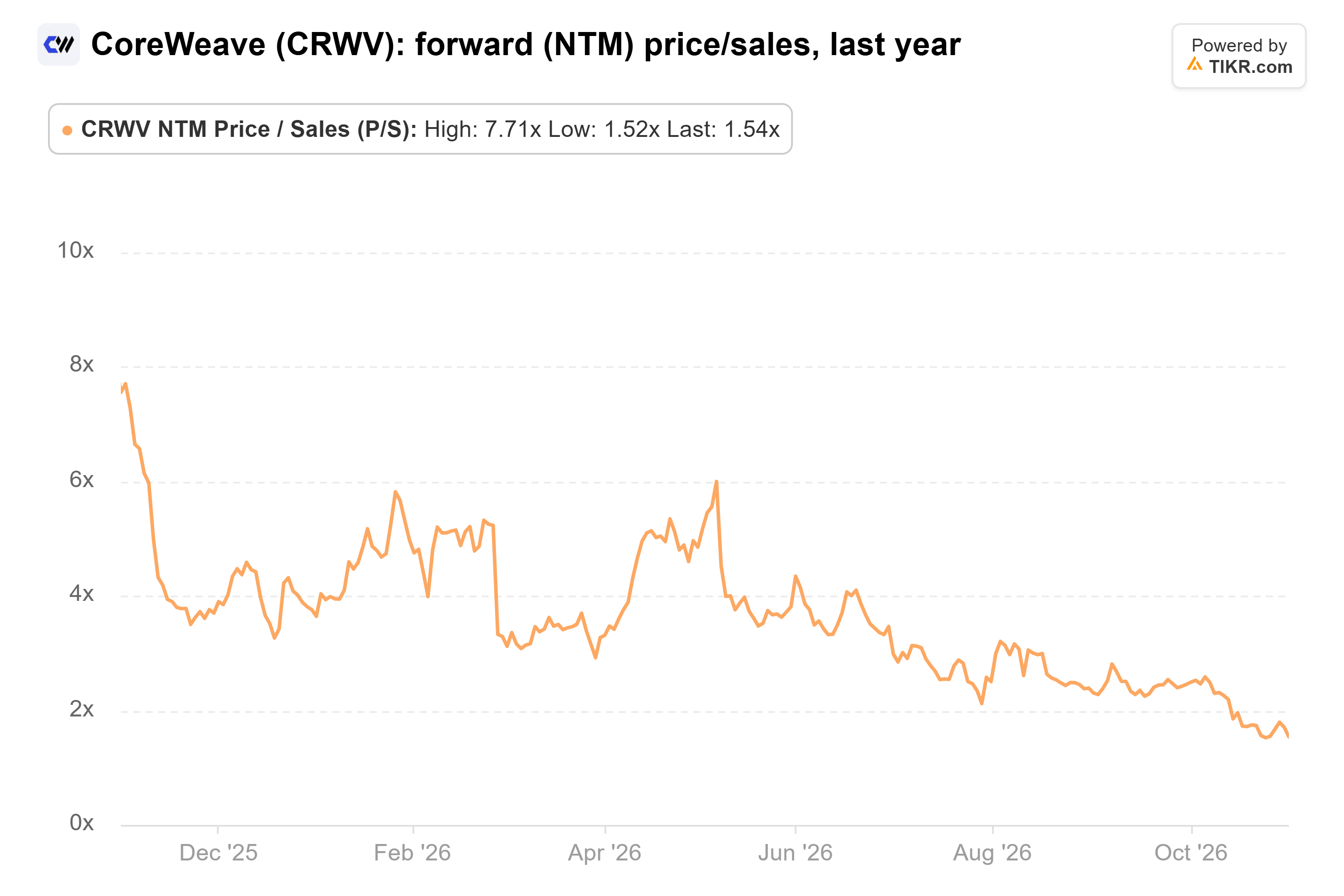
At approximately 1.5x forward sales on October 30, CoreWeave traded near its one-year valuation low and substantially below its historical average of 3.6x.
However, a discounted sales multiple does not necessarily signal an attractive investment when substantial capital spending, borrowing costs, and financing requirements remain.
Over the next 12 months, revenue growth, GPU utilization, contract profitability, and improved cash generation will determine whether shares can sustain a recovery.
CoreWeave’s scheduled November 10 earnings report will provide an important test of operating profitability and financing conditions.
For now, CoreWeave looks more likely to remain under pressure than deliver a sustained rebound until profitability begins catching up with financing costs. Its enormous backlog offers long-term potential, but stronger interest coverage will be necessary to support a durable recovery.
So what is CoreWeave stock actually worth?
TIKR lets you forecast the future price of any stock in less than a minute. Just enter a few assumptions into TIKR’s valuation model and see what CoreWeave could be worth. Start from Wall Street consensus estimates, or adjust the inputs to reflect your own view of the business. It’s free to use.
Disclaimer:
Please note that the articles on TIKR are not intended to serve as investment or financial advice from TIKR or our content team, nor are they recommendations to buy or sell any stocks. We create our content based on TIKR Terminal’s investment data and analysts’ estimates. Our analysis might not include recent company news or important updates. TIKR has no position in any of the stocks mentioned. Thank you for reading, and happy investing!