Key Takeaways
- Combined buybacks at Alphabet, Amazon, Microsoft, Meta and Oracle fell to $4.4 billion in the third quarter, 90% below their late-2021 peak, according to a tally by The Kobeissi Letter.
- AI capex has used up the cash that once paid for buybacks, and Alphabet, Meta and Oracle are now selling new stock instead.
- With no buybacks to offset stock pay, Alphabet’s diluted share count is rising again, so its earnings per share will grow more slowly than its net income.
- Analysts expect Alphabet’s free cash flow to stay negative through 2027, so buybacks don’t look likely to return soon.
Alphabet (GOOG), Amazon (AMZN) and Meta Platforms (META) haven’t bought back a single share of their own stock in 2026. Add Microsoft (MSFT) and Oracle (ORCL), and the five spent $4.4 billion on buybacks in the third quarter, according to a Nov. 4 tally by The Kobeissi Letter on X. That’s the lowest since the third quarter of 2017 and 90% below the roughly $45.9 billion they spent in the last quarter of 2021.
The cash has a new home. These companies are spending so much on AI data centers that the gap between their spending and the cash they bring in now has to be filled with outside money. The buyback budget was the first thing to go.
TIKR tracks 58 analysts on Alphabet. How many say “Buy”?
See the full breakdown of Buy, Hold, and Sell ratings on Alphabet, along with Wall Street’s revenue and earnings estimates, all in one place. More than 500,000 investors use TIKR to research stocks like this one. See Alphabet’s Analyst Ratings
The cash went into data centers
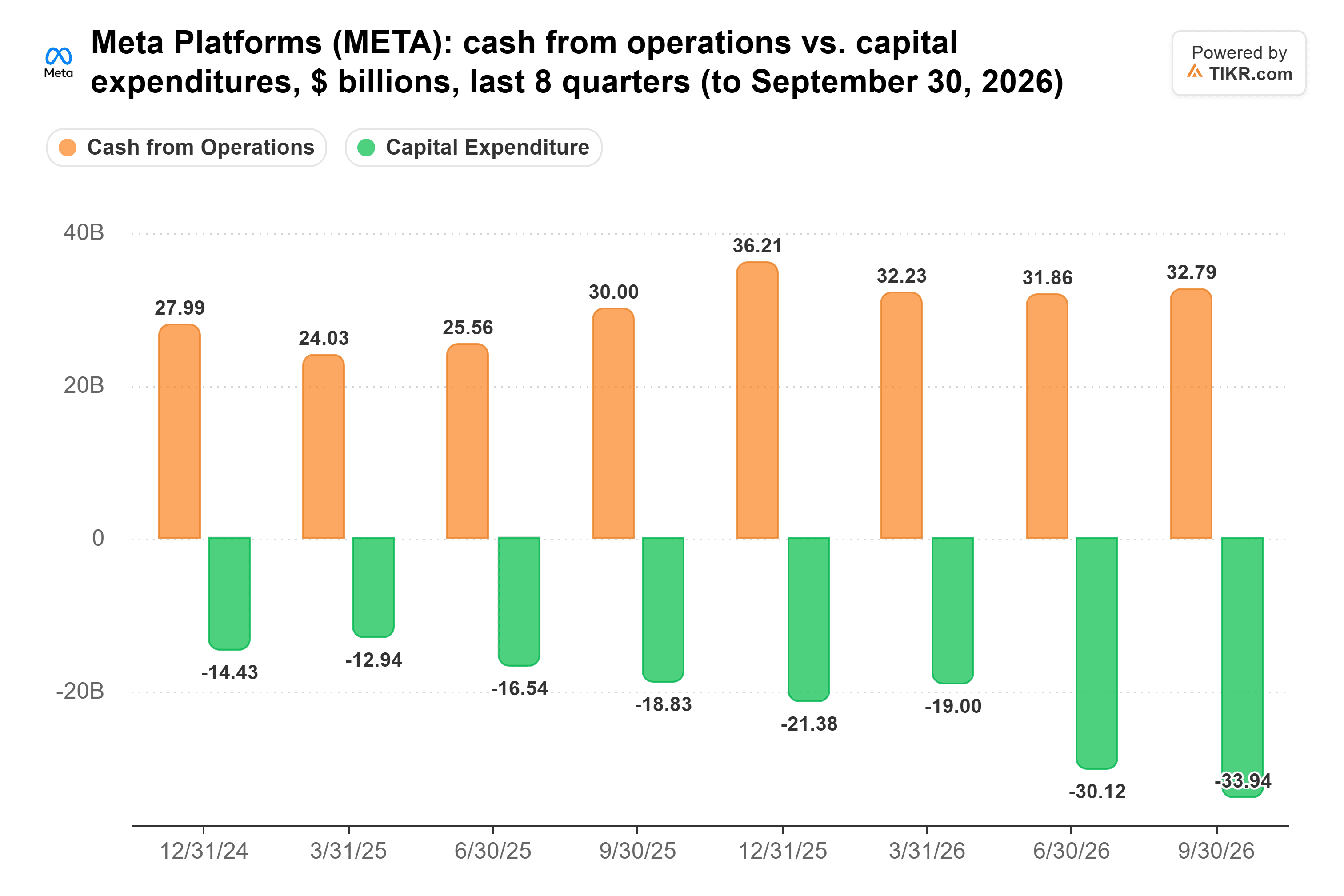
All of that $4.4 billion came from Microsoft, down from $5.7 billion a year earlier, Reuters reported. Alphabet’s 10-Q shows no repurchases in the first nine months of 2026, against $11.6 billion in the third quarter of 2025 alone. Meta’s numbers show why the others stopped. Its capex climbed from $18.8 billion in the third quarter of 2025 to $33.9 billion a year later, more than the $32.8 billion of cash its operations brought in:
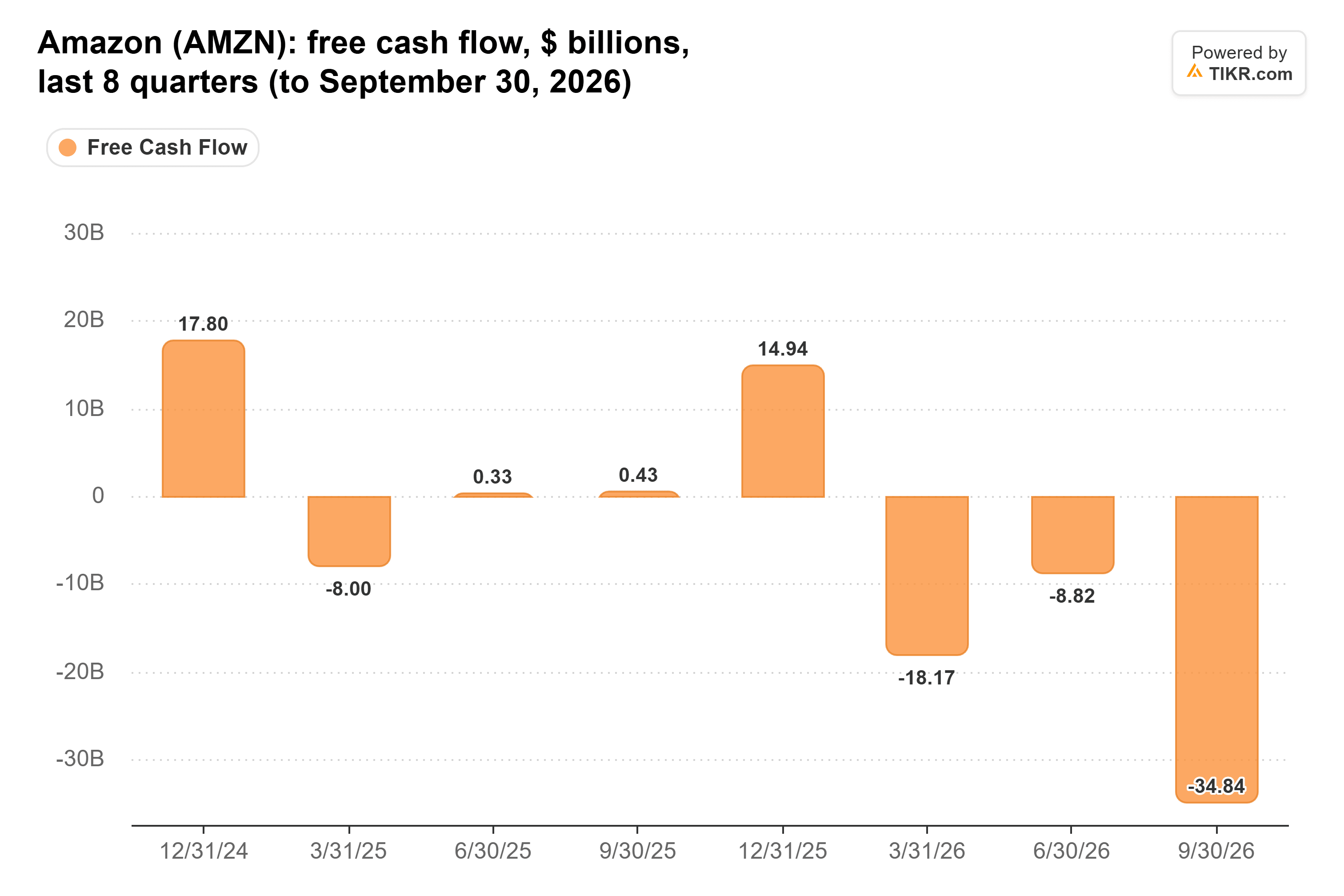
Amazon is deeper in the hole. It hasn’t bought back stock since 2022, and its free cash flow was negative $34.8 billion in the third quarter alone:
So instead of retiring shares, they’re selling them. Alphabet raised nearly $50 billion from new stock in June, $10 billion of it from Berkshire Hathaway, then sold another $12.4 billion through its at-the-market program in the third quarter. Oracle sold $19.9 billion of new stock in the three months through August. And Meta said in an Oct. 26 release that it was selling mandatory convertible preferred stock plus $22.5 billion of new Class A shares through forward sale agreements, which it can settle as late as November 2027.
The share count is climbing again
For years, buybacks soaked up the shares these companies hand out as stock pay. That’s how Alphabet’s diluted share count fell 13.1% from 2017 to 2025. Now nothing offsets it. Alphabet booked $15.2 billion of stock-based compensation in the first half of 2026 with no buyback behind it, and it says its at-the-market sales are mainly meant to cover taxes on employee stock awards as they vest. Its diluted share count has turned higher:
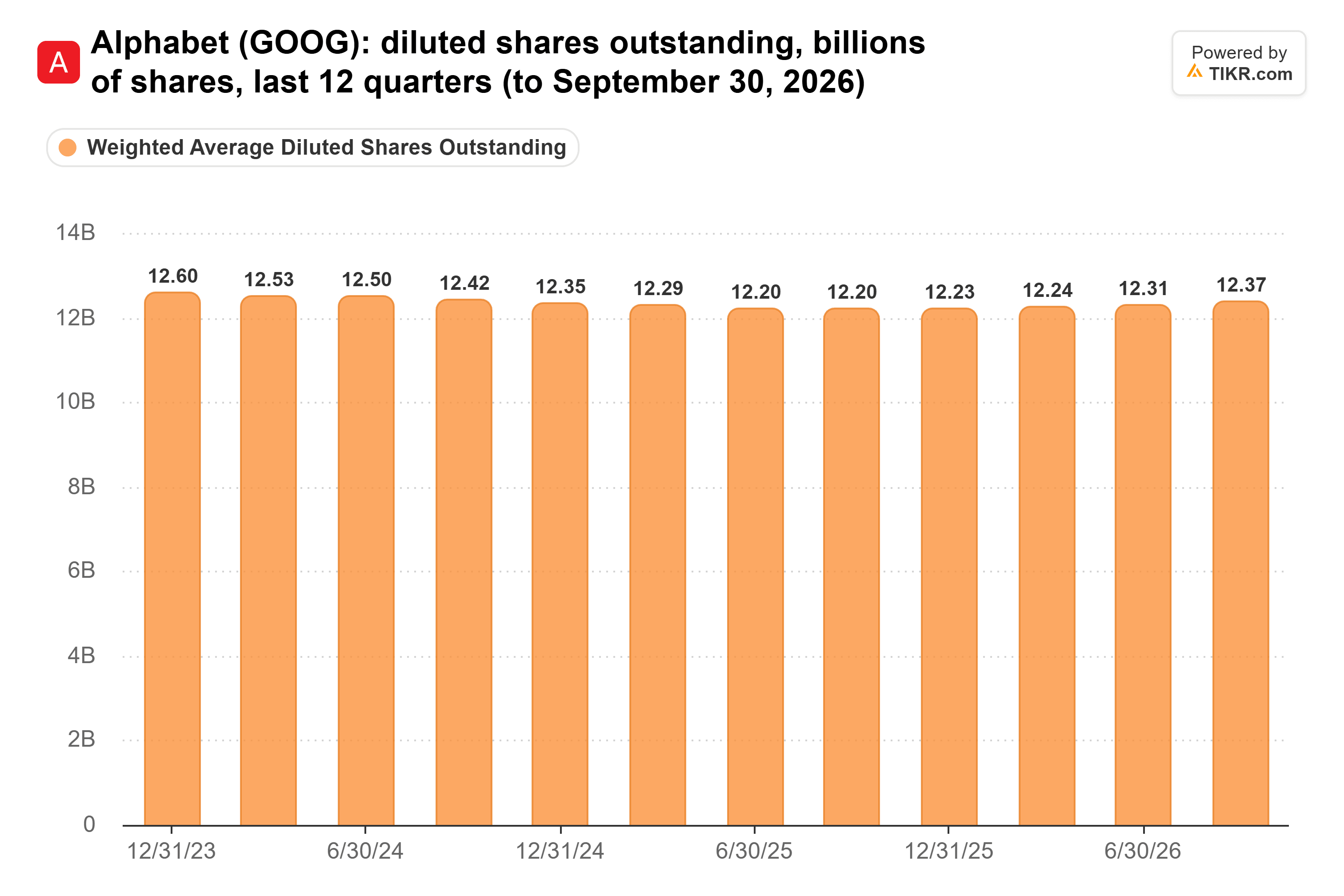
Every 1% added to the share count comes straight off earnings-per-share growth. So Alphabet’s EPS will trail its net income for as long as this lasts. And more shares are coming: the preferred stock Alphabet sold in June converts into 43.6 million to 54.5 million common shares around May 15, 2029.
Income investors have noticed that preferred. Its Series B depositary shares trade under the symbol GOOGN. They were issued at $50 and pay $3.125 a year. After Alphabet’s Oct. 29 post-earnings selloff, one investor on r/dividends worked out a 7.57% yield at a price of $41.25 on Nov. 3. But the conversion is mandatory. If Alphabet’s Class C stock is at or below about $352 at conversion, each depositary share becomes about 0.142 shares of it. With the Class C stock closing at $283.93 on Nov. 6, a buyer takes on the stock’s downside along with the yield.
Buybacks won’t be back in 2027
Buybacks come back when capex stops growing, and Alphabet’s plans go the other way. Management guides 2026 capex to $195-205 billion, up from $91.4 billion in 2025, and expects 2027 to be significantly higher again. Analysts see $308.0 billion of capex in 2027, with free cash flow of negative $18.0 billion this year and negative $41.8 billion next year, before it turns positive at $5.0 billion in 2028. Even the dividend is a stretch. Alphabet paid $2.9 billion of dividends in the third quarter while its free cash flow was negative $9.1 billion, a figure that includes a $5.2 billion EU fine payment, and the preferred adds about $1.2 billion a year.
Alphabet is at least spending into real demand: Google Cloud’s backlog reached $560.8 billion at the end of September, up from $513.9 billion three months earlier. Still, shareholders are paying for the buildout with a thinner slice of each company. That makes per-share numbers, not total profit, the yardstick for Alphabet, Meta and Amazon through at least 2027. A trimmed 2027 capex plan in the fourth-quarter reports, due in late January and early February, would bring buybacks back sooner than the estimates suggest.
So what is Alphabet stock actually worth?
TIKR lets you forecast the future price of any stock in less than a minute. Just enter a few assumptions into TIKR’s valuation model and see what Alphabet could be worth. Start from Wall Street consensus estimates, or adjust the inputs to reflect your own view of the business. It’s free to use.
Disclaimer:
Please note that the articles on TIKR are not intended to serve as investment or financial advice from TIKR or our content team, nor are they recommendations to buy or sell any stocks. We create our content based on TIKR Terminal’s investment data and analysts’ estimates. Our analysis might not include recent company news or important updates. TIKR has no position in any of the stocks mentioned. Thank you for reading, and happy investing!