Key Takeaways
- Five big funds, led by Viking Global and Hillhouse, bought or added to Alibaba (BABA) in the Q3, according to their 13Fs for the quarter ended Sept. 30.
- Alibaba is down 19% since then, and Hillhouse’s largest position is Alibaba’s rival PDD Holdings (PDD), which trades at about 7x forward earnings.
- Analysts expect Alibaba’s normalized EPS to rise about 65% in the year to March 2027, and at 11x forward earnings the stock sits below its five-year average of 13x.
- Waiting for this week’s report looks like the better move, since the rebound depends on cloud margins, AI app losses and cash flow all improving.
Anyone thinking about buying the dip in Alibaba before it reports this week has company. Five big funds bought or added to the stock in the third quarter, according to their 13Fs for the quarter ended Sept. 30, filed between Oct. 20 and Nov. 16.
The stock hasn’t cooperated since. Alibaba is down 19% from its Sept. 30 close and sits 52% below its 52-week high. And the fund that made the biggest bet on it made an even bigger one on PDD Holdings.
TIKR tracks 41 analysts on Alibaba. How many say “Buy”?
See the full breakdown of Buy, Hold, and Sell ratings on Alibaba, along with Wall Street’s revenue and earnings estimates, all in one place. More than 500,000 investors use TIKR to research stocks like this one. See Alibaba’s Analyst Ratings
Two new buyers and three much bigger bets
Andreas Halvorsen’s Viking Global, which manages $78.2 billion, opened a new position of 4.45 million shares worth $478 million at Sept. 30, its 13F filed Nov. 16 shows. That’s just 1.5% of its 13F stocks. SRS Investment Management, a $13.9 billion firm, was also new to the stock, with 1.69 million shares worth $181 million, or 1.7% of its 13F stocks.
The real conviction came from funds that already owned it. Hillhouse raised its stake 1,254% to 2.49 million shares worth $268 million. That made Alibaba its No. 2 holding, at 17.4% of the $1.54 billion of US stocks its 13F lists. Carrhae Capital, which manages $6.1 billion, more than tripled its shares to 1.59 million, worth $171 million and 10.9% of its 13F stocks. It also held call options with a notional value of $183 million. Taikang Asset Management’s Hong Kong arm added 23%, to 307,000 shares, 2.9% of the $1.12 billion of US stocks its 13F lists. A 13F shows only US-listed shares, so any Alibaba stock these funds hold in Hong Kong isn’t counted.
Hillhouse likes the cheaper rival even more
Hillhouse’s No. 1 position is PDD, at 22.5% of its 13F stocks after it raised its share count 789% to 4.45 million, worth $347 million. Taikang added 15% to its PDD stake, too. PDD is down just 0.7% since Sept. 30, and at about 7x forward earnings it’s even cheaper than Alibaba.
It also isn’t pouring cash into data centers. PDD’s capex was 0.3% of its 2025 revenue, while Alibaba’s nearly quadrupled in two years, to RMB 126.1 billion in the year to March 2026. PDD’s problem is growth: online marketing, about half its revenue, grew just 3% in the second quarter. That slowdown, plus Temu’s fight with Europe over cheap parcels, is why it trades at 7x earnings. PDD reports this week as well, and its ad growth is the number to watch.
Cheap, if the rebound shows up
Alibaba needs its earnings to bounce back. Normalized EPS fell 59% in fiscal 2026 (the year to March), to RMB 26.80 per ADS, as Alibaba spent on quick commerce and AI. Analysts expect it to rise about 65% in fiscal 2027 and reach RMB 61.65 in fiscal 2028, close to fiscal 2024’s level:
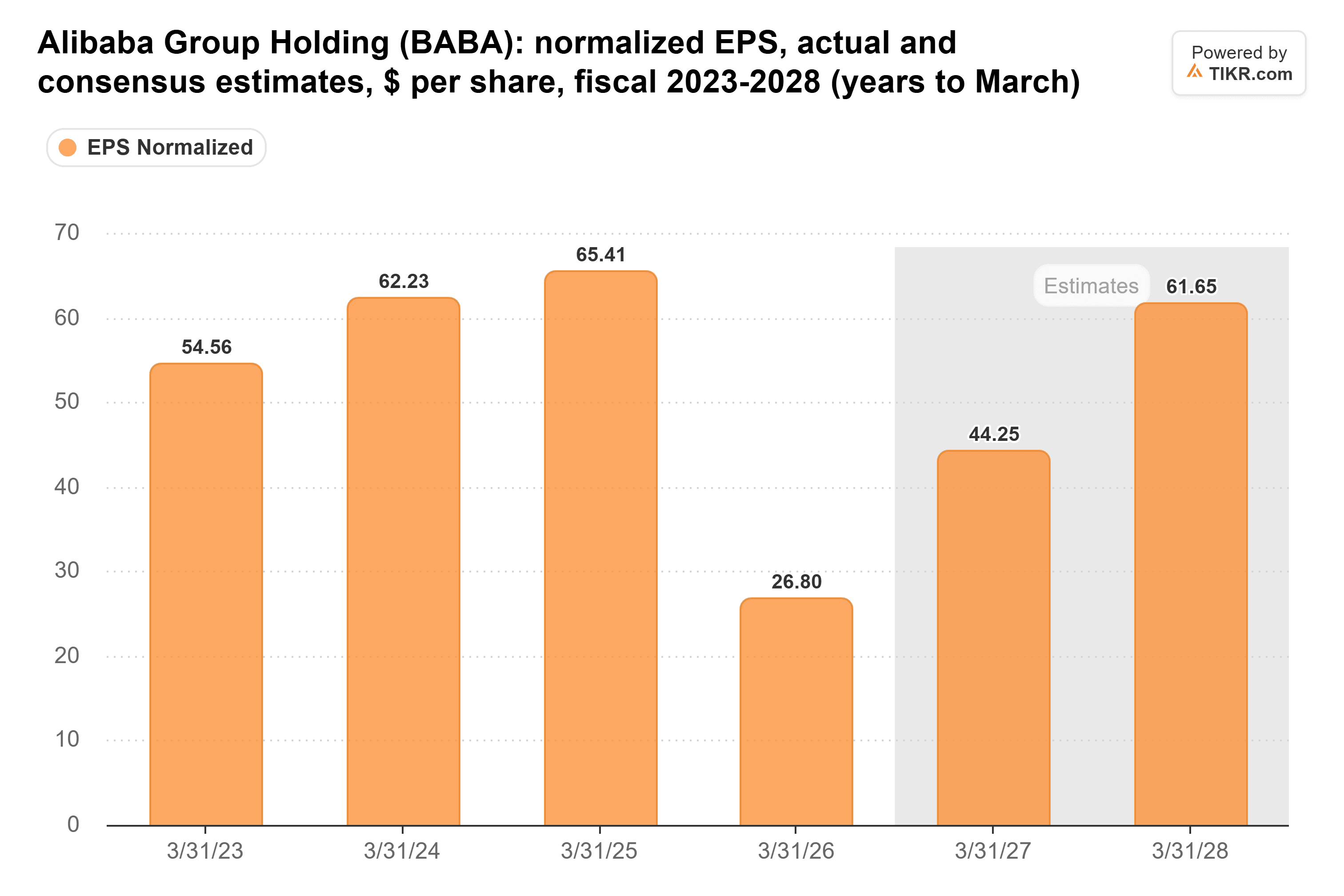
That rebound has to happen while spending keeps climbing: consensus has capex at RMB 198.4 billion in fiscal 2027. And Alibaba has missed analysts’ adjusted EPS estimates five quarters in a row.
The market isn’t paying for the rebound yet. Alibaba trades at 11x forward earnings, below its five-year average of 13x and far from the 25x it hit in January:
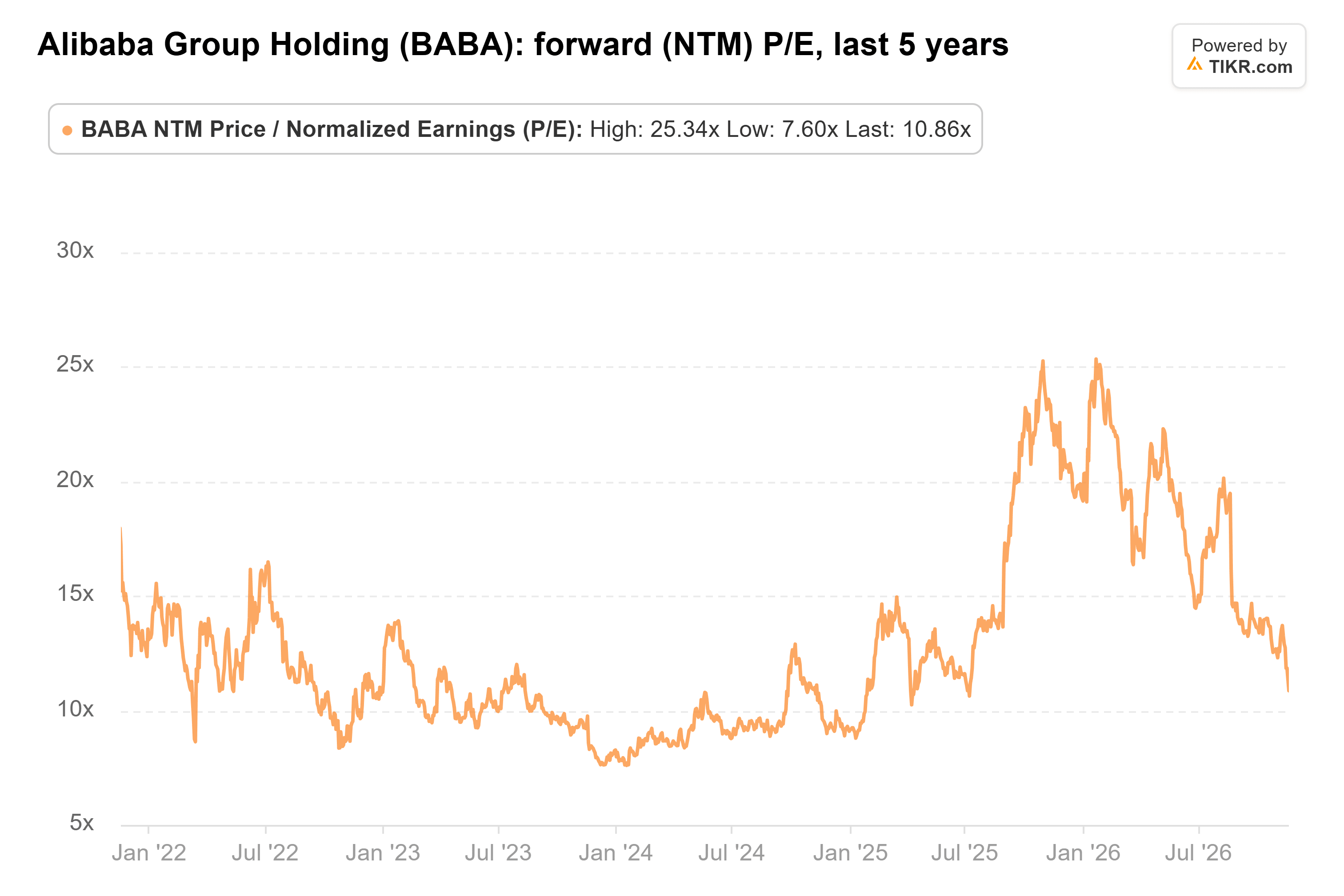
(It’s still well above its 7.6x low of January 2024, though.)
Analysts are far more upbeat than the market. The $185 average target from 41 analysts sits 113% above the last close, even after the consensus target slipped about 12% over the past year while the stock fell 45%:
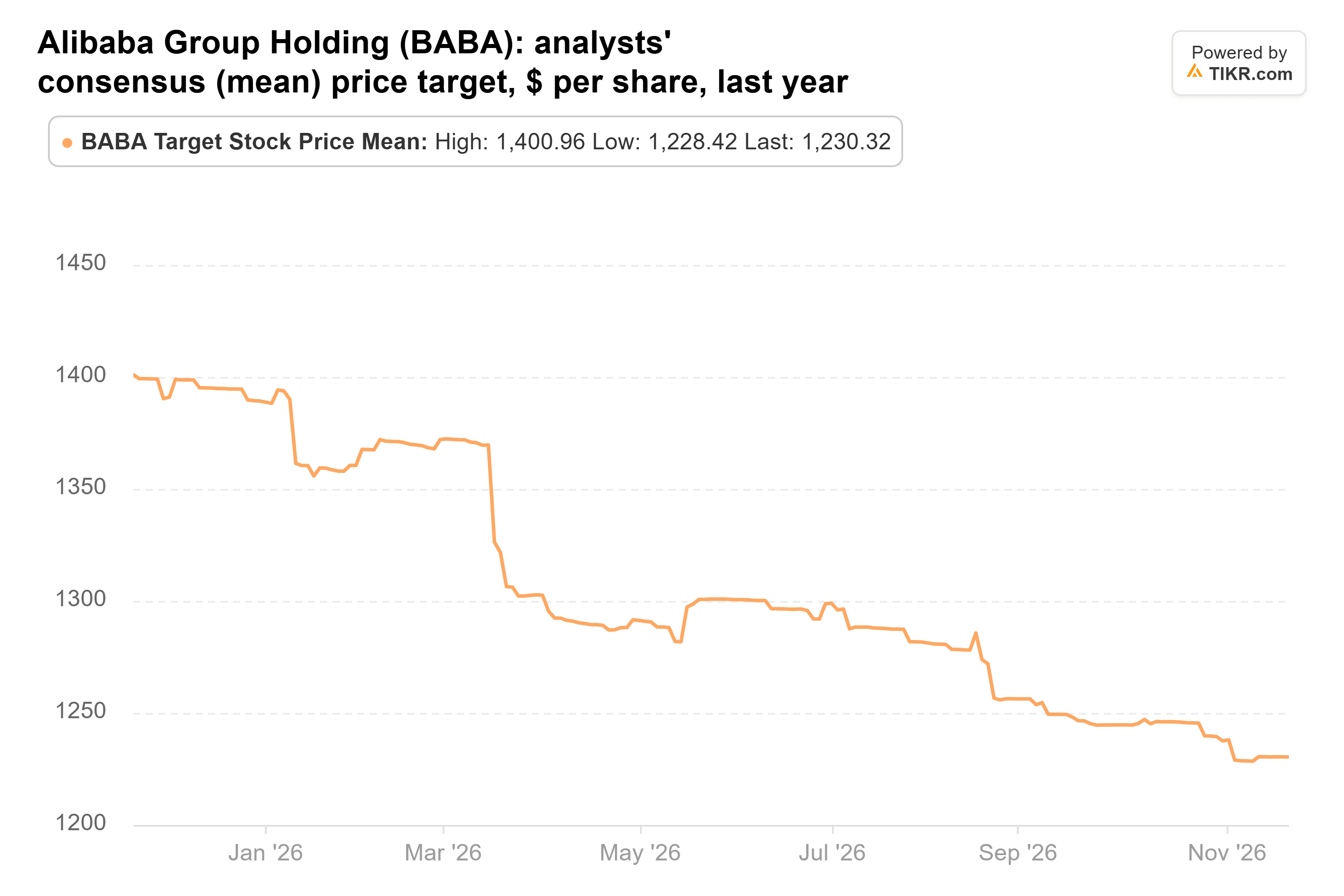
By my math, that target is about 20x fiscal 2028 consensus EPS, well above the stock’s 13x five-year average. So most of that upside would have to come from investors paying a higher multiple, on top of the earnings rebound itself.
I’d wait for the report
U.S. chip curbs are the other risk. They’ve already knocked the stock down this month as Washington readies limits on Chinese AI companies’ access to advanced chips abroad.
At 11x, Alibaba is only a little cheaper than usual. Buyers at that price are counting on a 65% earnings jump from a company that keeps missing, so I’d rather see the report first. The funds may simply be early: cloud revenue grew 45% in the June quarter, and its adjusted EBITA margin rose to 11.6% from 7.2% a year earlier.
What would make it a buy: this week’s report shows that margin still climbing, the AI Labs and Applications loss shrinking from June’s RMB 13.9 billion, and free cash flow better than the June quarter’s RMB 44.7 billion outflow. Then Alibaba has room to get back to its usual multiple. If not, the funds’ next 13Fs, due in mid-February, will show who stuck around.
So what is Alibaba stock actually worth?
TIKR lets you forecast the future price of any stock in less than a minute. Just enter a few assumptions into TIKR’s valuation model and see what Alibaba could be worth. Start from Wall Street consensus estimates, or adjust the inputs to reflect your own view of the business. It’s free to use.
Disclaimer:
Please note that the articles on TIKR are not intended to serve as investment or financial advice from TIKR or our content team, nor are they recommendations to buy or sell any stocks. We create our content based on TIKR Terminal’s investment data and analysts’ estimates. Our analysis might not include recent company news or important updates. TIKR has no position in any of the stocks mentioned. Thank you for reading, and happy investing!