Key Takeaways
- AbbVie raised its quarterly dividend 5% on Oct. 30, while Johnson & Johnson took a $5.5 billion talc charge in its third quarter.
- The two dividends are similarly well-covered, with AbbVie paying out 65% of its free cash flow over the trailing 12 months and Johnson & Johnson 62%.
- Johnson & Johnson carries far less debt, at 0.8x net debt to EBITDA against AbbVie’s 2.2x.
- The things to watch are whether AbbVie’s free cash flow climbs the way analysts expect and whether Johnson & Johnson’s talc settlement goes through.
On Oct. 30, AbbVie (ABBV) raised its quarterly dividend 5.2% to $1.82 a share, starting with February’s payment. It announced the raise alongside third-quarter results that beat its own guidance. On its call, management said its “robust free cash flow supports a strong and growing quarterly dividend.”
Johnson & Johnson (JNJ) raised its full-year guidance in October as well. But a $5.5 billion litigation charge tied to its proposed talc settlement cut its third-quarter net earnings to $210 million, from $5.15 billion a year earlier, and the stock fell 4% in premarket trading after the report.
So if you could own only one of these dividends for the next 20 years, which should it be?
| Metric | AbbVie (ABBV) | Johnson & Johnson (JNJ) |
|---|---|---|
| Dividend yield | 2.4% | 1.9% |
| Dividend growth, fiscal 2020-2025 | 6.6% a year | 5.2% a year |
| Cash dividend payout ratio, TTM | 65% | 62% |
| Cash dividend payout ratio, fiscal 2026 consensus | 60% | 56% |
| Net debt / EBITDA | 2.2x | 0.8x |
| Interest coverage | 8.2x | 26.8x |
| Forward P/E | 19x | 25x |
Source: TIKR, Nov. 9, 2026. TTM to Sept. 30, 2026 (AbbVie) and Sept. 27, 2026 (Johnson & Johnson).
6 safe dividend stocks paying retirees 6%+ yields
There are over 100 stocks paying 6%+ annual dividends today.
But after an extensive investment review leveraging TIKR’s proprietary data, we now believe only six of them are truly safe for retirees.
They’re all yours for free as part of our new investment report, which you can access right here.
AbbVie has moved past Humira
AbbVie’s third-quarter revenue rose 10.3% from a year earlier to $17.4 billion. Skyrizi alone brought in $5.8 billion, up 22.7%, and the neuroscience drugs grew 19.4% to $3.4 billion. Humira fell 31.2% to $683 million as biosimilars kept taking share.
Cash flow hasn’t kept pace with the dividend lately. This chart shows AbbVie’s free cash flow against the dividends it paid each year:
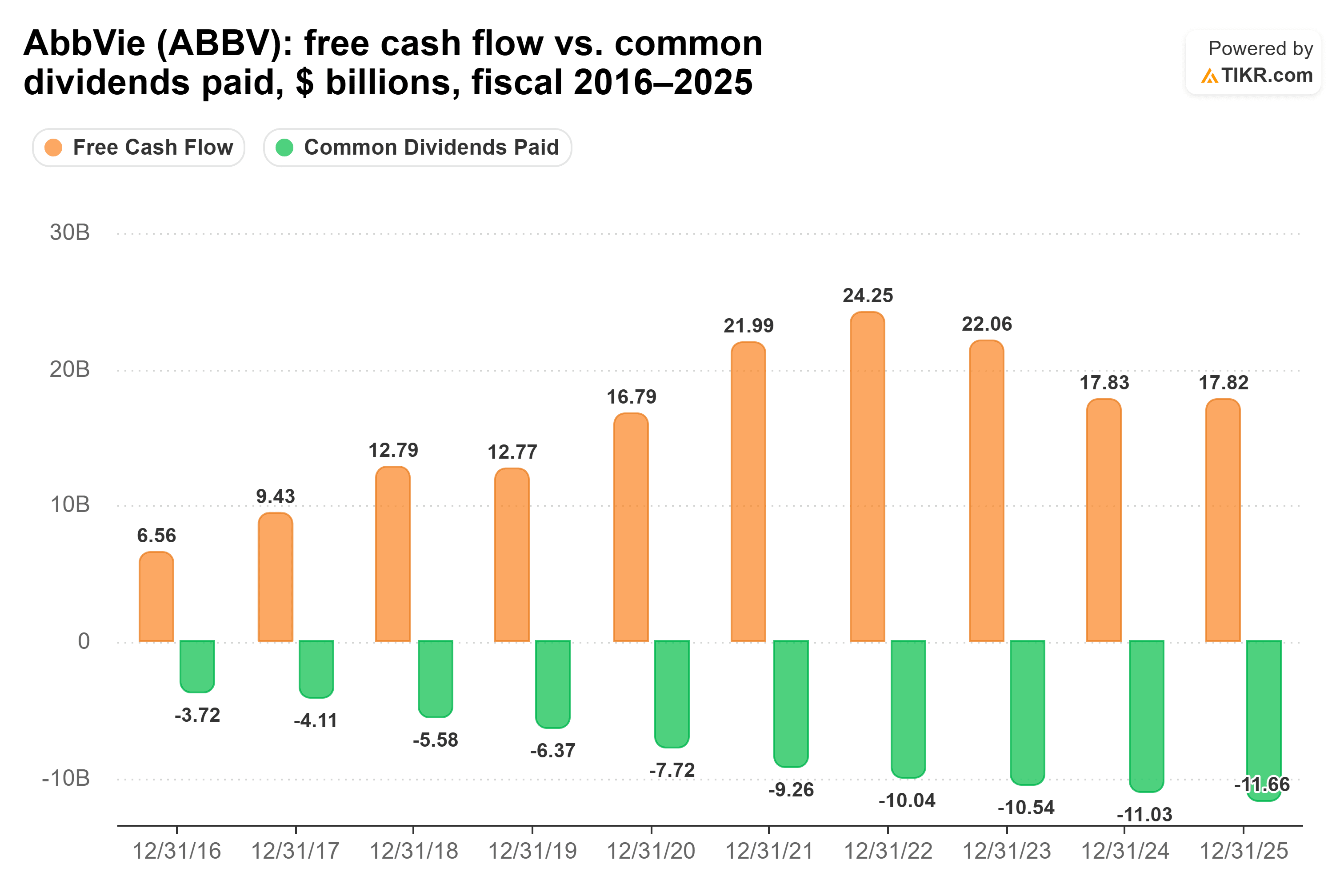
Free cash flow peaked at $24.3 billion in fiscal 2022 and came in at $17.8 billion in both fiscal 2024 and fiscal 2025. Over the same years, dividends rose to $11.7 billion. That pushed the cash dividend payout ratio from 41.4% in fiscal 2022 to 65.4% in fiscal 2025. That’s still a comfortable level, and fiscal 2026 consensus brings it down to 60%.
The main risk is debt. Net debt is 2.2x EBITDA, and after closing the Apogee deal, AbbVie says it’s on track to bring net leverage to 2x over the next two to three years.
Johnson & Johnson: steady cash, messy quarter
Johnson & Johnson pays out a similar share of its cash, from a business growing more slowly. Third-quarter sales rose 5.9% to $25.4 billion. Innovative Medicine grew 7.7% on newer cancer and immunology drugs, while MedTech grew just 2.5%. Tim Schmid, who runs MedTech, put it bluntly: “Simply put, we can do better and we absolutely will.”
J&J’s free cash flow has been much steadier than AbbVie’s:
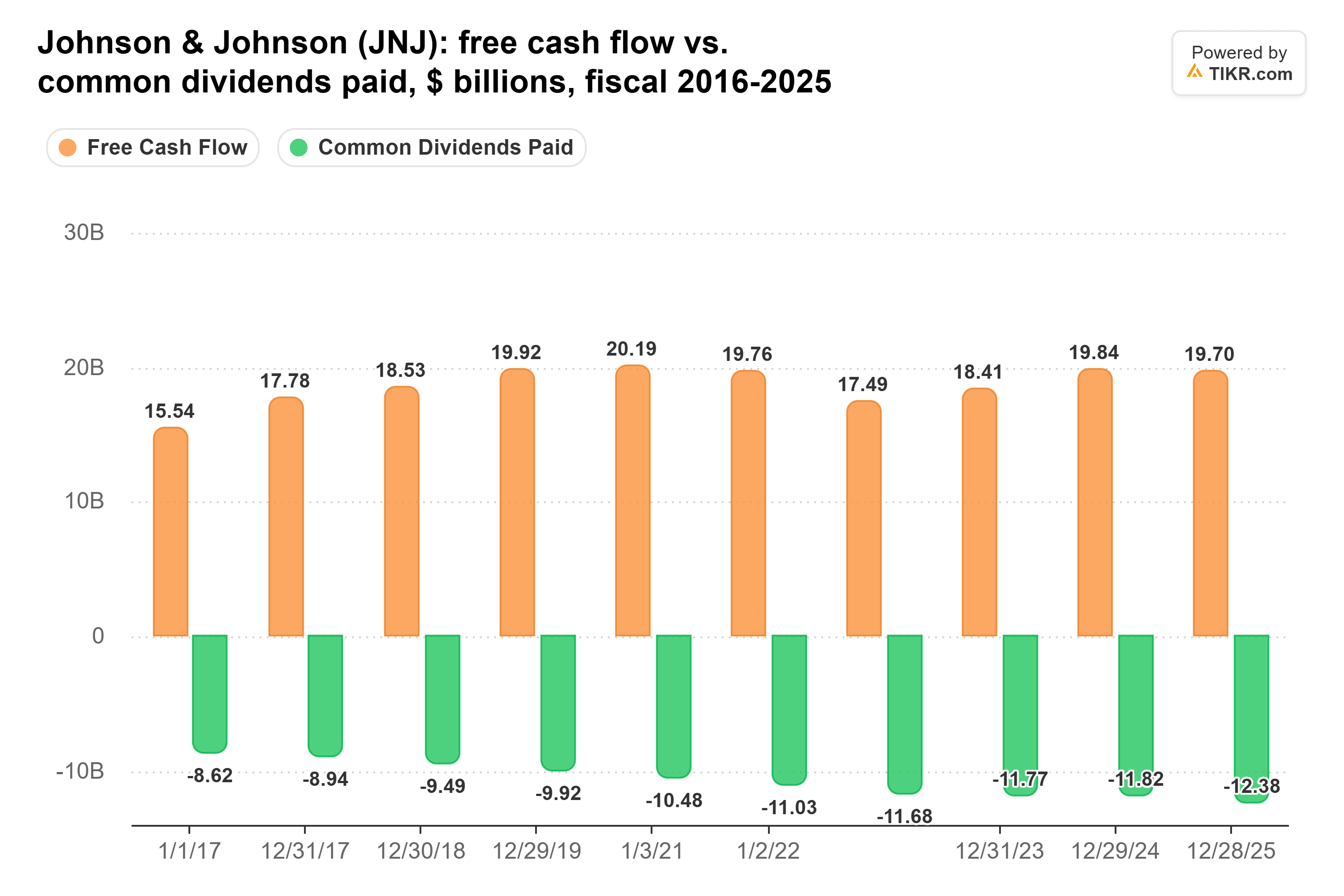
It stayed between $17.5 billion and $20.2 billion every year from fiscal 2018 to fiscal 2025, while dividends rose from $9.49 billion to $12.4 billion. That’s a well-covered 62% payout over the trailing 12 months and 56% on fiscal 2026 consensus. Management guides to about $21 billion of free cash flow this year and says J&J remains “committed to returning capital directly to shareholders, primarily through our dividend.”
The talc settlement behind the charge still has to clear its own bar. CFO Joseph Wolk said: “The agreement is conditioned upon the express participation of at least 95% of the remaining ovarian claims. We are trending to meet the 95% threshold.”
So which dividend wins?
AbbVie gets my dividend dollars for the next 20 years.
Over that long a stretch, I want a dividend the business can keep raising. On coverage, the two are close: J&J pays out only a few points less of its free cash flow, both today and on consensus. The difference is direction. AbbVie is growing faster, and its newer drugs are more than making up for Humira. Analysts expect its free cash flow to climb from here:
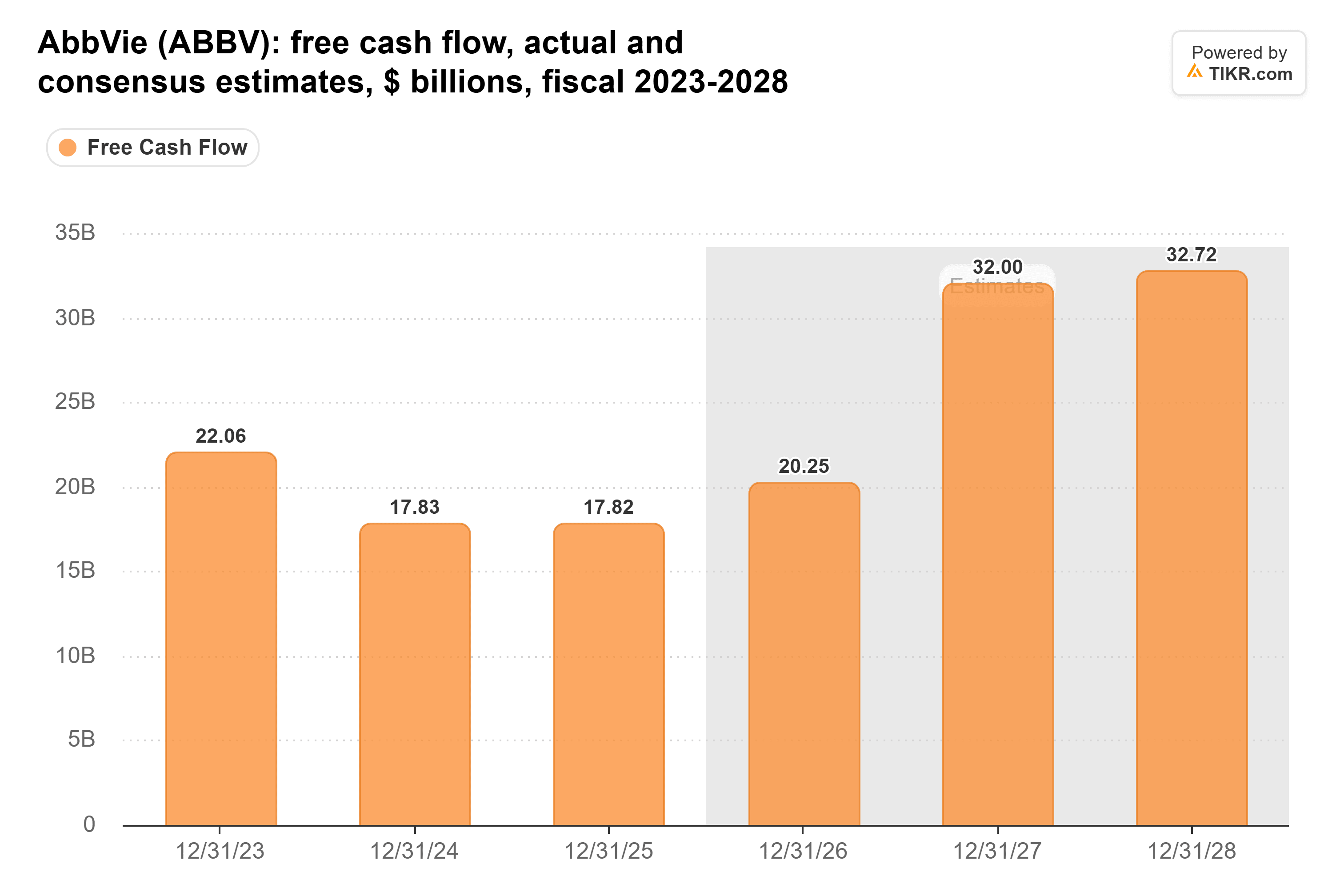
Consensus puts it at $20.3 billion in fiscal 2026 and $32.0 billion in fiscal 2027, well above its fiscal 2022 peak.
Then there’s the income. At its 2.4% yield and 6.6% growth rate, $10,000 in AbbVie would pay about $9,379 over 20 years. At 1.9% and 5.2%, the same $10,000 in J&J would pay about $6,450. By year 20, AbbVie’s check would be about $803, an 8.0% yield on the original $10,000, against about $502 for J&J. At those rates, J&J never catches up. And AbbVie costs 19x forward earnings to J&J’s 25x.
This isn’t to say J&J’s dividend isn’t safe. It carries a fraction of AbbVie’s debt, covers its interest 26.8x over, and its free cash flow has barely wavered in eight years. It’s just that AbbVie’s coverage is close enough that I don’t have to give up much safety to get a bigger, faster-growing check.
Of course, the fiscal 2027 jump analysts expect still has to happen. If AbbVie’s free cash flow stays near $17.8 billion while the dividend keeps climbing, I’d revisit this pick.
Forget AbbVie: 6 safe 6%+ dividend yields you can buy right now
Dividends can hold the key to enormous wealth. But only if you buy the right ones.
Picking the right high-yield dividend stock can be the difference between a dream retirement…and scraping by every month, waiting for the next Social Security check to clear.
We’ve identified six stocks yielding 6%+ that we believe every retiree should know about right now. (And AbbVie isn’t one of them.)
Disclaimer:
Please note that the articles on TIKR are not intended to serve as investment or financial advice from TIKR or our content team, nor are they recommendations to buy or sell any stocks. We create our content based on TIKR Terminal’s investment data and analysts’ estimates. Our analysis might not include recent company news or important updates. TIKR has no position in any of the stocks mentioned. Thank you for reading, and happy investing!