Key Takeaways
- A recently divorced 60-year-old caller on Jill on Money gets $6,000 a month of spousal support until she turns 65.
- A divorced spouse whose marriage lasted at least 10 years can claim on an ex’s Social Security from 62. If the ex hasn’t filed, the divorce has to be at least two years old.
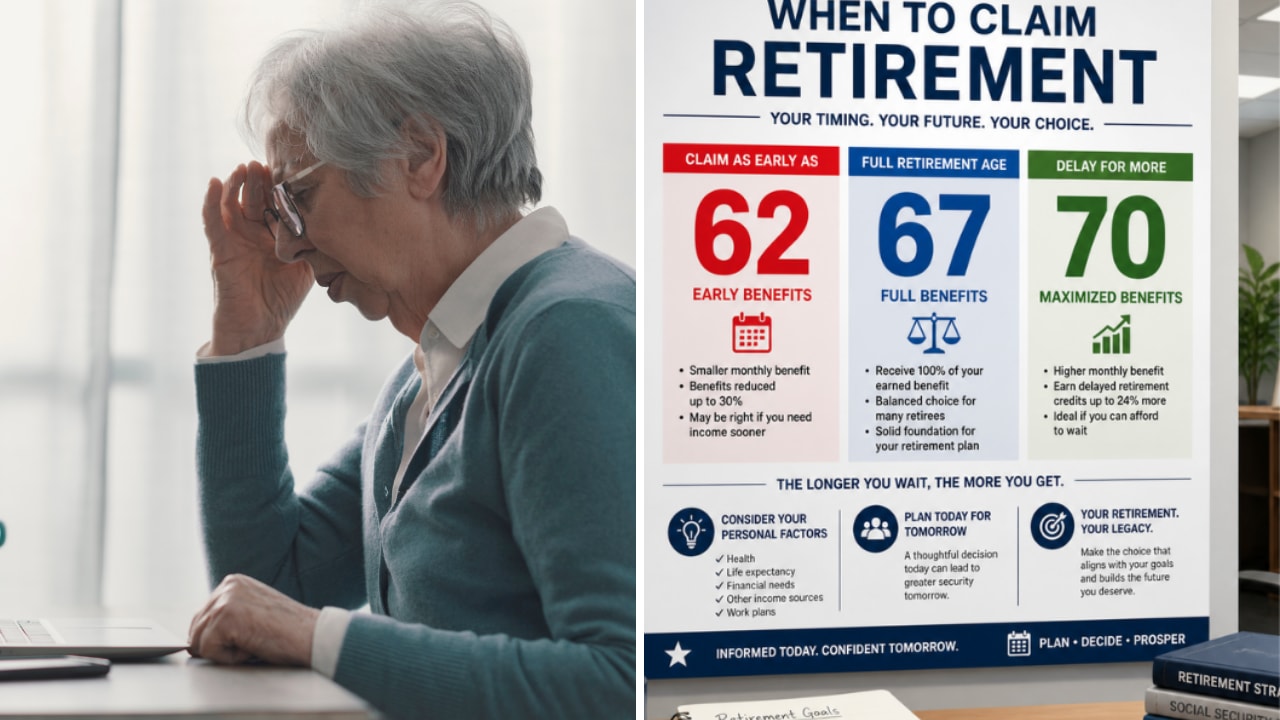
- If her ex’s full benefit is $3,400, claiming at 65 pays $1,416.67 a month. That compares with $1,700 at her full retirement age of 67 and $1,105 at 62.
- Social Security pays only the higher of her own benefit or the spousal one, and the $3,400 she gave may be her own figure.
If you were married for at least 10 years, your ex’s Social Security record can still pay you after the divorce, even if your ex hasn’t filed yet. That’s a real help when your support payments have an end date. But claim early and the check is cut for life, and Social Security won’t pay it on top of your own benefit.
A recently divorced 60-year-old caller to Jill on Money laid out that exact problem this week. She works part-time and gets $6,000 a month of spousal support, which she said isn’t taxable to her. It runs until she’s 65, and she figures she needs about $7,000 a month to live on.
Jill Schlesinger told her she’ll have to replace that $6,000 when it stops. Then she added that the caller “would still be able to claim half of his when you’re eligible at your full retirement age.” But the caller needs that money at 65, which is two years before her full retirement age.
6 safe dividend stocks paying retirees 6%+ yields
There are over 100 stocks paying 6%+ annual dividends today.
But after an extensive investment review leveraging TIKR’s proprietary data, we now believe only six of them are truly safe for retirees.
They’re all yours as part of our new investment report. Learn more about how to get access right here.
She’ll qualify long before 65
Under Social Security’s rules for divorced spouses, she can draw on her ex’s record if they were married at least 10 years before the divorce became final, she’s 62 or older and she isn’t married. If her ex hasn’t claimed yet, the divorce also has to be at least two years old. She described a long-term marriage, which I’ll take to mean 10 years or more. Her divorce is recent, and it’ll be about five years old by the time she’s 65, so the two-year wait won’t hold her up whatever her ex does.
The check is half of her ex’s full benefit if she claims at her full retirement age. That age is 67 for anyone born in 1960 or later. Her ex’s own claiming age doesn’t shrink it. Before 67, the spousal benefit drops 25/36 of 1% for each of the first 36 months early and 5/12 of 1% for each month beyond that. At 62, it can be as little as 32.5% of his full benefit.
At 65, the check is $1,416.67
The one figure she gave was $3,400: “Last I looked, I thought it was $3,400, but I’m not sure.” Jill had asked about the caller’s own benefit, but since she wasn’t sure of the number, let’s say it’s her ex’s full benefit. That’s the case where his record matters. Half of it is $1,700 a month at 67, which is the check Jill had in mind.
If she claims at 65, the month the support ends, she’s 24 months early. That cuts the check by a sixth (24 × 25/36 of 1%), to $1,416.67 a month. At 62 she’d be 60 months early and take the full 35% cut, which leaves $1,105.
Either way, that’s a long way from $6,000. At 65, the spousal check replaces less than a quarter of the support, so most of the gap has to come from her savings. Fortunately, she has plenty. Jill tallied roughly $1 million in brokerage accounts, $850,000 in pre-tax IRAs and $100,000 in savings.
Waiting until 67 means passing up 24 checks of $1,416.67, or about $34,000 in all, for about $283 more a month after that. The bigger check would take 120 months to make that up, so she’d come out ahead from about age 77 on. There’s nothing to gain by waiting past 67, since a spousal benefit is highest at full retirement age.
She gets the bigger check, and it may be her own
Social Security never pays two benefits in full at once. Someone who qualifies for her own retirement benefit and a spousal benefit gets no more than the highest single one. So the spousal check only matters if half of her ex’s full benefit is more than her own.
And Jill’s question was about the caller’s own benefit. If $3,400 is her own full benefit, half of her ex’s would only beat it if his full benefit were more than $6,800. Short of that, she’d simply collect her own. That wouldn’t be bad news. A $3,400 check at 67 is twice the spousal check worked out above.
So her first job is finding out whose $3,400 she saw. If it’s her own, she plans around her own record, and her ex’s doesn’t come into it. If it’s his, she’s choosing between $1,416.67 at 65 and $1,700 at 67.
The way I see it, with roughly $2 million saved, she can cover two years of about $7,000 a month and take the full $1,700 at 67. That’s especially true if she expects to live past 77. One thing could change all this before she claims: since the benefit requires her to be unmarried, remarrying first would take her ex’s record off the table.
Enjoy your retirement in style with these safe 6%+ dividend yields
Dividends can hold the key to enormous wealth. But only if you buy the right ones.
Picking the right high-yield dividend stock can be the difference between a dream retirement…and scraping by every month, waiting for the next Social Security check to clear.
We’ve identified six stocks yielding 6%+ that we believe every retiree should know about right now.
Disclaimer:
Please note that the articles on TIKR are not intended to serve as investment or financial advice from TIKR or our content team, nor are they recommendations to buy or sell any stocks. We create our content based on TIKR Terminal’s investment data and analysts’ estimates. Our analysis might not include recent company news or important updates. TIKR has no position in any of the stocks mentioned. Thank you for reading, and happy investing!