


Key Takeaways
- A $400,000 portfolio split evenly across General Mills, Plains All American and Kraft Heinz pays about $27,000 a year in dividends at today’s prices, a 6.8% yield.
- Plains All American and Kraft Heinz both cover their dividends comfortably, but General Mills’ dividend looks stretched.
- General Mills paid out 85% of its free cash flow over the last 12 months, and Piper Sandler has warned of a dividend cut.
- If General Mills halved its dividend, the portfolio’s income would fall to about $22,300 a year. If it stopped paying, the income would fall to about $17,600.
Retirees hunting for income can find yields above 6% in some very familiar names right now. General Mills (GIS), Plains All American Pipeline (PAA) and Kraft Heinz (KHC) all clear that bar at today’s prices.
So let’s take a hypothetical retiree who splits $400,000 evenly across the three. Together, they’d pay about $27,000 a year in dividend checks, or about $2,250 a month.
That’s a 6.8% yield on this part of the portfolio. (Of course, no one should ever own just three stocks.)
| Stock | Shares | Cost | Income a year | Share of income | Coverage, last reported / forward |
|---|---|---|---|---|---|
| General Mills (GIS) | 3,849 | $133,329 | $9,392 | 34% | 85% of free cash flow / 76% |
| Plains All American (PAA) | 5,537 units | $133,331 | $9,247 | 34% | 1.67x distributable cash flow / 1.60x |
| Kraft Heinz (KHC) | 5,234 | $133,310 | $8,374 | 32% | 50% of free cash flow / 63% |
| All three | $27,013 | 100% |
Source: TIKR, at today’s prices, with dividends at each company’s current rate. Coverage figures by company:
- General Mills: the 12 months to Aug. 30, 2026, and fiscal 2027 consensus.
- Plains All American: fiscal 2025, and fiscal 2026 consensus.
- Kraft Heinz: the 12 months to June 27, 2026, and fiscal 2026 consensus.
General Mills has the thinnest cushion
General Mills pays the biggest check, about $9,390 a year, and it’s the least covered of the three. Over the 12 months to Aug. 30, 2026, its dividend ate up a risky 85% of free cash flow, and analysts’ fiscal 2027 consensus only brings that to 76%.
6 safe dividend stocks paying retirees 6%+ yields
There are over 100 stocks paying 6%+ annual dividends today.
But after an extensive investment review leveraging TIKR’s proprietary data, we now believe only six of them are truly safe for retirees.
They’re all yours as part of our new investment report. Learn more about how to get access right here.
Free cash flow fell from $2.45 billion in fiscal 2021 to $1.63 billion in fiscal 2026. Over the same years, dividends paid edged up from $1.25 billion to $1.32 billion:
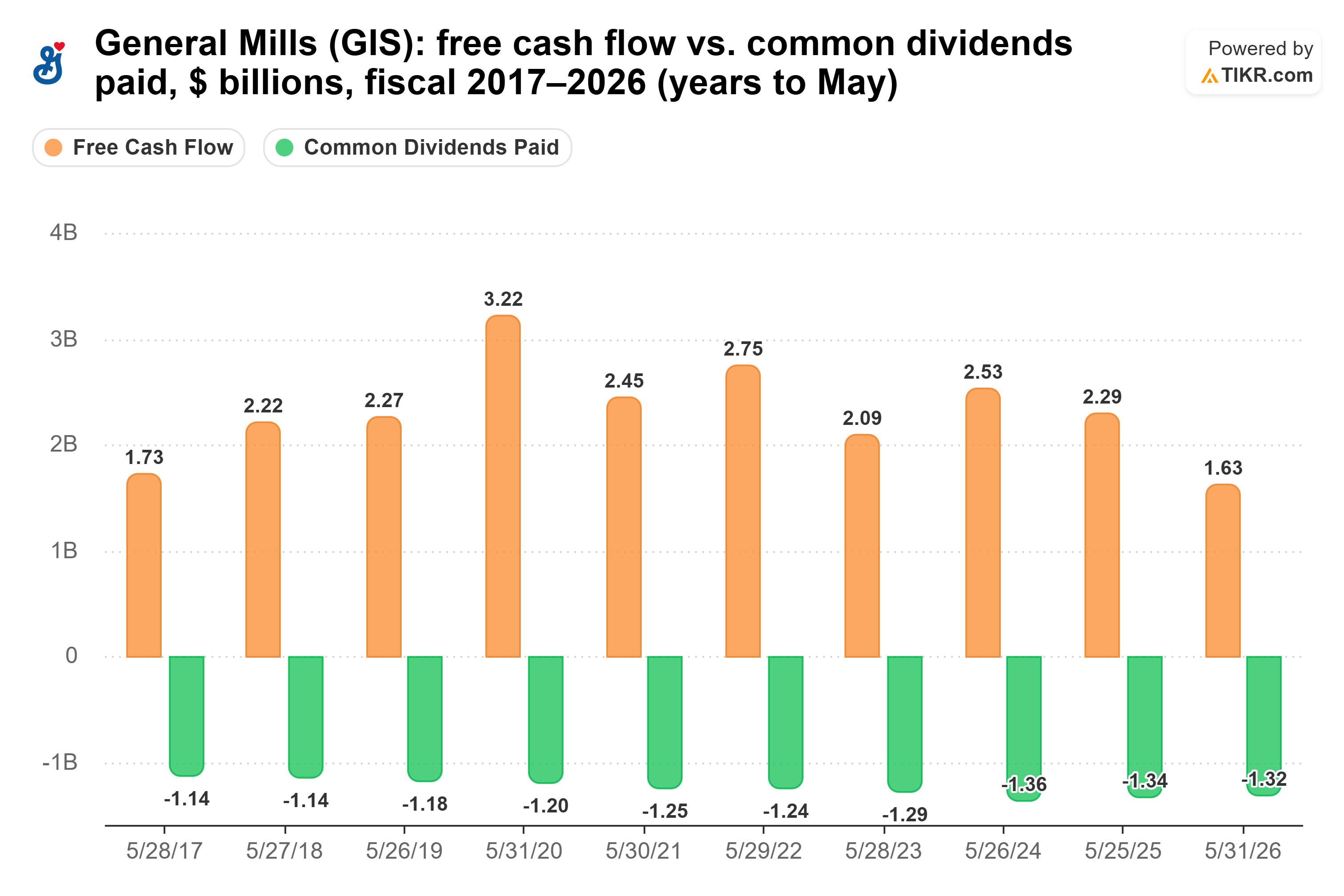
The business isn’t making up the gap yet. North America retail sales fell 3% organically in the fiscal first quarter ended Aug. 30, and management expects adjusted operating profit to fall 8% to 13% in constant currency in fiscal 2027.
CFO Kofi Bruce said in September that “we remain fully committed to our dividend.” But he plans to hold the rate flat while the company pays down debt, now 3.67x EBITDA, and he expects it to take “at least a couple of years” to get back to its 3x target. On Nov. 12, Piper Sandler downgraded the stock to Neutral and warned of a heightened risk of a dividend cut.
Plains All American keeps raising its check
Plains All American’s check is close behind, at about $9,250 a year, and it’s on much firmer footing. As a partnership, it pays distributions on units, and holders get a K-1 at tax time. Distributable cash flow covered the distribution 1.67x in fiscal 2025, and analysts expect 1.60x in fiscal 2026.
Plains has cut before. Distributions fell from $2.50 a unit in fiscal 2016 to $0.72 in fiscal 2020. They then climbed back to $1.56 in fiscal 2025, still well inside distributable cash flow of $2.61 a unit:
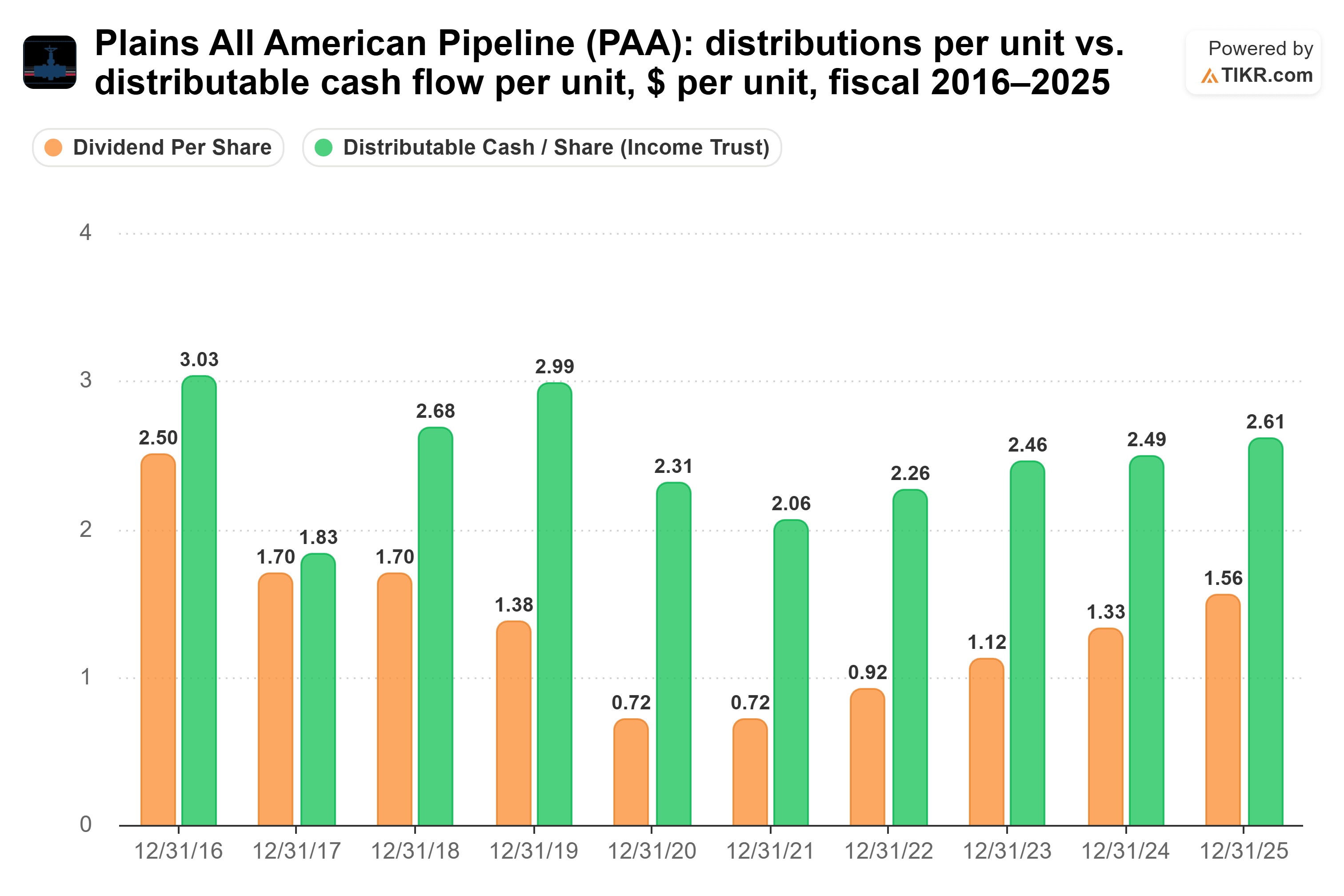
Management targets raises of $0.15 a unit a year, and the latest $0.4175 quarterly payment is up 10% from a year ago. Plains sold its Canadian NGL business to Keyera in May, and CEO Willie Chiang says what’s left, its crude oil business, has “a more durable and predictable cash flow stream.” Oil markets are volatile, as management itself says, but there’s plenty of cushion here.
Kraft Heinz’s flat check has room to spare
Kraft Heinz pays the smallest check, about $8,370 a year, and it hasn’t grown: the dividend was $1.60 a share in both fiscal 2020 and fiscal 2025. But it’s the best covered of the three, using just 50% of free cash flow over the 12 months to June 27, 2026.
Kraft Heinz earned that cushion the hard way. Dividends paid fell from $3.18 billion in fiscal 2018 to $1.95 billion in fiscal 2019. Free cash flow has covered them every year since except fiscal 2022:
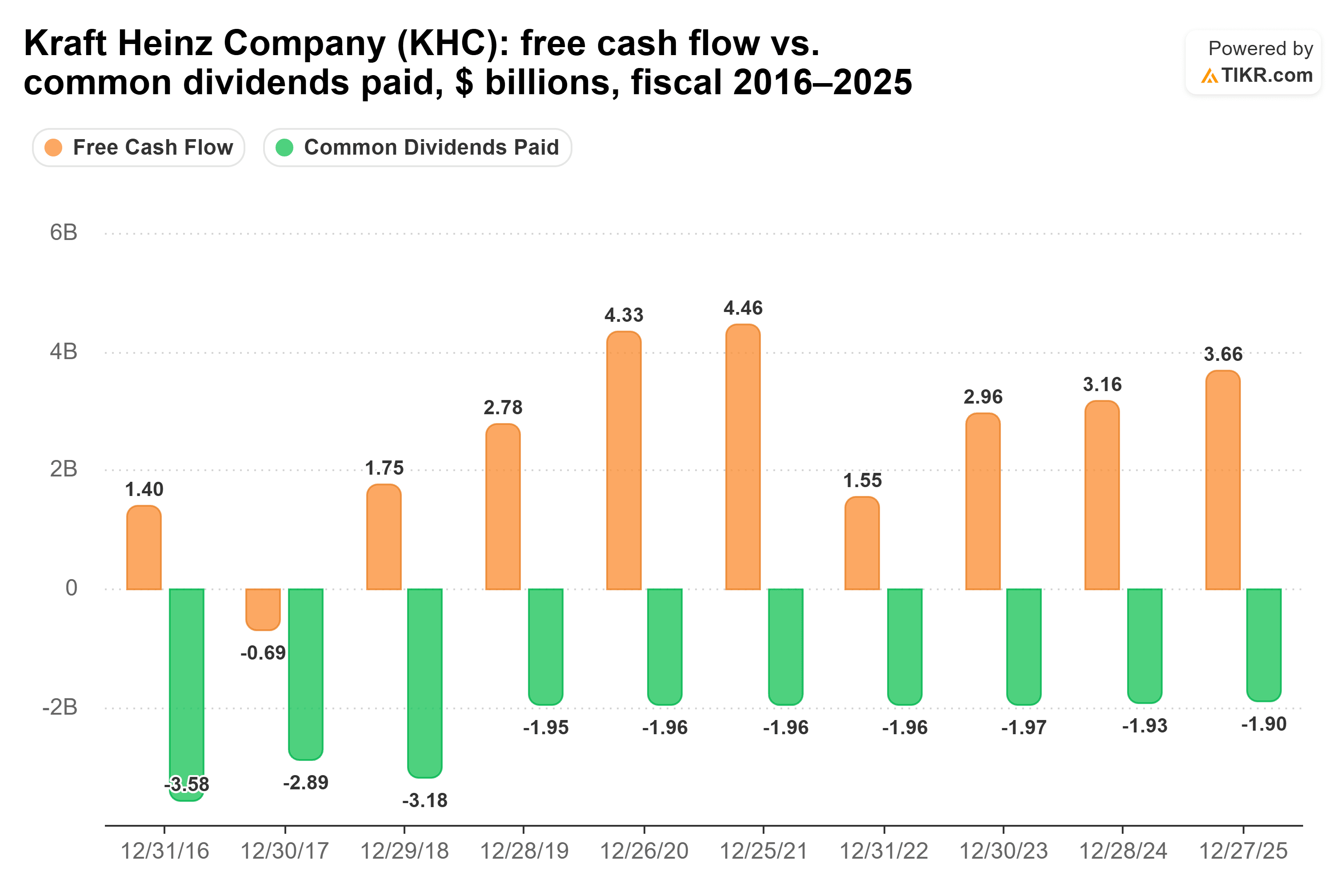
Analysts expect the payout ratio to rise to 63% in fiscal 2026, as free cash flow falls to $3.01 billion from $3.66 billion in fiscal 2025. Management guides for adjusted operating income to drop 16% to 18% in constant currency this year. On Nov. 4, Kraft Heinz agreed to sell its North American coffee business, and about $500 million of after-tax proceeds will go to debt when the deal closes in mid-2027.
Two solid checks, and one I’d watch
Plains All American and Kraft Heinz both look safe to me. Plains is growing its check with room to spare. Kraft Heinz’s check is slow, but free cash flow covers it twice over.
General Mills is the one I’d worry about. With its debt above its own target and its profit guidance pointing down, that check looks stretched, however committed management is.
If General Mills halved its dividend, this retiree’s income would fall to about $22,300 a year. If it stopped paying, the income would fall to about $17,600. I’d expect a trim long before a full stop, though, from a company that has paid for 128 years without interruption.
Dana McNabb takes over as CEO on Jan. 1, and the company plans at least $750 million of cost savings this fiscal year. I’ll be watching whether that brings debt down fast enough to keep the check whole.
Enjoy your retirement in style with these safe 6%+ dividend yields
Dividends can hold the key to enormous wealth. But only if you buy the right ones.
Picking the right high-yield dividend stock can be the difference between a dream retirement…and scraping by every month, waiting for the next Social Security check to clear.
We’ve identified six stocks yielding 6%+ that we believe every retiree should know about right now.
Disclaimer:
Please note that the articles on TIKR are not intended to serve as investment or financial advice from TIKR or our content team, nor are they recommendations to buy or sell any stocks. We create our content based on TIKR Terminal’s investment data and analysts’ estimates. Our analysis might not include recent company news or important updates. TIKR has no position in any of the stocks mentioned. Thank you for reading, and happy investing!


