Key Takeaways
- A hypothetical $1,500,000 portfolio split evenly across HP, Truist Financial and PepsiCo pays about $65,100 a year in dividends at today’s prices, or about $5,430 a month.
- HP’s dividend looks the safest of the three, taking 28% of free cash flow over the trailing twelve months.
- Truist’s dividend has held at $2.08 a share a year since fiscal 2023, but analysts expect it to take 45% of normalized EPS in fiscal 2026, down from 52% in fiscal 2025.
- PepsiCo is the least covered at 75% of free cash flow, and if it halved its dividend, the portfolio’s income would fall to about $54,500 a year.
Plenty of retirees want their portfolio to cover the bills without selling a share. Right now, HP (HPQ), Truist Financial (TFC) and PepsiCo (PEP) all yield 4% or more at today’s prices.
So let’s take a hypothetical retiree who splits $1,500,000 evenly between the three, $500,000 apiece. At each company’s current dividend, those shares pay a dividend check of about $65,100 a year, or about $5,430 a month.
That’s a 4.15% yield on this part of the portfolio. (Of course, no one should ever own just three stocks.) The three checks are close to even in size, but the cash behind them isn’t:
| Stock | Shares | Cost | Income a year | Share of income | Coverage |
|---|---|---|---|---|---|
| HP (HPQ) | 17,972 | $499,981 | $21,566 | 34% | 28% of free cash flow (TTM); 36% forward |
| Truist Financial (TFC) | 10,713 | $499,976 | $22,283 | 34% | 52% of normalized EPS (fiscal 2025); 45% forward |
| PepsiCo (PEP) | 3,597 | $499,983 | $21,294 | 32% | 75% of free cash flow (TTM) |
| Total | $65,144 | 100% |
Source: TIKR and StockAnalysis, at today’s prices and each company’s current dividend rate.
6 safe dividend stocks paying retirees 6%+ yields
There are over 100 stocks paying 6%+ annual dividends today.
But after an extensive investment review leveraging TIKR’s proprietary data, we now believe only six of them are truly safe for retirees.
They’re all yours as part of our new investment report. Learn more about how to get access right here.
HP’s PCs are carrying the load
HP’s check rests on its PC business right now. In its third quarter, ended July 31, 2026, Personal Systems revenue rose 18% from a year earlier to $11.8 billion on AI PCs and share gains, while Printing revenue fell 2% to $3.9 billion. Management also raised its fiscal 2026 free cash flow forecast to $3.0-$3.2 billion.
That’s plenty for the dividend, which took just 28% of free cash flow over the twelve months to July 31, 2026, and 36% on analysts’ fiscal 2026 estimates. Free cash flow has topped dividends paid by a wide margin in every year since fiscal 2016:
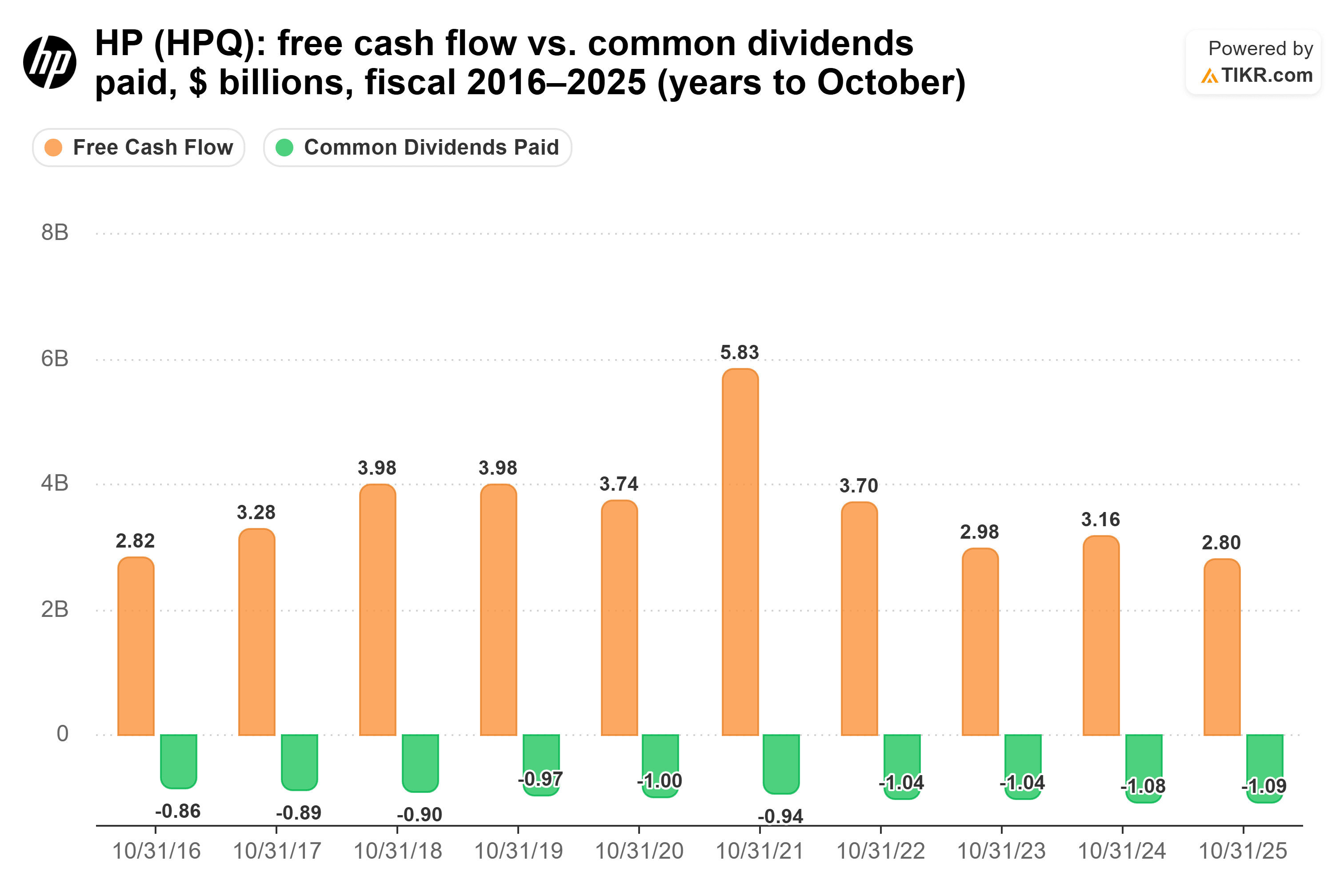
HP says it aims at “returning approximately 100% of our free cash flow to shareholders over time as long as our gross leverage remains under 2x and there aren’t better return opportunities.” The dividend is only about a third of that. The risk is rising memory and storage costs, and CFO Karen Parkhill expects fourth-quarter PC margins to be “a low point.” HP also gets a permanent CEO on Jan. 4, 2027: Emma Walmsley, the company said on Nov. 4.
Truist hasn’t raised in a while
Truist is a bank, so its check is judged on normalized EPS. The dividend has sat at $2.08 a share a year since fiscal 2023. Earnings fell from $4.96 a share in fiscal 2022 to $3.59 in fiscal 2023, then climbed back to $4.01 in fiscal 2025 while the dividend held:
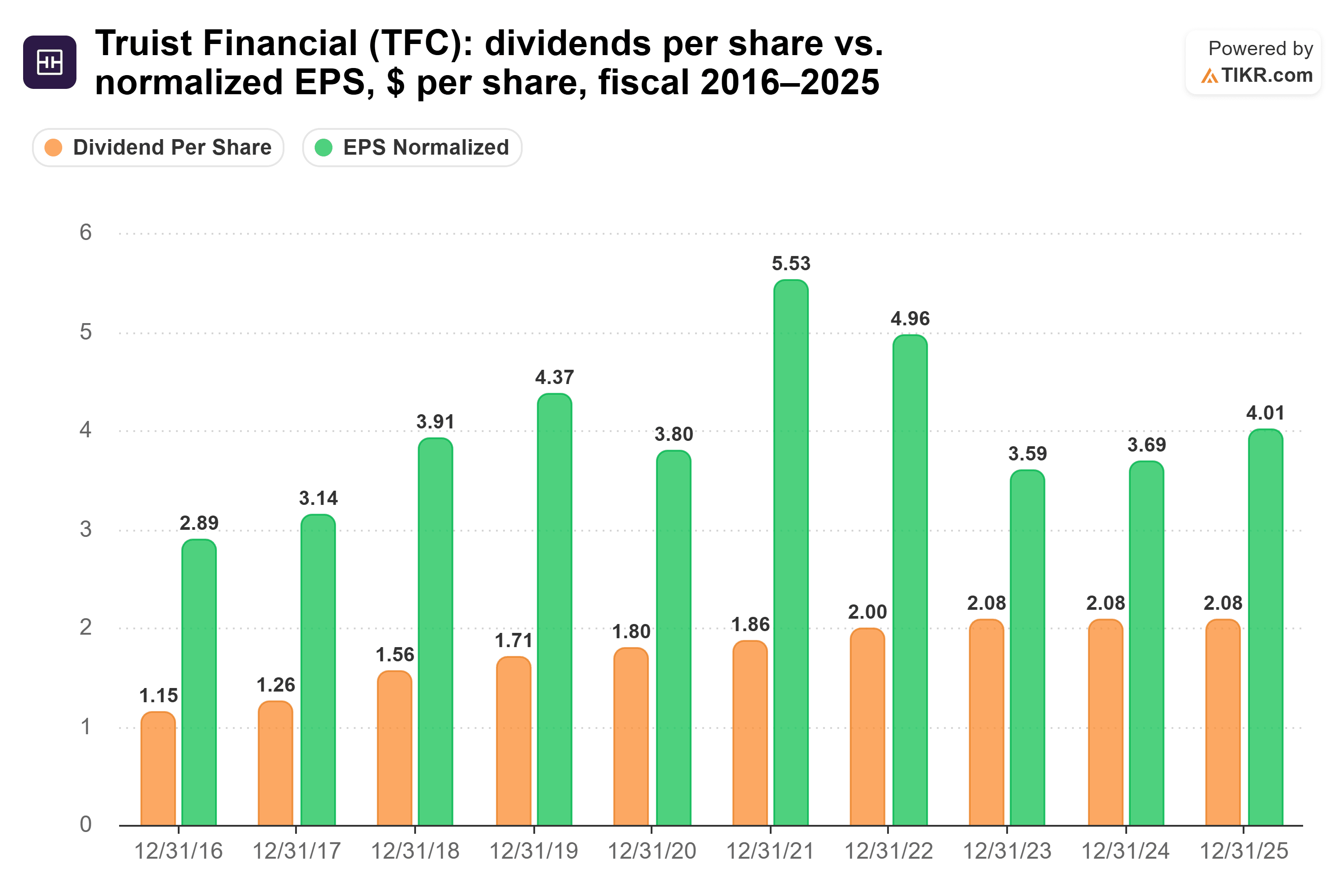
That recovery took the payout ratio from 57.9% in fiscal 2023 to 51.9% in fiscal 2025. Analysts’ fiscal 2026 estimate of $4.67 a share would bring it down to 45%.
CEO Michael Lyons is also resetting the bank. Truist sold its RAC loans and agreed to sell LightStream. Lyons said on the call that “this isn’t about taking a big charge and destroying tangible book value and rebuilding over time.” The risk is credit: its net charge-off ratio rose to 0.77% in the third quarter from 0.50% in the second.
PepsiCo’s soda problem
That brings us to PepsiCo, the least covered of the three. Organic revenue rose 3.1% in the third quarter of 2026 from a year earlier. At home, though, it’s another story. CEO Ramon Laguarta said on the call, “we’re not satisfied with the performance in the U.S.” On Oct. 8, PepsiCo cut its fiscal 2026 core EPS growth forecast to 2.5%-3.5%, from the low end of 5%-7%. Under pressure from activist Elliott Investment Management, it said on Nov. 12 that it plans to cut about 1,000 North American jobs.
Dividends took 75% of free cash flow over the trailing twelve months through its third quarter. For most of the past decade, dividends paid have climbed toward free cash flow, and they passed it in fiscal 2022 and fiscal 2024:
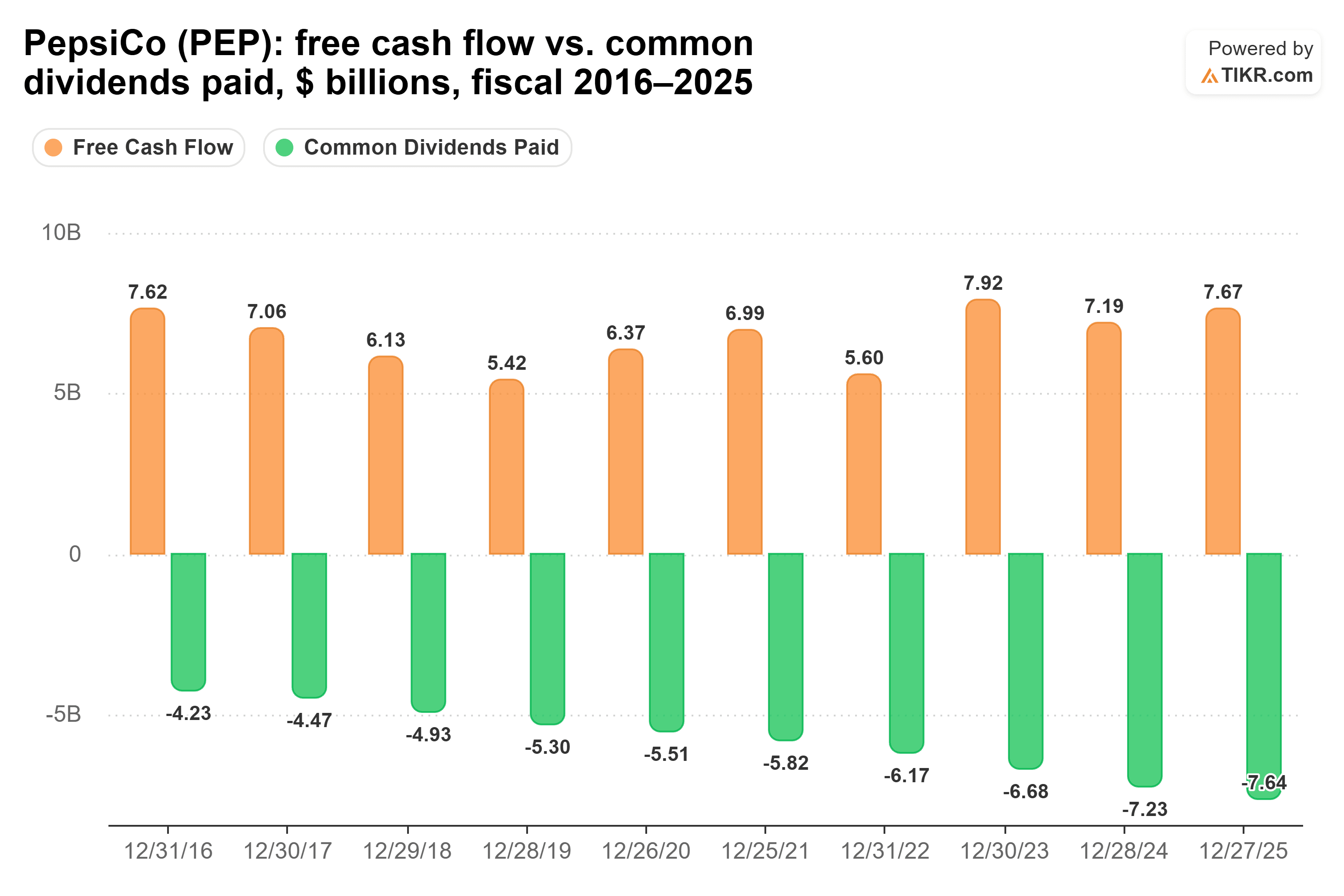
In fiscal 2025, the dividend took 99.6% of free cash flow. Operating cash flow has picked up since then: $7.95 billion over the first 36 weeks of 2026, against $5.47 billion a year earlier.
Here’s what a PepsiCo cut would cost
PepsiCo is the one I’d stress-test, since its dividend takes the biggest share of its cash. If it halved its dividend, the portfolio’s income would fall to about $54,500 a year. If it stopped paying altogether, the income would fall to about $43,800.
That said, least covered doesn’t mean truly risky. PepsiCo’s own fiscal 2026 plan calls for $7.9 billion of dividends and just $1.0 billion of buybacks, and its 75% is well below where it was in fiscal 2025.
I’d be happy collecting all three checks. HP’s is the safest, with the most cash to spare. Truist’s should get more comfortable as earnings recover. PepsiCo’s is the one I’d keep an eye on, without losing sleep over it.
Of course, a lot is still in motion. Truist plans to lay out 2027 in January, and PepsiCo’s turnaround is just getting going. If PepsiCo’s free cash flow slips back toward its dividend, I’d revisit.
Enjoy your retirement in style with these safe 6%+ dividend yields
Dividends can hold the key to enormous wealth. But only if you buy the right ones.
Picking the right high-yield dividend stock can be the difference between a dream retirement…and scraping by every month, waiting for the next Social Security check to clear.
We’ve identified six stocks yielding 6%+ that we believe every retiree should know about right now.
Disclaimer:
Please note that the articles on TIKR are not intended to serve as investment or financial advice from TIKR or our content team, nor are they recommendations to buy or sell any stocks. We create our content based on TIKR Terminal’s investment data and analysts’ estimates. Our analysis might not include recent company news or important updates. TIKR has no position in any of the stocks mentioned. Thank you for reading, and happy investing!