The Charles Schwab Corporation (NYSE: SCHH) is one of the most influential brokerage and wealth management platforms in the United States. Founded by Charles R. Schwab, the company helped democratize investing through low cost trading and now oversees trillions of dollars in client assets. Shares recently traded near $97, giving Schwab a market value of roughly $172.5B.
After a period shaped by interest rate volatility and shifts in client cash behavior, examining who owns Charles Schwab offers a clearer read on how major investors are positioning around its long term earnings power, interest income recovery, and scale driven asset growth. Ownership patterns can be especially telling for Schwab because its profitability is closely tied to client asset balances, cash sorting trends, and the broader rate environment. For investors this makes shareholder movements an important signal of how institutions and insiders view Schwab’s ability to stabilize net interest income, expand operating leverage, and sustain long term growth as market conditions normalize.
Who Are Charles Schwab’s Top Shareholders?

Charles Schwab’s shareholder base is dominated by large passive institutions that typically hold through market cycles, creating stability. Active managers made both sizable additions and reductions, showing differing views on valuation and rate sensitivity.
- The Vanguard Group: 150,789,233 shares (8.49%), ~$14.63B. Added 383,425 shares (+0.25%).
- Charles Schwab (Charles R Jr.): 104,331,837 shares (5.87%), ~$10.13B. Cut 1,782,325 shares (1.68%).
- Dodge & Cox: 83,043,253 shares (4.67%), ~$8.06B. Cut 1,314,632 shares (1.56%).
- BlackRock Institutional Trust: 79,280,835 shares (4.46%), ~$7.69B. Added 984,595 shares (+1.26%).
- State Street Investment Management: 73,156,290 shares (4.12%), ~$7.10B. Added 691,671 shares (+0.95%).
- T. Rowe Price Associates: 54,662,655 shares (3.08%), ~$5.31B. Cut 17,431,372 shares (24.18%).
- JP Morgan Asset Management: 43,790,695 shares (2.46%), ~$4.25B. Cut 7,552,566 shares (14.71%).
- Geode Capital Management: 37,569,398 shares (2.11%), ~$3.65B. Added 188,215 shares (+0.50%).
- Fidelity Management & Research: 26,974,287 shares (1.52%), ~$2.62B. Cut 3,000,146 shares (10.01%).
- Fisher Investments: 21,646,588 shares (1.22%), ~$2.10B. Added 269,898 shares (+1.26%).
- Harris Associates: 21,235,618 shares (1.20%), ~$2.06B. Cut 1,734,055 shares (7.55%).
Passive firms maintain a strong foundational base, while mixed moves among active managers show a range of expectations around Schwab’s earnings normalization and cash sorting trends, for investors illustrating an ownership structure shaped by long term conviction with shorter term macro driven adjustments.
Hedge Fund Highlights
One key highlight is Clough Capital Partners, which expanded its Schwab stake by 670.64%, now holding roughly 313k shares valued near $29.9M. This appears to reflect optimism toward improving earnings visibility.
DE Shaw increased its position by 399.46%, adding more than 6.1M shares for a total value near $731.8M. The scale of this increase suggests confidence in Schwab’s margin stabilization and client asset momentum.
Citadel Advisors, led by Ken Griffin, boosted its holdings by 303.36%, accumulating nearly 2.94M additional shares for a position worth about $372.7M. This indicates the firm may see attractive risk reward as Schwab moves past the most volatile rate dynamics.
Balyasny Asset Management, run by Dmitry Balyasny, lifted its Schwab stake by 234.15%, bringing its position to roughly $221.8M. The build suggests the fund is leaning into an expected recovery in net interest income.
Across these moves, hedge funds appear increasingly constructive on Schwab’s forward trajectory, for investors highlighting that sophisticated multi strategy firms see improving fundamentals.
Track the top shareholders of over 50,000 global stocks (It’s free) >>>
Charles Schwab’s Recent Insider Trades
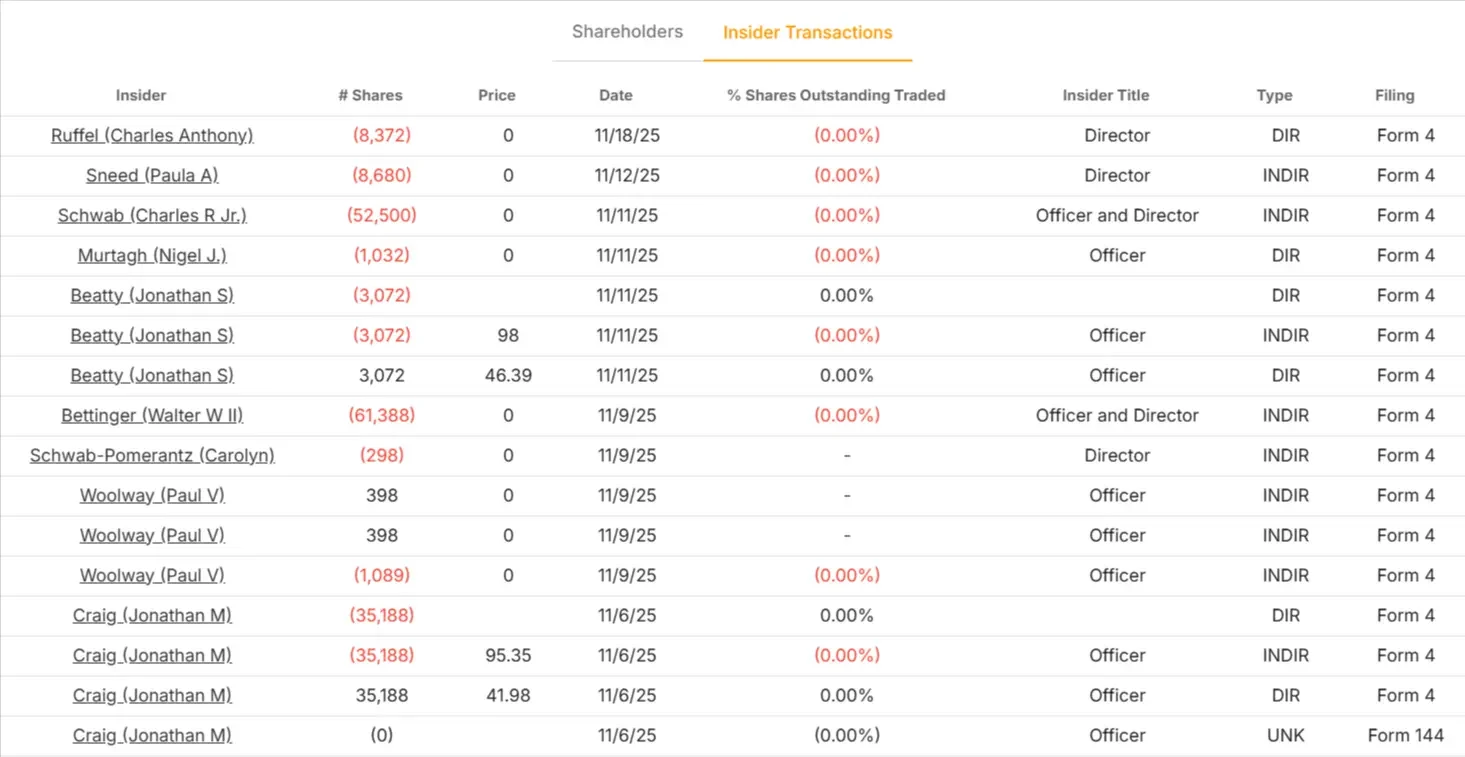
Insider filings show several modest sales and a few purchases at lower prices. While motivations are not confirmed, the transactions appear small relative to Schwab’s scale and do not materially shift ownership.
- Ruffel (Charles Anthony): Sold 8,372 shares at $0 on 11/18/25.
- Sneed (Paula A): Sold 8,680 shares at $0 on 11/12/25.
- Schwab (Charles R Jr.): Sold 52,500 shares at $0 on 11/11/25.
- Murtagh (Nigel J): Sold 1,032 shares at $0 on 11/11/25.
- Beatty (Jonathan S): Net activity of selling 3,072 shares at $98 and buying 3,072 shares at $46.39 on 11/11/25.
- Bettinger (Walter W II): Sold 61,388 shares at $0 on 11/9/25.
- Schwab Pomerantz (Carolyn): Sold 298 shares at $0 on 11/9/25.
- Woolway (Paul V): Net activity of selling 1,089 shares at $0 and buying 398 shares at $0 on 11/9/25.
- Craig (Jonathan M): Net activity of selling 35,188 shares at $95.35 and buying 35,188 shares at $41.98 on 11/6/25.
Overall insider activity appears modest and does not point to a clear internal sentiment shift, for investors suggesting leadership remains steady in its positioning.
See recent insider trade data for over 50,000 global stocks (It’s free) >>>
What the Ownership & Insider Trade Data Tell Us
Charles Schwab’s ownership profile reflects strong long term support from passive institutions and rising interest from hedge funds that meaningfully increased their positions. Active managers trimmed selectively, indicating differing views on how quickly net interest income and client cash sorting may normalize. Insider activity looks limited and directionally muted, which appears consistent with a leadership team navigating a transitional rate environment rather than signaling a major internal shift.
For investors this combination suggests that Schwab is still widely viewed as a durable financial services platform with steady client asset inflows and significant operating leverage as conditions stabilize. The growing hedge fund participation highlights renewed confidence in earnings recovery, while passive institutions anchoring the shareholder base reinforces Schwab’s positioning as a long term compounder with scale advantages, diversified revenue streams, and the potential for improved profitability once interest income and cash sweep dynamics settle into a more predictable range.
Value Any Stock in Under 60 Seconds (It’s Free)
With TIKR’s new Valuation Model tool, you can estimate a stock’s potential share price in under a minute.
All it takes is three simple inputs:
- Revenue Growth
- Operating Margins
- Exit P/E Multiple
From there, TIKR calculates the potential share price and total returns under Bull, Base, and Bear scenarios so you can quickly see whether a stock looks undervalued or overvalued.
If you’re not sure what to enter, TIKR automatically fills in each input using analysts’ consensus estimates, giving you a quick, reliable starting point.
See a stock’s true value in under 60 seconds (Free with TIKR) >>>