Key Takeaways
- NVIDIA’s total commitments rose to $518 billion from $366 billion a quarter earlier, mostly memory it has agreed to buy.
- UBS warns NVIDIA may have to keep funding its customers to sell that supply, just as it cuts back the backstops it gives AI clouds.
- Memory makers SK hynix and Micron face demand that’s only as solid as NVIDIA’s sales.
- NVIDIA’s bill for cloud capacity nearly doubled to $102 billion in one quarter, and that’s the number to watch.
NVIDIA (NVDA) has a commitment problem:
It has now agreed to spend $518 billion on supply, cloud capacity and more in the years ahead. That’s up from $366 billion just a quarter earlier, according to the CFO commentary it filed with its third-quarter results.
On paper, that’s terrific news for the memory makers on the other end of those deals, SK hynix (SKHY) and Micron (MU).
UBS sees it differently. In a note shared on X, the firm wrote: “we think there is a very real risk that NVDA becomes beholden to these purchase commitments and has to keep throwing money at its customers to drive revenue.”
Which, yikes.
Those customers include AI clouds like CoreWeave (CRWV), which counts NVIDIA as both a shareholder and a buyer of its capacity.
Most of the bill comes due next year
Two lines did most of the growing. Supply and capacity rose to $390 billion from $279 billion, and cloud services and data center leases nearly doubled to $102 billion from $54 billion. By the count of Ed Zitron, host of the Better Offline podcast, $203 billion of the supply commitments fall due in fiscal 2028, which starts in February 2027. At the end of July, NVIDIA’s 10-Q put that year’s supply commitments at $87 billion.
TIKR tracks 63 analysts on Nvidia. How many say “Buy”?
See the full breakdown of Buy, Hold, and Sell ratings on Nvidia, along with Wall Street’s revenue and earnings estimates, all in one place. More than 500,000 investors use TIKR to research stocks like this one. See Nvidia’s Analyst Ratings
NVIDIA still can’t make enough
Of course, NVIDIA says demand still outstrips supply, and it just raised its fiscal 2028 growth outlook to about 75% from 70%. Analysts expect revenue to keep climbing steeply for years, to about $726 billion in fiscal 2028:
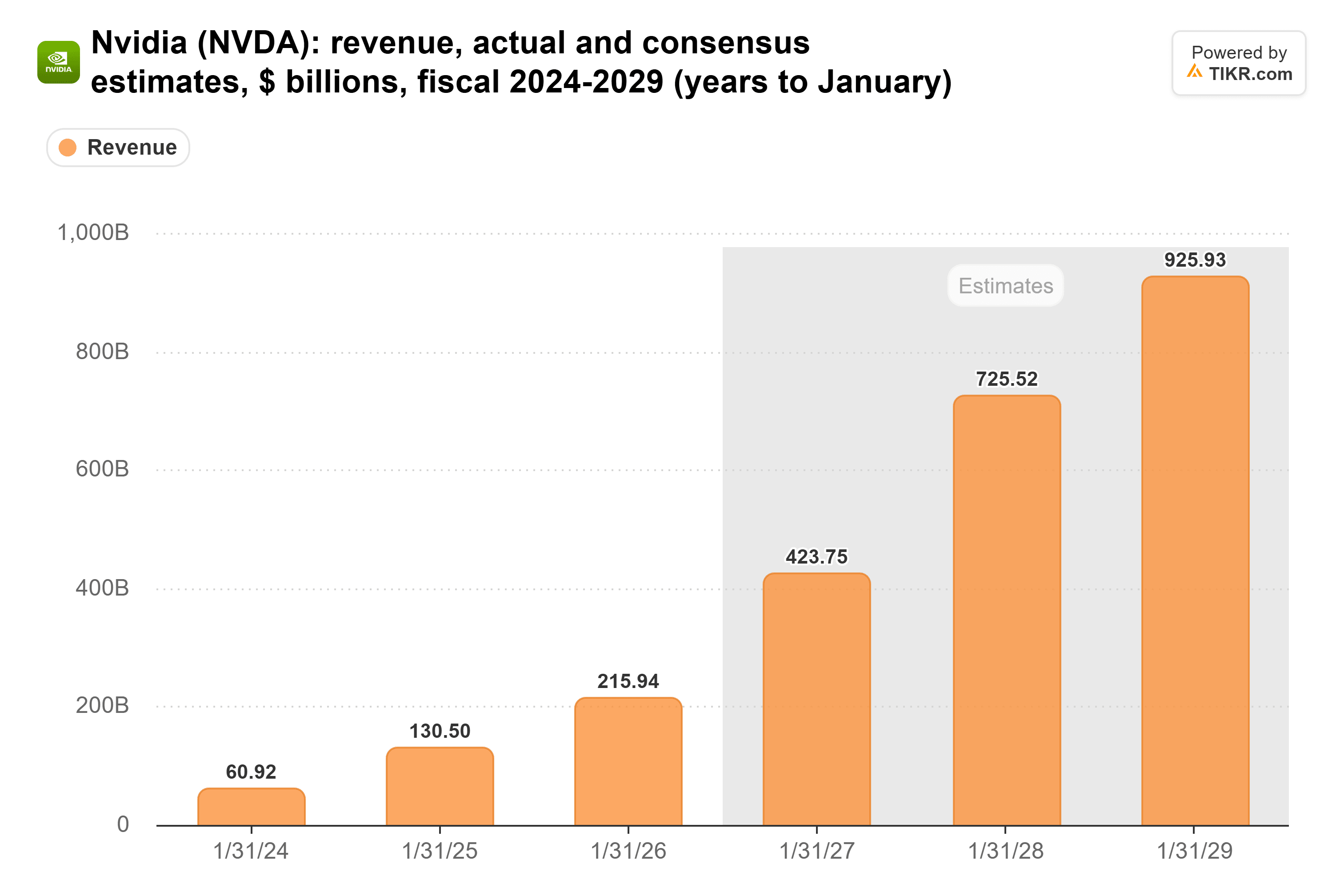
If those estimates hold, NVIDIA sells every system that memory goes into, and the commitments just lock in supply during a shortage.
But UBS has already cut its own revenue forecast for NVIDIA’s next fiscal year by 10%, worried that data centers won’t be built and powered in time. And a chip that can’t be installed doesn’t get reordered.
Less help, more supply
At the same time, NVIDIA is tightening the help it offers buyers. Its conditional agreements with AI clouds fell to $32 billion from $36 billion. If demand softens, NVIDIA would have to either loosen those terms again or sit on memory it agreed to buy. The $102 billion it now owes for cloud capacity alone is more than its free cash flow in the fiscal year that ended in January:
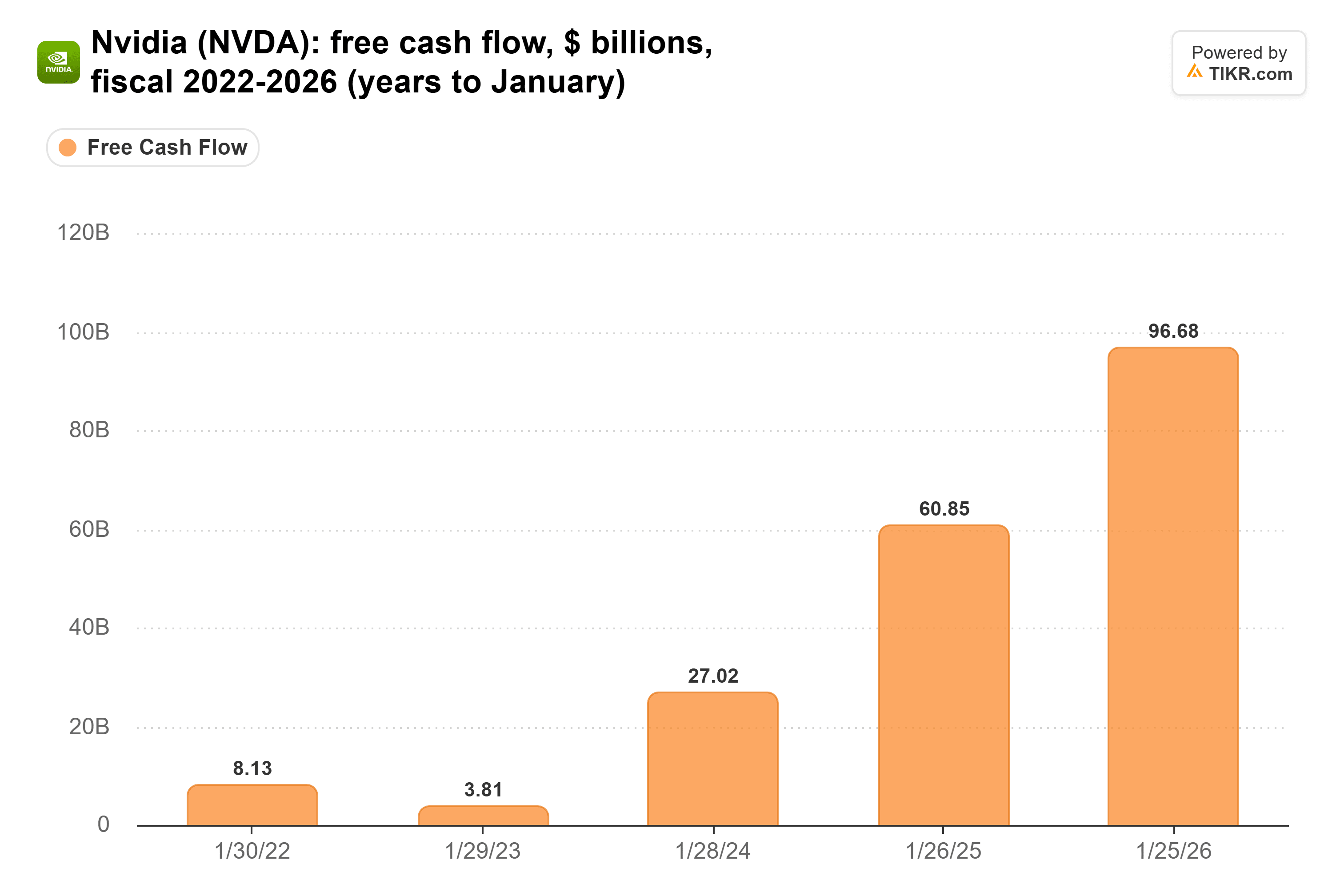
That cash is what UBS fears NVIDIA will have to keep spending on its customers. If it does, gross margin is where the cost would show up first:
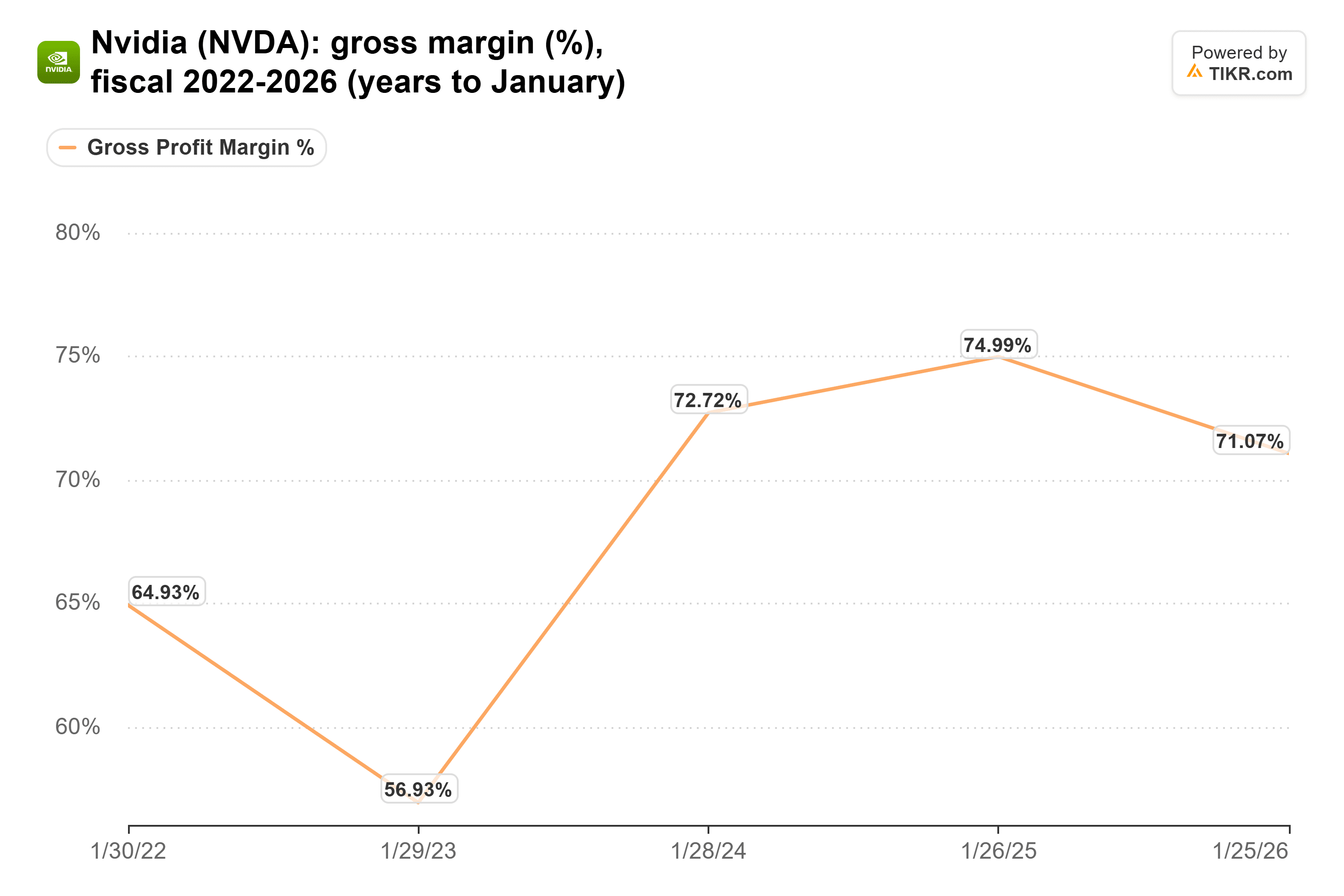
(The last time NVIDIA’s demand cooled, in fiscal 2023, gross margin fell to 56.9% and revenue was flat at $27.0 billion.)
The other side of the deal
SK hynix said in April that customers’ demand for its high-bandwidth memory over the next three years far exceeds its capacity. But it also says it has no order backlog under its long-term contracts, and most of its prices reset monthly or quarterly. So both memory makers face the question UBS raises.
Further down the chain, CoreWeave’s $846 million of third-quarter net interest expense was about 4x its $207 million operating income. If NVIDIA keeps tightening its backstops, AI clouds like CoreWeave have to find that support somewhere else.
Watch the cloud bill
The way I see it, UBS is right to call this a real risk, even if it isn’t today’s problem. But NVIDIA added nearly $50 billion to its cloud capacity bill in a single quarter, so it’s already paying to keep compute moving.
NVIDIA’s next report should come in late February. If that line climbs again from $102 billion while the conditional AI cloud deals keep shrinking, NVIDIA is paying for more of its own demand. If it levels off and revenue keeps beating guidance, buying all that memory was smart planning in a shortage.
So what is NVIDIA stock actually worth?
TIKR lets you forecast the future price of any stock in less than a minute. Just enter a few assumptions into TIKR’s valuation model and see what NVIDIA could be worth. Start from Wall Street consensus estimates, or adjust the inputs to reflect your own view of the business. It’s free to use.
Disclaimer:
Please note that the articles on TIKR are not intended to serve as investment or financial advice from TIKR or our content team, nor are they recommendations to buy or sell any stocks. We create our content based on TIKR Terminal’s investment data and analysts’ estimates. Our analysis might not include recent company news or important updates. TIKR has no position in any of the stocks mentioned. Thank you for reading, and happy investing!