Key Takeaways
- Uber and Nuro have started testing driverless Lucid Gravity robotaxis in the Bay Area, ahead of a commercial launch now planned for the first quarter of 2027.
- Uber also has robotaxi deals with Rivian and others, but its order for at least 35,000 Lucid vehicles is bigger than everything Lucid delivered in 2025 and the first nine months of 2026 combined.
- Lucid still sells its cars for less than they cost to build, and most of Uber’s order waits on Midsize robotaxis targeted for late 2028.
- The order adds volume long before it adds profit. Lucid’s Midsize dates, due in the first quarter of 2027, are the next test.
Uber (UBER) and Nuro said on Nov. 24 that they’ve started testing driverless Lucid (LCID) Gravity SUVs on public roads in the San Francisco Bay Area. They plan to open a commercial robotaxi service in the first quarter of 2027, later than the 2026 launch the companies were still targeting in April.
That’s a much bigger deal for Lucid than for Uber, which has robotaxi partners across the industry, including Rivian (RIVN) and Waymo.
Nobody behind the wheel
California’s DMV cleared Nuro to test the Gravity without a safety driver this spring, and the cars now run with no one behind the wheel in Palo Alto, Mountain View, Los Altos and Sunnyvale. Driverless rides for Uber employees come next. Lucid began building pre-production robotaxis at its Arizona factory in October.
TIKR tracks 50 analysts on Uber. How many say “Buy”?
See the full breakdown of Buy, Hold, and Sell ratings on Uber, along with Wall Street’s revenue and earnings estimates, all in one place. More than 500,000 investors use TIKR to research stocks like this one. See Uber’s Analyst Ratings
Uber’s order is bigger than Lucid’s own sales
In April, Uber raised its commitment to at least 35,000 Lucid vehicles from 20,000. It also raised its investment in Lucid to $500 million from $300 million. Lucid delivered 15,841 vehicles in all of 2025 and 10,852 in the first nine months of 2026. Even if Lucid matched its quarterly record of 5,345 deliveries again in the fourth quarter of 2026, the two years together would come to about 32,000 cars, still short of Uber’s order. Uber’s purchases are spread over six years and come with volume, quality and regulatory conditions, but next to Lucid’s current sales, the order is large.
Lucid has plenty of room for that volume. Its Arizona plant can build 90,000 cars a year, and it built 2,954 in the third quarter. Analysts expect Lucid’s revenue to more than quadruple by 2028, from $1.35 billion in 2025:
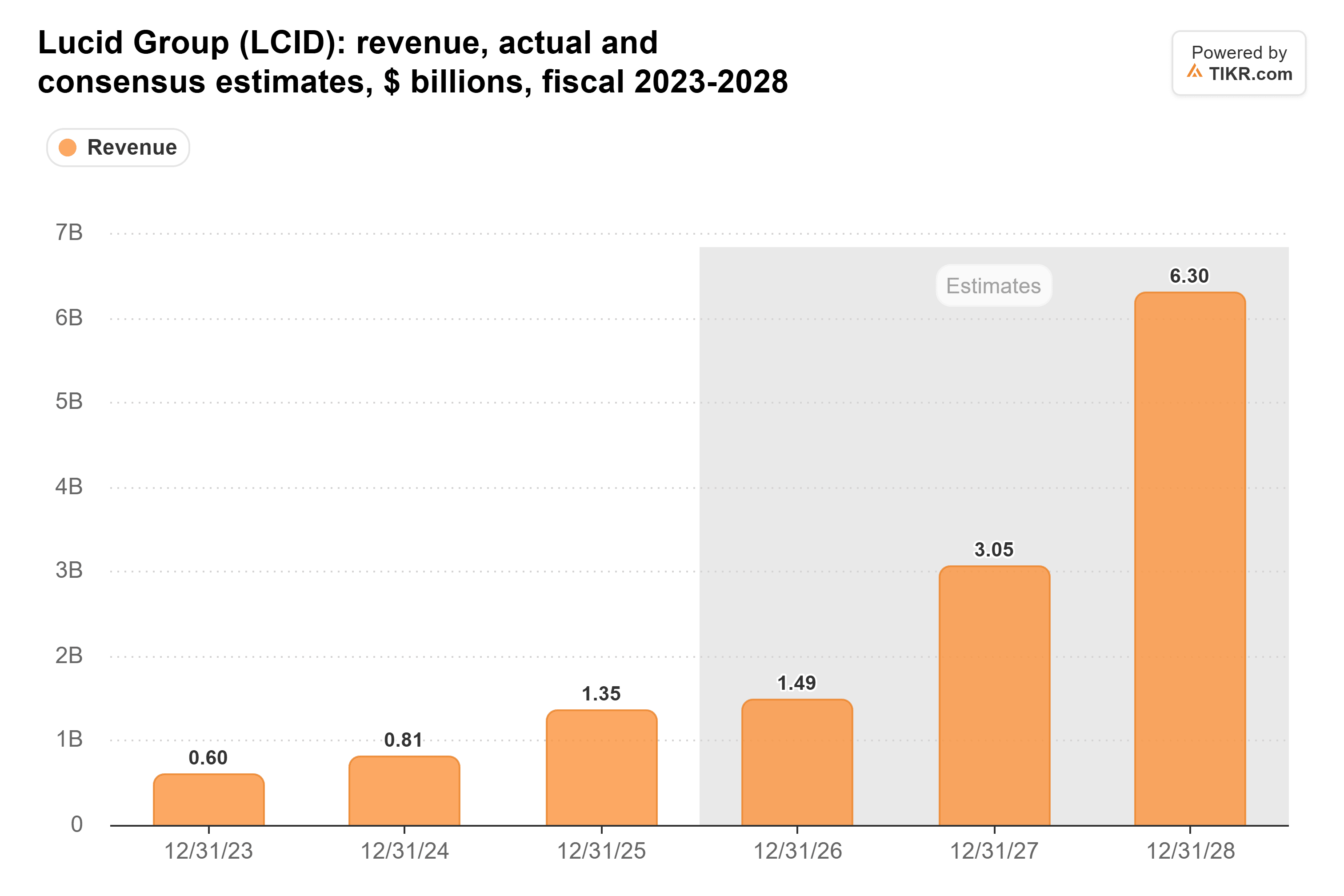
Most of that growth rests on the cheaper Midsize platform, and the driverless tests don’t change when Midsize arrives. They do make Uber’s part of those estimates easier to believe.
Rivian’s own Uber deal from March covers 10,000 R2 robotaxis starting in 2028, but Rivian delivered 19,248 vehicles in the third quarter of 2026 alone, more than Lucid delivered in all of 2025. Its software and services arm, mostly fed by its Volkswagen joint venture, earned $256 million of gross profit in that quarter, more than covering an $80 million gross loss on Rivian’s cars. Rivian has a second business to lean on while it waits for robotaxis, and Lucid has nothing like it yet.
Volume first, profit later
Lucid sells these robotaxis outright. Management said in February that the Uber partnership brings no ongoing fleet maintenance or software licensing revenue. At least 25,000 of Uber’s 35,000 vehicles are Midsize robotaxis, and their production is targeted for late 2028. Gross margin was -92.8% in 2025, up from -114.3% in 2024:

The third quarter of 2026 was better, at -73.7%.
Lucid has also used up between $2.9 billion and $3.8 billion of free cash flow every year from 2022 to 2025:

Uber’s $500 million, its total investment in Lucid to date, equals about 13% of the $3.80 billion Lucid burned in 2025 alone. On Nov. 9, Saudi Arabia’s Public Investment Fund expanded its loan facility by $1.75 billion, and Lucid says its $3.75 billion of pro forma liquidity lasts into the fourth quarter of 2027. As debt, that loan ranks ahead of common shareholders.
Good for the factory, and shareholders have to wait
Driverless testing makes Uber’s order more real, and Lucid badly needs the volume to fill a plant running far below its capacity. But with most of that volume waiting on a platform it hasn’t built yet, the order helps the factory long before it helps the bottom line. Lucid plans to announce Midsize’s reveal and production dates in the first quarter of 2027, around when the Bay Area service is due to open. If those dates keep consumer Midsize production in the second half of 2027, the Midsize robotaxis, the biggest piece of Uber’s order, keep a path to their late-2028 target. Another slip would push them further out.
So what is Lucid stock actually worth?
TIKR lets you forecast the future price of any stock in less than a minute. Just enter a few assumptions into TIKR’s valuation model and see what Lucid could be worth. Start from Wall Street consensus estimates, or adjust the inputs to reflect your own view of the business. It’s free to use.
Disclaimer:
Please note that the articles on TIKR are not intended to serve as investment or financial advice from TIKR or our content team, nor are they recommendations to buy or sell any stocks. We create our content based on TIKR Terminal’s investment data and analysts’ estimates. Our analysis might not include recent company news or important updates. TIKR has no position in any of the stocks mentioned. Thank you for reading, and happy investing!