Key Takeaways
- AMD and Broadcom fell Monday after Commerce required licenses for advanced AI chips shipped to five countries or to data centers serving Chinese firms.
- The rule covers advanced US AI chips whoever designs them, so swapping Nvidia for AMD or Broadcom didn’t escape it.
- AMD has the more direct exposure: its Instinct GPUs face the same licenses as Nvidia’s, and analysts expect sales to climb 84% in 2027.
- Broadcom’s main AI customers are US companies, which the country licenses exempt, so its drop looks more like a sympathy sale.
Advanced Micro Devices (AMD) fell 5.6% and Broadcom (AVGO) 3.9% on Monday, after Washington moved to cut off Chinese access to US AI chips through data centers abroad.
That stings, since both rallied last week as Nvidia alternatives after Jensen Huang resigned as CEO. Nvidia (NVDA) fell 4.1% too, since the rule doesn’t care who designed the chip.
Washington Shuts the Back Door
The Bureau of Industry and Security’s interim final rule requires licenses for advanced AI chips shipped to Indonesia, Malaysia, Singapore, Thailand and Brazil, which it says “present a higher-than-normal risk of diversion.” Those licenses don’t apply to buyers headquartered in the US, or whose parent company is, if exporters file monthly reports. The rule also requires licenses for chips going to data centers anywhere that give Chinese companies significant computing power, and that part has no such exemption.
Semafor’s Reed Albergotti called it. “I think there’s absolutely going to be very, very strict export controls. And not just export controls, but blocking of even access to data centers from inside China,” he said on Sunday’s episode of the MTS podcast.
AMD’s Exposure Is Real
AMD’s Instinct GPUs are exactly what the rule covers. A 2025 China cutoff already cost AMD about $800 million in MI308 inventory charges, later partly reversed. China and Hong Kong made up 22.4% of its 2025 revenue ($7.8 billion) by billing location, though that includes PCs and other chips the rule doesn’t touch.
Consensus has revenue rising from $34.6 billion in 2025 to $52.2 billion this year and $95.9 billion in 2027:
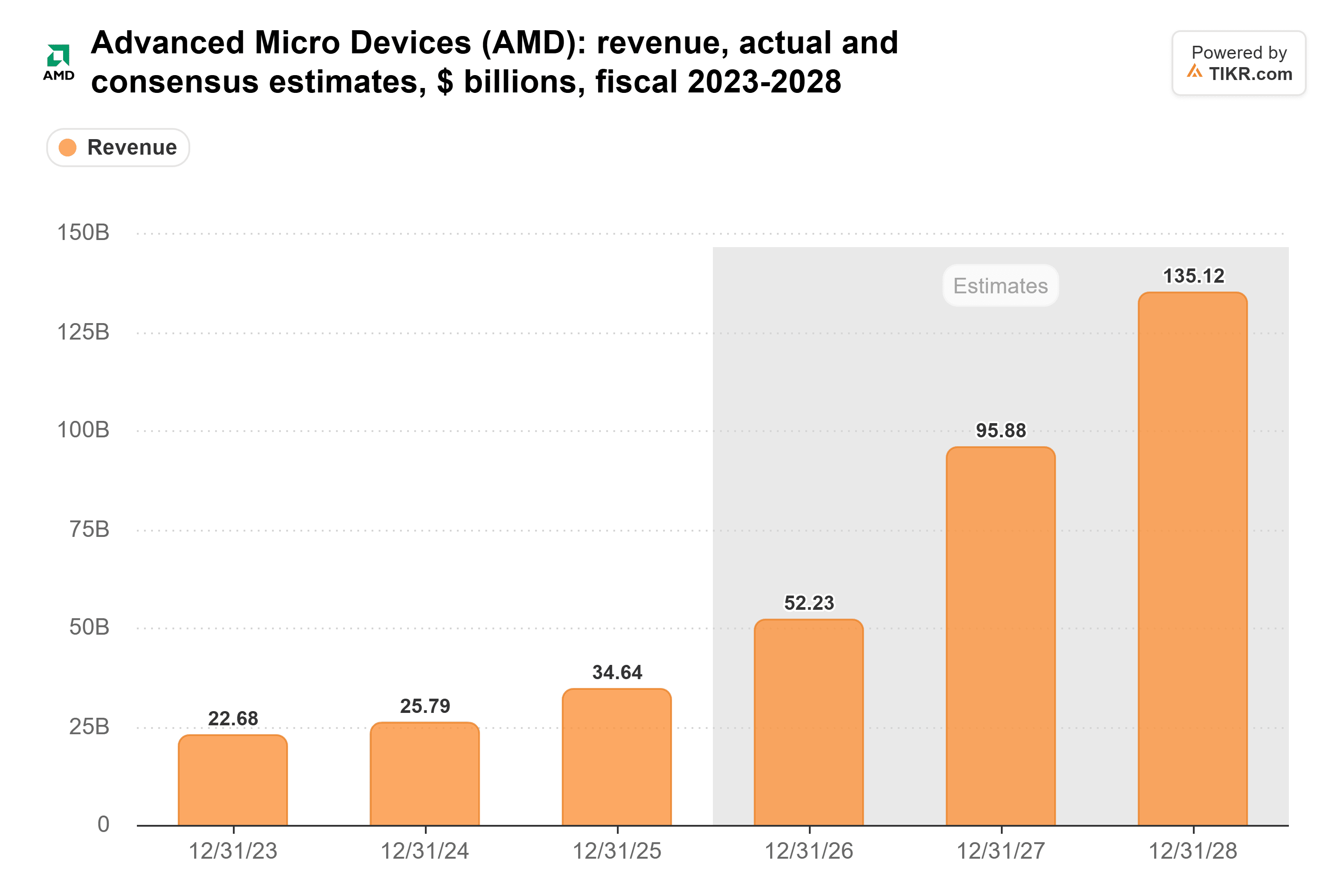
The exemption covers US-headquartered buyers, so I wouldn’t expect estimates to fall much, but with that growth priced in, AMD can’t afford to lose any market.
AMD’s forward P/E jumped to 36x on Nov. 13 from 27x on Nov. 5:
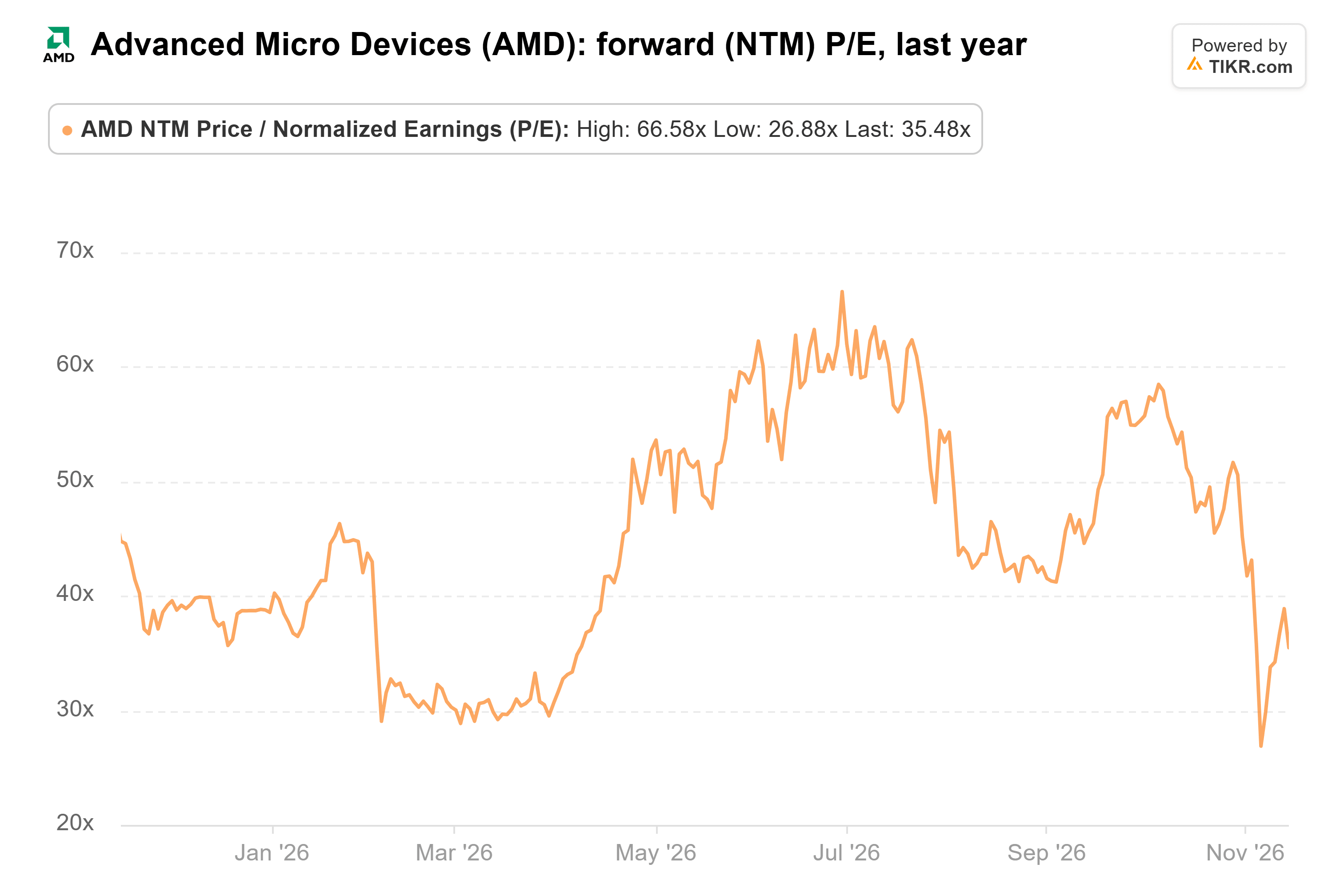
That’s still below its 45x one-year average, but the re-rating rested on AMD being a way around Nvidia, and Monday’s rule hits its chips the same way.
TIKR Tracks 54 Analysts on AMD. How Many Say “Buy”?
See the full breakdown of Buy, Hold, and Sell ratings on AMD, along with Wall Street’s revenue and earnings estimates, all in one place. More than 500,000 investors use TIKR to research stocks like this one. See AMD’s Analyst Ratings
Broadcom Looks Worse on Paper Than It Is
Broadcom’s fiscal 2025 annual report shows $11.2 billion of revenue, or 17%, shipped to China and Hong Kong, and $10.8 billion to Singapore. But those track shipments to distributors and contract manufacturers, and Broadcom says much of what goes to China ends up in devices sold in the US and Europe. Its custom AI chips go to Google, Meta, OpenAI and Anthropic, all US companies.
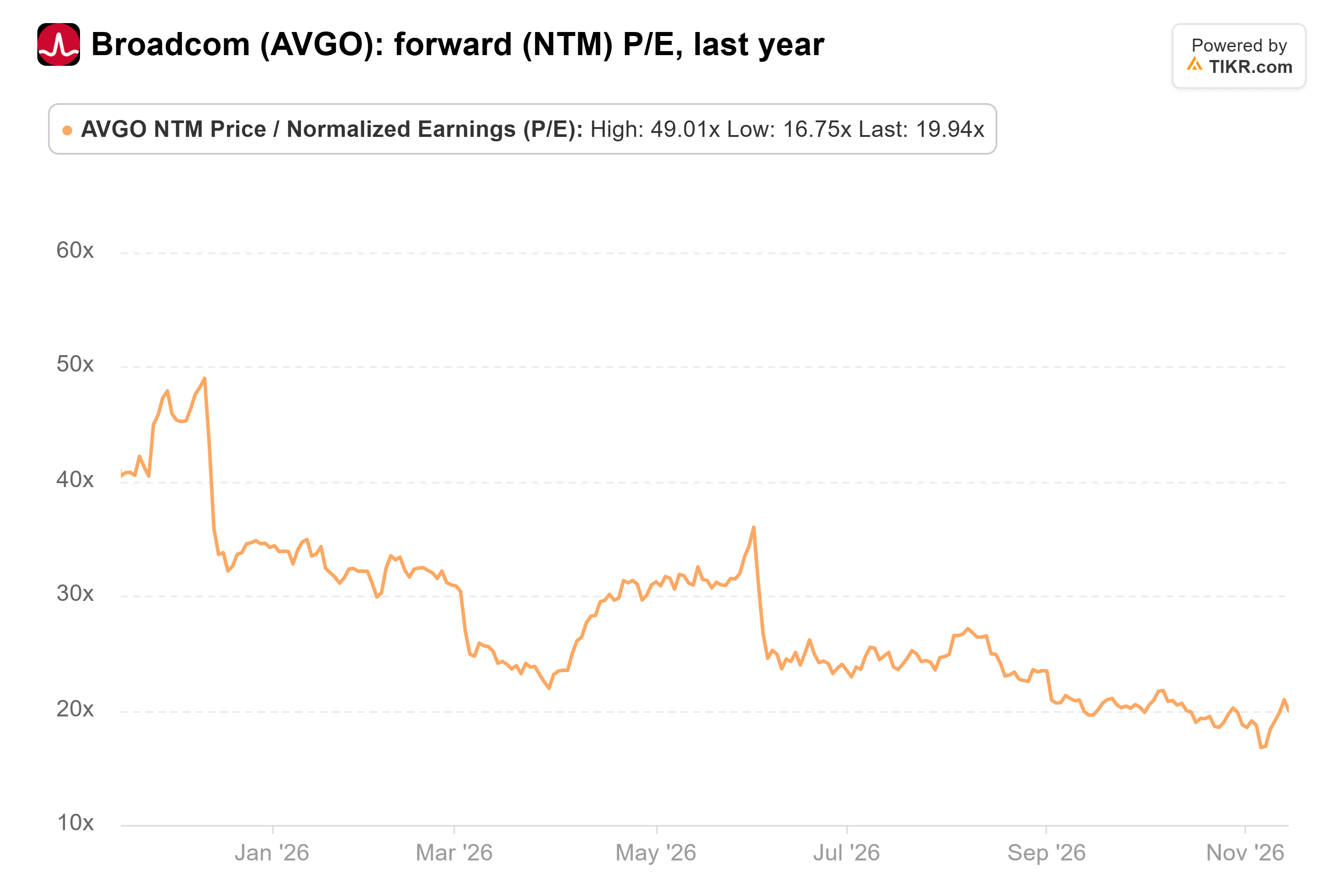
Its forward P/E rose from a low base: 17x on Nov. 5 to 20x on Nov. 13, against a 28x one-year average.
Why I’d Pick Broadcom Over AMD Stock
AMD’s drop is the one I’d take seriously: its GPUs face the same licenses Nvidia’s do, and the stock was re-rated sharply in a week. Broadcom’s big customers fall inside the country exemption, if not the data center rule, and at 20x it never priced in much of the Nvidia-alternative story. If I had to buy one today, it’d be Broadcom.
This is an interim rule, so the final version could end up tighter or looser. Nvidia reports on Nov. 17, and Broadcom on Dec. 9.
So What Is AMD Stock Actually Worth?
TIKR lets you forecast the future price of any stock in less than a minute. Just enter a few assumptions into TIKR’s valuation model and see what AMD could be worth. Start from Wall Street consensus estimates, or adjust the inputs to reflect your own view of the business. It’s free to use.
Disclaimer:
Please note that the articles on TIKR are not intended to serve as investment or financial advice from TIKR or our content team, nor are they recommendations to buy or sell any stocks. We create our content based on TIKR Terminal’s investment data and analysts’ estimates. Our analysis might not include recent company news or important updates. TIKR has no position in any of the stocks mentioned. Thank you for reading, and happy investing!