Key Takeaways
- Sequoia’s Shaun Maguire and 20VC’s Harry Stebbings have named Palo Alto Networks CEO Nikesh Arora as their pick to replace Jensen Huang at Nvidia, which is searching for a new CEO.
- The louder the case for Arora gets, the more key-man risk Palo Alto carries, because its premium valuation depends on a deal-driven plan he is still carrying out.
- Palo Alto trades at 77x forward earnings, against a five-year average of 57x, and analysts expect its EPS growth to speed up in fiscal 2028 as the deals pay off.
- Arora hasn’t said publicly that he wants the job, and Palo Alto’s Nov. 18 report is the next look at whether his plan is on track.
Nvidia (NVDA) is looking for a new CEO, and a few of tech’s loudest voices think the best candidate already runs Palo Alto Networks (PANW).
Jensen Huang resigned as Nvidia’s CEO on Nov. 12, effective immediately. CFO Colette Kress is serving as interim CEO while the board searches for a permanent one, and Nvidia says it will consider candidates from inside and outside the company. Treasury Secretary Scott Bessent wants the board to “go outside the company,” as he told Fox News’ “Sunday Morning Futures” on Nov. 15.
Sequoia’s Shaun Maguire has his pick: Palo Alto CEO Nikesh Arora. In a post on X, Maguire wrote that Huang was so important to AI because he was technical, aggressive and had “the credibility required to be aggressive.” He says Arora has all three “while being a world class deal maker.”
Harry Stebbings, founder of venture firm 20VC, went further: “Hands down, Nikesh would be the single best replacement for Jensen.”
That’s high praise. It’s also a problem for anyone who owns Palo Alto.
TIKR tracks 61 analysts on Nvidia. How many say “Buy”?
See the full breakdown of Buy, Hold, and Sell ratings on Nvidia, along with Wall Street’s revenue and earnings estimates, all in one place. More than 500,000 investors use TIKR to research stocks like this one. See Nvidia’s Analyst Ratings
Palo Alto is priced for Arora’s plan
Arora spent fiscal 2026 (the year to July) remaking Palo Alto. The company made more than $24 billion of acquisitions, mostly CyberArk and Chronosphere, and paid for CyberArk largely in stock: 112 million new shares worth $18.5 billion. In June, management said it expects CyberArk to be as profitable as the rest of Palo Alto within 12 to 18 months. It also expects stock pay to fall back toward pre-deal levels as a share of revenue on about the same timeline. Analysts expect earnings growth to speed up as that happens:
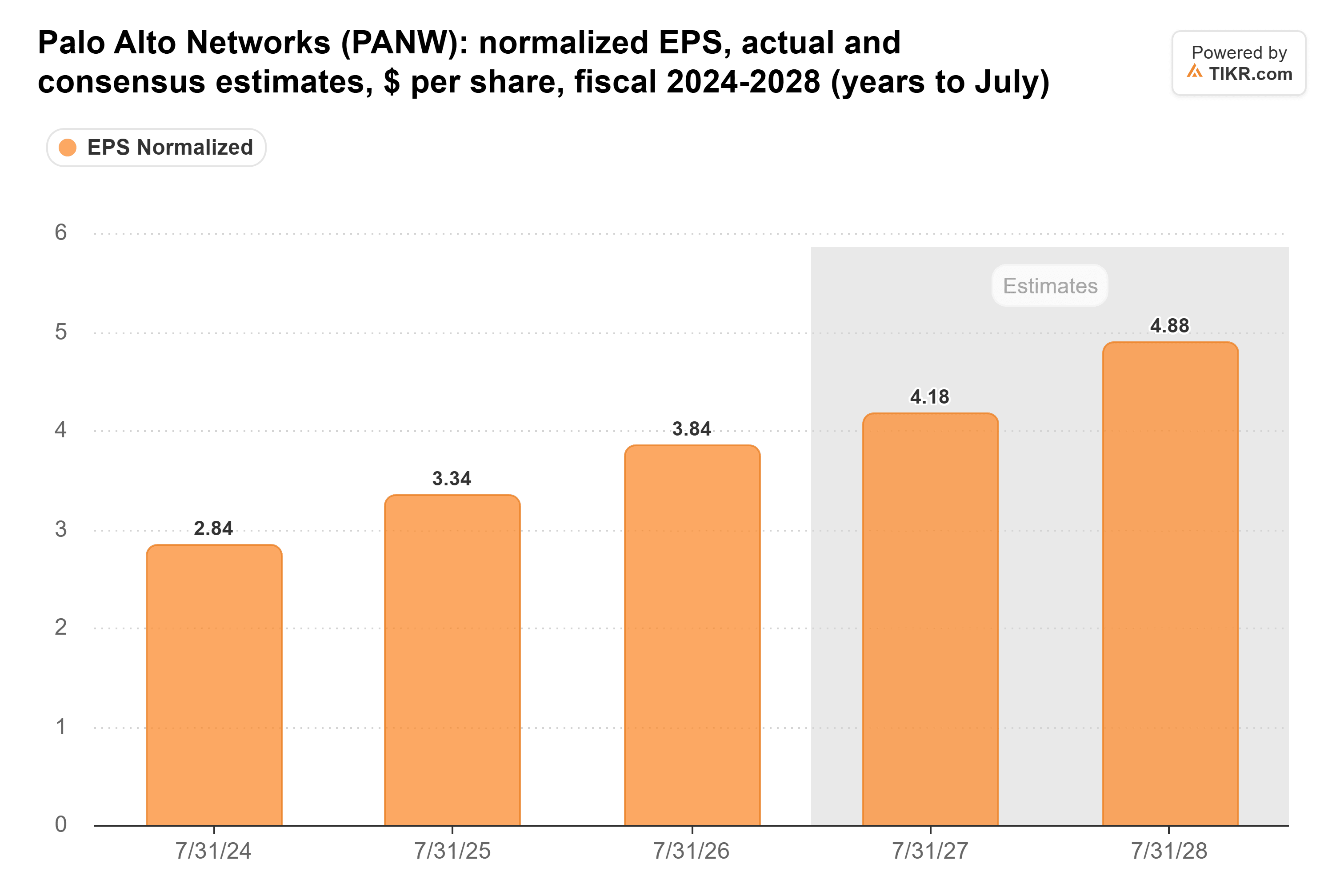
Normalized EPS rises about 9% to $4.18 in fiscal 2027, in line with management’s own guidance of $4.16 to $4.19 in non-GAAP EPS, then about 17% to $4.88 in fiscal 2028. That second-year jump assumes the deals start paying off on Arora’s schedule.
Investors are paying up for that path. Palo Alto trades at 77x forward earnings, against a five-year average of 57x:
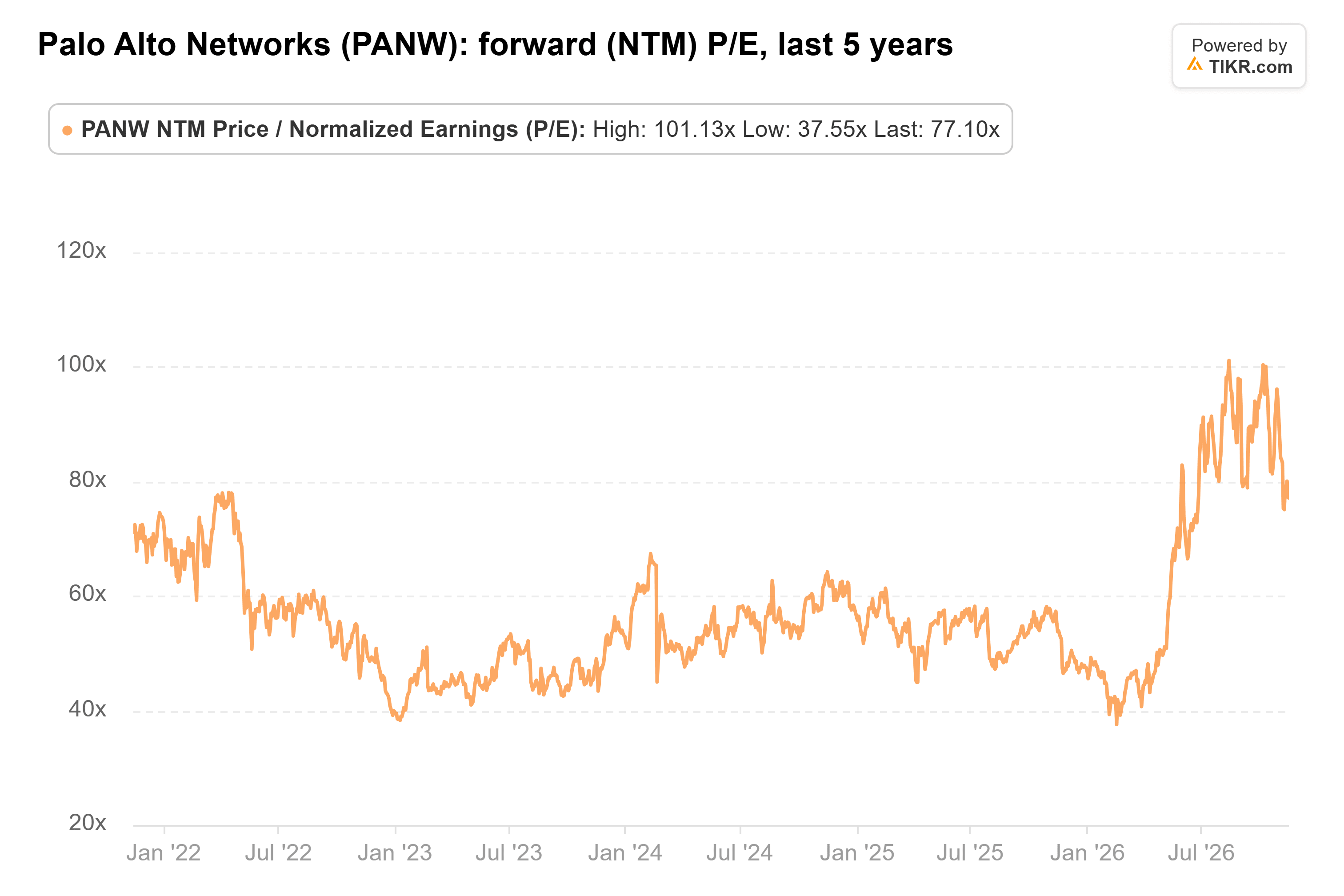
If the multiple fell back to that average with earnings unchanged, the shares would be worth roughly a quarter less. Much of that premium likely reflects investors’ trust in the person running the plan.
The better his record, the bigger the risk
Maguire also points to Arora’s eight years at Palo Alto. Free cash flow shows what that stretch looked like. It went from $930 million in fiscal 2018, the year Arora took over, to $4.11 billion in fiscal 2026:
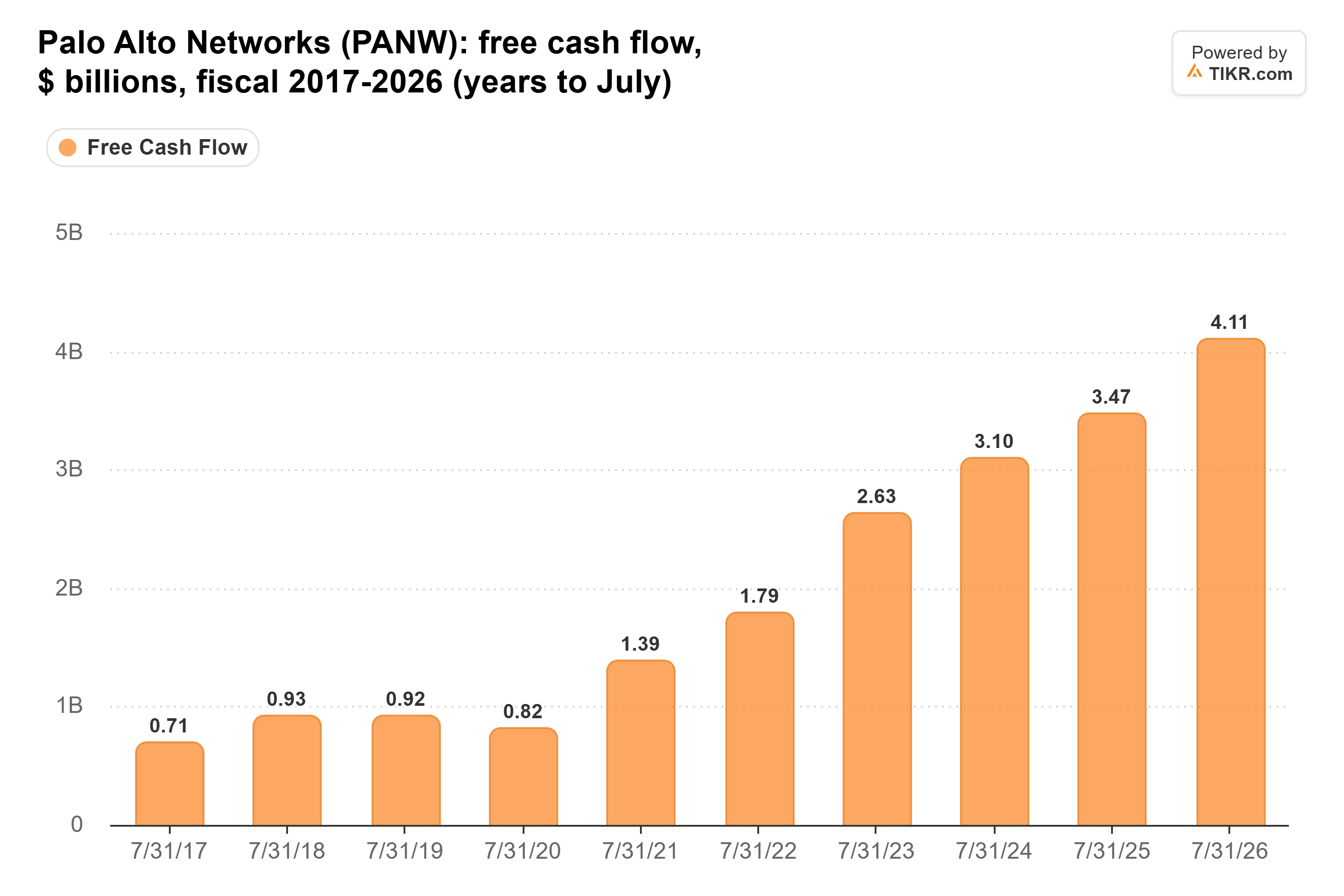
That record is why Arora is on these lists, and also why he’d be so hard to replace. The “world class deal maker” Maguire wants at Nvidia is the person Palo Alto needs to finish its own deals. Shares outstanding rose 22% from July 2025 to 818 million as of Aug. 31, mostly from the stock paid for CyberArk. On the Sept. 1 earnings call, management said its CyberArk synergy targets remain three to six months ahead of plan, which means the integration is still underway.
Shareholders accepted that dilution because they were promised the deals would pay off. Losing the CEO who made that promise before it’s kept would hurt. Of course, Arora hasn’t said publicly that he wants the Nvidia job, and venture capitalists’ wish lists rarely turn into CEO appointments. He also bought $10 million of Palo Alto stock in March, which is hardly what someone looking for the exit does.
Nov. 18 is the next test
At 77x, Palo Alto already asks a lot of investors, and the Nvidia talk adds a risk that multiple doesn’t price in. Nvidia’s board may never call. But as long as people like Maguire and Stebbings keep pushing Arora for the job, investors have to allow for some chance that Palo Alto loses its CEO partway through the deals. Palo Alto reports its fiscal first quarter after the close on Nov. 18. Management has guided for $3.30 billion to $3.31 billion of revenue and $0.96 to $0.98 of non-GAAP EPS. If Arora sounds fully committed on that call and the deals look on track, the premium is easier to justify. Nvidia’s board could also name someone else first, and then the question goes away.
So what is Palo Alto Networks stock actually worth?
TIKR lets you forecast the future price of any stock in less than a minute. Just enter a few assumptions into TIKR’s valuation model and see what Palo Alto Networks could be worth. Start from Wall Street consensus estimates, or adjust the inputs to reflect your own view of the business. It’s free to use.
Value Palo Alto Networks for free
Disclaimer:
Please note that the articles on TIKR are not intended to serve as investment or financial advice from TIKR or our content team, nor are they recommendations to buy or sell any stocks. We create our content based on TIKR Terminal’s investment data and analysts’ estimates. Our analysis might not include recent company news or important updates. TIKR has no position in any of the stocks mentioned. Thank you for reading, and happy investing!