


Key Stats for TSLA Stock
- Past week’s performance: Consolidating
- 52-week range: $297 to $499
- Valuation model target price: $483
- Implied upside: 43.5% over 2.4 years
Value your favorite stocks like TSLA with 5 years of analysts’ forecasts using TIKR (It’s free) >>>
Record Deliveries, Shrinking Profits
Tesla (TSLA) posted one of its busiest quarters in years, but the market reaction has been anything but simple. Revenue climbed 26% to $28.2 billion, and deliveries hit a record 480,126 vehicles. Yet net profit fell 57%, and free cash flow turned negative for the first time in over a year. Investors are trying to decide whether this is a temporary cost spike or a longer transition.
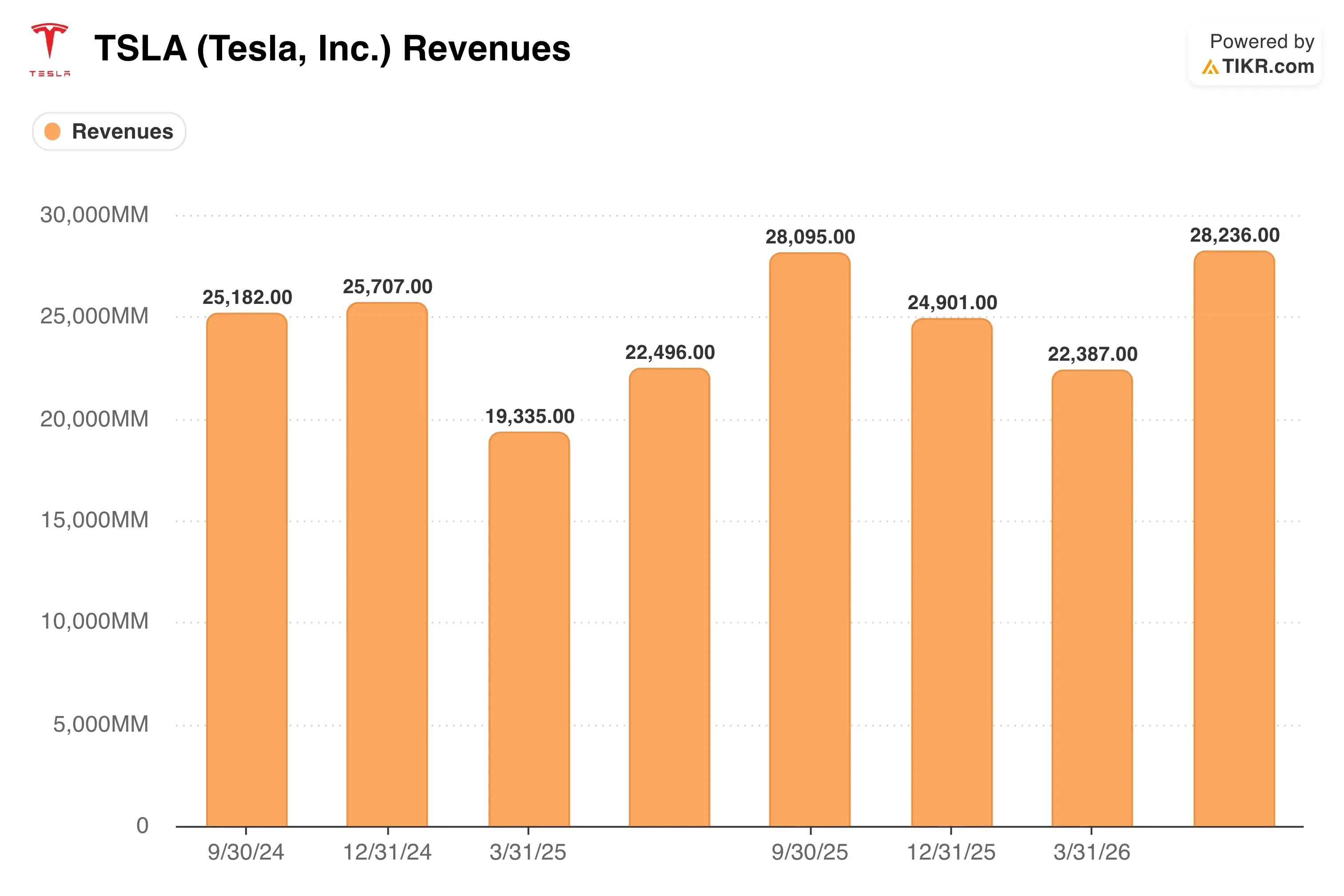
The gap between growth and profit comes down to timing. Tesla is spending heavily on Cybercab, its purpose-built robotaxi without a steering wheel, and on Optimus, its humanoid robot project. Neither generates meaningful revenue yet, so the costs land on the income statement before the payoff shows up. Management has said capital expenditures will exceed $25 billion this year, and CFO Vaibhav Taneja has told investors that spending will keep climbing for the next two to three years.
Elon Musk has been candid about the difficulty of scaling Optimus. On the earnings call, he said, “This is going to be the hardest product to scale manufacturing we’ve ever made,” because there is no existing supply chain for a humanoid robot built from scratch. That admission matters because it frames the next year as an execution test, not a demand problem.
Commercial signs are still encouraging. Einride, a Swedish logistics company, agreed to deploy 500 Tesla Semi trucks over the next 24 months to serve Amazon and other customers, the largest publicly disclosed Semi order yet. Tesla’s energy storage business is also expanding quickly through Megapack deployments, giving the company a growing, higher-margin revenue stream that does not depend on vehicle cycles.
If Tesla stock is going to re-rate higher, the next two quarters need to show that Cybercab volume and energy growth can offset the capex drag.
See analysts’ growth forecasts and price targets for TSLA (It’s free) >>>
Is TSLA Stock Undervalued?

Under valuation model assumptions realized through 12/31/28, the stock is modeled using:
- Revenue Growth (CAGR): 14.3%
- Operating Margins: 7.2%
- Exit P/E Multiple: 127.8x
Based on these inputs, the model estimates a target price of $483, implying 43.5% upside from the current share price and a 16.4% annualized return over the next 2.4 years.
Tesla’s valuation has always demanded a leap of faith, and that has not changed. A 127.8x exit multiple only makes sense if Cybercab and Optimus eventually become real businesses instead of cost centers. Right now the numbers do not support that yet. LTM operating margin sits at just 4.1%, well below where Tesla traded a few years ago, because the AI and robotics buildout is being funded largely out of current profits.
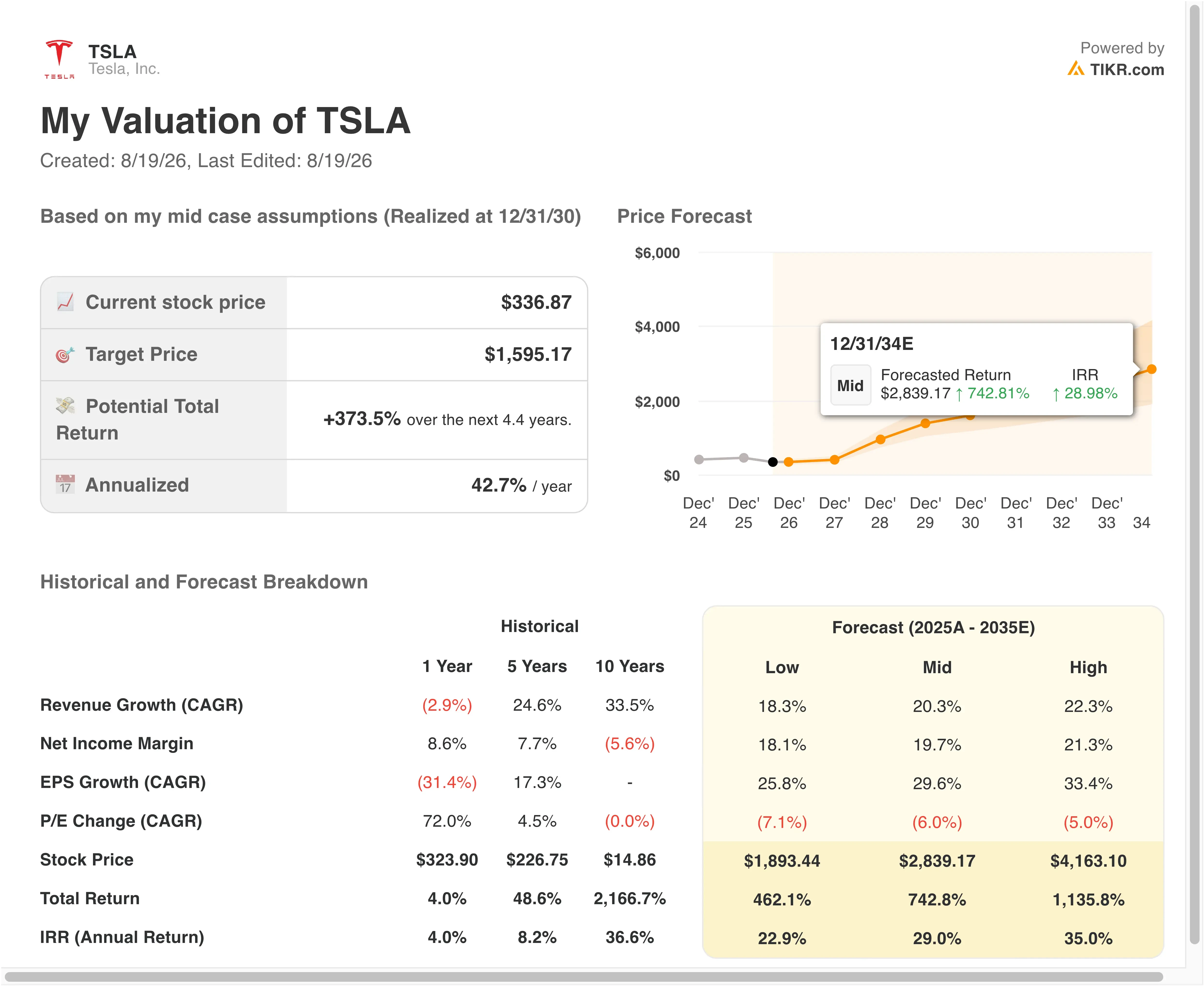
Still, the growth assumptions are not unreasonable given Tesla’s history. A 14.3% revenue CAGR is actually below Tesla’s 10-year average, so the model is not pricing in a miracle. What it is pricing in is patience. Investors who believe Cybercab can scale the way Model 3 once did will see today’s price as a discount. Those who doubt the robotaxi timeline will see a stock priced for perfection regardless.
The next real test comes from volume, not announcements. Once unsupervised Cybercab rides start generating fares instead of headlines, the market will have real data to judge the bet against.
Tesla Versus the Field: Who Else Is Racing to Robotaxi Profits
Tesla is not alone in burning cash to build the next generation of autonomous and electric vehicles, but its competitors are choosing very different paths. Rivian (RIVN), the electric truck and SUV maker, grew Q2 revenue 27% year over year to $1.66 billion, but posted an operating loss of $836 million, an operating margin near negative 50%. That is a steeper near-term loss than Tesla is running, though Rivian’s business is far smaller and still ramping its mass-market R2 model.

General Motors (GM) offers the opposite comparison. GM grew Q2 revenue just 1.9% year over year, but its adjusted operating margin held at 8.2%, actually higher than Tesla’s 4.1% LTM EBIT margin. GM is still absorbing billions in EV-related charges, yet its profitable truck and SUV lineup gives it a cushion Tesla does not have. That contrast captures Tesla’s core challenge. It has the growth story and the AI ambition, but its margins currently trail a traditional automaker that is barely growing at all.
Tesla’s edge remains its vertical integration, and its head start in full self-driving software, with active FSD subscriptions up 56% to 1.48 million. Whether that technology lead translates into the fattest margins in the industry is the multi-year question the stock is now pricing.
What’s Driving TSLA Stock Going Forward?
The most immediate catalyst is the Cybercab rollout itself. Tesla is preparing to launch the vehicle in Austin as early as late August, starting with rides for employees before expanding to the public Robotaxi service. Any delay or safety incident would likely weigh on sentiment quickly, since Musk has said publicly that a single injury could trigger major regulatory pushback.
Energy storage is a quieter but steadier catalyst. Megapack demand keeps growing alongside global grid investment, and unlike Cybercab, this business already generates real revenue and is improving margins. If energy becomes a larger share of the mix, it could smooth out some of the volatility tied to vehicle deliveries.
Capital spending intensity will remain the swing factor for at least two more years. Management has guided to capex above $25 billion in 2026, and Taneja has said that figure will keep rising as Cybercab, Optimus, and energy projects all scale simultaneously. Investors should expect free cash flow to stay pressured until at least one of these newer businesses reaches meaningful scale.
Beyond the core roadmap, speculation around a potential Roadster unveiling and a Tesla-SpaceX relationship remains mostly noise for now. The next real signal comes with Q3 earnings, when investors will look for early Cybercab ride volume and whether margins begin stabilizing as the newest factories ramp.
Track how Tesla’s Cybercab rollout could reshape its valuation (Free with TIKR) >>>
Should You Invest in Tesla?
The only way to really know is to look at the numbers yourself. TIKR gives you free access to the same institutional-quality financial data that professional analysts use to answer exactly that question.
Pull up TSLA, and you’ll see years of historical financials, what Wall Street analysts expect for revenue and earnings in the quarters ahead, how valuation multiples have moved over time, and whether price targets are trending up or down.
You can build a free watchlist to track TSLA alongside every other stock on your radar. No credit card required. Just the data you need to decide for yourself.
Analyze TSLA stock on TIKR Free→
Disclaimer:
Please note that the articles on TIKR are not intended to serve as investment or financial advice from TIKR or our content team, nor are they recommendations to buy or sell any stocks. We create our content based on TIKR Terminal’s investment data and analysts’ estimates. Our analysis might not include recent company news or important updates. TIKR has no position in any stocks mentioned. Thank you for reading, and happy investing!


