Key Takeaways
- Steve Eisman expects AI data center construction to slow 10% to 30%, which he says could return the hyperscalers to positive cash flow by the end of 2027.
- Meta could gain the most, since capex growth has outrun its fast-growing revenue and pushed quarterly free cash flow negative.
- Insuring Meta’s debt costs about twice as much as Microsoft’s, Alphabet’s or Amazon’s, while suppliers like Arista would trade some growth for a longer cycle.
- JPMorgan models $255 billion of Meta capex in 2027, so Meta’s late-January plan is the number to watch.
Meta Platforms (META) spent more on capex last quarter than its operations brought in. Steve Eisman thinks the fix could come from the thing many AI investors fear: a slowdown.
On the Nov. 27 weekly wrap of his podcast, The Real Eisman Playbook, Eisman argued that local politics will slow AI data center construction: “What I think is more likely is that AI data center construction will slow by 10% to 30%.” He admitted it’s a guess.
Then came the twist: “A slowdown could mean that the hyperscalers return to positive cash flow by the end of 2027.”
Alongside Meta, that group includes Microsoft (MSFT), Alphabet (GOOG) and Amazon (AMZN). In Eisman’s telling, the cost falls on suppliers like Arista Networks (ANET), which “would see slower growth, but the cycle would be elongated.”
Meta’s cash crunch comes from spending
Analysts expect Meta’s free cash flow to go from $43.6 billion in 2025 to a burn of $48.8 billion in 2027:
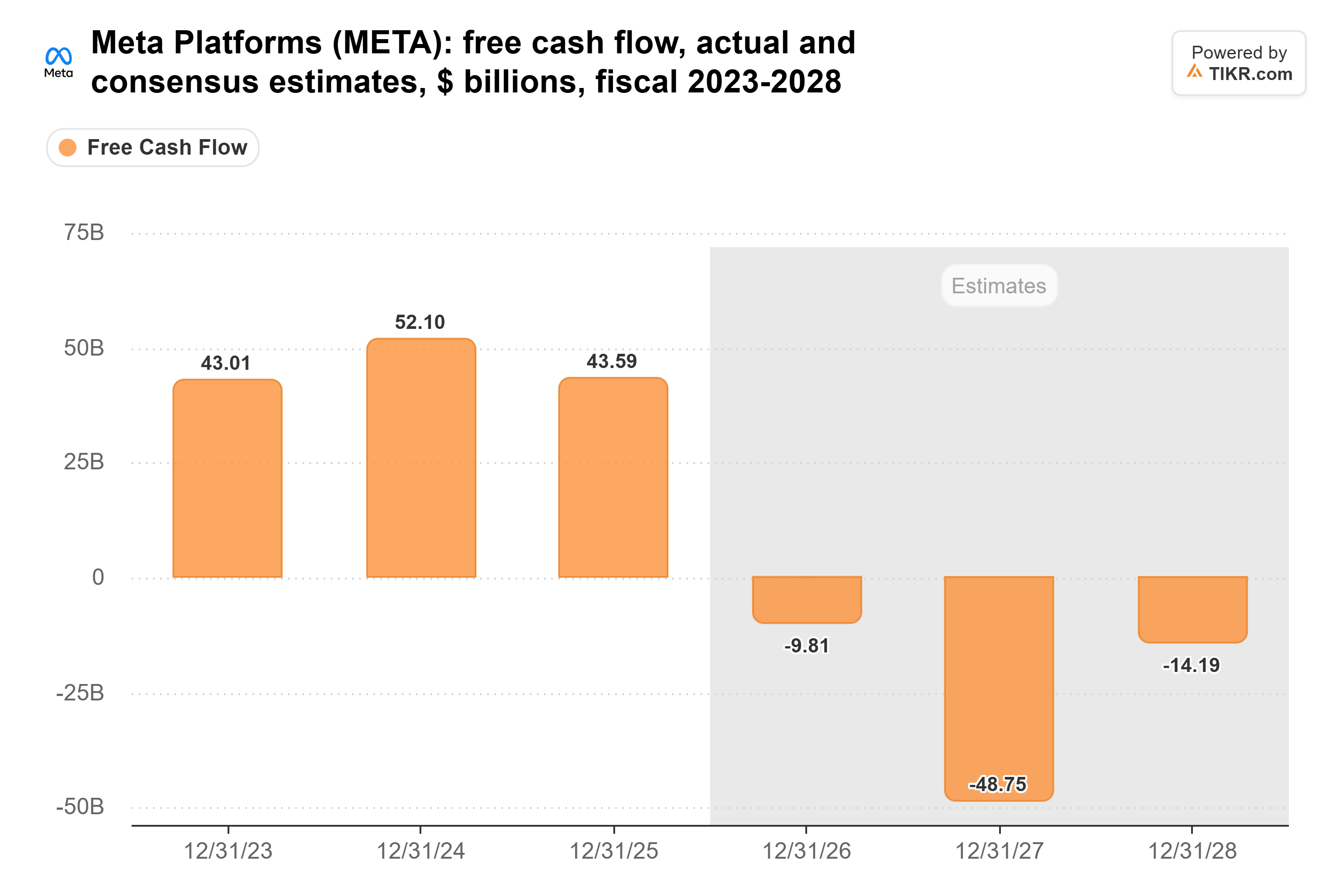
And they still have it negative in 2028.
Meanwhile, the ads business is humming: third-quarter revenue rose 26% to $64.6 billion. Spending is what changed. Meta’s operating cash flow doubled from 2021 to 2025, while capex nearly quadrupled:

By the third quarter of 2026, Meta’s $34.9 billion of capex was more than the $32.8 billion its operations brought in.
TIKR tracks 62 analysts on Meta Platforms. How many say “Buy”?
See the full breakdown of Buy, Hold, and Sell ratings on Meta Platforms, along with Wall Street’s revenue and earnings estimates, all in one place. More than 500,000 investors use TIKR to research stocks like this one. See Meta Platforms’ Analyst Ratings
About a fifth less capex would do it
The analyst consensus puts Meta’s 2027 capex at roughly $210 billion. Wiping out the $48.8 billion burn would take a cut of about 23%, assuming the ad business keeps bringing in the cash analysts expect.
That falls within Eisman’s 10% to 30% range if Meta’s capex falls proportionately with industry construction. And JPMorgan expects a quarter “in late 2027 or early 2028” when the outlook for capital spending will be “basically flat,” as CNBC’s Carl Quintanilla flagged on X.
Meta needs it more than its peers
At Sept. 30, Meta owed $83.7 billion of debt against $82.5 billion of cash and marketable securities. Meanwhile, JPMorgan’s credit default swap data put the cost of insuring its debt at about 160 basis points, roughly twice the 80 for Microsoft, Alphabet and Amazon
Microsoft’s numbers show what it looks like when a company pays for its build out of its own cash:
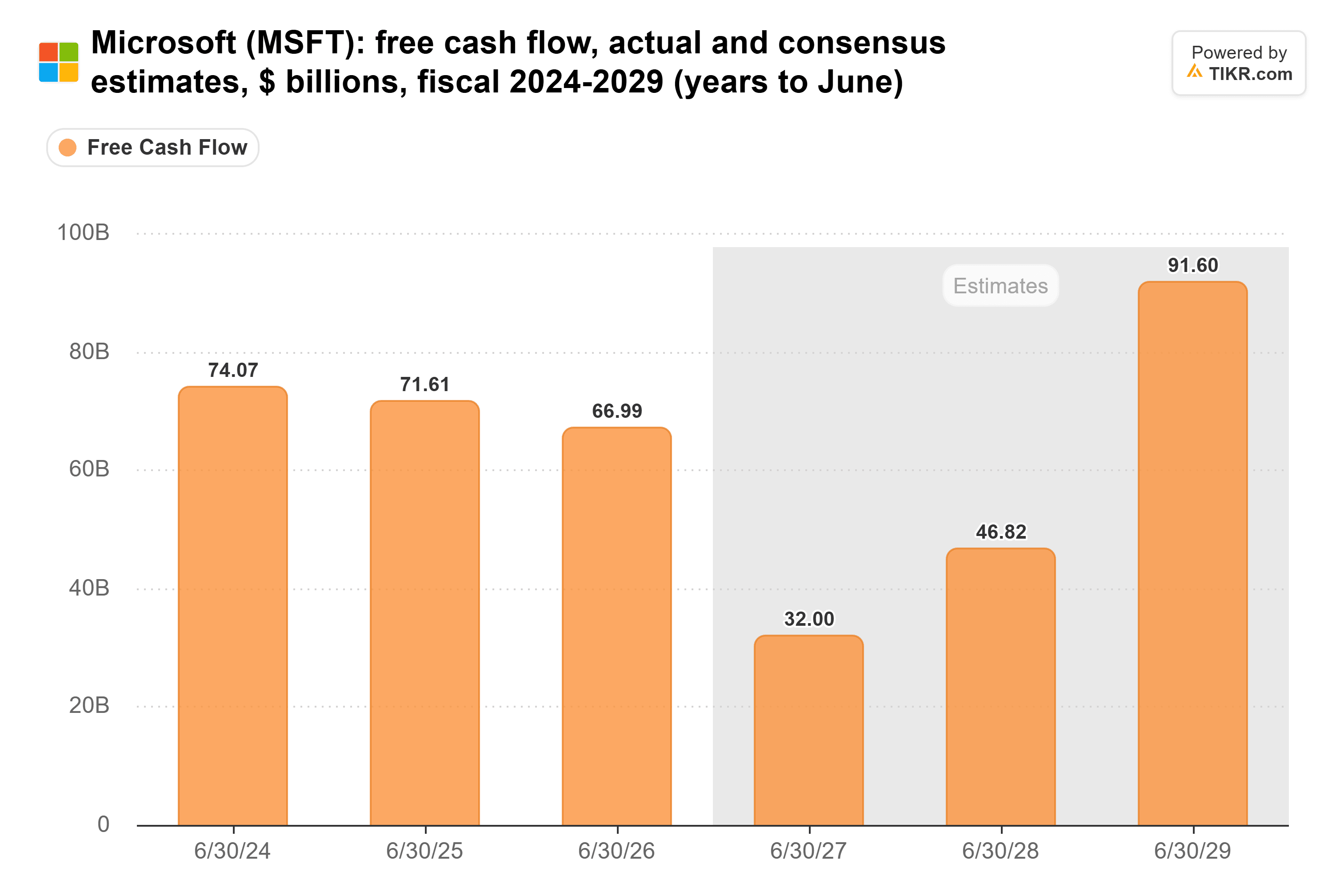
Analysts see its free cash flow bottoming at $32.0 billion in fiscal 2027, then nearly tripling to $91.6 billion by fiscal 2029. For Meta, a slowdown could mean paying for its build itself instead of borrowing more.
As for suppliers, Arista’s third-quarter revenue grew 58.5% to $3.66 billion, and a 10% to 30% construction slowdown could hit that growth rate quickly. Two customers accounted for 42% of Arista’s 2025 revenue. But its deferred revenue rose to $6.8 billion at Sept. 30 from $5.4 billion at the end of 2025, the kind of cushion that stretches a cycle out the way Eisman describes.
Meta isn’t easing up on its own
Of course, Meta shows no sign of slowing down by choice. JPMorgan’s Doug Anmuth now models $255 billion of Meta capex in 2027, up 78% and about $45 billion above the consensus, and cut his price target to $775 from $940.
Still, I read Eisman’s call as good news for Meta shareholders. Heavy capital spending is keeping Meta from generating positive quarterly free cash flow. And if politics forces a slower build, Meta gets the discipline investors have been asking for without having to choose it.
However, slower construction could also delay the returns Meta expects from its AI investments.
The test comes in late January, when Meta is expected to lay out its 2027 capex plan on its fourth-quarter call. A number near the roughly $210 billion consensus would put Eisman’s turn within reach, while one closer to $255 billion could push it into 2028 or later.
So what is Meta stock actually worth?
TIKR lets you forecast the future price of any stock in less than a minute. Just enter a few assumptions into TIKR’s valuation model and see what Meta could be worth. Start from Wall Street consensus estimates, or adjust the inputs to reflect your own view of the business. It’s free to use.
Disclaimer:
Please note that the articles on TIKR are not intended to serve as investment or financial advice from TIKR or our content team, nor are they recommendations to buy or sell any stocks. We create our content based on TIKR Terminal’s investment data and analysts’ estimates. Our analysis might not include recent company news or important updates. TIKR has no position in any of the stocks mentioned. Thank you for reading, and happy investing!