Key Takeaways
- Of 460 big funds that have filed 13Fs for the quarter ended Sept. 30, 10 sold Carvana, including Stanley Druckenmiller’s Duquesne Family Office, and 11 bought, led by Dragoneer.
- The buyers have the stronger case: Carvana sold a record 217,385 cars in the third quarter, up 39%, and its forward P/E has roughly halved since the end of 2025.
- The sellers’ case is profit per car: Carvana’s adjusted EBITDA per car fell from a year earlier for a fourth straight quarter, and CarMax also cut its own per-car profit to keep sales growing.
- At about 31x forward earnings, roughly twice Penske Automotive’s 15x, Carvana needs profit per car to stop falling, and its fourth-quarter report in February is the next test.
Big funds split almost evenly on Carvana (CVNA) last quarter.
Of the 460 big funds that have filed 13Fs for the quarter ended Sept. 30 (most on Nov. 16), 11 bought Carvana by opening a position or adding 20% or more. Ten sold out or cut their stake by 20% or more, and 32 held it at the quarter’s end. The counts include funds readers know and funds with $1 billion or more of US stocks in their 13Fs, leaving out quant and index funds.
Druckenmiller’s exit was a small one
Stanley Druckenmiller’s Duquesne Family Office, whose 13F holds $4.15 billion of US stocks, sold all 151,000 of its Carvana shares by Sept. 30. The quarter before, that stake was worth $10 million, or just 0.2% of its 13F stocks.
The bigger sales came from elsewhere. Lone Pine Capital, a $22 billion hedge fund, cut its stake 51% to 5.13 million shares, selling $337 million of stock at quarter-end prices. Whale Rock Capital, a $13 billion hedge fund, sold all 4.27 million of its shares, worth $281 million, after Carvana made up 2% of its 13F stocks the quarter before.
Lone Pine still held $321 million of Carvana at Sept. 30. That was 2% of its 13F stocks and more than either of the two biggest new buyers held.
TIKR tracks 24 analysts on Carvana. How many say “Buy”?
See the full breakdown of Buy, Hold, and Sell ratings on Carvana, along with Wall Street’s revenue and earnings estimates, all in one place. More than 500,000 investors use TIKR to research stocks like this one. See Carvana’s Analyst Ratings
Dragoneer and Atreides jumped in
On the other side, Dragoneer Investment Group, a firm that manages $37 billion, opened a position of 3.02 million shares worth $189 million. That’s 3.1% of its 13F stocks and its eighth-largest holding. Atreides Management, an $11 billion fund, opened a position of 2.48 million shares worth $155 million.
Divisadero Street Capital, a $5.6 billion fund, added 44% to reach 5.99 million shares worth $374 million. At 6.7% of its 13F stocks, that’s its third-largest holding. Lee Ainslie’s Maverick Capital added 22% to its stake, and Larry Robbins’ Glenview Capital opened a small position worth $638,000.
Carvana is up 2% since Sept. 30, so neither side has much to show for it yet.
Record cars, thinner profit per car
The sellers’ case starts with profit per car. Carvana sold a record 217,385 cars in the third quarter, up 39%, and adjusted EBITDA hit a record $800 million, up from $637 million a year earlier. But adjusted EBITDA per car fell to about $3,680 from $4,085. Other gross profit per car, which comes mostly from selling the loans Carvana makes, fell $307. Carvana put that drop mainly down to the lower loan rates it gave buyers.
Its biggest rival is making the same trade. CarMax (KMX) grew retail used-car sales 13.8% to 227,391 in its quarter ended Aug. 31. It also cut gross profit per car by $111 to $2,105, through pricing moves meant to support sales. So CarMax is still growing, and Carvana is growing nearly three times as fast. Carvana now sells within about 10,000 cars a quarter of CarMax.
At 31x, the squeeze looks priced in
Analysts expect Carvana’s earnings to keep climbing after a dip this year:
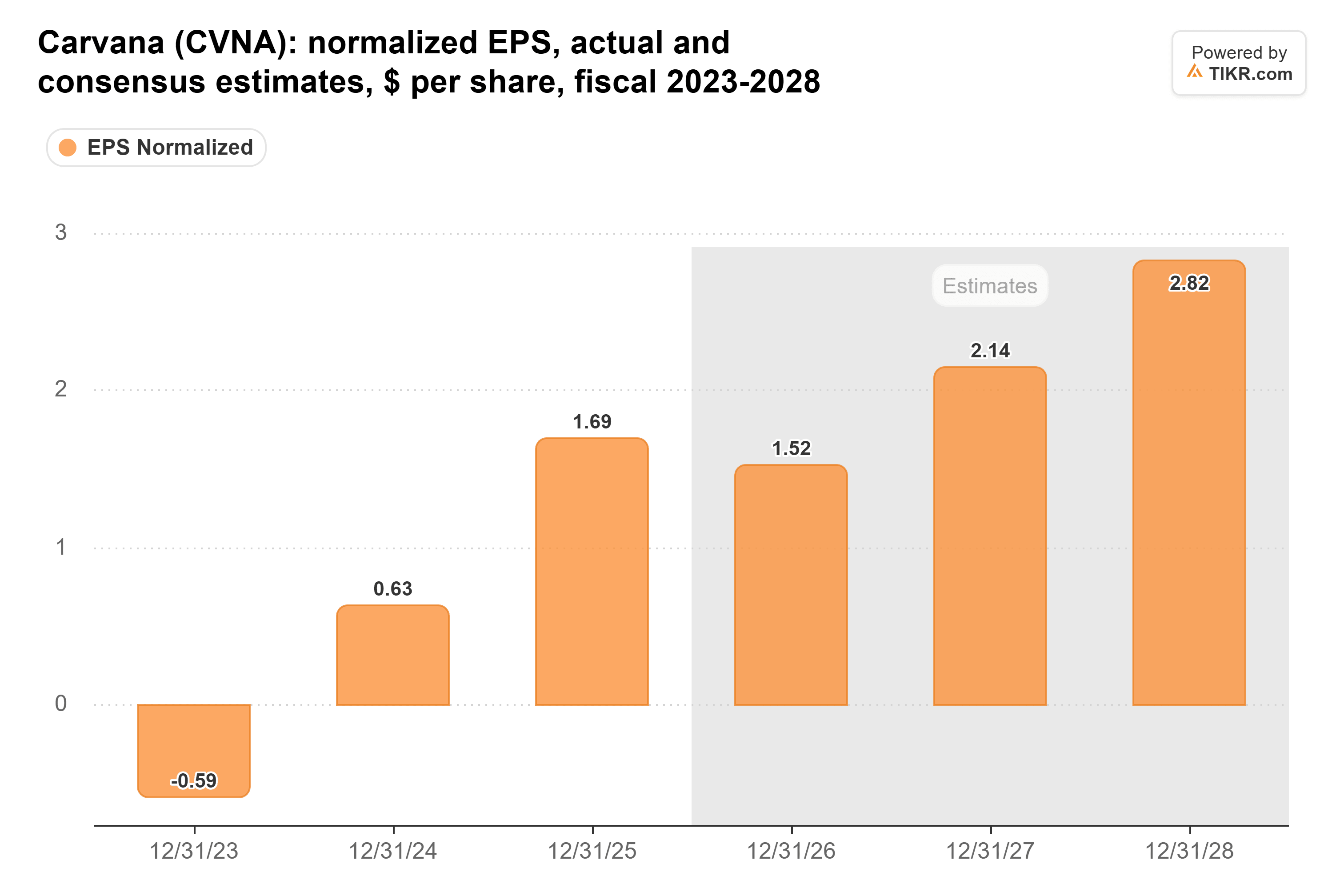
The 2026 dip is mostly about taxes. Carvana’s $1.69 of 2025 EPS included a $2.8 billion income tax benefit, and its pre-tax income rose 49% to $1.0 billion in the first half of 2026. Analysts have trimmed their 2027 estimate to $2.14 from $2.24 the week before the third-quarter report. Even so, that’s still 41% growth over 2026.
Meanwhile, the stock’s multiple has come down hard. Carvana trades at about 31x forward earnings. That’s half the 63x it traded at at the end of 2025, and close to its lowest since its earnings turned positive in late 2024. It’s still about twice the 15x for Penske Automotive (PAG), a traditional dealership group. But Wall Street’s average target for Penske sits right at its price, while Carvana’s sits 29% above it.
The average target for Carvana has barely moved over the past year:
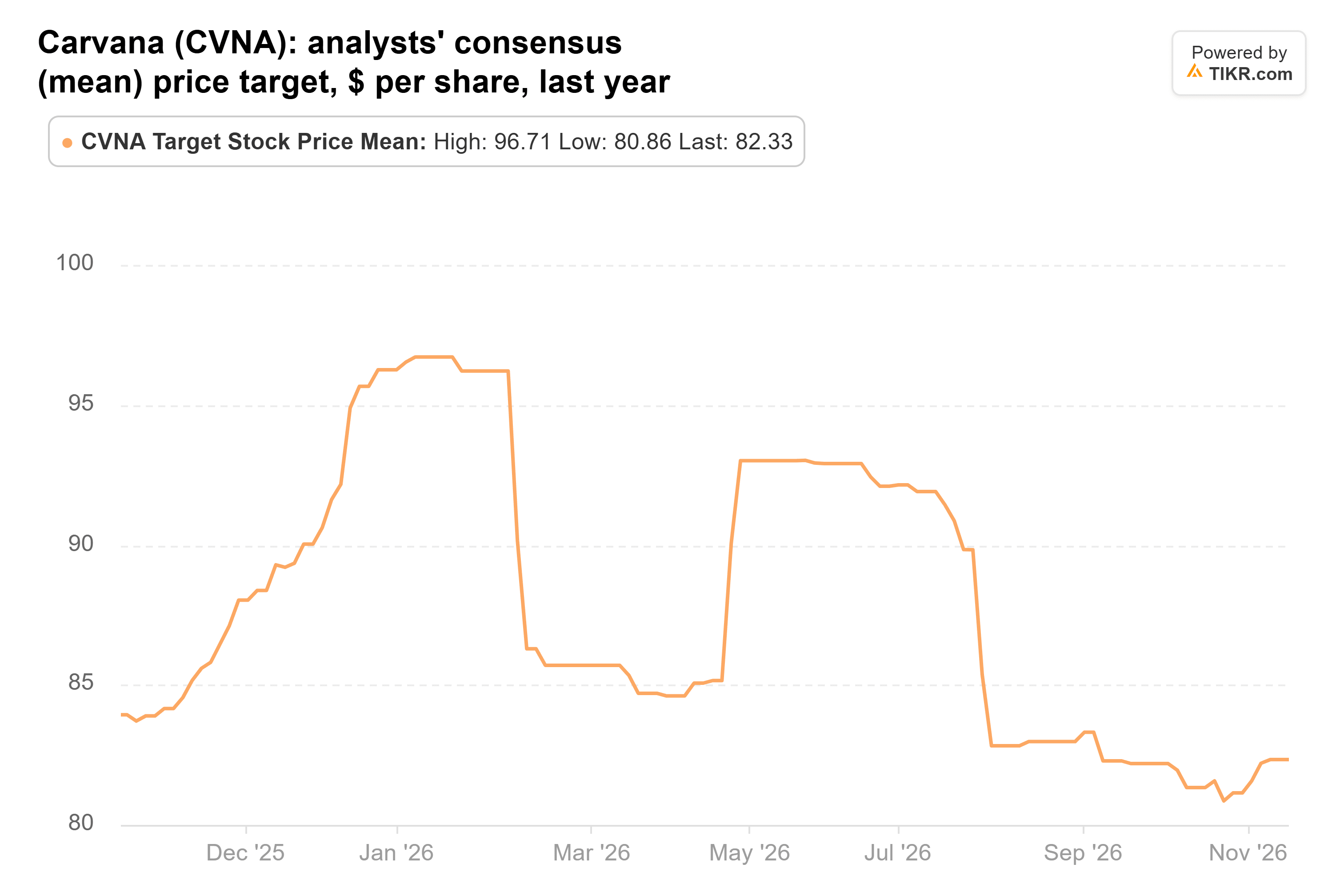
At $82, it’s a touch below the $84 of a year ago. Even the lowest target, $65, sits above Carvana’s last close.
The buyers have the better case
The risk is that profit per car keeps sliding. Carvana will also stop giving an outlook as it switches to GAAP reporting in 2027, so investors will see the trend one quarter at a time.
The way I see it, the buyers have the better of this one. At 31x, Carvana’s price already reflects a per-car squeeze that’s showing up in the reported numbers. Meanwhile, unit growth near 40% is doing the work of pushing earnings higher. If profit per car just stops falling, the 29% upside to analysts’ average target looks reasonable to me.
Carvana reports its fourth quarter in February, around when the funds’ next 13Fs are due. With no guidance to measure against, the bar is last year’s fourth quarter. Adjusted EBITDA per car above about $3,125 would end the streak of declines, as would units above the third quarter’s 217,385, which management expects. Another drop in profit per car would hand the argument to the sellers.
So what is Carvana stock actually worth?
TIKR lets you forecast the future price of any stock in less than a minute. Just enter a few assumptions into TIKR’s valuation model and see what Carvana could be worth. Start from Wall Street consensus estimates, or adjust the inputs to reflect your own view of the business. It’s free to use.
Disclaimer:
Please note that the articles on TIKR are not intended to serve as investment or financial advice from TIKR or our content team, nor are they recommendations to buy or sell any stocks. We create our content based on TIKR Terminal’s investment data and analysts’ estimates. Our analysis might not include recent company news or important updates. TIKR has no position in any of the stocks mentioned. Thank you for reading, and happy investing!