Key Takeaways
- SpaceX says it will pay $3.6 billion to upgrade the grid for its Cochise County, Arizona, supercomputer site, with no gas plant and no industrial water use.
- Paying its own way is now the cost of building AI data centers, and SpaceX can afford it: the bill is roughly a tenth of one quarter’s planned capital spending.
- The harder part is funding: analysts expect SpaceX’s free cash flow to stay deeply negative through 2028, and its newest chip financing priced at a yield above 8%.
- CleanSpark is pitching the same model with far less money, while GE Vernova makes the equipment these builds need.
SpaceX (SPCX) wants to build a supercomputer in Cochise County, Arizona, and it’s offering to pick up the bill. In a post on X on Nov. 25, it promised “no gas plant, no industrial water use,” plus $50 billion or more of investment in the area. Then came the kicker: “We will pay for our own power and pay $3.6B to upgrade the grid.”
SpaceX isn’t alone. CleanSpark (CLSK) pitched nearly the same deal on its Nov. 24 earnings call, and grid work on this scale means orders for equipment makers like GE Vernova (GEV).
Why the generosity? Voters turned on data centers in the midterms, so SpaceX went straight at power bills: “Current residents will not subsidize this project,” its post said. Some version of that promise now looks like the price of every big AI build.
SpaceX can easily afford $3.6 billion
The grid bill is about 7% of what SpaceX plans to invest in Cochise County, and roughly a tenth of the $35 billion to $40 billion it has guided to spend in the fourth quarter alone. The problem is that SpaceX already spends far more than it brings in, and analysts expect its free cash flow to stay deeply negative through 2028:

And its spending had already climbed fast before this year:
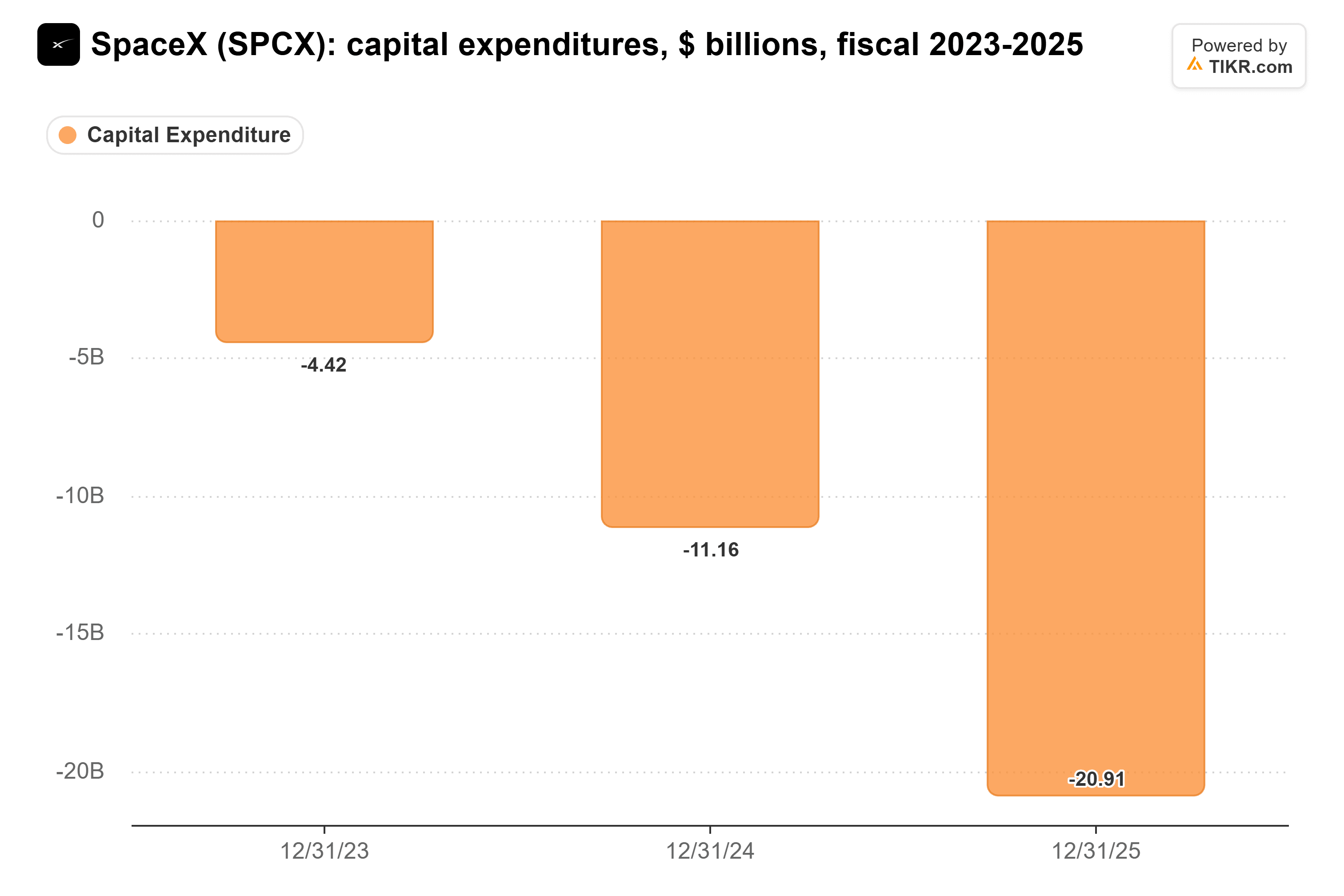
SpaceX then spent $48.1 billion in the first nine months of 2026 alone.
TIKR tracks 41 analysts on SpaceX. How many say “Buy”?
See the full breakdown of Buy, Hold, and Sell ratings on SpaceX, along with Wall Street’s revenue and earnings estimates, all in one place. More than 500,000 investors use TIKR to research stocks like this one. See SpaceX’s Analyst Ratings
The money costs more than it used to
SpaceX has been borrowing to fill the gap:

Debt and finance leases reached $38.8 billion at Sept. 30. Then on Nov. 19, a $32 billion bond sale to fund SpaceX’s Nvidia chips priced its largest slice, about $25.2 billion, at a yield of 8.259%, Bloomberg reported. The debt sits in a separate entity that buys the chips and leases them to SpaceX, so SpaceX covers it through lease payments. That big slice alone carries about $2.1 billion a year of interest, more than the $1.9 billion SpaceX paid in interest in all of 2025. The notes SpaceX sold in June carry a weighted rate of 5.855%, so the money behind the grid check costs a lot more than it did five months ago.
Texas got a gas plant
After Texas regulators resumed data center permitting on Nov. 16, one of the first air permits went to the gas-fired power plant for SpaceX’s $24 billion Starbase supercomputer, Politico reported. So SpaceX is building to each state’s terms: its own gas plant in Texas, grid payments in Arizona. And Texas could shut the door again: Gov.-elect Gina Hinojosa ran on a data center moratorium and takes office Jan. 19. In Washington, the Senate passed the Bipartisan American Affordability and Jobs Act 62-33 on Nov. 19. The permitting bill would make data center developers pay for the grid upgrades they need instead of passing the cost to households, and it now goes to the House.
CleanSpark has the plan but not the cash
That price is a lot harder for smaller builders. On CleanSpark’s Nov. 24 earnings call, CEO Matt Schultz described the same playbook: “Bring your own power, pay your fair share, and improve the lives of the communities where you operate.”
But CleanSpark ended its fiscal year on Sept. 30 with about $1.3 billion of liquidity, $1.13 billion of it in bitcoin, and the exclusivity period on its Sealy and Brazoria sites in Texas expired without a signed lease. If Texas asks builders to pay for their own grid work, CleanSpark has to find that money before it has a Texas tenant to borrow against.
GE Vernova sells to both sides
SpaceX is making its own gas power in Texas and paying for grid upgrades in Arizona, and GE Vernova sells into both models: gas turbines for sites that generate their own electricity, and grid equipment for sites that pay to connect. Its Electrification segment booked $5.4 billion of orders in the third quarter, about 1.4x its revenue, though that was down 9% organically from a year earlier, when large synchronous condenser orders lifted the comparison. The segment’s equipment backlog still grew about 60% to $42.2 billion. Its next report, likely in late January, will show whether Electrification orders return to growth.
SpaceX is buying a site that gets built
Frankly, $3.6 billion is a bargain if it gets Cochise County built, since a site stuck in a fight with voters earns nothing on the tens of billions going into it. The risk is that every state now wants its own version of this check, paid with debt that costs more than the last. The next tests are the Cochise County Planning and Zoning Commission’s Dec. 9 hearing on the project, whether the House takes up the Senate’s permitting bill, and fourth-quarter results early next year, which will show how much of the $89.9 billion of cash and marketable securities SpaceX held at Sept. 30 is left.
So what is SpaceX stock actually worth?
TIKR lets you forecast the future price of any stock in less than a minute. Just enter a few assumptions into TIKR’s valuation model and see what SpaceX could be worth. Start from Wall Street consensus estimates, or adjust the inputs to reflect your own view of the business. It’s free to use.
Disclaimer:
Please note that the articles on TIKR are not intended to serve as investment or financial advice from TIKR or our content team, nor are they recommendations to buy or sell any stocks. We create our content based on TIKR Terminal’s investment data and analysts’ estimates. Our analysis might not include recent company news or important updates. TIKR has no position in any of the stocks mentioned. Thank you for reading, and happy investing!