Key Takeaways
- SoftBank Group (SFTBY) recorded a $3.7 billion loss after canceling power-equipment commitments for US AI data centers, raising concerns about demand for GE Vernova (GEV) gas turbines.
- SoftBank had reserved more than 13 GW of turbine capacity, largely from GE Vernova, but the exact amount canceled remains unconfirmed. GE Vernova said the announcement had no financial impact on its business.
- GE Vernova has 122 GW of gas equipment under contract, including 64 GW in firm orders and 58 GW in reservations, making backlog conversions important to its growth outlook.
- At approximately $780 per share and 34x forward earnings, GE Vernova looks like a buy as stronger turbine pricing and improving margins support future earnings growth.
Elon Musk claimed on November 6 that SoftBank was “defaulting on their turbine orders.” Four days later, SoftBank disclosed a $3.7 billion loss tied to changes in its power-equipment procurement plans for US AI data centers.
According to The Wall Street Journal, SoftBank had reserved more than 13 GW of gas turbine capacity, largely from GE Vernova, before unwinding some commitments.
But a GE Vernova spokesperson told Reuters:
“While we can’t comment on individual customer relationships, there is no negative or positive impact to GE Vernova from SoftBank’s recent announcements.”
That’s the distinction investors need to understand. SoftBank faces the financial loss, while GE Vernova says its business is unaffected. The bigger test is whether other customers continue converting turbine reservations into firm orders.
SoftBank pays $3.7 billion to rethink its turbine orders
SoftBank’s November 10 results revealed approximately $3.7 billion in losses tied to changes in its US power-equipment procurement strategy.
About $2.85 billion involved non-refundable advance payments, while another $880 million related to contract modifications and settlements.
CFO Yoshimitsu Goto rejected Musk’s default allegation, explaining that SoftBank had secured equipment aggressively before reassessing its purchasing plans.
The company also maintained its broader Ohio infrastructure ambitions, including a planned 9.2 GW natural gas development.
For GE Vernova, the immediate consequences appear limited. Non-refundable deposits help protect suppliers, while strong turbine demand could allow any released manufacturing capacity to serve other customers.
TIKR tracks 38 analysts on GE Vernova. How many say “Buy”?
See the full breakdown of Buy, Hold, and Sell ratings on GE Vernova, along with Wall Street’s revenue and earnings estimates, all in one place. More than 500,000 investors use TIKR to research stocks like this one.
See GE Vernova’s Analyst Ratings
GE Vernova has 122 GW under contract, but 58 GW is still reserved
GE Vernova ended September with 122 GW of gas equipment under contract, comprising 64 GW in firm orders and 58 GW in slot reservations.
That means nearly 48% of its contracted capacity has yet to become firm equipment orders.
SoftBank’s decision shows why that distinction matters. Customers can abandon reservations when project economics change, even when deposits are non-refundable.
Still, GE Vernova continues converting commitments into orders.
During the third quarter, the company converted 13 GW of existing reservations into firm orders. It also signed 11 GW of new gas equipment contracts, including 3 GW in orders and 8 GW in new reservations.
Management expects contracted gas equipment capacity to reach at least 130 GW by year-end.
Wall Street expects GE Vernova’s annual revenue to increase from $38.1 billion in 2025 to approximately $61.3 billion in 2028, representing roughly 17% annualized growth.
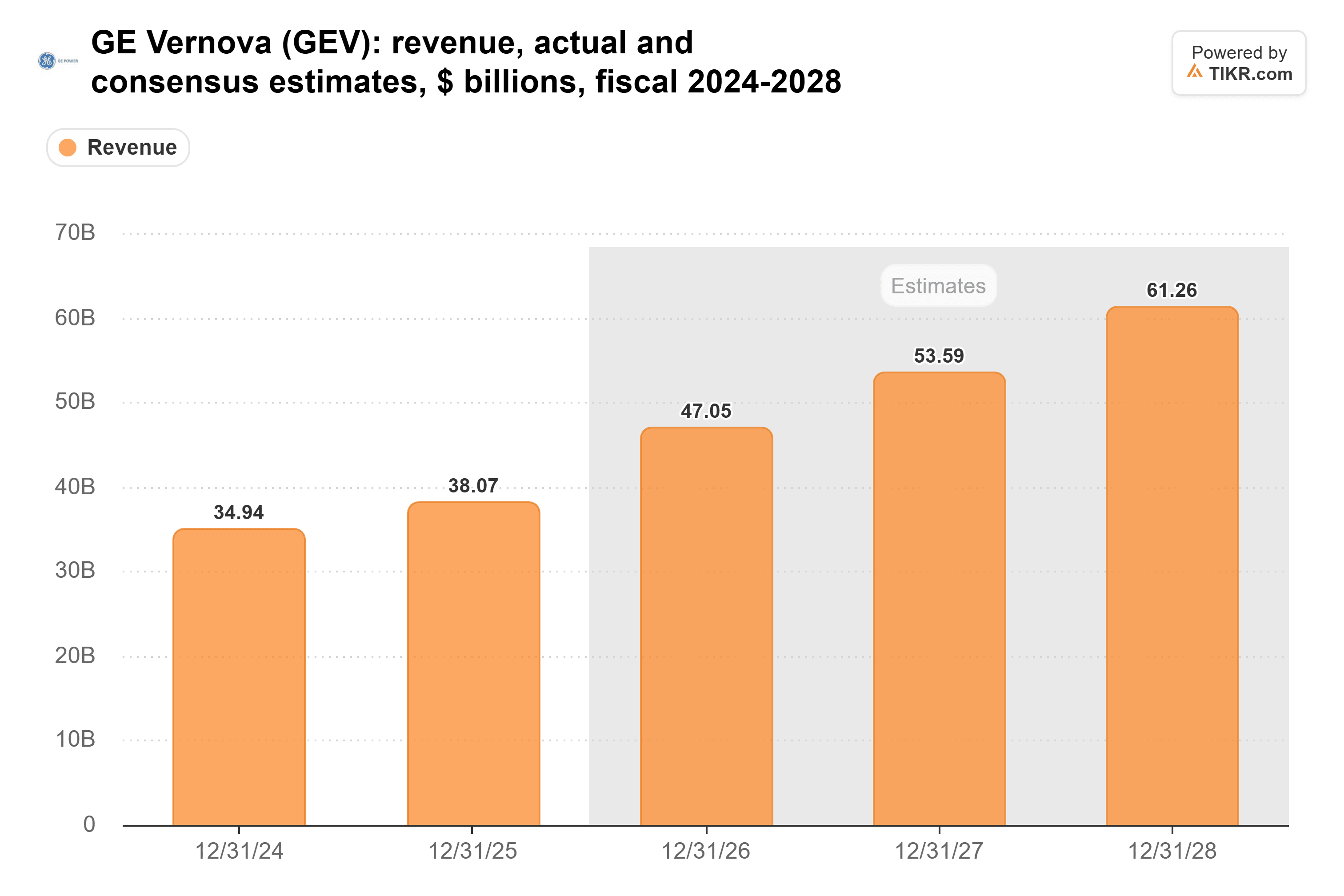
Those forecasts depend on turning equipment commitments into shipments. Continued reservation conversions would strengthen the investment case, while widespread cancellations would weaken future revenue visibility.
Higher turbine prices mean more profits are still ahead
GE Vernova’s pricing power is another reason SoftBank’s cancellation may have limited long-term consequences.
During the third quarter, new gas equipment contracts carried prices more than 20% above fourth-quarter 2025 levels.
Management also expects 2026 gas equipment order pricing per kilowatt to average approximately 50% higher than in 2025.
Those increases reflect tight manufacturing capacity and sustained demand for electricity generation equipment.
Higher prices should support profitability as newer contracts move through production.
GE Vernova’s EBIT margin improved from negative 5.9% in 2022 to approximately 5.6% in 2025, according to TIKR’s historical figures.
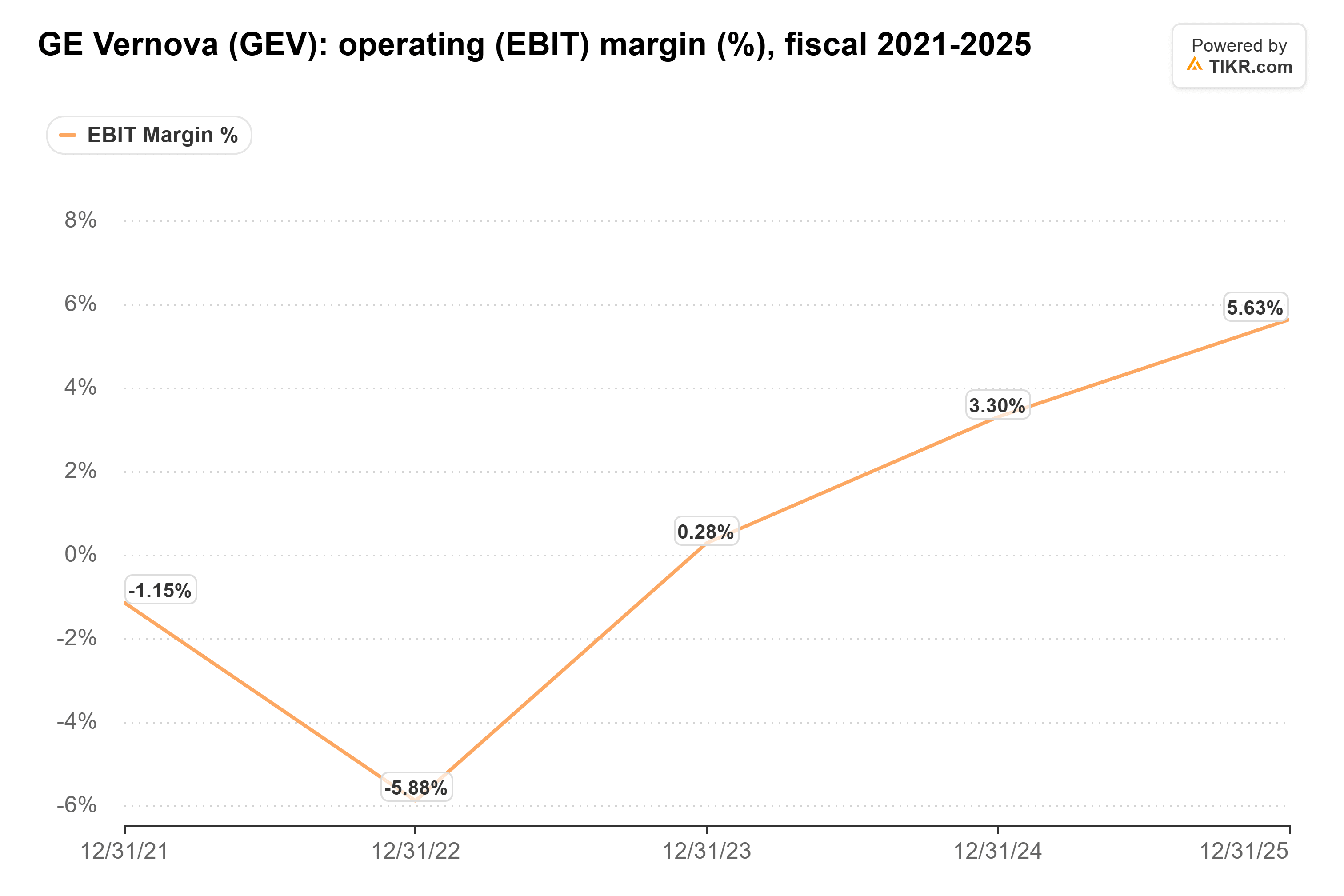
Management previously indicated that many higher-margin orders secured in 2024 and 2025 would not ship until 2027 or later.
That means the full earnings benefits from stronger turbine pricing have yet to materialize.
GE Vernova does not need every AI infrastructure project to proceed exactly as planned. It needs enough demand to keep production utilized while converting its higher-priced backlog into profitable deliveries.
At roughly 34x forward earnings, I’d buy GE Vernova
GE Vernova’s valuation has compressed as investors reassess the sustainability of AI infrastructure spending.
The stock trades at roughly 34x forward earnings, substantially below the one-year average of approximately 54x shown in TIKR’s valuation history and its April peak near 70x.
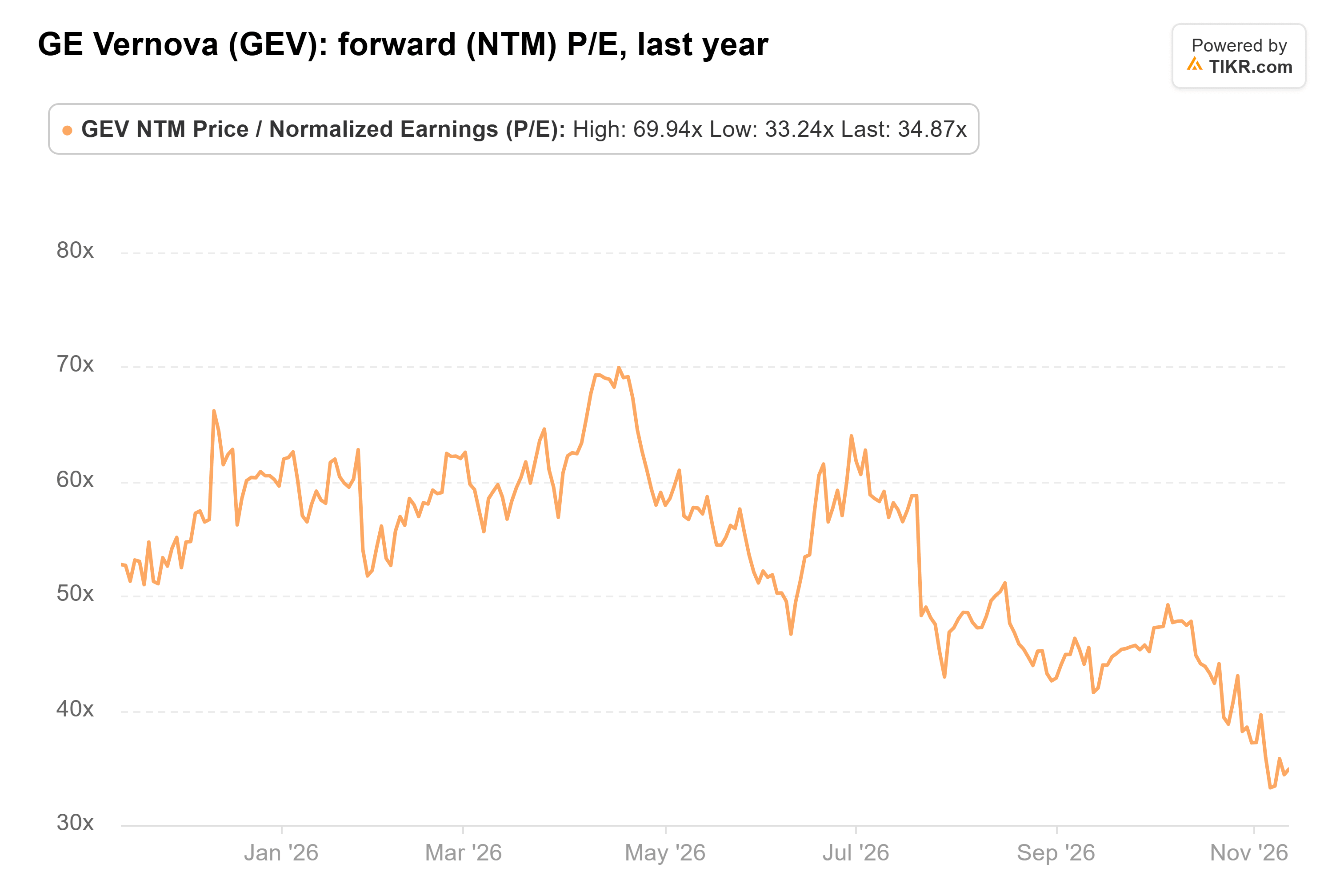
At approximately $780 per share, I would buy GE Vernova for a long-term investment horizon.
The stock is not cheap by traditional industrial-sector standards, but its growth prospects justify paying a premium.
Wall Street expects revenue to grow approximately 17% annually through 2028, while higher-priced turbine orders and improving margins provide opportunities for further earnings expansion.
SoftBank’s $3.7 billion loss does not establish that GE Vernova’s backlog is deteriorating, especially after the company said the announcement had no financial impact.
The company’s fourth-quarter results, expected in late January 2027, will provide another important test of whether reservations continue converting into firm equipment orders.
The principal risk is a broader slowdown in infrastructure investment that leads to additional reservation cancellations and weaker turbine pricing.
My verdict: GE Vernova is a buy around $780 because its substantial backlog, stronger turbine pricing, and long-term earnings opportunities outweigh the currently demonstrated impact of SoftBank’s canceled commitments.
So what is GE Vernova stock actually worth?
TIKR lets you forecast the future price of any stock in less than a minute. Just enter a few assumptions into TIKR’s valuation model and see what GE Vernova could be worth. Start from Wall Street consensus estimates, or adjust the inputs to reflect your own view of the business. It’s free to use.
Disclaimer:
Please note that the articles on TIKR are not intended to serve as investment or financial advice from TIKR or our content team, nor are they recommendations to buy or sell any stocks. We create our content based on TIKR Terminal’s investment data and analysts’ estimates. Our analysis might not include recent company news or important updates. TIKR has no position in any of the stocks mentioned. Thank you for reading, and happy investing!