


Key Takeaways
- Micron president Scott DeBoer called rivals’ talk of 4F2 DRAM “smoke and mirrors” and said 3D DRAM will win instead.
- Micron invented 4F2 and has evaluated it for two decades, so I take him seriously, and Lam Research and ASML have a stake too.
- The next DRAM nodes set Micron’s cost per bit, and its gross margin went from 2.7% in fiscal 2023 to 80.7% in fiscal 2026.
- At 3.4x forward earnings, Micron is priced for a downturn, and its Dec. 17 report is the next test.
There’s a fight over how the next generation of DRAM gets built, and the answer matters for Micron Technology (MU) and for toolmakers like Lam Research (LRCX) and ASML (ASML).
At Micron’s Technology and Product Leadership Webinar on Oct. 21, UBS analyst Timothy Arcuri asked about 4F2, a DRAM design he said “other competitors” are pushing. Micron president Scott DeBoer didn’t mince words:
“First off, it’s a bit of a myth that 4F2 actually provides anything versus 6F2. It’s the capacitor pitch that defines the DRAM.”
“So some of that is just kind of smoke and mirrors in terms of talking about 4F2 versus 6F2,” he added.
Not exactly diplomatic.
The names refer to how much room each memory cell takes up: on paper, a 4F2 cell is a third smaller than today’s 6F2. DeBoer’s point is that the capacitor sets how tightly cells pack, whatever the layout.
Micron would know
Micron “invented 4F2 DRAM,” DeBoer said, and has evaluated it “over the past 2 decades.” He even granted that “4F2 can be built back a few nodes,” though “it’s more complex, it’s more costly.”
His bottom line: “There’s fundamental problems with 4F2 scaling that ultimately will lead to 3D DRAM coming in, instead of 4F2.”
Micron’s bet is on stacking cells on top of each other, the way NAND already does.
TIKR tracks 50 analysts on Micron. How many say “Buy”?
See the full breakdown of Buy, Hold, and Sell ratings on Micron, along with Wall Street’s revenue and earnings estimates, all in one place. More than 500,000 investors use TIKR to research stocks like this one. See Micron’s Analyst Ratings
Cost per bit is the whole game
The design a memory maker picks sets what each bit costs, and a cheaper bit means a fatter margin. Micron’s next node, 1-delta, ramps “into volume in the second half of next year” with a “mid-20s percentage bit density improvement,” DeBoer said.
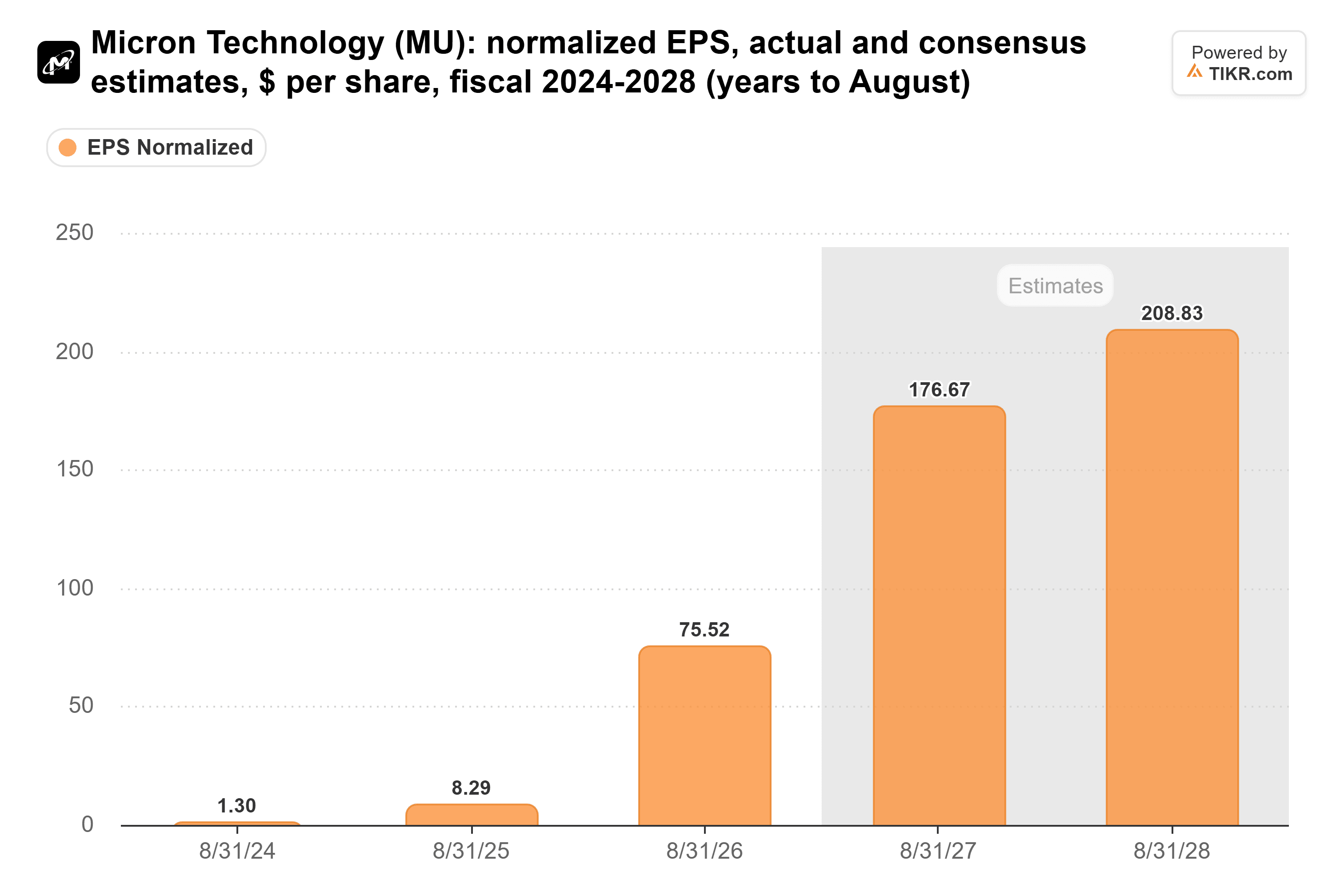
Analysts expect Micron’s normalized EPS to more than double in fiscal 2027 (which ends in August), then climb again in fiscal 2028:
Get the roadmap wrong, and a rival makes each bit for less. Micron’s GAAP gross margin fell from 45.2% in fiscal 2022 to 2.7% in fiscal 2023, before soaring memory prices lifted it to 80.7% in fiscal 2026:

Lam and ASML have a stake in this too
My read: if DRAM goes vertical, memory makers will spend more on the etch and deposition work stacking takes, which is good news for Lam Research. Its systems revenue hit $5.73 billion in the quarter ended Sept. 27, up from $3.55 billion a year earlier. How much of that is DRAM is a question for its next call.
ASML is in a different spot: I suspect a DRAM roadmap that grows upward could need fewer of its most advanced steps for each node after 1-delta. It isn’t short of work, though. It said in its Oct. 14 release that its planned supply for 2027 and 2028 won’t fully meet customers’ demand.
Investors are already pricing in a downturn
Micron trades at about half its June high, and at 4x (or so) forward earnings. Analysts see a turn coming too: their gross margin estimates slide from 87.0% in fiscal 2027 to 65.5% in fiscal 2030.
Of course, every chipmaker talks down a rival’s approach, and a rival could get cheaper bits out of 4F2 for a few nodes while 3D DRAM is still on the way.
The way I see it, the company making the cheapest bit keeps the most margin when the cycle turns, and I’ll take the word of the company that invented 4F2.
How right will I be? Well, let’s check back in at Micron’s Dec. 17 report, against its guide of $61.5 billion of revenue and an 86.25% non-GAAP gross margin. The bigger one is 1-delta: if it reaches volume in the second half of 2027 with that mid-20s density gain, “smoke and mirrors” will look like the right call.
So what is Micron stock actually worth?
TIKR lets you forecast the future price of any stock in less than a minute. Just enter a few assumptions into TIKR’s valuation model and see what Micron could be worth. Start from Wall Street consensus estimates, or adjust the inputs to reflect your own view of the business. It’s free to use.
Disclaimer:
Please note that the articles on TIKR are not intended to serve as investment or financial advice from TIKR or our content team, nor are they recommendations to buy or sell any stocks. We create our content based on TIKR Terminal’s investment data and analysts’ estimates. Our analysis might not include recent company news or important updates. TIKR has no position in any of the stocks mentioned. Thank you for reading, and happy investing!


