
Key Takeaways
- On Shopify’s third-quarter call, President Harley Finkelstein said Shopify has captured nearly half of all incremental US e-commerce since the start of 2025, with a 14% share of the market.
- Taking half the market’s growth from a 14% base raises Shopify’s share every year, which supports the 26% to 32% yearly revenue growth analysts expect through 2028.
- AI agents are a new channel, with AI traffic to Shopify stores up 2.6x year over year, though the volume is still small.
- After a 15% drop since the report, Shopify trades at 67x forward earnings, below its one-year average of 74x, and the drop looks like a buying chance.
Shopify (SHOP) stock is down 15% since its third-quarter report, after GMV came in about $1 billion short of expectations, even as operating income jumped 66%.
But the stat I’d pay the most attention to came from President Harley Finkelstein, who was talking about the new ways agents bring shoppers to merchants.
Since the start of 2025, he said, “we’ve captured nearly half of all incremental e-comm in the U.S. despite only being 14%.”
That’s the bull case in one sentence.
TIKR tracks 55 analysts on Shopify. How many say “Buy”?
See the full breakdown of Buy, Hold, and Sell ratings on Shopify, along with Wall Street’s revenue and earnings estimates, all in one place. More than 500,000 investors use TIKR to research stocks like this one. See Shopify’s Analyst Ratings
Shopify’s share keeps climbing
Earlier on the call, CFO Jeff Hoffmeister gave the longer history. Three years ago, Shopify merchants drove nearly a fifth of US e-commerce growth. Over those three years, their US online sales grew 23% a year, against 8% for US e-commerce as a whole.
Now say US e-commerce keeps growing 8% a year, and Shopify keeps taking half of that growth. That puts 4 points of growth on a 14% share, so Shopify’s US volume grows about 29% a year. Its share reaches about 17% after one year and about 21% after three.
That base is already huge. Merchants sold over $119 billion through Shopify in the third quarter, almost as much as in all of 2020. As Hoffmeister said, “An entire year of Shopify GMV has now become a single quarter and not even the holiday shopping quarter.”
Shopify’s growth rate will slow as its share grows, and analysts already expect that. They have revenue growth easing from 32% this year to 26% in 2028:
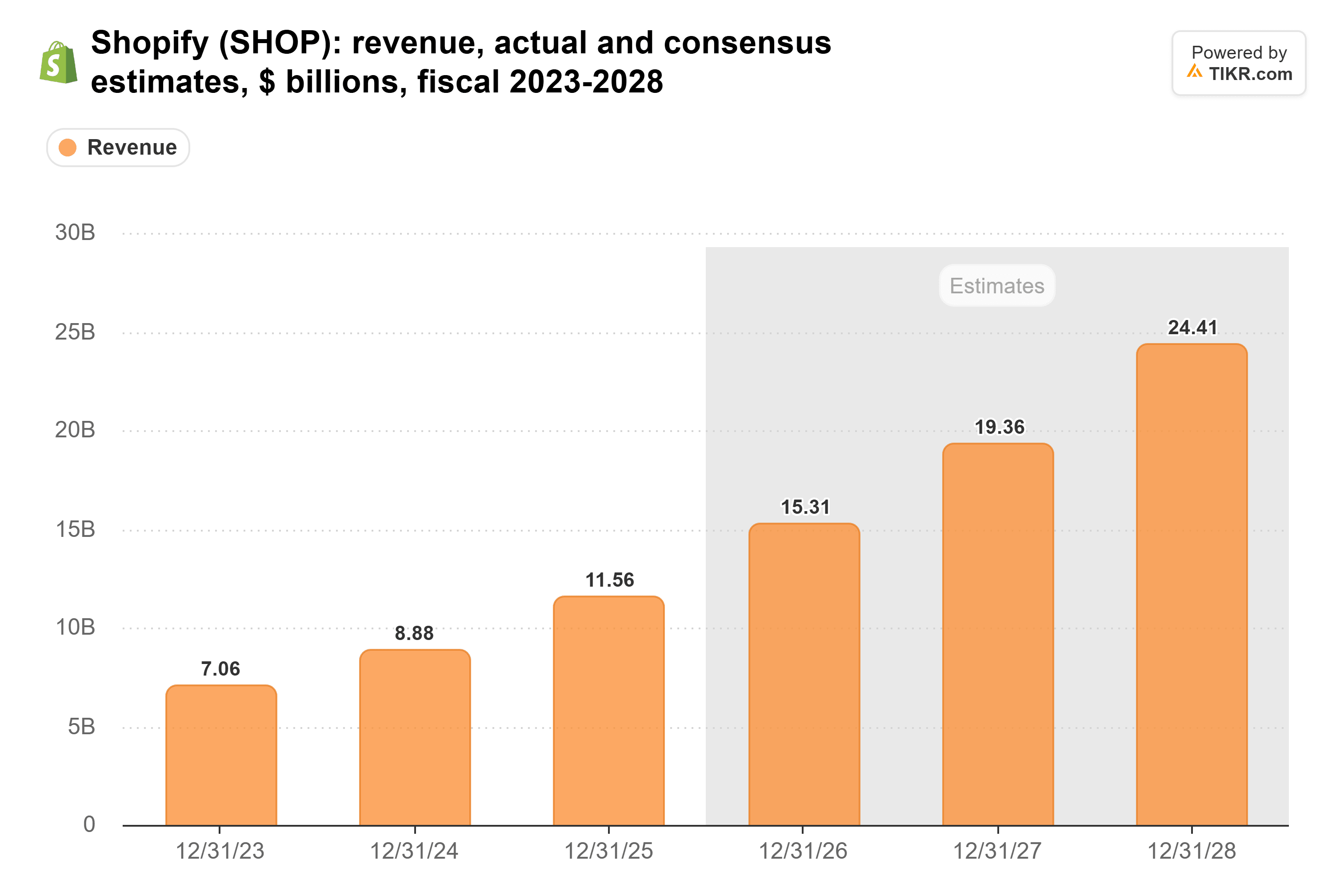
That would still more than double revenue from 2025’s $11.6 billion. And as long as Shopify keeps taking half the market’s growth, I don’t see much reason for those estimates to come down.
Agents are a new front door
Plus: Shopify has a new channel feeding that share. Finkelstein said AI traffic to Shopify stores is “up 2.6x year-over-year,” orders are up 3.3x, and shoppers from AI channels convert 64% more often. Personal agents like Muse, Claude Duet and Grok Bot all partner with Shopify, so merchants’ checkouts work inside them and buyers can pay with Shop Pay.
Venture investor Alexis Ohanian, founder of 776, has seen it in his own shopping. “My agent is buying a LOT more from Shopify-powered stores,” he posted on X on Nov. 6.
Finkelstein said himself that agent volume is still small, and the companies that own the agents control the screen the shopper sees. But every agent that checks out through Shopify gives the company one more way to keep taking more than its share.
Rich, but below its usual premium
A share of growth can swing from one quarter to the next, and the third quarter’s GMV miss shows how hard investors will punish any slip. Shopify isn’t cheap, either: after the drop, it trades at 67x forward earnings. But that’s below the 74x it averaged over the past year, and well off the 96x it reached at the end of 2025.
The business also pays for its own growth. Free cash flow went from negative in 2022 to $2.0 billion in 2025:
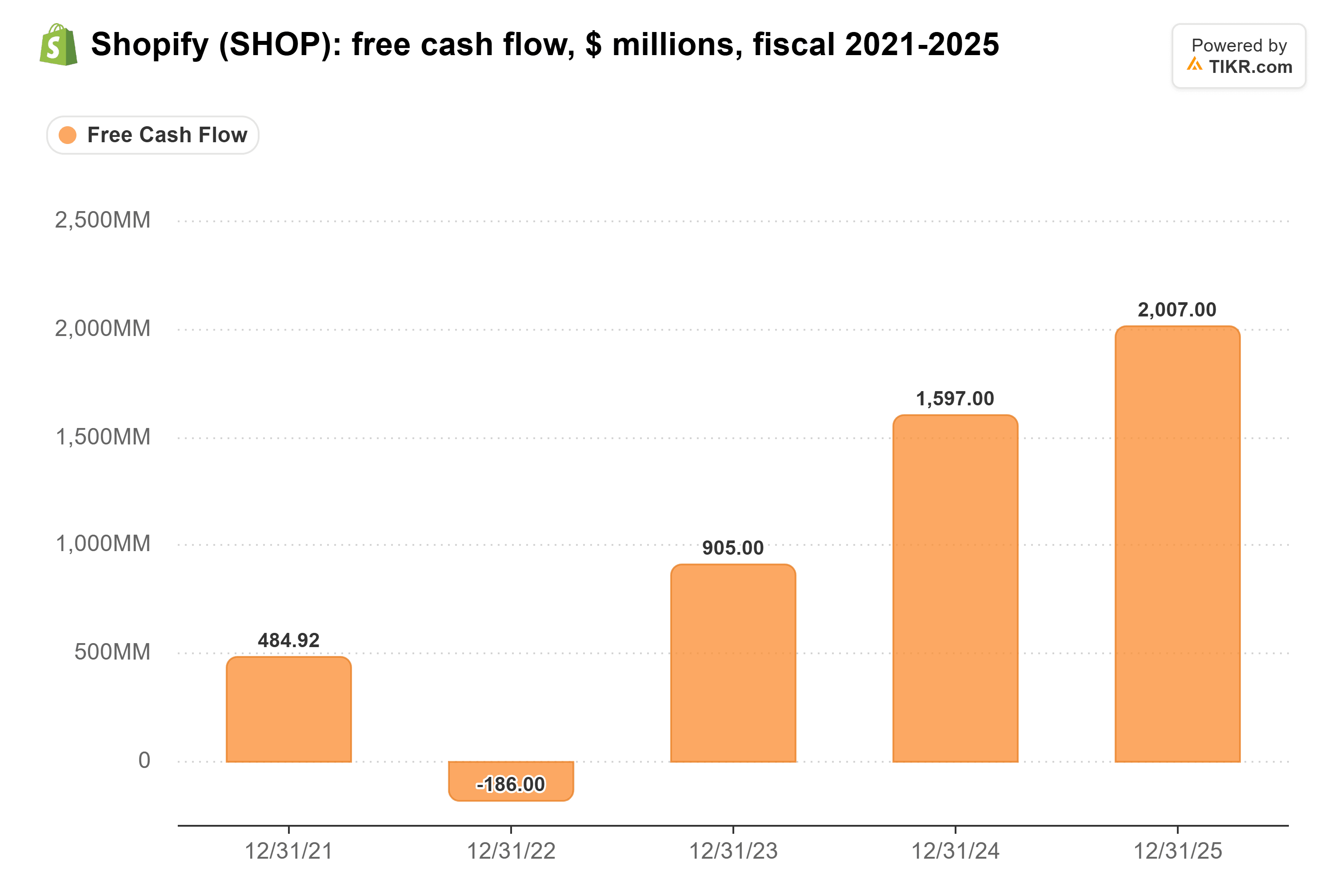
The third quarter alone brought in $816 million of free cash flow, or 22% of revenue.
Here’s where I land: Shopify is taking half of US e-commerce growth with a seventh of the market, and investors are paying less for that than they have on average over the past year. I think the drop is a buying chance. Of course, “nearly half” is Shopify’s own figure since the start of 2025, and its fourth-quarter report in February will show us whether it holds.
So what is Shopify stock actually worth?
TIKR lets you forecast the future price of any stock in less than a minute. Just enter a few assumptions into TIKR’s valuation model and see what Shopify could be worth. Start from Wall Street consensus estimates, or adjust the inputs to reflect your own view of the business. It’s free to use.
Disclaimer:
Please note that the articles on TIKR are not intended to serve as investment or financial advice from TIKR or our content team, nor are they recommendations to buy or sell any stocks. We create our content based on TIKR Terminal’s investment data and analysts’ estimates. Our analysis might not include recent company news or important updates. TIKR has no position in any of the stocks mentioned. Thank you for reading, and happy investing!