Key Takeaways
- Kalshi is reportedly raising money at a valuation as high as $65 billion, more than Robinhood’s (HOOD) entire market value.
- The gap says Robinhood’s stock is too cheap more than it says Kalshi is worth $65 billion.
- Robinhood earned $1.88 billion in 2025 and trades at 20x forward earnings, below Interactive Brokers (IBKR) and CME Group (CME).
- The main risk is that Robinhood’s profits still lean on trading and crypto, the market Coinbase (COIN) depends on.
Robinhood has an odd problem: a company it helps feed may soon be worth more than it is.
Kalshi, the prediction exchange that Robinhood has said gets a large share of its volume from Robinhood customers, is reportedly in talks to raise money at a valuation as high as $65 billion. Robinhood’s whole market value is about $56 billion.
Terry Duffy, chairman and CEO of CME Group, noted on Friday’s RiskReversal Pod that Kalshi’s price “is greater than Robinhood’s market cap and there’s no diversification.”
Josh Brown, CEO of Ritholtz Wealth Management, put it more simply on Friday’s episode of The Compound and Friends: “There is no way in real life that Kalshi is worth as much or more than Robinhood. No way in the world.”
I agree, and the gap tells you more about Robinhood’s stock than about Kalshi.
Duffy also lumped in Coinbase, which he said lives and dies by the price of bitcoin. But Interactive Brokers, which also offers its customers prediction markets, trades at a higher multiple than Robinhood.
So investors aren’t punishing every retail broker the same way.
TIKR tracks 33 analysts on Robinhood. How many say “Buy”?
See the full breakdown of Buy, Hold, and Sell ratings on Robinhood, along with Wall Street’s revenue and earnings estimates, all in one place. More than 500,000 investors use TIKR to research stocks like this one. See Robinhood’s Analyst Ratings
Robinhood earns real money
Brown called Robinhood “a real business earning a lot of money,” and it is.
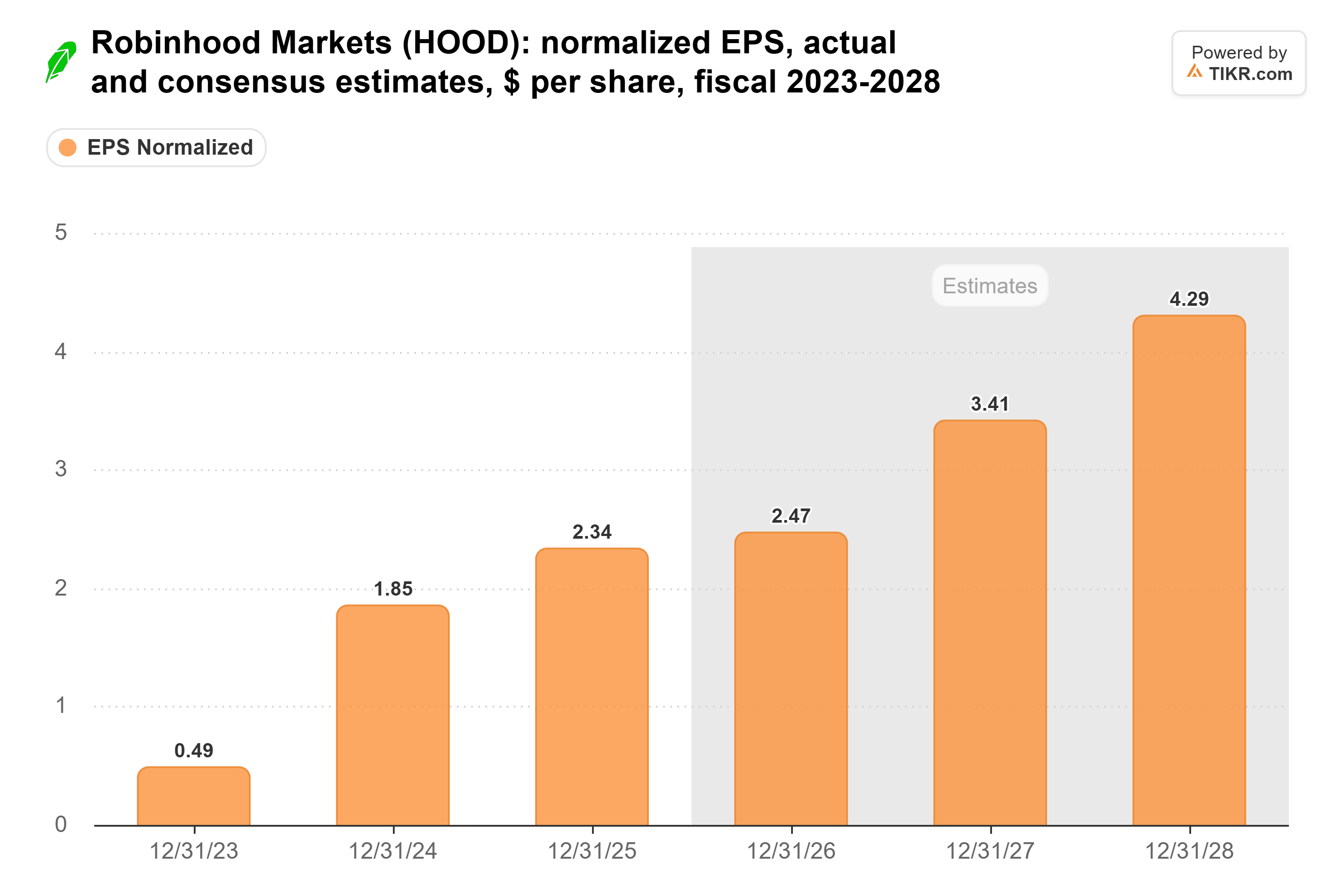
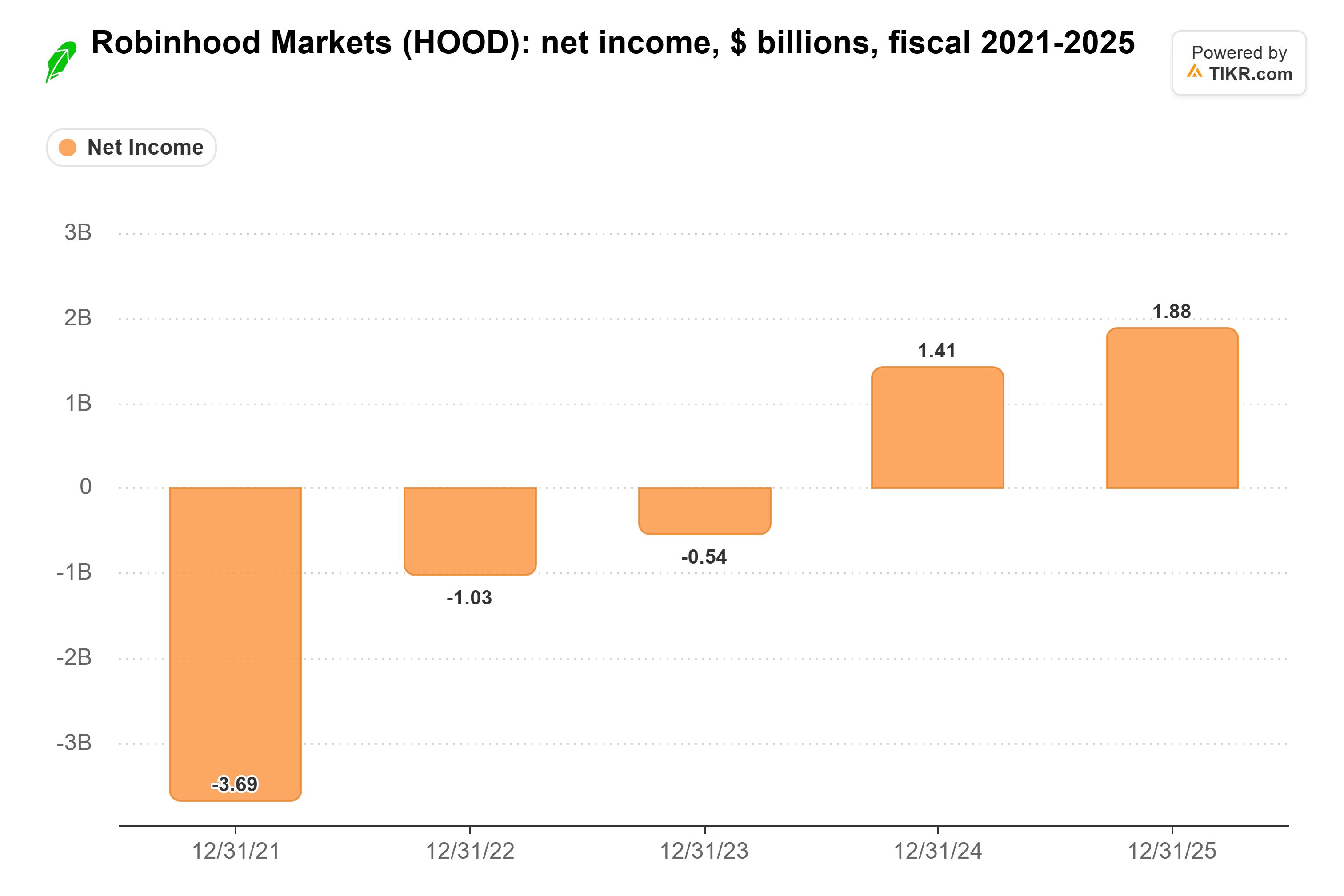
Robinhood posted GAAP net income of $1.88 billion in 2025. Analysts expect normalized EPS to rise from $2.34 in 2025 to $3.41 in 2027 and $4.29 in 2028:
Robinhood lost $3.69 billion in 2021, its IPO year, and was still in the red in 2023:
Duffy’s sports critique applies to Robinhood too
Duffy’s main knock on Kalshi is what its volume comes from: “90% of Kalshi’s business on predictions is sports. There’s no money in that. There’s absolutely no money.”
He also said most of Robinhood’s prediction business was sports, and that’s Robinhood’s fastest-growing line.
Event-contract revenue jumped to $156 million in Q2 2026 from $10 million a year earlier, then reached $173 million in Q3.
Only $28 million of that came through Rothera, the exchange Robinhood runs with Susquehanna; the rest went to outside exchanges, Kalshi among them.
If sports bets really are worth that little, Kalshi’s valuation is the one in trouble. Robinhood would lose a line that made up about 12% of its Q2 revenue and keep the other 88%.
Of course, Duffy runs a rival exchange. And Kalshi is becoming a Robinhood competitor: it plans to launch stock and ETF trading within two months, The Wall Street Journal reported.
Robinhood is priced for the bad news
Robinhood’s profits still lean on trading. Transaction-based revenue was 59.3% of Q2 revenue. Crypto revenue fell 38% to $100 million.
That cut crypto to 7.6% of revenue from 16.2%, though, so crypto prices matter far less to Robinhood than they do to Coinbase.
The stock already reflects a lot of that worry:
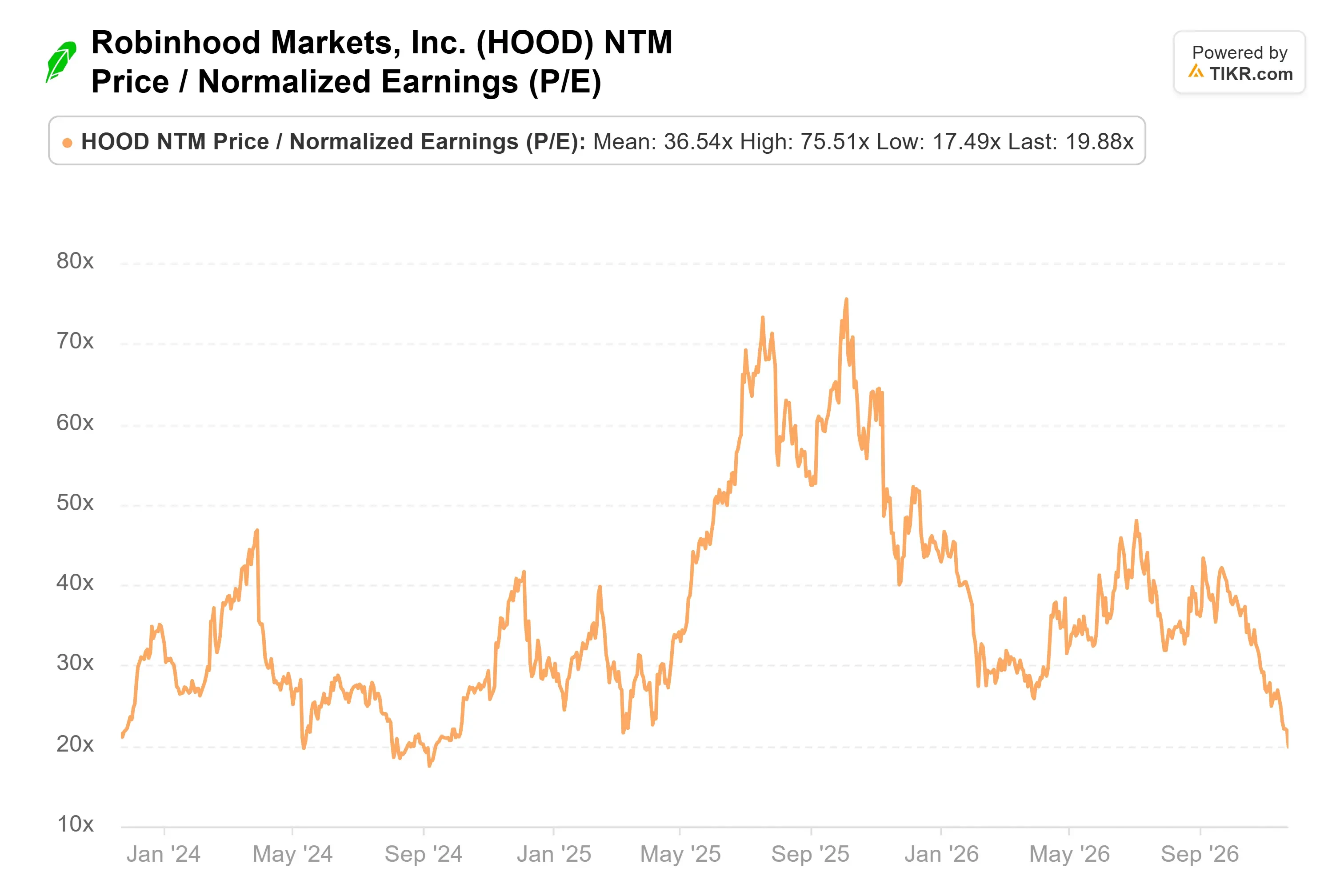
At 20x next-12-months earnings, Robinhood trades well below its three-year average of 37x and far below its peak of 76x in October 2025.
It’s also cheaper than Interactive Brokers and CME, both at about 22x to 24x. Yet analysts expect Robinhood’s normalized EPS to grow 38% in 2027, against about 23% for Interactive Brokers and 7% for CME.
I’d take the broker
Think about what Kalshi is: a private exchange that leans on sports bets, is fighting state-by-state legal battles, and is about to compete with its biggest partner.
It shouldn’t be worth more than a profitable broker. The way I see it, the gap is Robinhood’s discount, and at 22x forward earnings, that discount looks too steep.
The test comes with Q4 results early next year. Event-contract revenue needs to hold near Q3’s level, and the 2027 expense outlook needs to leave room for the growth analysts expect.
If either one slips, the market’s discount will look a lot more reasonable.
So what is Robinhood stock actually worth?
TIKR lets you forecast the future price of any stock in less than a minute. Just enter a few assumptions into TIKR’s valuation model and see what Robinhood could be worth. Start from Wall Street consensus estimates, or adjust the inputs to reflect your own view of the business. It’s free to use.
Disclaimer:
Please note that the articles on TIKR are not intended to serve as investment or financial advice from TIKR or our content team, nor are they recommendations to buy or sell any stocks. We create our content based on TIKR Terminal’s investment data and analysts’ estimates. Our analysis might not include recent company news or important updates. TIKR has no position in any of the stocks mentioned. Thank you for reading, and happy investing!