Key Takeaways
- Realty Income yields 5.7% and Weyerhaeuser 4.3%, but Weyerhaeuser’s dividend grew 10.5% a year from fiscal 2020 to fiscal 2025, against 2.9% for Realty Income.
- Realty Income’s dividend took 75% of its AFFO in fiscal 2025, while Weyerhaeuser’s took 153%.
- At each dividend’s five-year growth rate, Weyerhaeuser’s income passes Realty Income’s in about four years. At the pace each grew last year, it never does.
- The thing to watch is whether Weyerhaeuser’s AFFO per share recovers enough to cover its dividend again.
Realty Income (O) raised its monthly dividend again on Nov. 10, to $0.274 a share from $0.2715. That’s its 137th increase since listing on the NYSE in 1994. Two days later, Weyerhaeuser (WY) held its quarterly base dividend at $0.21 a share.
But over the last five years, Weyerhaeuser’s dividend grew much faster: 10.5% a year from fiscal 2020 to fiscal 2025, against 2.9% a year for Realty Income. Realty Income starts with the bigger check, a 5.7% yield against 4.3%.
So if you put $10,000 into one of them today, which pays you more over the next 10 years?
| Metric | Realty Income (O) | Weyerhaeuser (WY) |
|---|---|---|
| Dividend yield | 5.7% | 4.3% |
| Dividend growth, fiscal 2020-2025 | 2.9% a year | 10.5% a year |
| Dividend growth, fiscal 2015-2025 | 3.6% a year | -3.5% a year |
| AFFO payout ratio, fiscal 2025 | 75% | 153% |
| Net debt/EBITDA, last 12 months | 5.8x | 6.6x |
| Interest coverage, last 12 months | 2.4x | 0.8x |
Source: TIKR.
6 safe dividend stocks paying retirees 6%+ yields
There are over 100 stocks paying 6%+ annual dividends today.
But after an extensive investment review leveraging TIKR’s proprietary data, we now believe only six of them are truly safe for retirees.
They’re all yours as part of our new investment report. Learn more about how to get access right here.
Realty Income keeps a cushion
Realty Income’s AFFO per share rose 3.7% to $1.12 in the third quarter of 2026 from a year earlier. Management raised its 2026 AFFO guidance to $4.45-$4.46 a share, from $4.44-$4.45. The growth is coming from Europe, industrial property and credit investments. Less of it is funded by selling new stock: public equity paid for just 19% of its investment so far this year.
The dividend took a comfortable 72.6% of AFFO in the quarter. That fits a long trend: from fiscal 2016 to fiscal 2025, the dividend rose every year, from $2.39 to $3.22 a share, while the AFFO payout ratio fell from 83.0% to 75.2%.
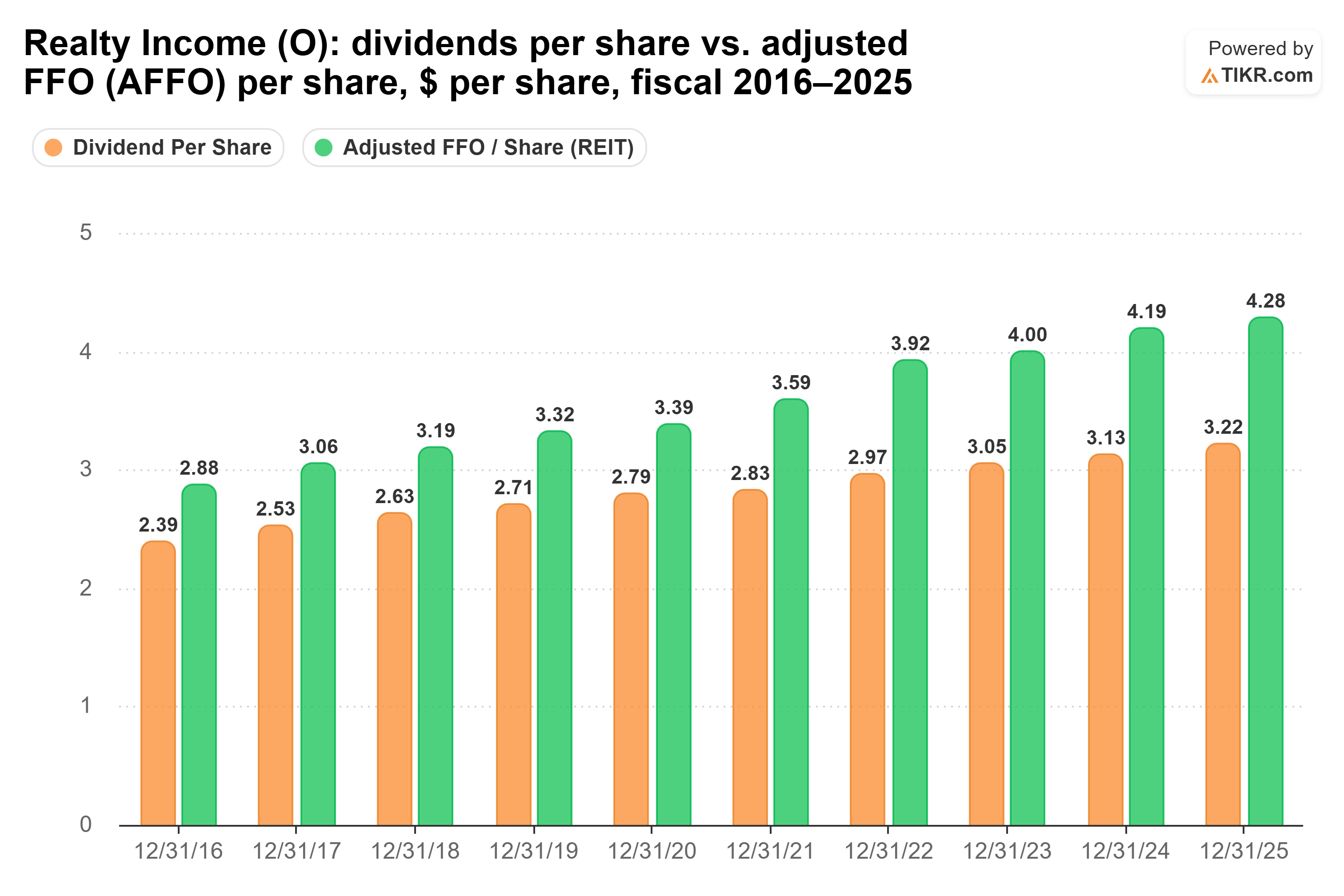
Realty Income has raised its dividend for over 32 consecutive years. Even at 2.9% a year, $10,000 pays about $738 in year 10, a 7.4% yield on your cash today.
The risk is a leadership gap in Europe. On Nov. 12, the company said Neil Abraham, its chief strategy officer and president of Realty Income International, leaves on Dec. 31, and it named no successor.
Weyerhaeuser’s dividend is running ahead of its AFFO
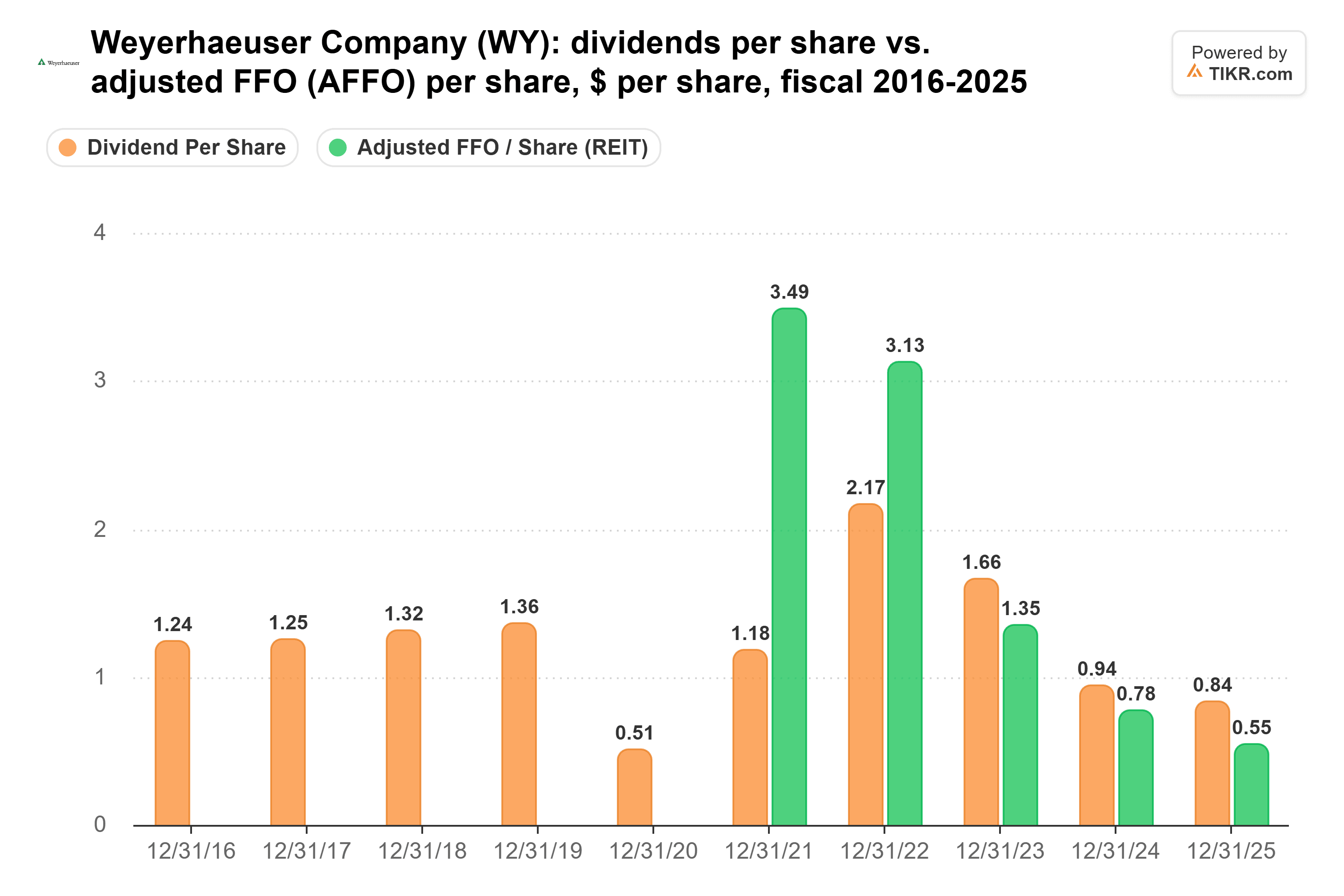
Weyerhaeuser’s faster growth rate comes with a much thinner cushion, and it starts from a low year. Fiscal 2020’s dividend of $0.51 a share was well under fiscal 2019’s $1.36. Since then the dividend has slipped, to $0.84 in fiscal 2025 from $0.94 in fiscal 2024. Over 10 years it shrank 3.5% a year, from $1.20 in fiscal 2015.
Housing is the problem. Softer demand and lower prices cut Weyerhaeuser’s wood products earnings in the third quarter of 2026. GAAP net earnings fell to $61 million from $80 million a year earlier, even as net sales grew to $1.9 billion from $1.7 billion.
AFFO per share fell every year from $3.49 in fiscal 2021 to $0.55 in fiscal 2025. The dividend hasn’t been covered since fiscal 2022, and last year it took a risky 153% of AFFO:
Management is leaning on its cash-return framework. That framework pairs the base dividend with a target of returning 75% to 80% of adjusted funds available for distribution. “For us, having the right dividend framework really is critical to allowing us to withstand periods of time with more challenging market conditions,” CFO David Wold said on the third-quarter call.
Weyerhaeuser lowered its 2026 guidance for capex to about $375 million. It also agreed to sell 81,000 acres of Arkansas timberland for $146 million.
Still, EBIT covered its interest just 0.84x over the last twelve months, so there’s little slack.
So which dividend wins?
I’d take Realty Income. It’s the stock more likely to pay you more over the next 10 years.
At each dividend’s five-year rate, Weyerhaeuser comes out ahead. It would pay about $7,018 in all against about $6,507, and pass Realty Income around 2030. But that requires Weyerhaeuser to raise its dividend 10.5% a year, starting from a dividend that took 153% of AFFO in fiscal 2025 and didn’t rise. At the pace each grew last year, Realty Income pays about $6,497 over the decade against about $4,300 from Weyerhaeuser, roughly $2,200 more.
That isn’t to say Weyerhaeuser’s dividend is broken. Management is trimming capex and selling land it doesn’t need. CEO Devin Stockfish also said on the call, “we do continue to have confidence in the longer-term prospects for U.S. housing.” It’s just that Realty Income’s check is bigger today, the business covers it, and it’s still growing.
Of course, a housing recovery could flip the answer fast. If Weyerhaeuser’s AFFO per share climbs back above its $0.84 dividend, the case for faster raises gets a lot more believable. It was $3.13 in fiscal 2022.
Forget Realty Income: 6 safe 6%+ dividend yields you can buy right now
Dividends can hold the key to enormous wealth. But only if you buy the right ones.
Picking the right high-yield dividend stock can be the difference between a dream retirement…and scraping by every month, waiting for the next Social Security check to clear.
We’ve identified six stocks yielding 6%+ that we believe every retiree should know about right now. (And Realty Income isn’t one of them.)
Disclaimer:
Please note that the articles on TIKR are not intended to serve as investment or financial advice from TIKR or our content team, nor are they recommendations to buy or sell any stocks. We create our content based on TIKR Terminal’s investment data and analysts’ estimates. Our analysis might not include recent company news or important updates. TIKR has no position in any of the stocks mentioned. Thank you for reading, and happy investing!