Key Takeaways
- Realty Income raised its 2026 AFFO outlook to $4.45 to $4.46 per share after third-quarter AFFO rose 3.7% to $1.12.
- Interest and dividend income from loans and preferred equity more than doubled to $105.0 million, so lending is becoming a real profit stream.
- Interest expense rose 13.3% to $333.6 million, outpacing revenue growth, while loan loss provisions nearly doubled over nine months.
- The fourth-quarter report, expected in late February, brings guidance for 2027 and shows how hard refinancing costs bite.
Realty Income (O) is still the monthly dividend landlord most income investors know. Its third quarter, though, showed a company that increasingly earns like a lender too.
Interest and dividend income from loans and preferred equity jumped to $105.0 million from $51.1 million a year earlier. In September, KKR (KKR) also paid €528 million for a 49% stake in a new venture holding 54 of Realty Income’s European properties.
That shift matters because funding got pricier. The 10-year Treasury yield touched 5.34% on October 1, its highest level since 2002.
Meanwhile, Agree Realty (ADC), a smaller retail net lease rival, grew AFFO per share 4.9% in the same quarter. Realty Income managed 3.7%, so the gap deserves a closer look.
A steady quarter on paper
The company reported results on November 2, and the headline figures were steady:
- Total revenue rose 10.3% to $1.62 billion.
- AFFO per share climbed 3.7% to $1.12.
- Occupancy held at 98.8%, and re-leased properties recaptured 103.5% of prior rent.
Management also lifted its 2026 AFFO outlook to $4.45 to $4.46 per share, up a penny at each end. However, it cut GAAP net income guidance to $1.55 to $1.56 from $1.59 to $1.60.
Revenue has climbed steadily as the company keeps buying…
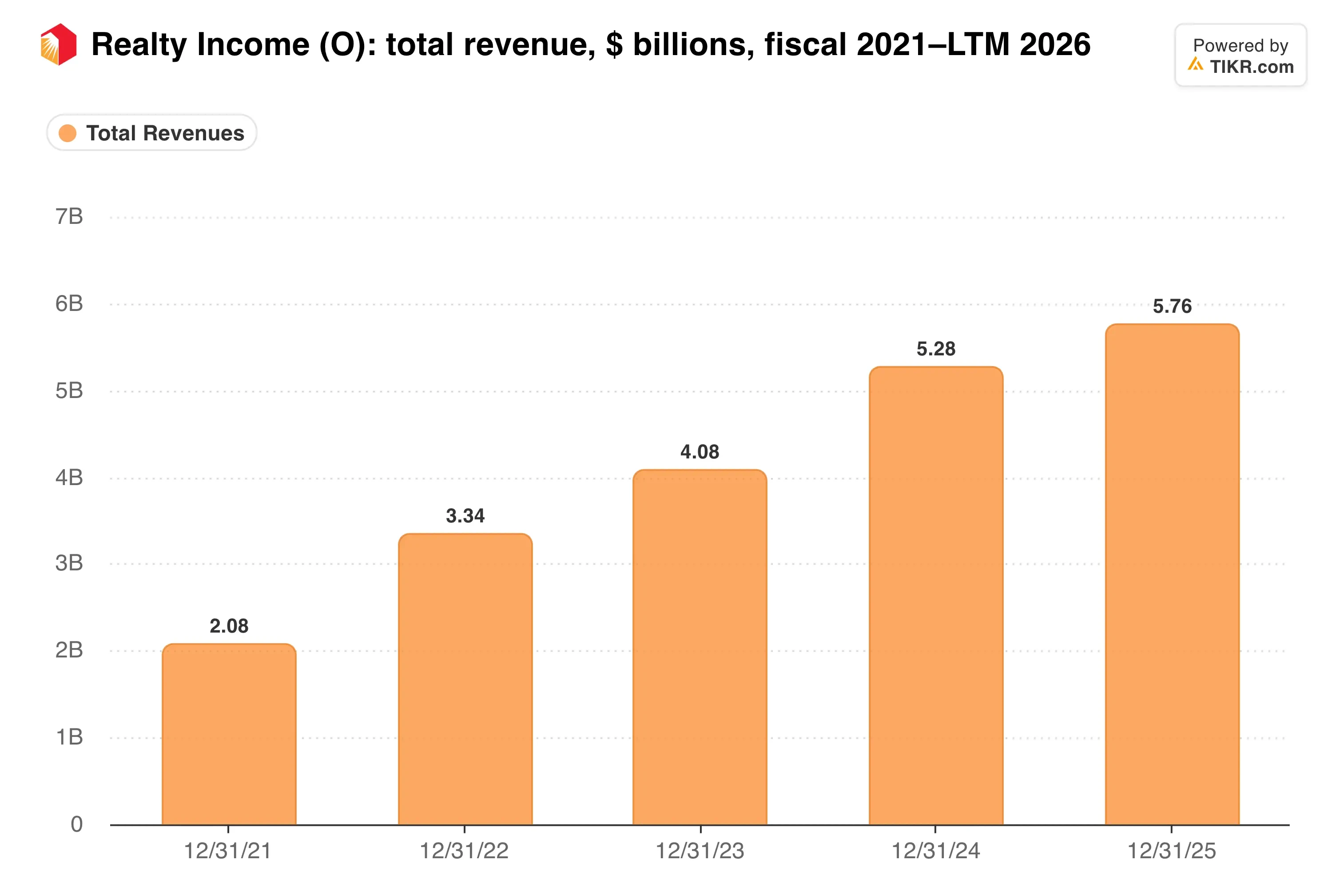
Same store rental revenue grew just 1.1%, though. Almost all of the growth comes from fresh money going out the door.
Europe and credit drive growth
Where that money goes is changing fast. Realty Income invested $2.2 billion at its pro rata share in the quarter, at a 6.8% initial cash yield. Europe took $940 million of that at 7.1%, above the 6.5% earned on U.S. and other deals.
Credit is the bigger shift. So far this year, the company has put $1.9 billion into credit investments at an 8.3% initial yield. Their 3.7-year average term is also far shorter than the 9.4 years on property purchases.
CEO Sumit Roy said the company has “deliberately expanded our sources of capital and global investment capabilities.” In practice, that means partners like KKR and Apollo, a $1.0 billion convertible note at 3.750%, and $526.6 million of property sales in the quarter.
How does that funding mix stack up against a simpler peer?
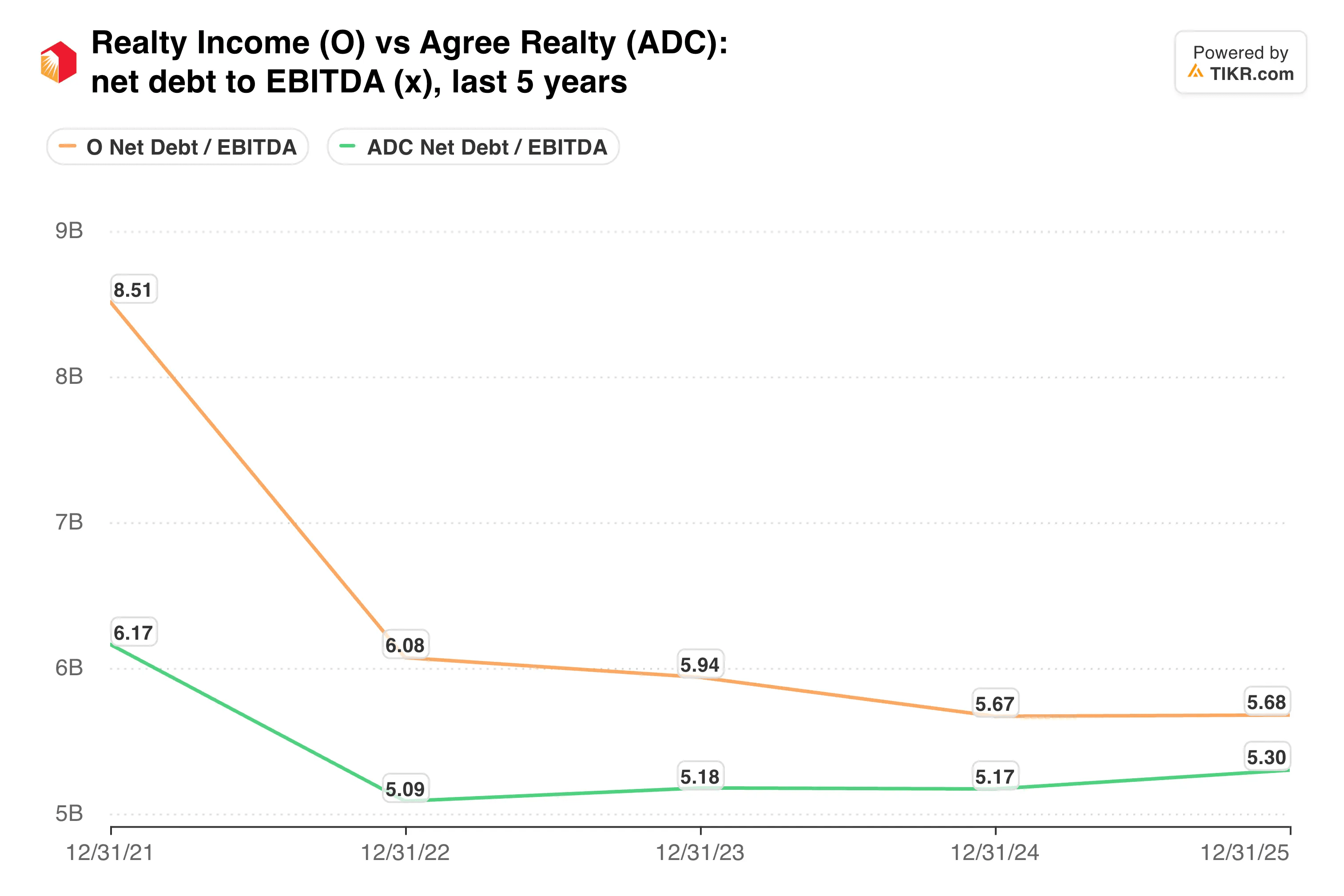
Realty Income ended the quarter at 5.4x net debt to annualized pro forma adjusted EBITDAre. Agree reported 3.9x on its own pro forma basis, which leaves it more room if rates stay high.
TIKR tracks 25 analysts on Realty Income. How many say “Buy”?
See the full breakdown of Buy, Hold, and Sell ratings on Realty Income, along with Wall Street’s revenue and earnings estimates, all in one place. More than 500,000 investors use TIKR to research stocks like this one. See Realty Income’s Analyst Ratings
Funding costs are the catch
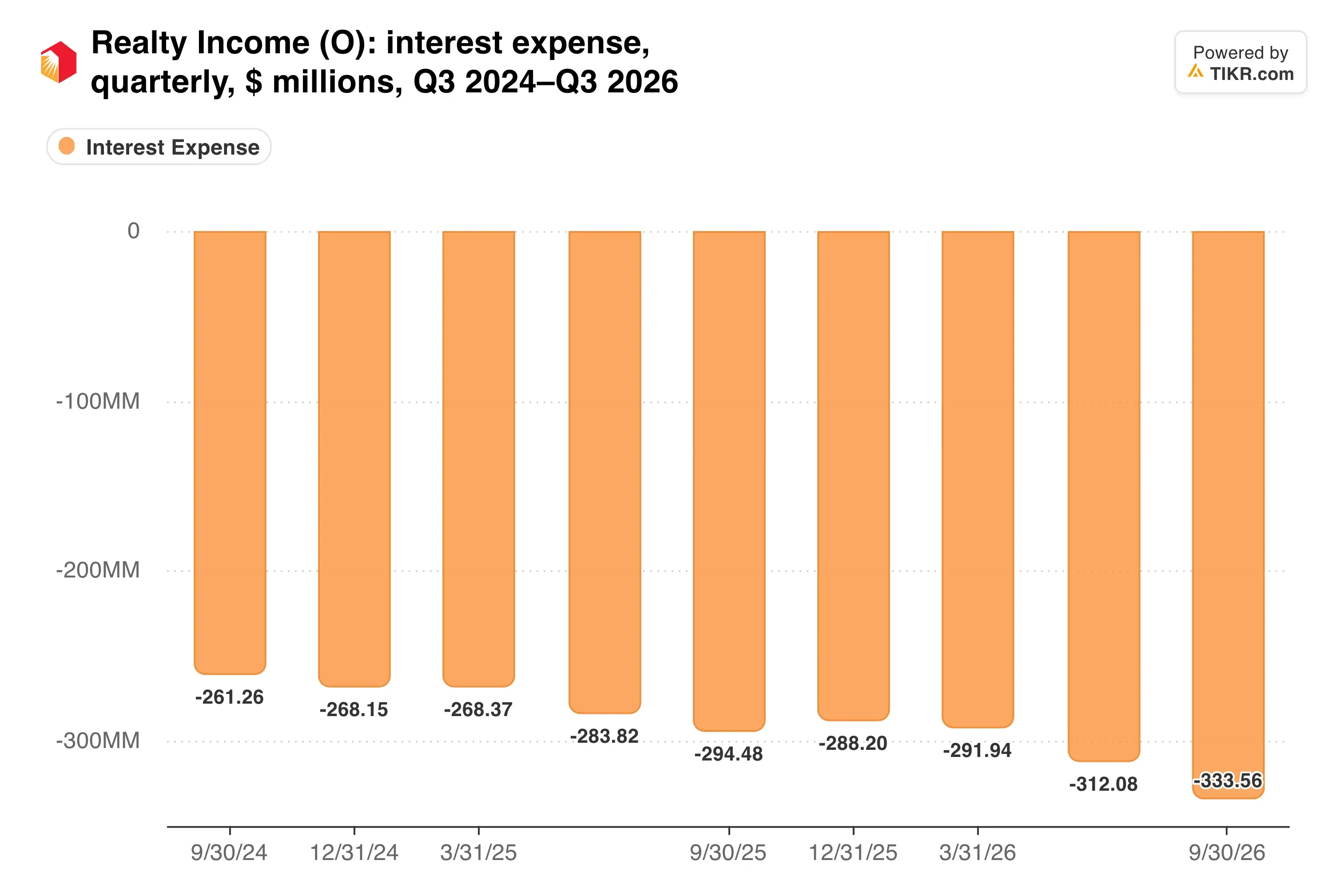
Higher rates hit the income statement first. Interest expense rose 13.3% to $333.6 million in the quarter, while total revenue grew 10.3%.
That is a bill growing faster than the business it funds.
Credit risk is creeping up as well. Provisions for credit losses on loans reached $60.6 million over nine months, up from $31.9 million a year earlier. Real estate impairments added $111.6 million in the third quarter alone.
The dividend still looks well covered. Monthly payouts equaled 72.6% of AFFO, close to Agree’s roughly 70%. Yet Realty Income’s quarterly dividend grew only 0.7% from a year ago, while Agree’s annualized rate rose 4.3%.
My take: Lending and partnering are sensible moves when new stock and bonds cost more. Still, a landlord booking rising loan losses deserves more caution than a pure landlord. I’d want proof the credit book stays clean before paying up.
The next checkpoint is the fourth-quarter report, expected in late February. Guidance implies fourth-quarter AFFO of $1.10 to $1.11 per share, a small step down from $1.12. The first 2027 outlook will show how hard refinancing costs bite.
So what is Realty Income stock actually worth?
TIKR lets you forecast the future price of any stock in less than a minute. Just enter a few assumptions into TIKR’s valuation model and see what Realty Income could be worth. Start from Wall Street consensus estimates, or adjust the inputs to reflect your own view of the business. It’s free to use.
Disclaimer:
Please note that the articles on TIKR are not intended to serve as investment or financial advice from TIKR or our content team, nor are they recommendations to buy or sell any stocks. We create our content based on TIKR Terminal’s investment data and analysts’ estimates. Our analysis might not include recent company news or important updates. TIKR has no position in any stocks mentioned. Thank you for reading, and happy investing!