Key Takeaways
- Oracle said on Friday, Nov. 20, that it’s fully funded for its OpenAI contract, days after its credit default swaps hit record wides. Its stock rose 12.34% the next session in a broad AI rally.
- Getting paid back depends on OpenAI, which S&P estimated in July makes up about half of Oracle’s backlog, now $664 billion.
- AMD and Broadcom have big OpenAI chip deals, so the same question hangs over their AI growth.
- Analysts expect Oracle’s free cash flow to stay negative through fiscal 2028, then reach $17.5 billion in fiscal 2029.
Oracle (ORCL) went out of its way on Friday, Nov. 20, to tell investors it can pay for the data centers it’s building for OpenAI. OpenAI is also the customer behind big chip deals at Advanced Micro Devices (AMD) and Broadcom (AVGO).
“Oracle has secured all the funding we need to fulfill our contract with OpenAI,” the company posted on X. “With our final capital raise earlier this month, we became the first hyperscaler fully funded for this investment cycle.”
The stock rebounded. Oracle closed up 12.34% at $113.68 on Monday, Nov. 23, though nearly every AI stock rallied that day after Jensen Huang’s return to Nvidia. Even after the jump, shares closed below the $116 Oracle got for the stock it sold this month.
The bond market had weighed in before the statement. Oracle’s five-year credit default swaps hit record wides on Tuesday, Nov. 17, and Friday’s statement says nothing about the risk swap buyers are insuring against.
Raising the money is the easy part
Oracle’s funding claim holds up. It sold $20 billion of stock between June and August, then in early November raised the full $20 billion it had capped for new funding through fiscal 2030, half in stock and half in bonds with coupons as high as 8.65%.
The harder question is when the cash comes back. Oracle expects positive free cash flow in the second half of fiscal 2028 and is targeting at least $30 billion in fiscal 2029. Analysts expect free cash flow to stay negative for fiscal 2028 as a whole and reach $17.5 billion in fiscal 2029:
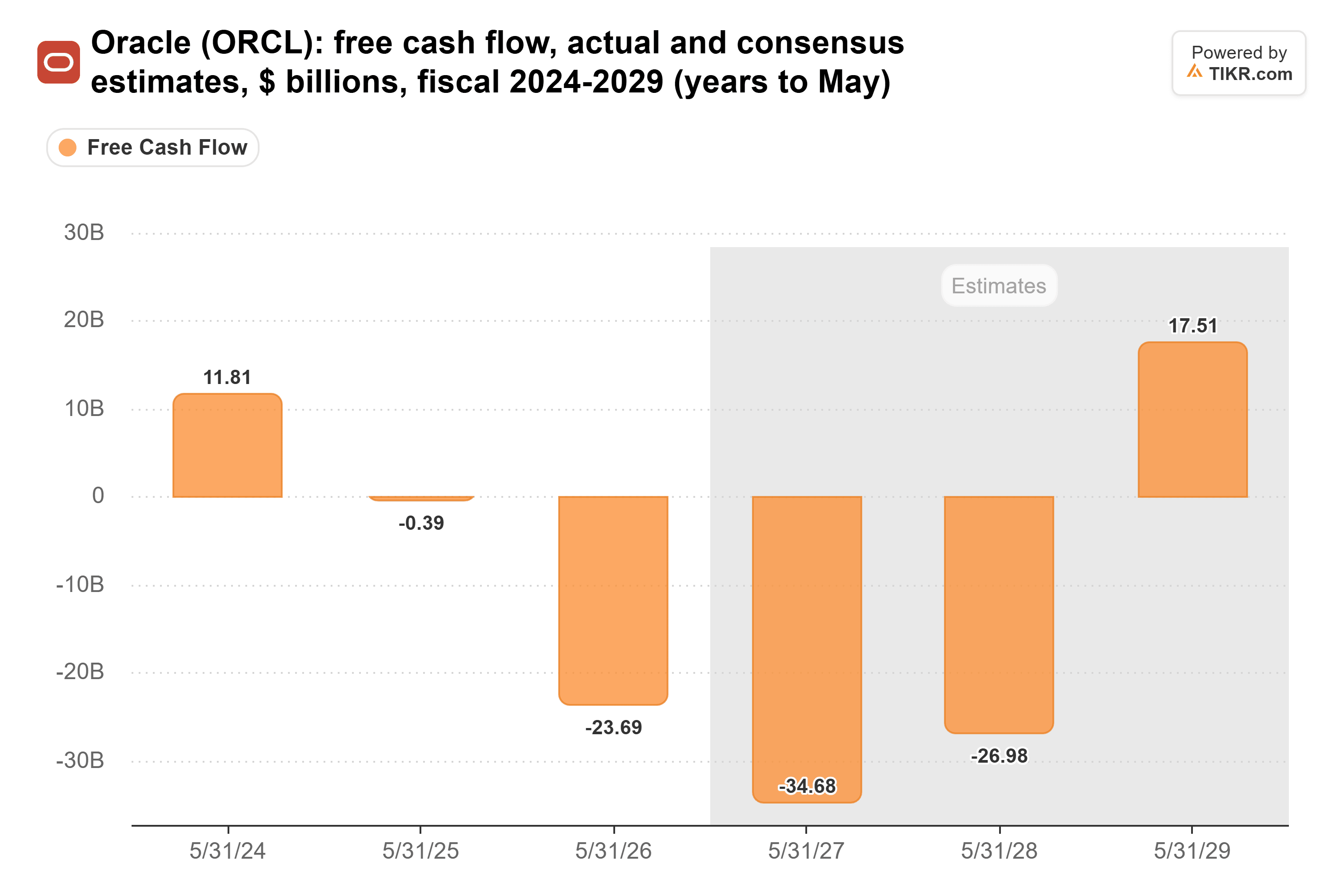
Oracle and the analysts are both counting on OpenAI paying for the capacity Oracle is building now.
TIKR tracks 42 analysts on Oracle. How many say “Buy”?
See the full breakdown of Buy, Hold, and Sell ratings on Oracle, along with Wall Street’s revenue and earnings estimates, all in one place. More than 500,000 investors use TIKR to research stocks like this one. See Oracle’s Analyst Ratings
A huge bill, mostly borrowed
Oracle’s capital spending went from $4.5 billion in fiscal 2022 to $55.7 billion in fiscal 2026, the year to May:

Management guides to $90 billion to $95 billion for fiscal 2027, though it expects customers to repay up to $25 billion of that.
Total debt, leases included, reached $167 billion at the end of fiscal 2026, against $31.9 billion of cash:
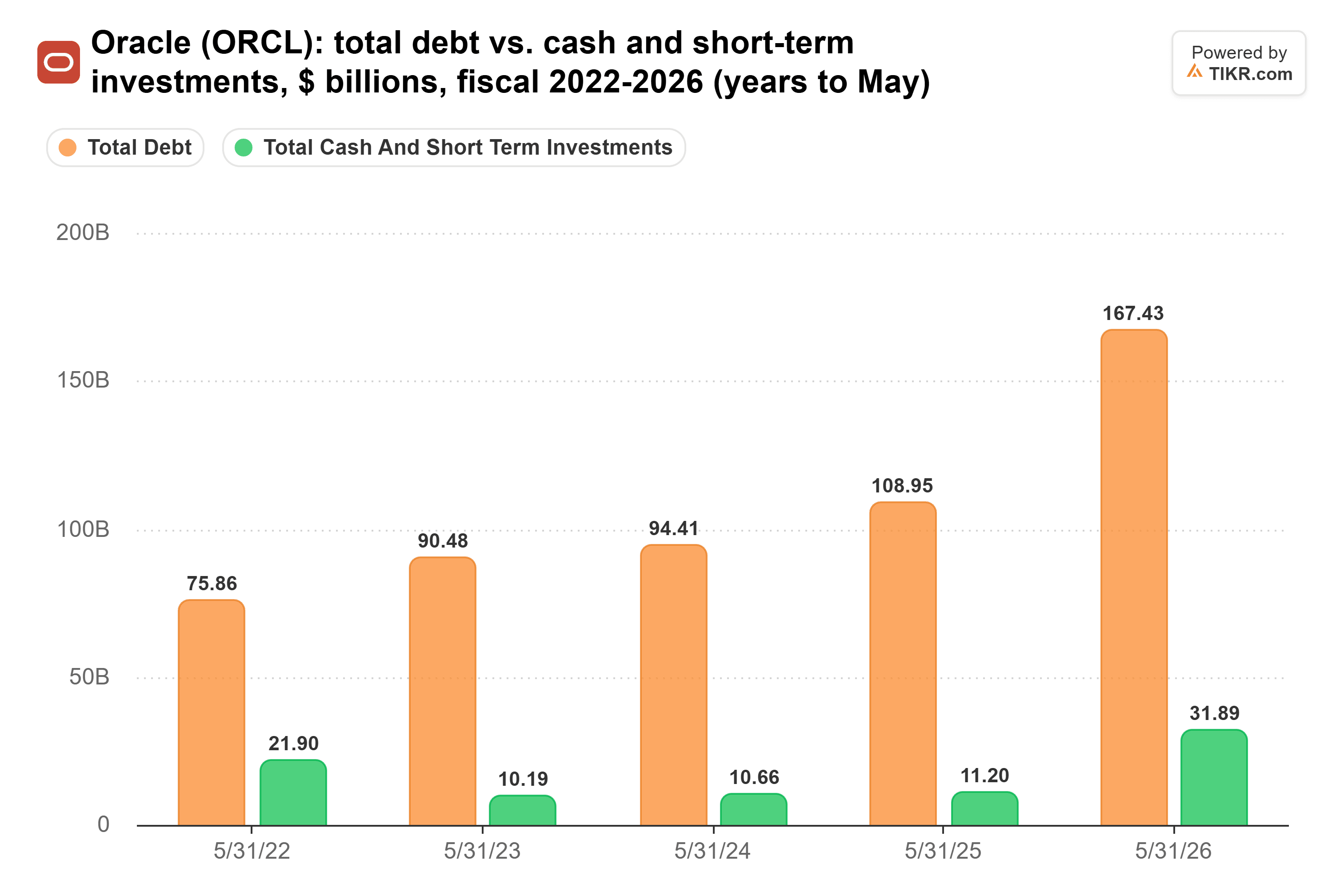
Another $288 billion of data center leases hasn’t started yet and sits off the balance sheet. S&P rates Oracle BBB-, one notch above junk.
Swap traders are pricing OpenAI
Whether Oracle earns that money back depends on OpenAI. In July, S&P estimated OpenAI accounts for about half of Oracle’s backlog, which reached $664 billion at the end of August.
OpenAI’s third-quarter revenue rose nearly 50% from the second quarter to $10 billion, per CFO Sarah Friar. But it also had an adjusted operating loss of $10.9 billion, before about $2.6 billion of stock-based pay, per The Wall Street Journal. Its latest funding round has reached $15 billion, per CNBC, half its $30 billion goal. That round covers roughly one to one and a half quarters of those losses.
AMD and Broadcom have the same customer
Two chipmakers have tied big pieces of their growth to OpenAI too.
In October 2025, AMD agreed to supply OpenAI with 6 gigawatts of GPUs. Its data center revenue nearly doubled to $8.5 billion in the third quarter as its MI450 GPUs launched. If bond traders doubt OpenAI can pay Oracle, shouldn’t AMD investors ask the same about its MI450 ramp?
Broadcom agreed the same month to deploy 10 gigawatts of OpenAI-designed accelerators by the end of 2029. Its AI semiconductor revenue rose 221% to $16.7 billion in its fiscal third quarter, and its Dec. 9 report is the next chance to hear how much of that growth comes from OpenAI.
OpenAI can still grow into its bills
If OpenAI keeps raising money, Oracle’s backlog turns into revenue at the 30% to 40% gross margins management expects on AI capacity.
Still, the swaps have the better argument. Oracle is very likely fully funded, but its credit spreads are right to stay wide, since nothing Oracle says about its own financing changes how much cash OpenAI has.
Oracle’s fiscal 2027 second-quarter results, expected in mid-December, are the next test, and new backlog from customers other than OpenAI would ease the worry.
So what is Oracle stock actually worth?
TIKR lets you forecast the future price of any stock in less than a minute. Just enter a few assumptions into TIKR’s valuation model and see what Oracle could be worth. Start from Wall Street consensus estimates, or adjust the inputs to reflect your own view of the business. It’s free to use.
Disclaimer:
Please note that the articles on TIKR are not intended to serve as investment or financial advice from TIKR or our content team, nor are they recommendations to buy or sell any stocks. We create our content based on TIKR Terminal’s investment data and analysts’ estimates. Our analysis might not include recent company news or important updates. TIKR has no position in any of the stocks mentioned. Thank you for reading, and happy investing!