Key Takeaways
- OpenAI President Greg Brockman says the world is short on compute, but analysts didn’t raise their capex forecasts for Amazon, Alphabet, Microsoft or Meta during third-quarter earnings season.
- Analysts expect Nvidia’s revenue to grow 71% in the fiscal year ending January 2028, faster than its biggest customers’ capex. Management raised its own outlook to about 75% on November 17.
- More of that growth has to come from AI labs like OpenAI, which Nvidia already backs with guarantees and investments.
- Nvidia’s estimates only hold up if the hyperscalers’ 2027 capex plans keep rising when they report early next year.
Nvidia (NVDA) shares closed up 31.48% at $165.05 on November 23 after the board reinstated Jensen Huang as CEO. The rally settled who runs the company, but not how long its biggest customers keep spending at today’s pace.
At the New York Times’ DealBook Summit on November 18, OpenAI President Greg Brockman was asked whether he’d gone to Elon Musk and Alphabet (GOOG) co-founder Sergey Brin for compute. “Oh, certainly I’ve asked,” he said. “Look, I think the world is not building enough compute.”
On November 23, Axios reported that analysts covering Amazon (AMZN), Alphabet, Microsoft (MSFT), Meta Platforms (META) and Oracle didn’t raise their capex forecasts during third-quarter earnings season, after raising them for a long time. Those are Nvidia’s biggest customers.
Nvidia is counting on bigger budgets
Hyperscale customers brought in $60.1 billion of Nvidia’s $115.8 billion in revenue in the quarter ended October 25, 2026, or about half the total. Analysts expect Nvidia’s revenue to nearly double this fiscal year to $424 billion, then climb to $726 billion in the year ending January 2028:

That’s 71% growth in fiscal 2028, and management is more bullish still. On the November 17 call, CFO Colette Kress, then also interim CEO, raised the fiscal 2028 growth outlook to about 75% from 70%. On the August call, management cited expectations that the top five hyperscalers would spend near $1.3 trillion on capex in 2027, up from about $800 billion in 2026.
TIKR tracks 63 analysts on Nvidia. How many say “Buy”?
See the full breakdown of Buy, Hold, and Sell ratings on Nvidia, along with Wall Street’s revenue and earnings estimates, all in one place. More than 500,000 investors use TIKR to research stocks like this one. See Nvidia’s Analyst Ratings
Nvidia has to outgrow its customers’ budgets
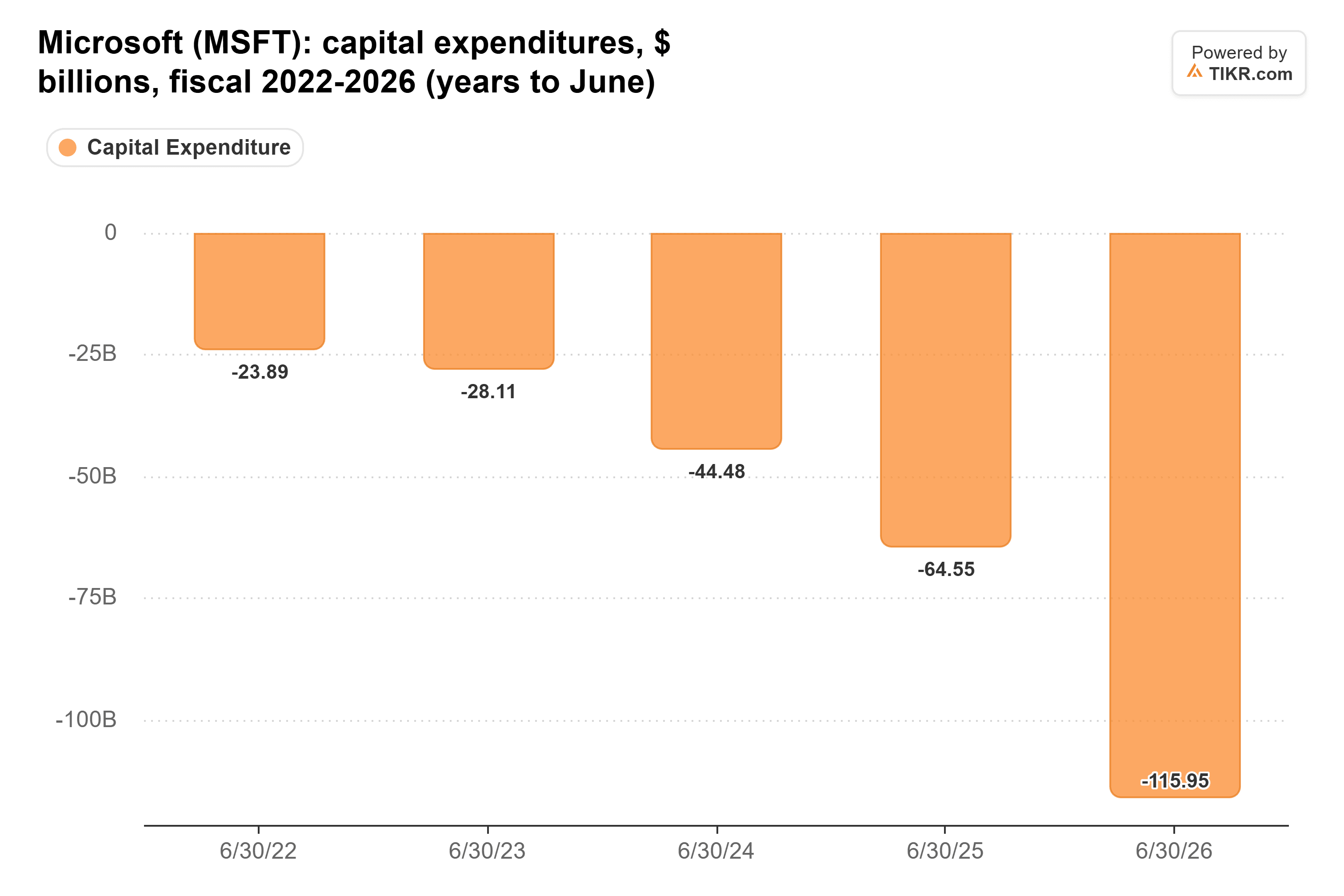
Those budgets have already multiplied. Microsoft spent $116 billion on capex in the fiscal year ended June 2026. That’s nearly 5x what it spent four years earlier and 80% more than the year before:
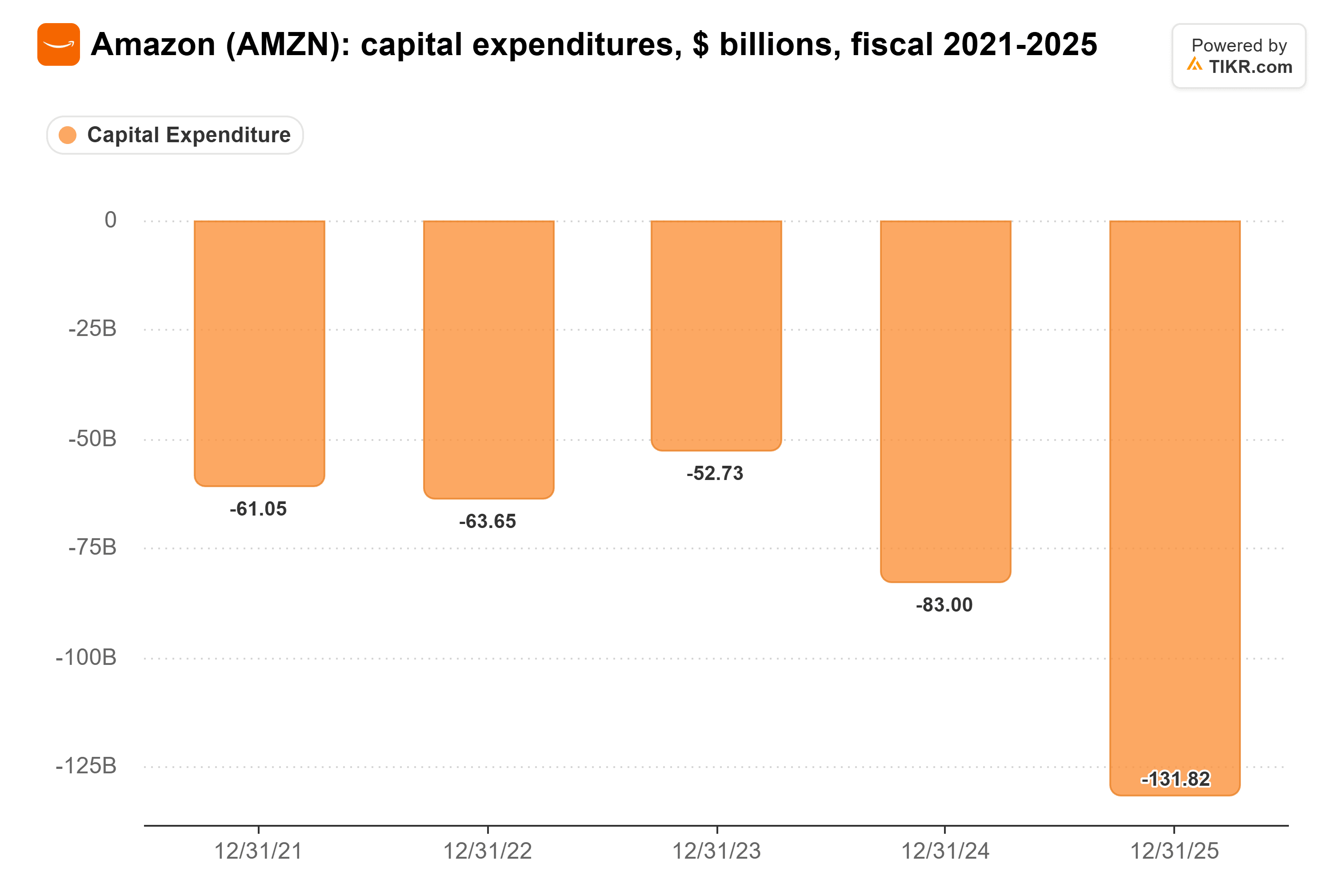
Amazon’s capex dipped in 2023, then jumped to $83.0 billion in 2024 and $132 billion in 2025:
Peter Boockvar, chief investment officer at OnePoint BFG Wealth Partners, thinks that growth is slowing. On the RiskReversal Pod, he said hyperscaler capex should be up about 100% in 2026 and that expectations for 2027 are about 50%.
Nvidia’s fiscal 2028 covers almost the same months. If Nvidia grows 71% while its biggest customers’ capex grows about 50%, it has to win a bigger share of every dollar they spend or find faster growth elsewhere. Even the $1.3 trillion management cited works out to about 63% growth.
Nvidia has two ways to close that gap. Management puts its revenue per gigawatt of data center capacity at about $25 billion for Blackwell and $40 billion for Vera Rubin. And sales to its AI cloud, industrial and enterprise customers grew 195% to $47.5 billion in the October quarter, compared with 71% growth for the hyperscalers.
OpenAI wants the compute. Can it pay for it?
Those faster-growing buyers include AI labs like OpenAI, which Brockman said doubled its enterprise revenue in the third quarter alone. But as David Lefkowitz, head of U.S. equities at UBS Global Wealth Management, told Axios: “We need to see the monetization at the AI layer, because that’s ultimately who’s paying for all this capex.”
More and more, Nvidia itself is helping to pay. In August, it agreed to guarantee up to $105 billion of conditional lease and power payments on OpenAI’s Ohio data center campus, which SoftBank’s SB Energy is building. Management said that month that Nvidia has invested nearly $50 billion in frontier AI labs, and it expects the labs it backs this way to make up roughly a quarter of next year’s business.
Watch the 2027 budgets
Brockman is probably right about the shortage. But with the hyperscalers’ forecasts flat, more of Nvidia’s growth has to come from labs it helps fund, and that revenue is riskier. The $726 billion fiscal 2028 consensus already sits below management’s 75% outlook, and flat customer budgets make even the consensus look closer to the best case than the base case.
The test comes with the hyperscalers’ next reports in late January and early February. If their 2027 capex plans add up to something near $1.3 trillion, Brockman’s shortage becomes Nvidia revenue. If they come in closer to flat, Nvidia’s estimates are likely to come down.
So what is Nvidia stock actually worth?
TIKR lets you forecast the future price of any stock in less than a minute. Just enter a few assumptions into TIKR’s valuation model and see what Nvidia could be worth. Start from Wall Street consensus estimates, or adjust the inputs to reflect your own view of the business. It’s free to use.
Disclaimer:
Please note that the articles on TIKR are not intended to serve as investment or financial advice from TIKR or our content team, nor are they recommendations to buy or sell any stocks. We create our content based on TIKR Terminal’s investment data and analysts’ estimates. Our analysis might not include recent company news or important updates. TIKR has no position in any of the stocks mentioned. Thank you for reading, and happy investing!