Key Takeaways
- Dwarkesh Patel says AI labs must quadruple R&D compute yearly just to keep the same pace of progress.
- That ties chip demand to the race itself, favoring NVIDIA, Broadcom and TSMC while the spending lasts.
- Analysts already expect NVIDIA’s and Broadcom’s revenue to roughly quadruple over three years.
- The risk is cost: author Ramez Naam estimates that boosting Anthropic’s capabilities now costs 8x what it did two years ago.
Podcast host Dwarkesh Patel just laid out an argument that, to me, reads like one of the cleanest bull cases for NVIDIA (NVDA) I’ve heard in a while. The same case covers Broadcom (AVGO), which designs custom AI chips for buyers like Alphabet (GOOG), and Taiwan Semiconductor Manufacturing (TSM), which makes chips for both and grew revenue 41.2% last quarter.
In his Nov. 13 essay, Patel argued that new AI ideas are already getting harder to find:
“AI companies have to quadruple their R&D compute and double their workforce every single year just to maintain the same rate of progress.”
If that holds, it’s a great setup for whoever sells the chips: a lab that only wants to keep pace has to keep buying far more compute. Patel doesn’t treat it as a sure thing, though. He gives a 50% chance to a scenario where automated AI research drives fast progress without more compute.
Wall Street Already Expects NVIDIA to Ride the Race
NVIDIA brought in $216 billion of revenue in the year ended January 2026. Consensus calls for $412 billion this fiscal year and $896 billion in the year ending January 2029.
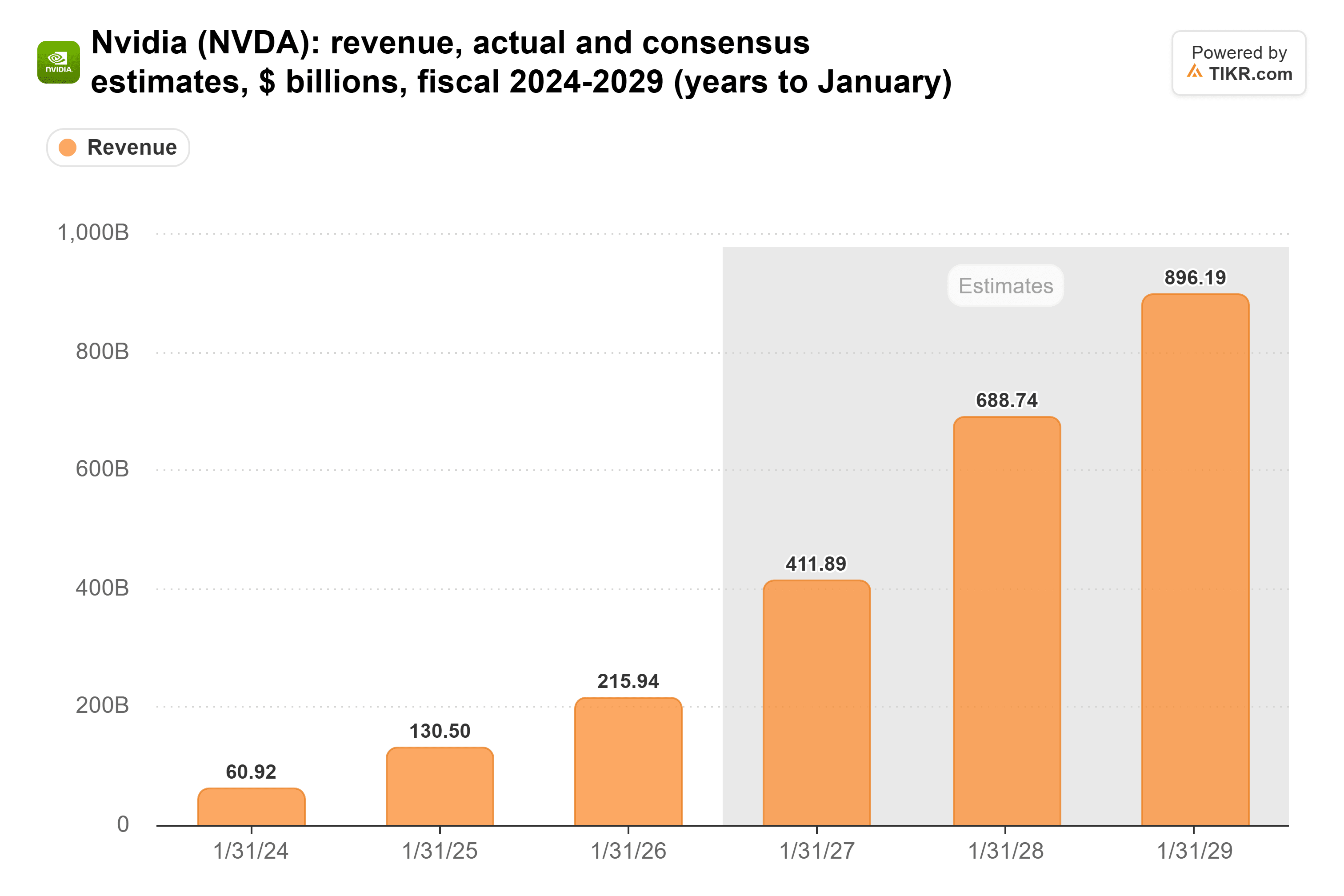
That’s roughly 4x in three years, though it doesn’t map neatly onto Patel’s figure. Compute measures work done, while NVIDIA’s revenue also depends on chip prices, product mix, market share and buyers well beyond the labs.
What stands out is how fast the estimates slow: about 30% growth in the year ending January 2029, then 21% the year after (only eight analysts go that far). If labs keep expanding compute this fast, those later years could prove conservative, though Patel’s argument alone doesn’t prove it.
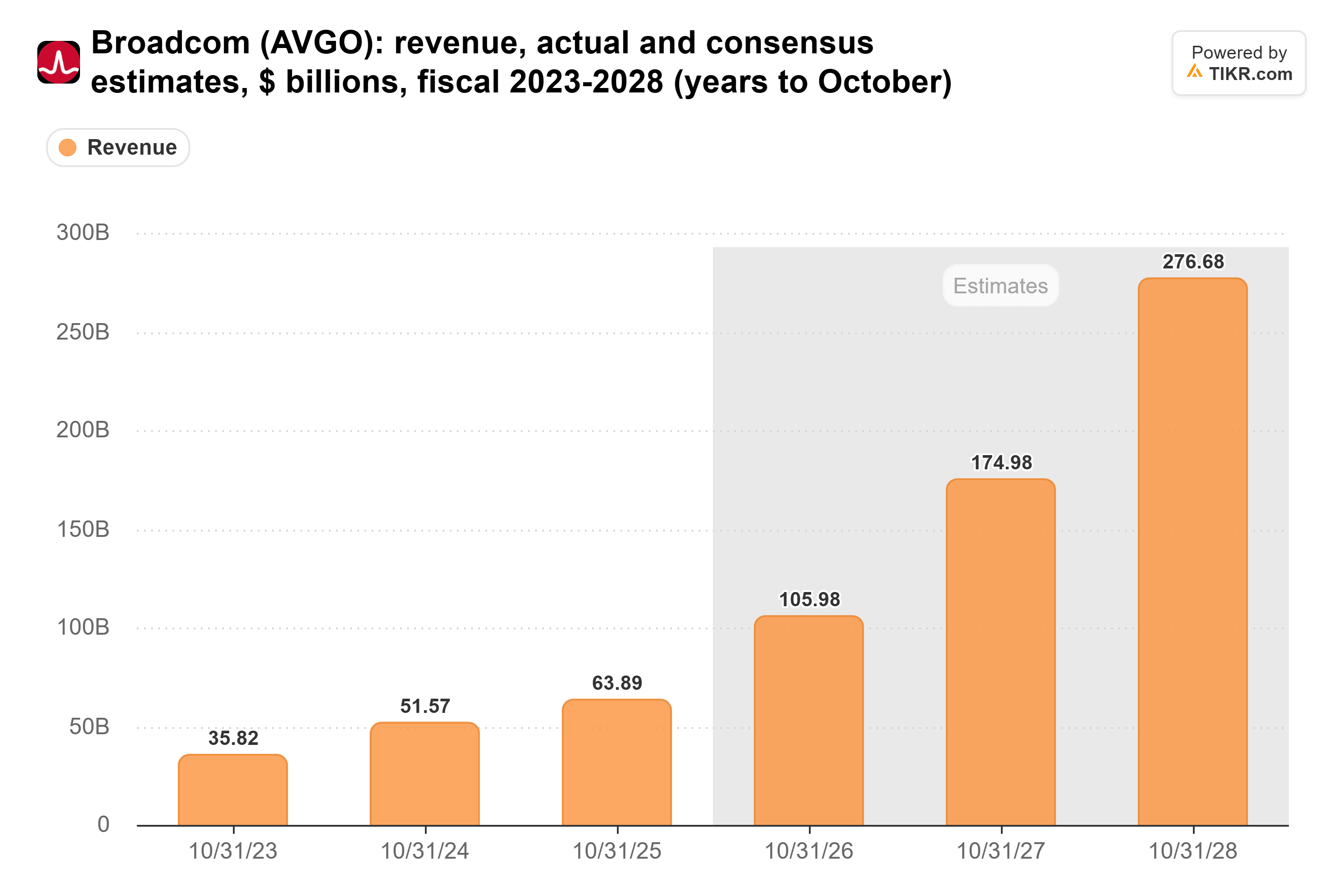
Broadcom looks similar, with revenue expected to climb from $63.9 billion in fiscal 2025 to $277 billion in fiscal 2028.
TSMC gets paid whichever chip wins. CEO C.C. Wei said in October that all AI players work with TSMC, which still expects AI accelerator revenue to grow at a mid-to-high-50s percent annual rate from 2024 to 2029.
TIKR Tracks 62 Analysts on NVIDIA. How Many Say “Buy”?
See the full breakdown of Buy, Hold, and Sell ratings on NVIDIA, along with Wall Street’s revenue and earnings estimates, all in one place. More than 500,000 investors use TIKR to research stocks like this one. See NVIDIA’s Analyst Ratings
The Bill Keeps Getting Bigger
Author Ramez Naam wrote on X that Anthropic gets less capability per billion dollars: “It’s now 8x as expensive to boost AI capabilities as it was 2 years ago.”
Alphabet’s capital spending nearly quadrupled from 2021 to 2025, and it expects $195 billion to $205 billion this year, with a significant rise in 2027.
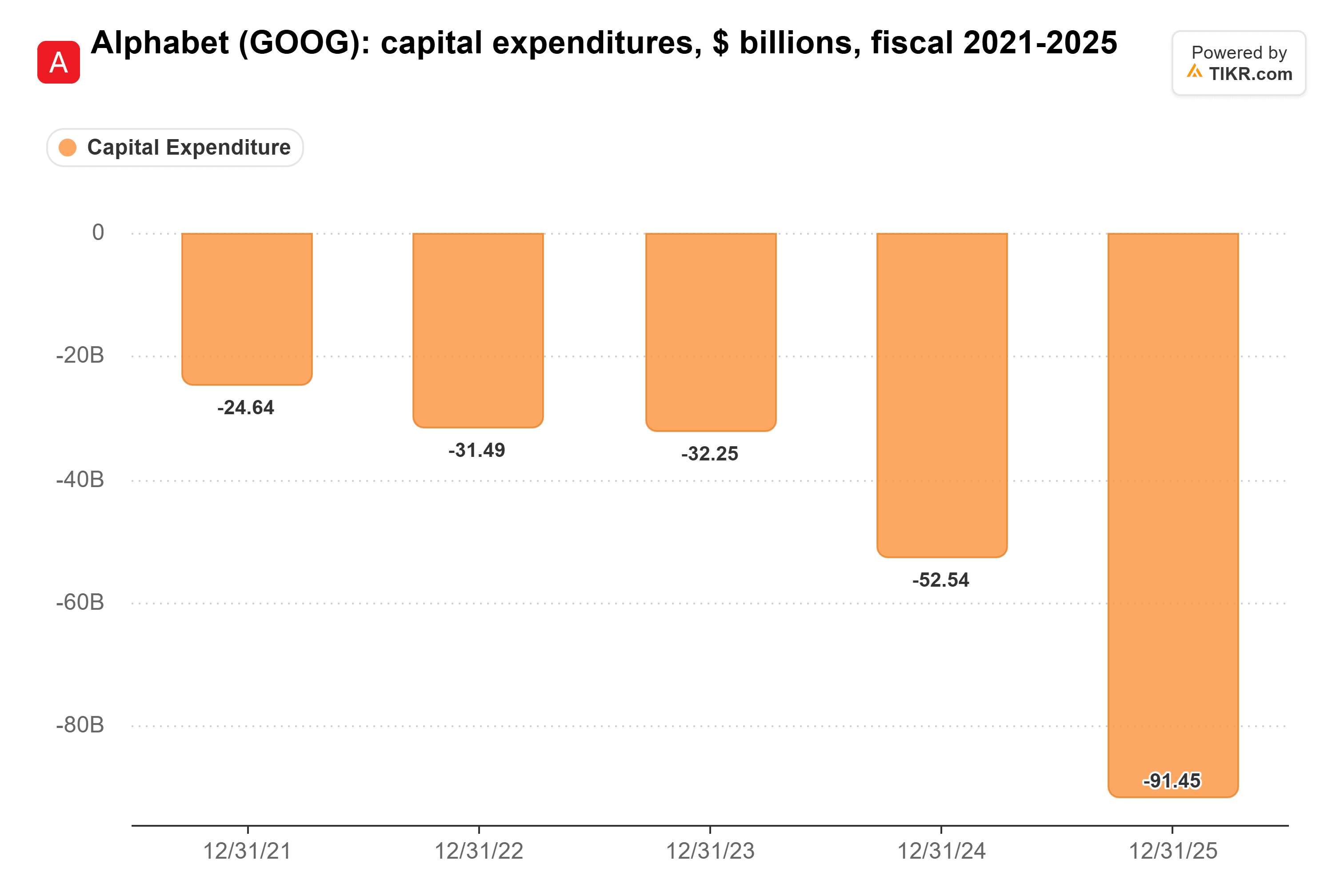
That now outruns Alphabet’s cash: free cash flow was negative $9.1 billion last quarter, and in June it announced an $80 billion equity raise, part of it for AI infrastructure.
NVIDIA’s own help may slow, too. CFO Colette Kress said on the August call that NVIDIA had invested nearly $50 billion in frontier labs. Since Jensen Huang resigned on Nov. 11, The Information has reported that NVIDIA is expected to slow its AI investing and credit guarantees.
Why the Race Still Favors NVIDIA
Naam’s math hurts the labs’ investors more than their suppliers. If each gain costs more, a lab that wants to stay in front buys even more compute. The risk is the day the money stops, and buyers aren’t there yet: Alphabet is still raising its budget, and Wei says AI demand still exceeds supply.
As long as the money keeps coming, rising compute budgets support NVIDIA’s revenue, even with some of that spending going to custom chips like Google’s TPUs. NVIDIA reports Nov. 17, and its outlook will show whether buyers are keeping pace.
So What Is NVIDIA Stock Actually Worth?
TIKR lets you forecast the future price of any stock in less than a minute. Just enter a few assumptions into TIKR’s valuation model and see what NVIDIA could be worth. Start from Wall Street consensus estimates, or adjust the inputs to reflect your own view of the business. It’s free to use.
Disclaimer:
Please note that the articles on TIKR are not intended to serve as investment or financial advice from TIKR or our content team, nor are they recommendations to buy or sell any stocks. We create our content based on TIKR Terminal’s investment data and analysts’ estimates. Our analysis might not include recent company news or important updates. TIKR has no position in any of the stocks mentioned. Thank you for reading, and happy investing!