Key Takeaways
- Nvidia fell 7% today after the US blacklisted its customer Megaspeed and a Singapore unit of Alibaba, a day after a 31% jump on Jensen Huang’s return.
- Huang faces a Senate hearing on Dec. 3, and the board’s probe is still open.
- Credo fell with the AI hardware group, and Alibaba called its unit’s listing a mistake.
- Analysts still expect Nvidia’s earnings to more than double in two years, so the stock already prices in plenty of bad news.
Nvidia (NVDA) fell 7% today, giving back part of Monday’s 31% jump on Jensen Huang’s return as CEO.
The Commerce Department has added Nvidia customer Megaspeed and a Singapore unit of Alibaba (BABA) to its Entity List over the risk of AI chip diversion, news that broke before the open. The AI hardware group fell with it, Credo Technology (CRDO) down 12% among them.
Megaspeed brings the Huang saga back
Nvidia investors already know the name Megaspeed. Huang’s admitted affair was reportedly with Megaspeed executive Alice Huang (no relation), an alleged Chinese spy, and a report this month said the affair helped move $7.5 billion of chips into China. Huang testifies before a Senate committee on Dec. 3. The board’s independent committee is also still investigating reports that he was the target of a foreign intelligence effort.
On CNBC’s Squawk Box this morning, Rochefort Asset Management founder Kyle Bass called the fallout “an absolute, calamitous governance failure.”
Alibaba and Credo have their own questions
Alibaba called the listing of its Singapore unit a mistake, and the timing is rough: its AI Cloud and Compute Services revenue rose 53% year over year in the September quarter. Its T-Head unit’s new Zhenwu V900 AI chip gives it a fallback, so the question for its February report is whether overseas cloud growth slows.
Credo depends on the same AI buildout, with fiscal first-quarter revenue up 115% year over year to $479.0 million. Its Dec. 1 report will show whether any of that demand runs through the Southeast Asian channels Washington just targeted.
TIKR tracks 61 analysts on Nvidia. How many say “Buy”?
See the full breakdown of Buy, Hold, and Sell ratings on Nvidia, along with Wall Street’s revenue and earnings estimates, all in one place. More than 500,000 investors use TIKR to research stocks like this one. See Nvidia’s Analyst Ratings
The earnings case still holds
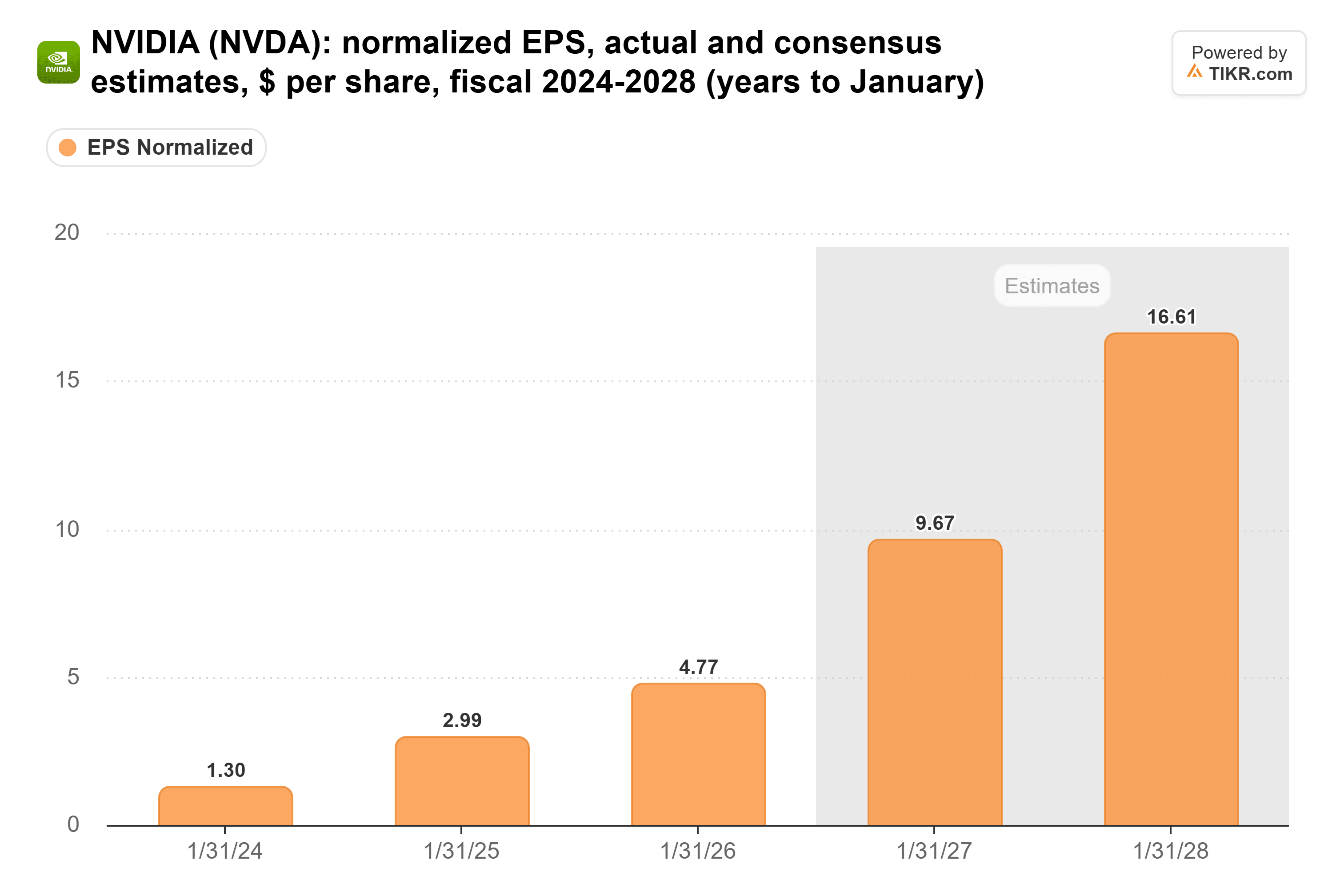
Analysts expect Nvidia’s normalized EPS to climb from $9.67 in the fiscal year ending January 2027 to $21.77 two years later:
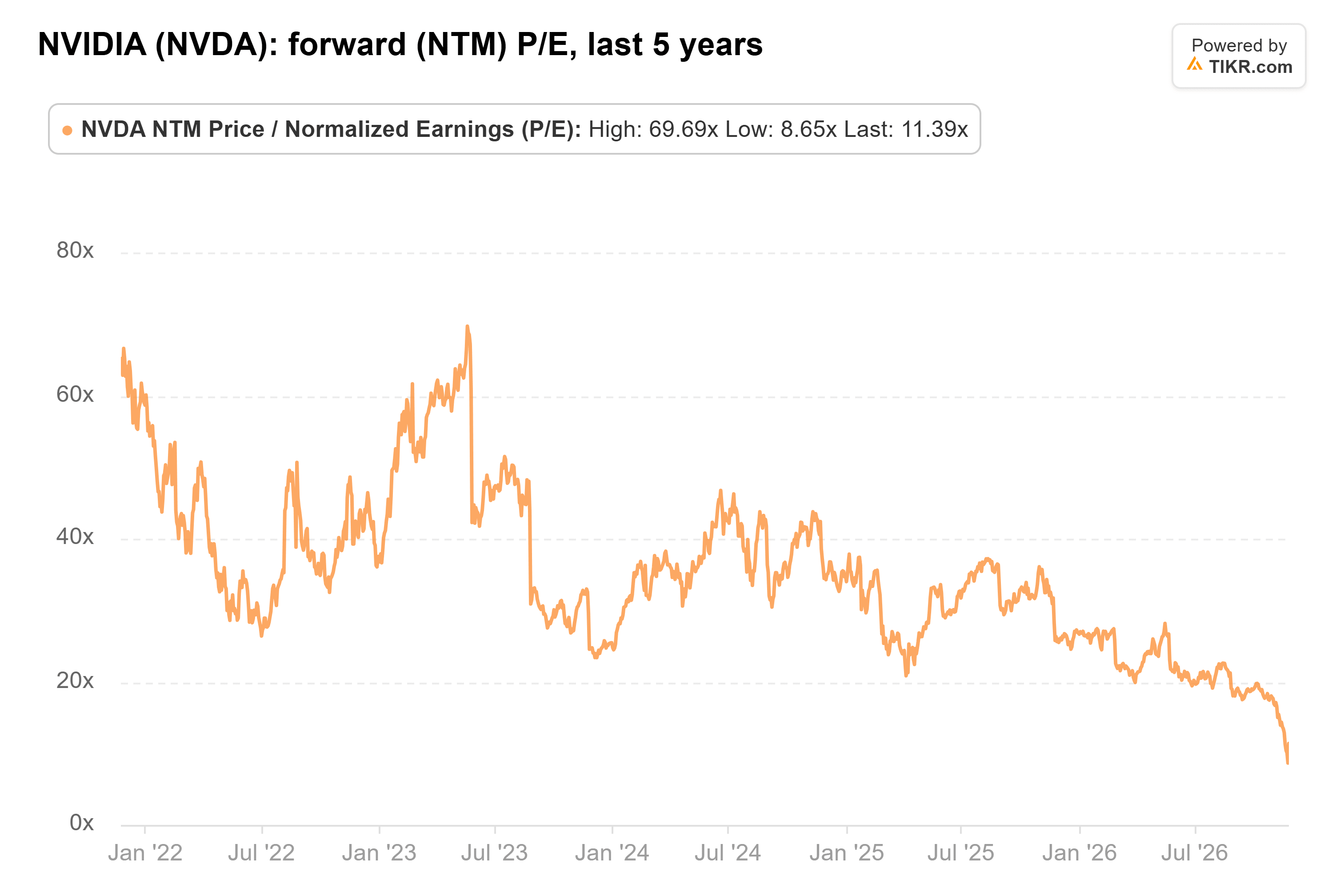
Yet the stock closed Monday at 11x forward earnings, against a five-year average of 35x, and today’s drop takes it lower still:
The legal bill looks manageable. D.A. Davidson’s Gil Luria puts Nvidia’s settlements at hundreds of millions to low billions of dollars, against $65.3 billion of GAAP net income last quarter. The bigger risk is that estimates come down if Washington goes after more Southeast Asian buyers like Megaspeed.
The way I see it, at this multiple, today’s drop is an overreaction. Huang’s testimony on Dec. 3 and Nvidia’s quarterly filing in early December will show whether the October quarter’s $115.8 billion of revenue holds up.
So what is Nvidia stock actually worth?
TIKR lets you forecast the future price of any stock in less than a minute. Just enter a few assumptions into TIKR’s valuation model and see what Nvidia could be worth. Start from Wall Street consensus estimates, or adjust the inputs to reflect your own view of the business. It’s free to use.
Disclaimer:
Please note that the articles on TIKR are not intended to serve as investment or financial advice from TIKR or our content team, nor are they recommendations to buy or sell any stocks. We create our content based on TIKR Terminal’s investment data and analysts’ estimates. Our analysis might not include recent company news or important updates. TIKR has no position in any of the stocks mentioned. Thank you for reading, and happy investing!