Key Takeaways
- NVIDIA’s supply commitments rose to $390 billion from $279 billion in one quarter, mostly for multi-year memory purchases.
- Micron trades at 4.0x forward earnings, though analysts expect its EPS to keep rising through fiscal 2028.
- NVIDIA hasn’t named its memory suppliers, SK hynix led HBM in 2025, and Sandisk faces warnings of a NAND glut in 2027.
- Micron’s December report is the next test of whether its earnings last.
NVIDIA (NVDA) added $111 billion of supply commitments in a single quarter, and most of that is memory. Yet Micron Technology (MU) trades at just 4.0x forward earnings, and Sandisk (SNDK) trades at 3.3x. SK hynix (SKHY), the biggest HBM supplier, is in the same spot.
One investor on X asked whether anyone remembers when news like NVIDIA’s “was good news for memory names like $MU and SK Hynix.”
What NVIDIA signed up for
On NVIDIA’s fiscal third-quarter call on Nov. 17, its first since Jensen Huang resigned as CEO, interim CEO and CFO Colette Kress said its purchase commitments rose to $390 billion, “reflecting our confidence in the long-term sustainability of demand for NVIDIA infrastructure.” That is up from $279 billion a quarter earlier, and NVIDIA’s CFO commentary says the increase was mainly for memory bought over several years.
Of those commitments, $203 billion fall in fiscal 2028, which runs from February 2027 to January 2028. Its filing three months earlier showed $87 billion for that year. That’s more than double, for a stretch that overlaps Micron’s fiscal 2027 and 2028.
TIKR tracks 63 analysts on Nvidia. How many say “Buy”?
See the full breakdown of Buy, Hold, and Sell ratings on Nvidia, along with Wall Street’s revenue and earnings estimates, all in one place. More than 500,000 investors use TIKR to research stocks like this one. See Nvidia’s Analyst Ratings
Priced for a bust anyway
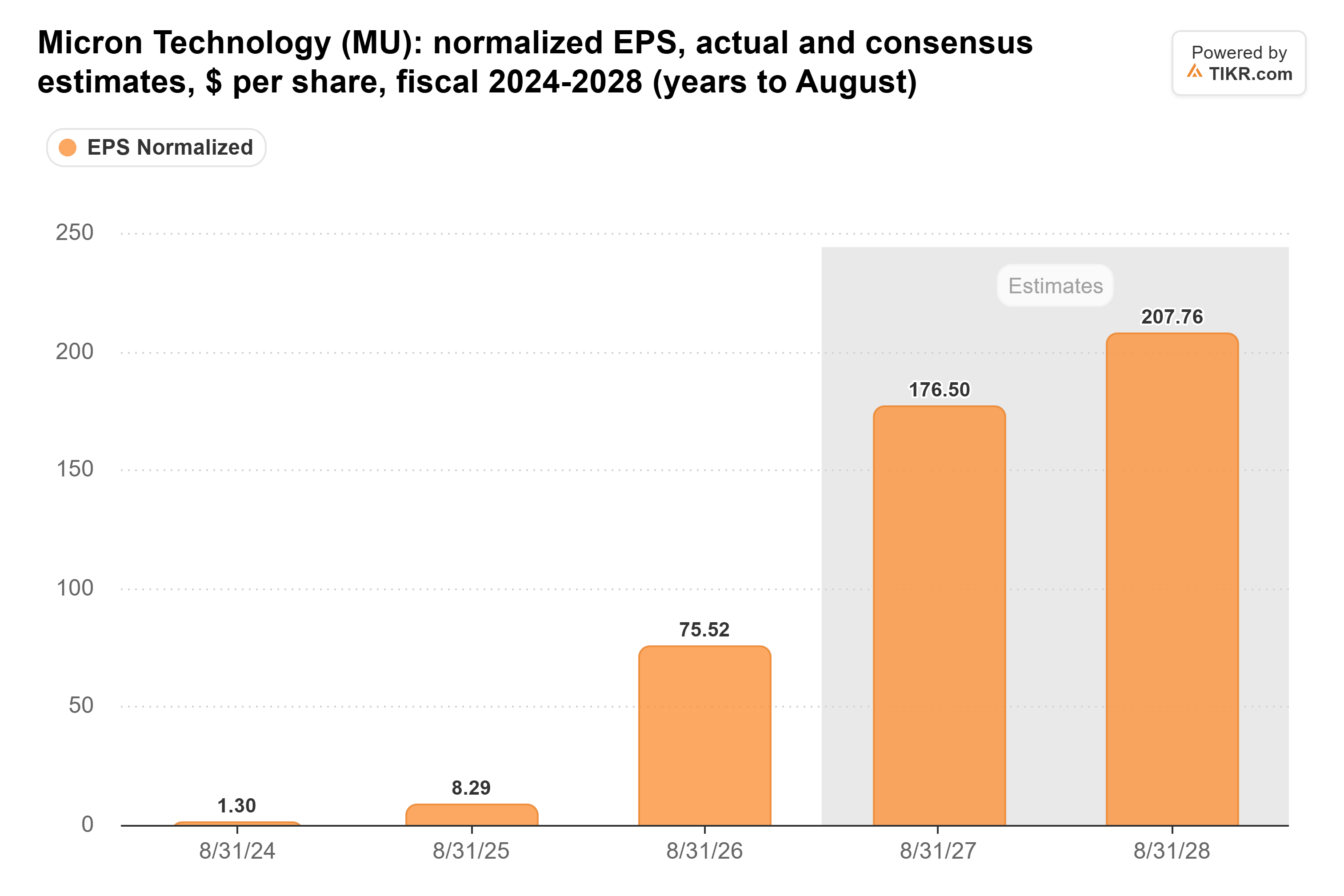
Normalized EPS was $75.52 in fiscal 2026, and consensus has it rising to about $177 in fiscal 2027 and $208 in fiscal 2028.
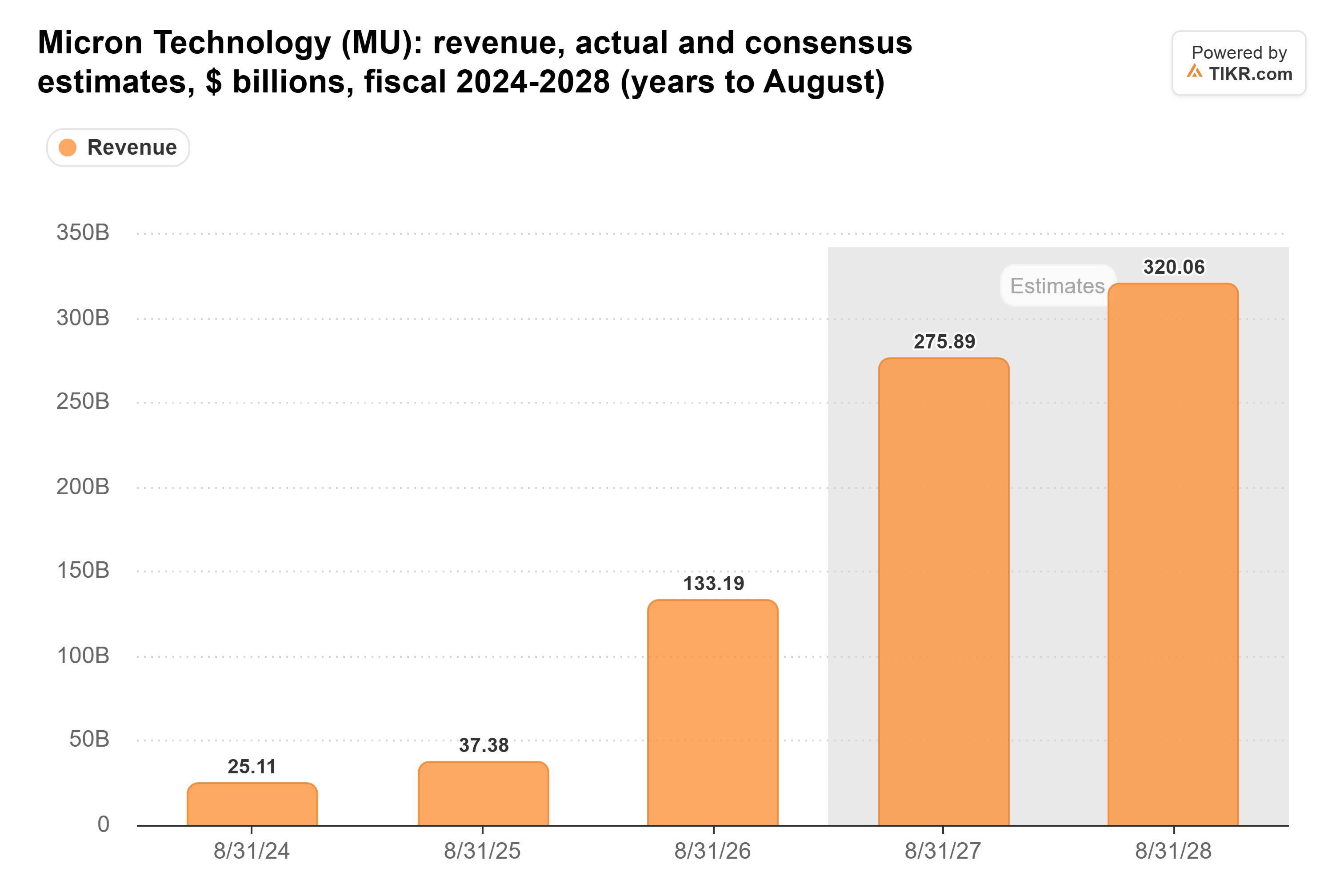
Revenue follows the same path, from $133 billion in fiscal 2026 to an estimated $276 billion in fiscal 2027 and $320 billion in fiscal 2028.
Micron has some of that under contract already: about $134 billion of remaining performance obligations at Sept. 3, from multi-year agreements that management estimates cover over 35% of revenue through 2030.
Even so, Micron’s 4.0x forward P/E is about where it was at quarter-ends in 2017 and 2018 (3.7x to 5.3x), far below its 9.9x median since 2014. If analysts cut its earnings in half tomorrow, Micron would trade at 8.0x, still below that median.
NVIDIA hasn’t said whose memory it’s buying
NVIDIA doesn’t name its memory suppliers. According to IDC figures in SK hynix’s US listing filing, SK hynix held 56.4% of HBM revenue in the first quarter of 2026, which is why an earlier TIKR piece on the same filing put it first in line. On its September call, Micron said it had already contracted the vast majority of its calendar 2027 HBM supply at significantly higher prices.
Sandisk is a shakier case. Its data center revenue rose 61% from the quarter before to $4.80 billion in the quarter ended Oct. 2. But GF Securities now sees NAND moving into surplus in 2027. It calls Sandisk the most exposed, and thinks DRAM and HBM protect Micron better.
Memory has been here before
Micron closed at $656.39 on Nov. 5, 46% below its June 25 record close of $1,213.56, after a 17.5% one-day drop in a chip selloff. A post on the r/ValueInvesting subreddit argues both sides. In 2018 and 2022, the stock bottomed while earnings were still at the top. In 2016, it kept falling until earnings had already cracked.
The last time Micron’s forward P/E was this low, its GAAP EPS fell 79% between fiscal 2018 and fiscal 2020, from $11.51 to $2.37. Contracts are the difference this time, but only about a quarter of that $134 billion is expected to turn into revenue in the next 12 months. There is legal noise too: on Nov. 14, a federal judge let a proposed DRAM price-fixing class action against Micron, Samsung, and SK hynix move forward. The allegations are unproven.
That multiple prices in an earnings collapse that NVIDIA’s own commitments push past early 2028. Micron looks too cheap for that much contracted demand.
Micron reports its fiscal first quarter in mid-to-late December. Management calls that quarter the year’s margin floor. Revenue near the $61.5 billion guide and a non-GAAP gross margin at or above 86.25% would support the case.
So what is Micron stock actually worth?
TIKR lets you forecast the future price of any stock in less than a minute. Just enter a few assumptions into TIKR’s valuation model and see what Micron could be worth. Start from Wall Street consensus estimates, or adjust the inputs to reflect your own view of the business. It’s free to use.
Disclaimer:
Please note that the articles on TIKR are not intended to serve as investment or financial advice from TIKR or our content team, nor are they recommendations to buy or sell any stocks. We create our content based on TIKR Terminal’s investment data and analysts’ estimates. Our analysis might not include recent company news or important updates. TIKR has no position in any of the stocks mentioned. Thank you for reading, and happy investing!