Key Takeaways
- Nu Holdings (NU) stock has fallen approximately 21% since October 6, as Brazil’s presidential election triggered a sharp selloff in the digital bank’s shares.
- MercadoLibre (MELI) also declined approximately 19% over the same period, despite reporting strong third-quarter growth in Brazil.
- Nu’s second-quarter gross revenue increased 39% to nearly $5.9 billion, while analysts expect normalized EPS to rise from $0.63 in 2025 to $1.13 in 2027.
- Nu appears potentially undervalued following the selloff, although political uncertainty, credit quality, and upcoming earnings remain important risks.
What Happened?
Nu Holdings (NU) stock has fallen approximately 21% from its October 6 closing price of $15.66 to $12.34 on November 11, as political uncertainty in Brazil weighed on investor sentiment.
The biggest decline followed President Luiz Inácio Lula da Silva’s victory over Flávio Bolsonaro in Brazil’s October 25 presidential runoff, which Lula won with 51.79% of the vote.
Investors had initially positioned for a Bolsonaro victory following his stronger-than-expected first-round performance. Nu shares jumped 13% on October 5, and JPMorgan raised its price target from $20 to $23 the following day.
However, Lula’s victory reversed that optimism. Nu shares plunged approximately 17% on October 26, reflecting concerns about Brazil’s political outlook and its potential impact on financial companies.
Nu also announced on October 23 that Chief Technology Officer Eric Young would resign, with founder and CEO David Vélez temporarily overseeing Global Platforms.
Meanwhile, MercadoLibre (MELI), another major Latin American company, declined approximately 19% over the same period.
Despite the market pressure, MercadoLibre’s third-quarter earnings report showed revenue growth of 45% to $10.75 billion, with Brazil delivering its strongest regional performance.
Although those results covered the quarter ended September 30, before Brazil’s presidential runoff, they highlight the difference between underlying business performance and political concerns affecting valuations.
For Nu, the central question is whether the selloff reflects weakening fundamentals or investors demanding a lower valuation because of political risk.
Is Nu Holdings Stock Undervalued or Overvalued?
Nu’s underlying business entered the election period with strong financial momentum.
According to its second-quarter financial results, gross revenue reached nearly $5.9 billion, increasing 39% year over year, while quarterly net income surpassed $1.1 billion for the first time.
The digital bank continued expanding its customer base across Latin America, demonstrating the scale of its technology-driven model without relying on extensive physical branch networks.
Speaking on the Invest Like the Best podcast in October, CEO David Vélez highlighted Nu’s operating efficiency, saying, “we have 140 million customers with 10,000 employees.”
That efficiency remains central to Nu’s competitive position against traditional banks with larger workforces and extensive branch networks.
According to TIKR’s November 3 consensus estimates, normalized EPS could increase from $0.63 in 2025 to $1.13 in 2027, representing approximately 79% cumulative earnings growth over two years.
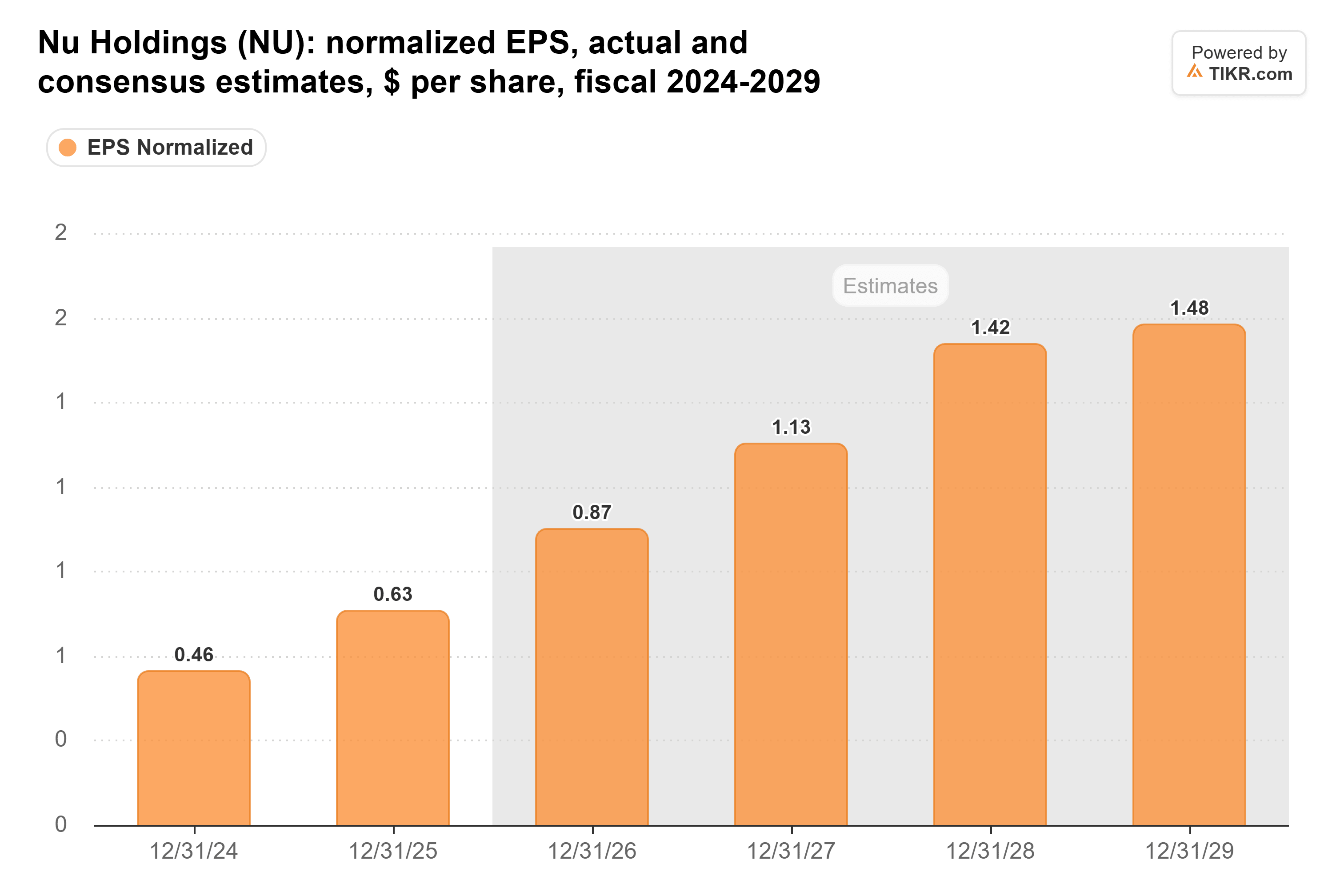
However, these estimates were compiled before Nu’s upcoming quarterly results, and only six analysts contributed to the 2026 and 2027 forecasts shown in the chart.
Valuation has also become more attractive following the decline.
On November 5, Nu traded at approximately 4.7 times tangible book value, near its three-year low and considerably below its historical average of 8.2 times, according to TIKR data.
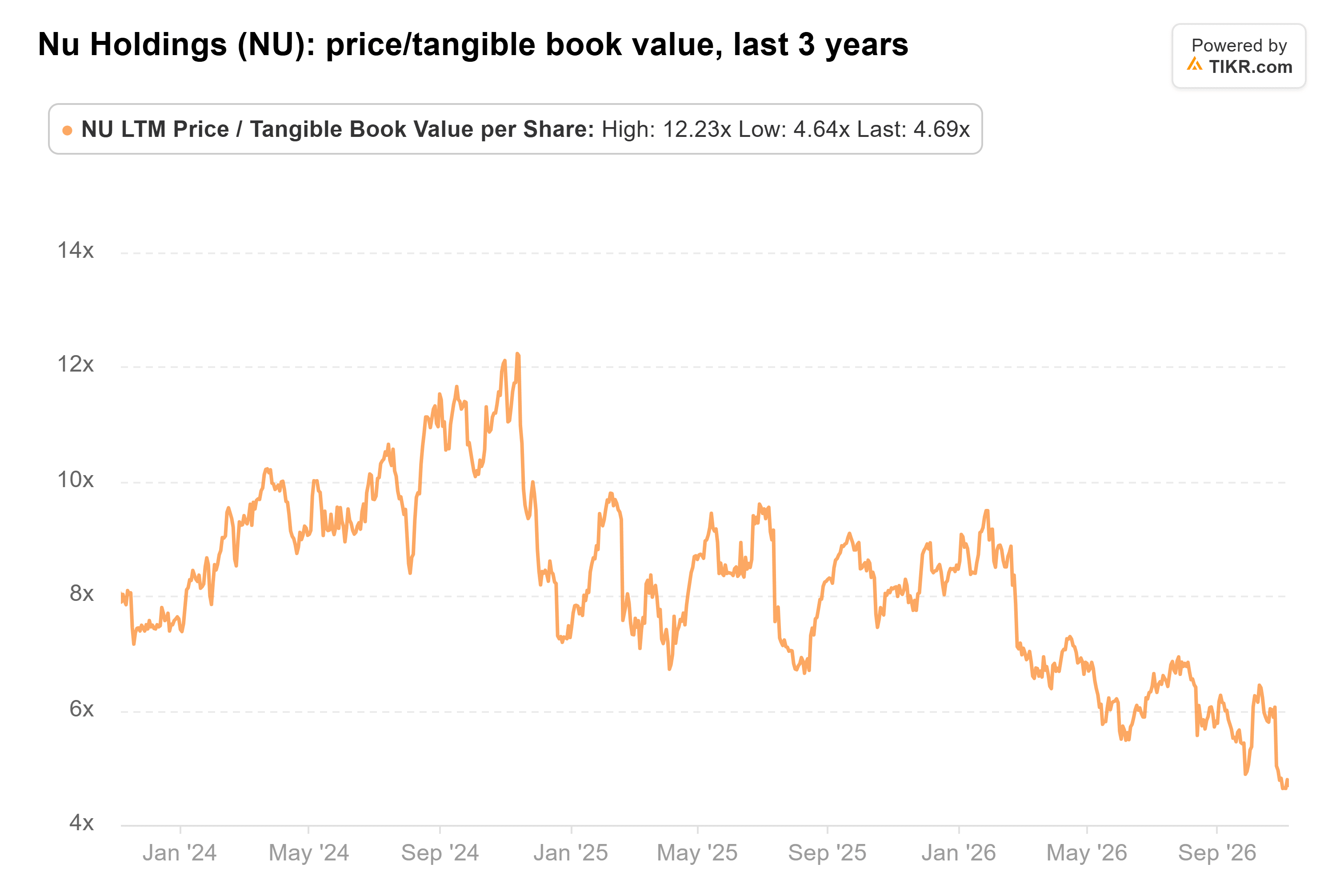
According to TIKR’s earlier consensus data, 23 analysts had an average price target of $18.62 for Nu, implying approximately 51% upside from its November 11 closing price.
Nu appears potentially undervalued relative to its historical tangible book valuation, particularly if earnings continue growing toward analysts’ expectations. Its expanding customer base, efficient digital banking model, and profitability could support a recovery over the next 12 months. However, higher credit losses, slower lending growth, and political uncertainty could keep its valuation below historical levels. Expansion into the United States also introduces regulatory and execution risks. Ultimately, Nu’s valuation looks attractive, but its upcoming quarterly results will be important in determining whether the growth outlook remains intact.
For now, Nu appears to offer a potentially attractive long-term opportunity, although investors should weigh its earnings prospects against the risks behind the recent selloff.
So what is Nu Holdings stock actually worth?
TIKR lets you forecast the future price of any stock in less than a minute. Just enter a few assumptions into TIKR’s valuation model and see what Nu Holdings could be worth. Start from Wall Street consensus estimates, or adjust the inputs to reflect your own view of the business. It’s free to use.
Disclaimer:
Please note that the articles on TIKR are not intended to serve as investment or financial advice from TIKR or our content team, nor are they recommendations to buy or sell any stocks. We create our content based on TIKR Terminal’s investment data and analysts’ estimates. Our analysis might not include recent company news or important updates. TIKR has no position in any of the stocks mentioned. Thank you for reading, and happy investing!