Key Takeaways
- The US added Apex Enterprise Solutions, an Alibaba subsidiary in Singapore that rents computing power in Southeast Asia, to its entity list, along with Nvidia customer Megaspeed International.
- The listing came days after management cut next year’s cloud growth target to 30% to 45% and warned that its 20 gigawatt build may shrink.
- More of Alibaba’s cloud plan now rests on its own chips, and management doesn’t expect positive cash flow until the second half of 2028.
- Baidu is also building its own AI chips and could pick up Chinese cloud customers Alibaba can’t serve.
Alibaba (BABA) just lost part of the workaround that kept its cloud supplied with AI computing power.
On Monday, the Commerce Department added Apex Enterprise Solutions, a Singapore subsidiary that secures computing capacity in Southeast Asia for Alibaba, to its entity list. Nvidia (NVDA) customer Megaspeed International went on with it. US authorities have investigated Megaspeed since 2024 over suspected chip diversion to China.
Alibaba and Baidu (BIDU) were already among the Chinese companies the Pentagon accused in June of supporting the Chinese military.
What Washington just cut off
Anything covered by US export rules now needs a license to reach Apex, and applications are presumed to be denied. Reuters reported, citing a person familiar with the arrangement, that Apex paid about $4.2 billion upfront to Megaspeed and other companies to rent computing capacity in Southeast Asia. That’s more than a fifth of Alibaba’s capital spending in fiscal 2026 (the year ended March 2026).
Alibaba says the listing “is erroneous because Apex has never diverted advanced computing chips subject to US export restrictions,” a spokesperson told Bloomberg.
TIKR tracks 40 analysts on Alibaba. How many say “Buy”?
See the full breakdown of Buy, Hold, and Sell ratings on Alibaba, along with Wall Street’s revenue and earnings estimates, all in one place. More than 500,000 investors use TIKR to research stocks like this one. See Alibaba’s Analyst Ratings
The cloud plan was already shrinking
The timing hurts. On Alibaba’s Nov. 19 earnings call, CEO Eddie Wu said new US export rules may lead to “a downward revision of that long-term 20 gigawatt target.” He said next year’s cloud growth target “might” land “in the 30% to 45% range,” with growth bouncing back to 50% or more in calendar 2028. That rebound depends on Alibaba’s own T-Head chips. Until then, rented capacity abroad fills the gap, and Apex looks like a big part of that.
Analysts still expect total revenue to keep growing through fiscal 2028:
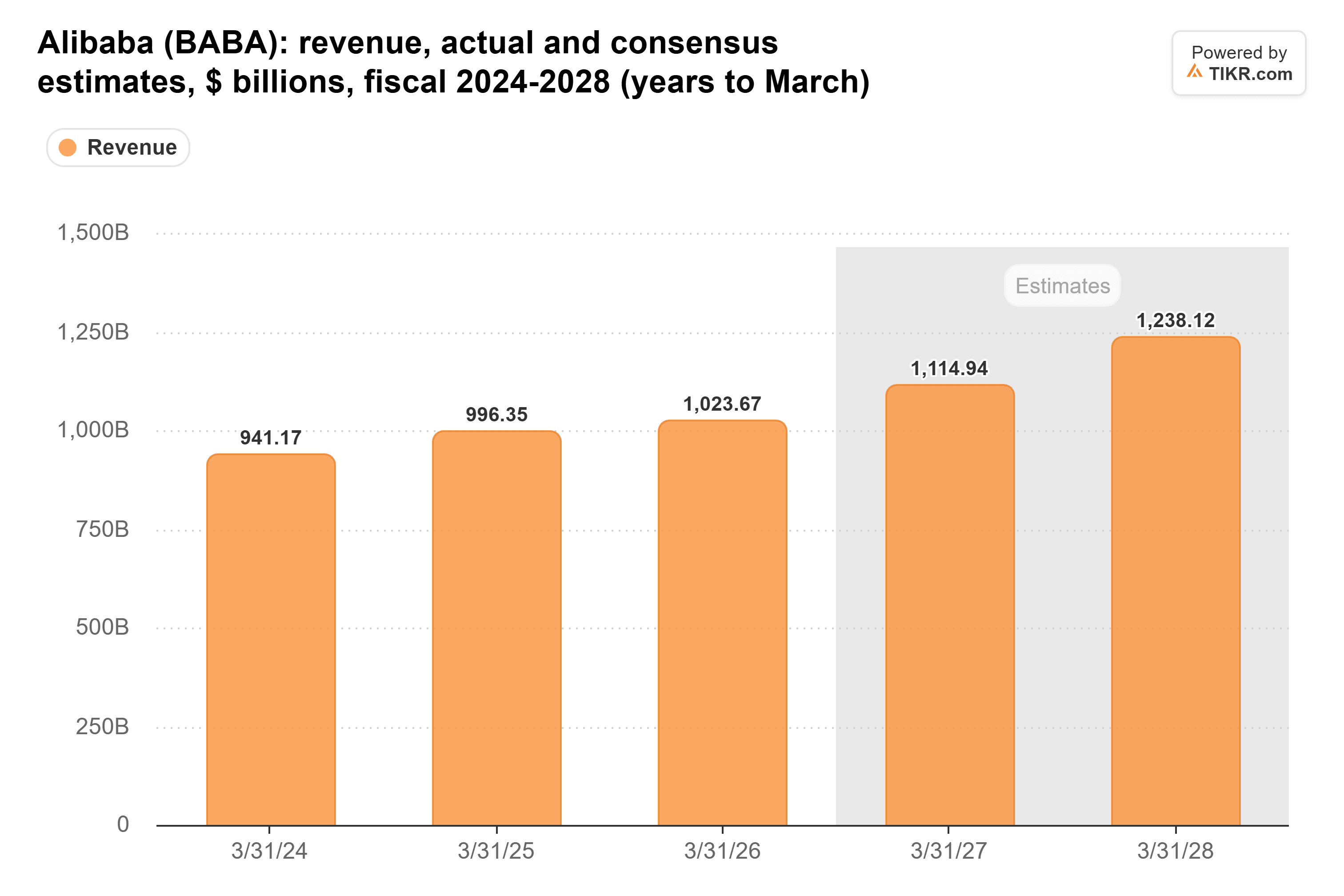
Analysts set those estimates before Monday’s listing. Cloud is the part of that growth at risk if Alibaba can’t replace Apex’s capacity.
The bill comes before the chips
Alibaba’s capital spending nearly quadrupled in two years, from RMB 32.1 billion in fiscal 2024 to RMB 126 billion in fiscal 2026:
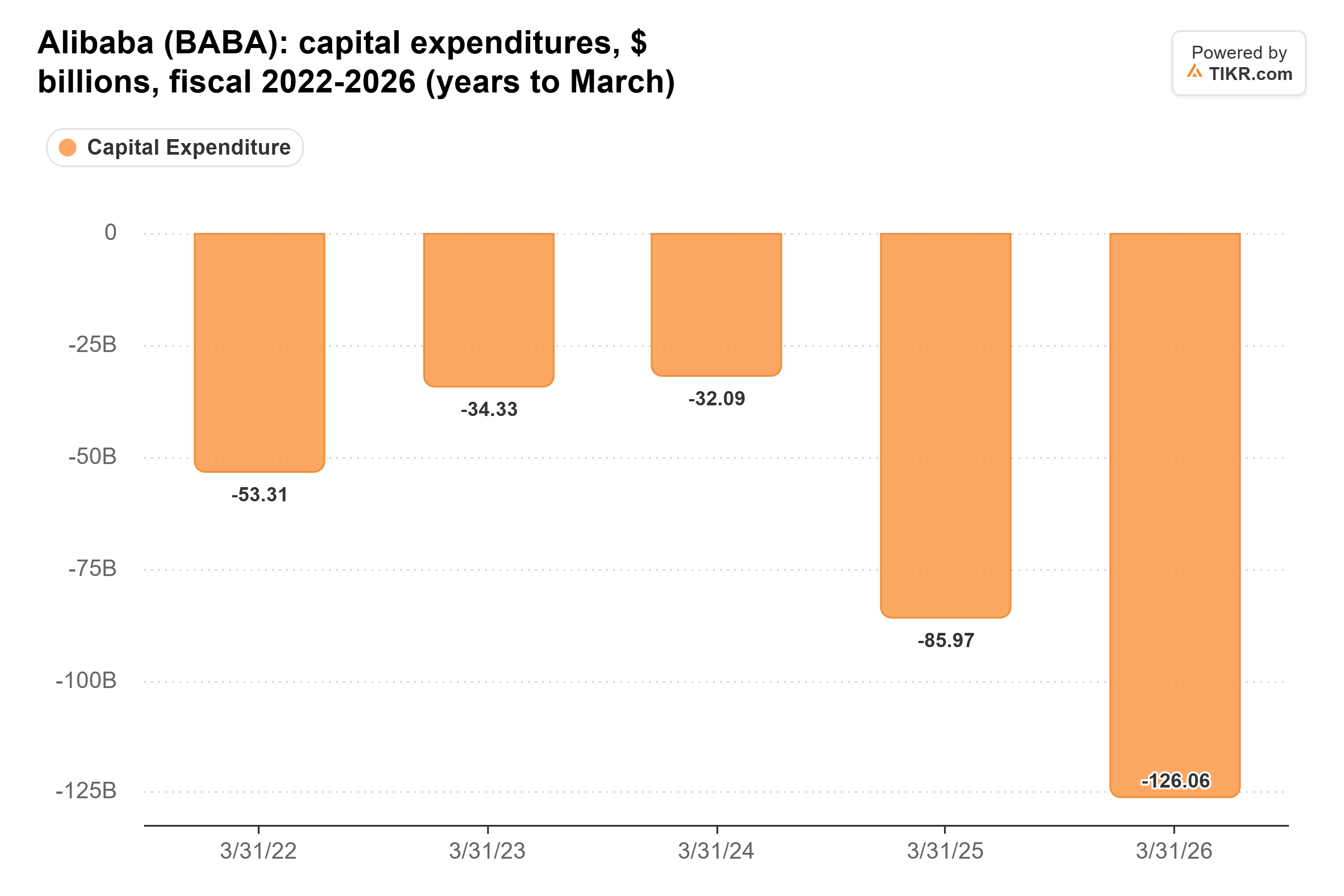
Free cash flow went the other way, from RMB 151 billion in fiscal 2024 to an outflow of RMB 49.9 billion in fiscal 2026:

Management still expects to invest “most aggressively” in ramping up its own chips in 2027 and 2028. It said “we should be able to achieve positive cash flow overall by 2028 in the second half of that year.”
Scarce chips help whoever has them
Management called 2027 and 2028 “the period in which compute supply is at its scarcest in China’s domestic market.” That could help Baidu, which is building its own chips too. Its AI Cloud Infra revenue rose 94% year over year to RMB 8.2 billion in the third quarter. My read: Baidu is well placed to win cloud customers Alibaba can’t serve.
Nvidia loses out more slowly. Alibaba said that after 2027, “most of the incremental AI chip capacity we will add will be primarily domestic.”
One less way around the chip curbs
At the end of the day, the Apex listing is small next to a business that earns nearly all of its revenue in China. But it removes part of Alibaba’s cushion for the two years management called the tightest, and that puts more of next year’s cloud growth on T-Head delivering on time. Alibaba’s next report, early next year, should show whether cloud growth holds at 30% or better and how far the 20 gigawatt target shrinks.
So what is Alibaba stock actually worth?
TIKR lets you forecast the future price of any stock in less than a minute. Just enter a few assumptions into TIKR’s valuation model and see what Alibaba could be worth. Start from Wall Street consensus estimates, or adjust the inputs to reflect your own view of the business. It’s free to use.
Disclaimer:
Please note that the articles on TIKR are not intended to serve as investment or financial advice from TIKR or our content team, nor are they recommendations to buy or sell any stocks. We create our content based on TIKR Terminal’s investment data and analysts’ estimates. Our analysis might not include recent company news or important updates. TIKR has no position in any of the stocks mentioned. Thank you for reading, and happy investing!