Key Takeaways
- Nomura raised its 2027 forecast for Nvidia racks to 75,000 from 66,000, mainly on SpaceX’s plan to reach 13 gigawatts or more of AI compute by the end of 2027.
- SpaceX’s rentals to Alphabet and Anthropic bring in about $2.2 billion a month, which covers only a small part of what 10 more gigawatts of racks would cost.
- SpaceX spent twice its operating cash flow on capex last quarter, and suppliers like Dell vet AI orders for the buyer’s access to capital.
- SpaceX can start the build but would need much more borrowing to finish it, so its racks are the riskiest part of Nomura’s 2027 forecast.
Nvidia (NVDA) picked up 9,000 more racks in Nomura’s 2027 forecast, and the broker credits most of them to one customer: SpaceX (SPCX).
Nomura said the increase was “mainly driven by the aggressive expansion plan from SpaceX.” SpaceX wants 13 gigawatts or more of compute by the end of 2027, up from close to 3 gigawatts by the end of this year. Nomura figures the extra 10 gigawatts is “likely requiring c.30k racks” of Vera Rubin systems.
That’s good news for Nvidia and for rack builders like Dell Technologies (DELL). But can SpaceX pay for it, even with rent coming in from Alphabet (GOOG)?
A $150 billion question, at least
Tech writer and AI industry critic Ed Zitron asked in a reply on X: “Wouldn’t 13gw of Vera Rubin be like $150bn plus? How would he afford that.”
Nvidia’s management has put its revenue opportunity at about $40 billion per gigawatt of data center capacity with Vera Rubin. On that figure, 10 more gigawatts means closer to $400 billion of Nvidia gear, before SpaceX pays for the buildings and the power.
Two of every five racks
Nvidia has a lot riding on this. The stock closed at $150.49 on Nov. 27, up 0.80% in a shortened session but about 37% below its Oct. 6 closing high. Analysts still expect its sales to keep climbing fast:
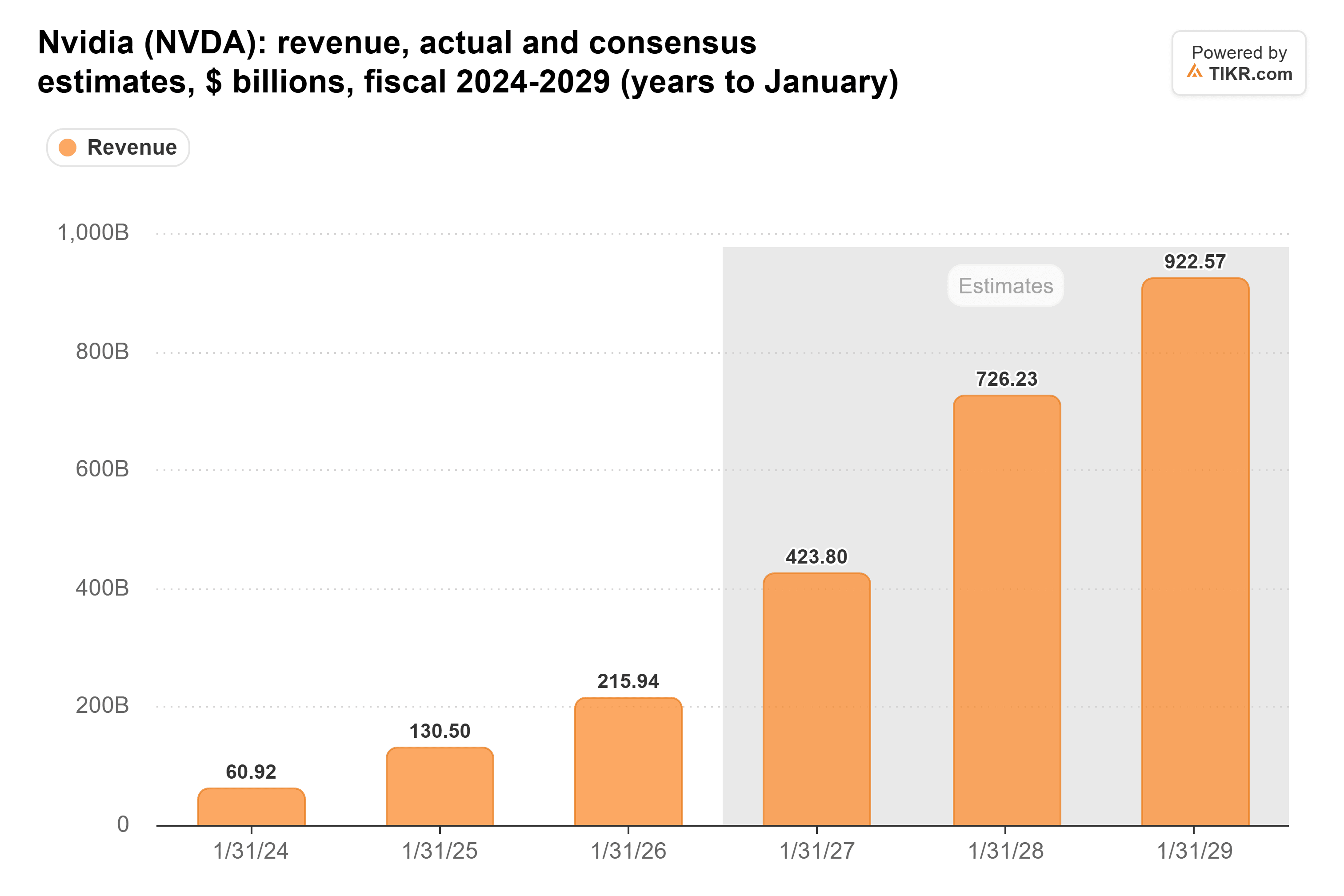
Consensus has $726 billion of revenue for fiscal 2028, the year to January 2028. If all 30,000 of SpaceX’s racks ship in 2027, they’d be two of every five racks in Nomura’s forecast. Part of the raise is also timing: Nomura cut its 2026 forecast to 60,000 racks from 62,000, as component shortages push some deliveries into 2027. Either way, a big part of one year’s sales rests on one customer’s ability to raise money.
TIKR tracks 63 analysts on Nvidia. How many say “Buy”?
See the full breakdown of Buy, Hold, and Sell ratings on Nvidia, along with Wall Street’s revenue and earnings estimates, all in one place. More than 500,000 investors use TIKR to research stocks like this one. See Nvidia’s Analyst Ratings
SpaceX already spends more than it brings in
SpaceX’s capex has been higher than its operating cash flow in every quarter on this chart:

In the quarter to Sept. 30, SpaceX spent $19.6 billion on capex against $9.6 billion of operating cash flow. So far, the IPO and borrowing have covered the gap:
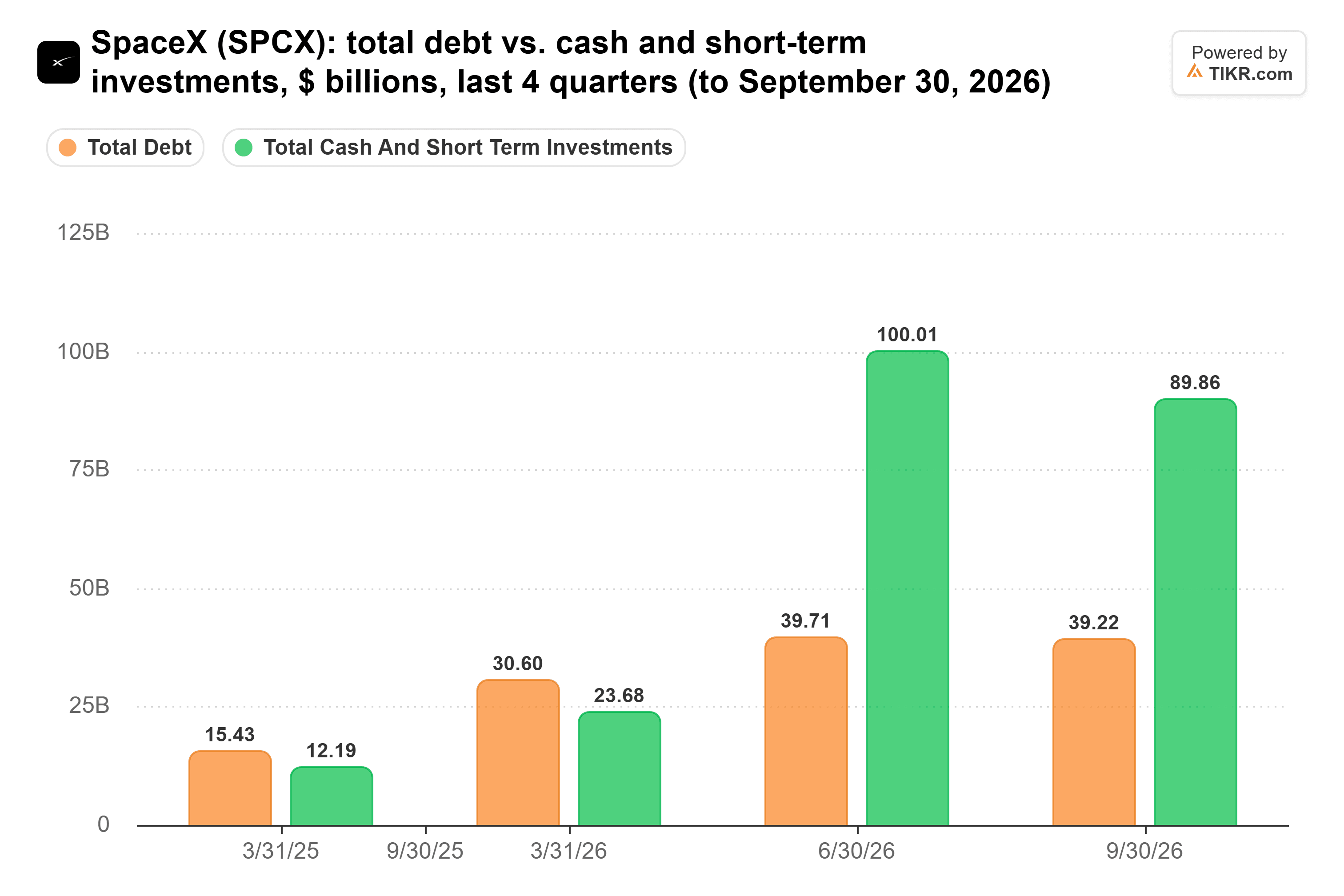
Total debt was $39.2 billion at Sept. 30, up from $15.4 billion at March 31, 2025. The cash cushion, $89.9 billion, was already down from $100 billion three months earlier.
New debt costs more, too. Pershing Square CEO Bill Ackman noted on X that SpaceX “just raised secured debt financing at an 8.259% interest rate versus below 6% for its unsecured bond offering at the time of its IPO.” Bloomberg reported that the deal was built to keep the borrowing off SpaceX’s balance sheet: a trust buys the Nvidia chips and leases them to SpaceX. That means it may not show up in the debt figures above.
Suppliers are watching. Dell assembled half the racks for xAI’s supercomputer in 2024, before xAI became part of SpaceX. In its Nov. 24 results, Dell’s vice chairman and chief operating officer, Jeff Clarke, said each of the quarter’s $60.2 billion in AI orders was “rigorously vetted for customer quality and access to capital, land and power.”
The rentals are real money
SpaceX does have real money coming in. According to its S-1, Anthropic pays it $1.25 billion a month for compute. A later SpaceX filing showed Google paying $920 million a month from October 2026 through June 2029. That’s about $26 billion a year under contract, from two of the best-funded buyers in AI, though either side can end each deal on 90 days’ notice (Google’s from 2027). Alphabet is raising money too: in the third quarter, it raised $28.7 billion from senior notes and $12.4 billion from stock sales through its at-the-market program.
Where this leaves Nvidia
SpaceX can clearly get this build started. Finishing 10 gigawatts by the end of 2027 would take far more, and the largest slice of its newest chip financing yields more than 8%, even with the chips as collateral. That makes SpaceX’s racks the softest part of Nomura’s 75,000.
More stock sales or rental deals would change the math quickly. The next test is SpaceX’s fourth-quarter report early next year. Chief Financial Officer Bret Johnsen has already guided capex to $35 billion to $40 billion for the quarter, about double the third quarter’s $19.6 billion. If operating cash flow stays near the third quarter’s $9.6 billion, that gap points to more borrowing at 8% or higher.
So what is Nvidia stock actually worth?
TIKR lets you forecast the future price of any stock in less than a minute. Just enter a few assumptions into TIKR’s valuation model and see what Nvidia could be worth. Start from Wall Street consensus estimates, or adjust the inputs to reflect your own view of the business. It’s free to use.
Disclaimer:
Please note that the articles on TIKR are not intended to serve as investment or financial advice from TIKR or our content team, nor are they recommendations to buy or sell any stocks. We create our content based on TIKR Terminal’s investment data and analysts’ estimates. Our analysis might not include recent company news or important updates. TIKR has no position in any of the stocks mentioned. Thank you for reading, and happy investing!