Key Takeaways
- Nike shares fell 6.3% after its first investor day in nine years, which targeted adjusted EPS of $3.00 to $3.50 by fiscal 2031.
- Nike plans about $12 billion of dividends through fiscal 2031, but its $1.64 annual payout tops this year’s adjusted EPS guidance of $1.15 to $1.35.
- On Holding grew third-quarter net sales 17.2%, while Nike’s first-quarter revenue fell 4% and Greater China dropped 22%.
- Nike’s fiscal second-quarter report, expected in December, will show whether gross margin keeps expanding and whether cash flow starts covering the dividend.
Nike (NKE) shares fell 6.3% on Tuesday, their largest drop since April, after the company held its first investor day in nine years. Management laid out a path to adjusted EPS of $3.00 to $3.50 by fiscal 2031.
That path runs through two more years of shrinking sales, though. Nike doesn’t expect revenue to grow again until fiscal 2029.
Meanwhile, On Holding (ONON) just grew third-quarter net sales 17.2%, and sales through its own stores and website jumped 25%. That’s the running momentum Nike is fighting to win back.
So what do patient shareholders get in the meantime? Mostly a dividend, and Nike made a big promise about it.
A five-year plan, slow start
Nike’s 2031 framework uses fiscal 2027 as the base. From there, it targets:
- About $5 billion of incremental revenue, with roughly $4 billion from performance sports
- Operating margins of 12% to 14%
- About $12 billion of dividends from fiscal 2027 through fiscal 2031
The company also reaffirmed this year’s guidance. Revenue should fall by a high single digit percentage, and the adjusted operating margin should land near 6%.
Then executives said fiscal 2028 would be difficult, with adjusted EPS slipping modestly. That warning deepened the selloff.
Here’s how far the top line has to travel…
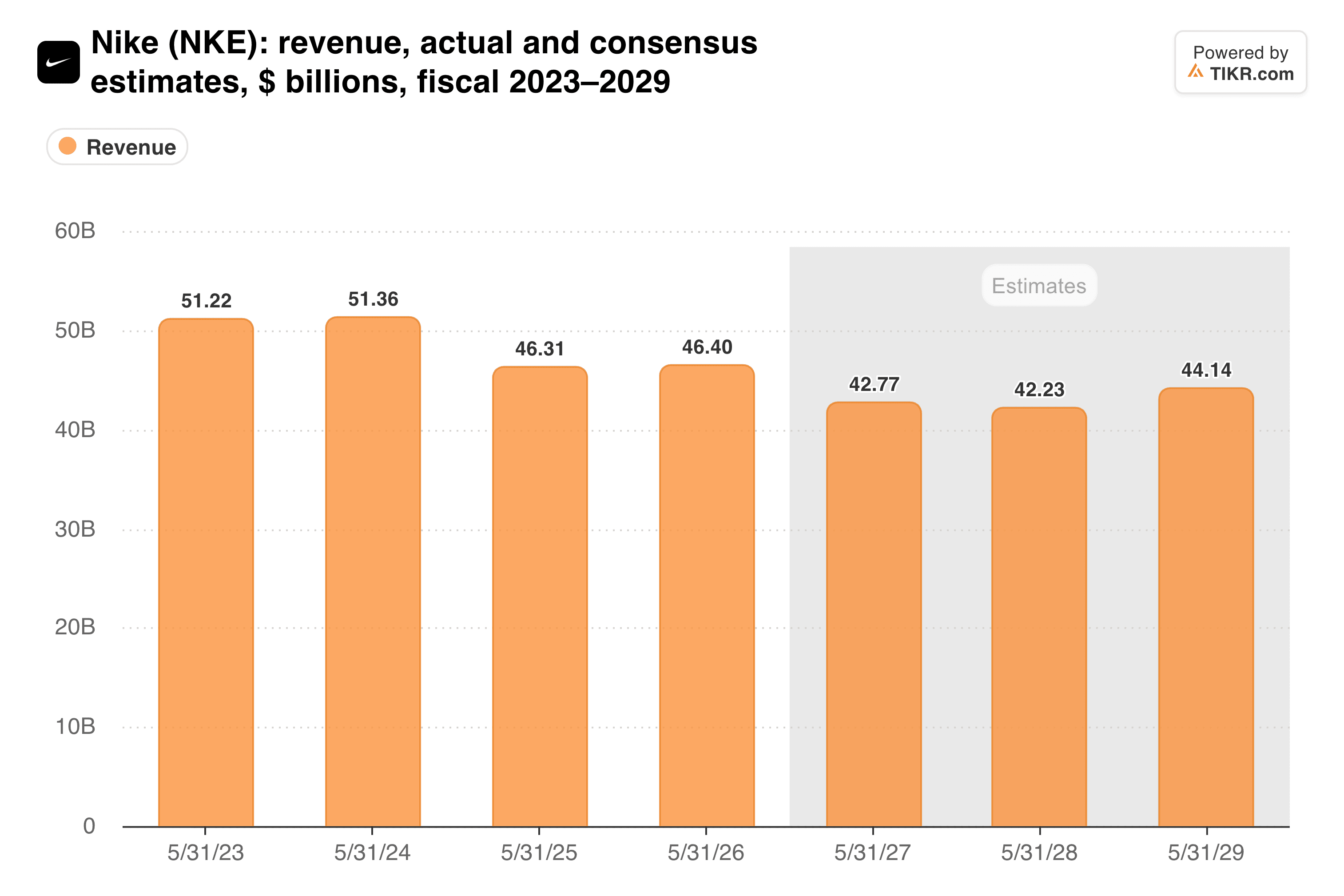
First-quarter revenue fell 4% to $11.2 billion. Greater China dropped 22%, while Converse sank 28%.
The dividend carries the case
Nike has raised its dividend for 24 straight years. The quarterly payout now sits at $0.41, or $1.64 a year.
Yet that annual payout exceeds the top of this year’s adjusted EPS guidance of $1.15 to $1.35. Earnings should dip again in fiscal 2028, so the gap won’t close quickly.
Cash flow tells a similar story. In the first quarter, cash and short-term investments fell about $0.2 billion to $8.4 billion because operating cash didn’t cover dividends and capital spending.
Can free cash flow keep pace with roughly $2.4 billion a year in dividends?
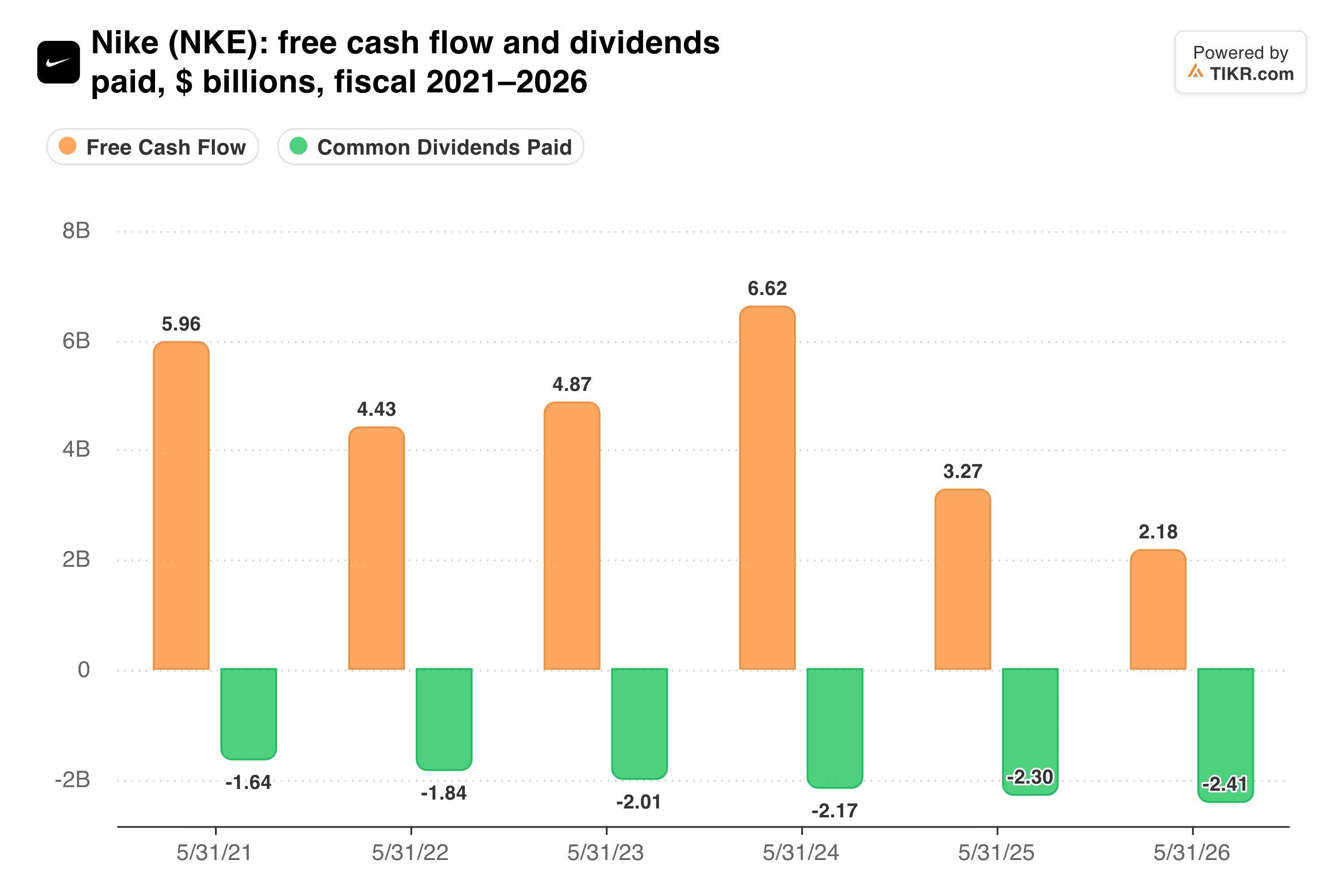
For now, the balance sheet can absorb the shortfall. However, $2.0 billion of debt comes due within a year, so the cushion is thinner than the cash pile suggests.
CFO Dave Denton acknowledged the gap in the investor day release: “Our current financial performance does not yet reflect the full potential of those assets.”
TIKR tracks 44 analysts on Nike. How many say “Buy”?
See the full breakdown of Buy, Hold, and Sell ratings on Nike, along with Wall Street’s revenue and earnings estimates, all in one place. More than 500,000 investors use TIKR to research stocks like this one. See Nike’s Analyst Ratings
Margins have to do the lifting
The 2031 math leans on Pace, Nike’s restructuring program. It should deliver about $2.5 billion of annualized savings by fiscal 2031, and most of the benefit arrives in fiscal 2029 and 2030. Implementation will cost about $1.3 billion in pretax charges.
Gross margin is moving the right way, up 60 basis points to 42.8% last quarter. Still, the gap with the fastest growing rival is wide…
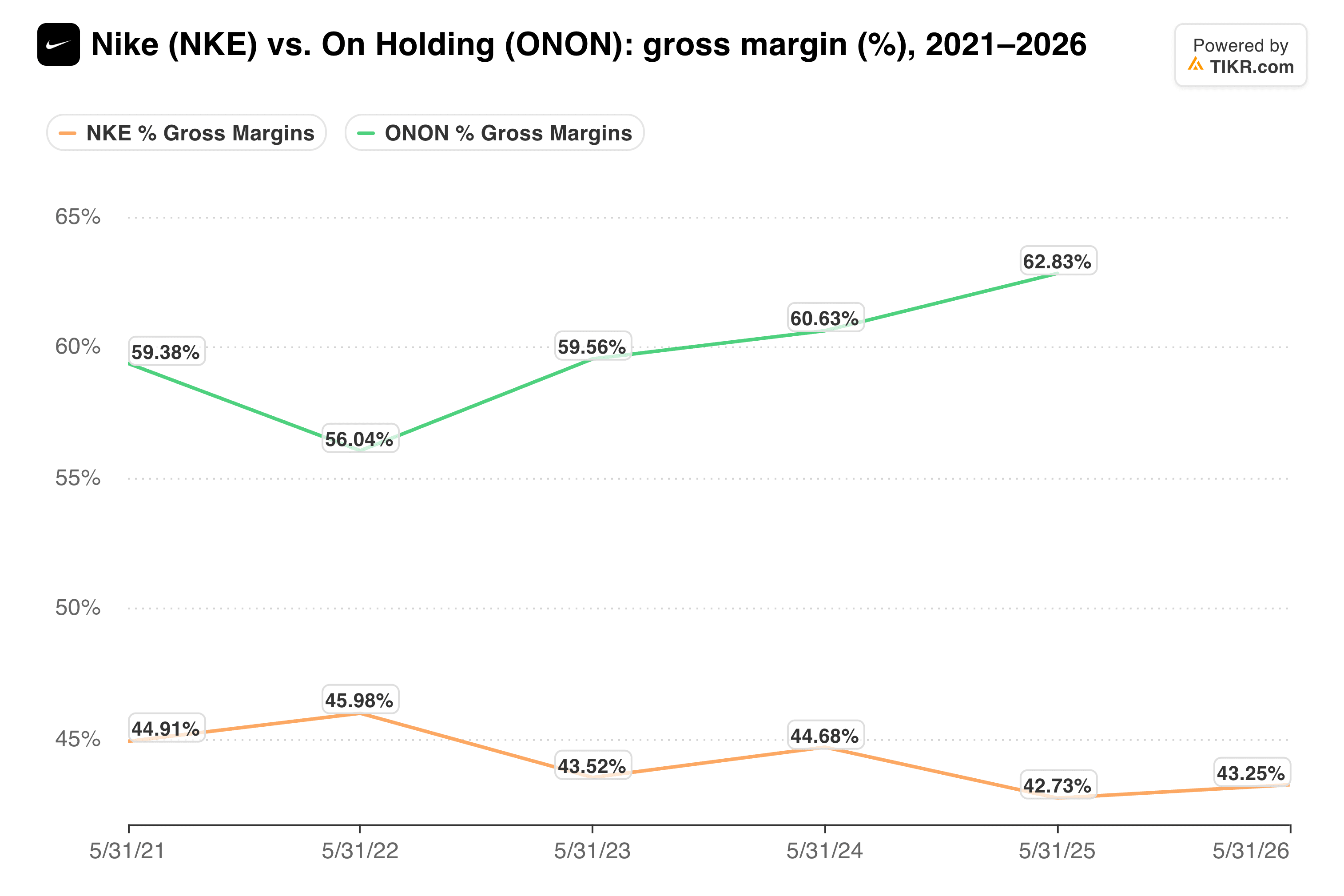
On posted a record 72.6% gross margin in its third quarter, although U.S. tariff refunds helped. Nike sells far more shoes, yet it’s chasing the same runners with much less pricing power.
My take: The $12 billion pledge signals real confidence, and the balance sheet can fund it for a while. Still, a dividend that outruns earnings for at least two years offers little margin of safety. I’d want proof that free cash flow is recovering before calling the payout the reason to own Nike.
The first test is Nike’s fiscal second-quarter report, expected in December. Watch whether gross margin keeps expanding and whether operating cash flow starts covering the dividend. Nike raised its dividend last November too, so a 25th straight increase, or a pause, should come soon and will say plenty.
So what is Nike stock actually worth?
TIKR lets you forecast the future price of any stock in less than a minute. Just enter a few assumptions into TIKR’s valuation model and see what Nike could be worth. Start from Wall Street consensus estimates, or adjust the inputs to reflect your own view of the business. It’s free to use.
Disclaimer:
Please note that the articles on TIKR are not intended to serve as investment or financial advice from TIKR or our content team, nor are they recommendations to buy or sell any stocks. We create our content based on TIKR Terminal’s investment data and analysts’ estimates. Our analysis might not include recent company news or important updates. TIKR has no position in any stocks mentioned. Thank you for reading, and happy investing!