Key Takeaways
- Navitas Semiconductor (NVTS) stock fell nearly 15% between October 29 and November 5, before rebounding to approximately $10.28 on November 11.
- Nvidia (NVDA) is collaborating with Navitas on an 800-volt-to-12-volt power-delivery board for next-generation AI infrastructure.
- Navitas reported third-quarter revenue of $14 million, up 38% year-over-year, while fourth-quarter revenue guidance exceeded expectations.
- Management expects AI infrastructure revenue to triple in 2027, but continued losses and a premium valuation remain important risks.
What Happened?
Navitas Semiconductor (NVTS) stock declined approximately 15% between October 29 and November 5, 2026, despite reporting stronger-than-expected quarterly results.
The company is collaborating with Nvidia (NVDA) on advanced power-delivery technology for AI data centers, giving Navitas exposure to the growing demand for more efficient AI infrastructure.
However, shares subsequently rebounded from $7.86 on November 5 to approximately $10.28 on November 11, highlighting significant volatility following the earnings announcement.
According to its third-quarter earnings release, Navitas reported revenue of $14 million, increasing 38% year-over-year and exceeding the $13.17 million consensus estimate.
Management also guided for fourth-quarter revenue of approximately $16 million, plus or minus $500,000, above analysts’ $15.12 million expectation.
The results marked the company’s first year-over-year revenue growth since 2024, reflecting progress in its transition away from mobile and lower-end consumer markets toward higher-power applications.
Non-GAAP gross margin improved to 40% from 38.7% a year earlier, reflecting stronger contributions from high-power markets.
Despite the encouraging results, investors remain concerned about whether growing AI demand can translate into sustained revenue growth and profitability.
Is Navitas Stock Undervalued or Overvalued?
Navitas’s long-term investment opportunity increasingly depends on supplying advanced power semiconductors for AI data centers and electrical infrastructure.
During the third-quarter earnings call, CEO Chris Allexandre said its AI infrastructure business was “poised to triple in the calendar 2027.”
Management expects AI infrastructure markets, including AI data centers and grid and energy infrastructure, to account for more than 40% of total revenue by year-end, supported by a backlog extending into mid-2027.
Navitas’s collaboration with Nvidia could strengthen its position in next-generation AI systems requiring greater power efficiency and density.
However, native 800-volt solutions are expected to become a more meaningful revenue opportunity in late 2027 and early 2028.
According to TIKR’s November 2 consensus estimates, analysts projected revenue of approximately $47.7 million in 2026, increasing to $116 million by 2028.
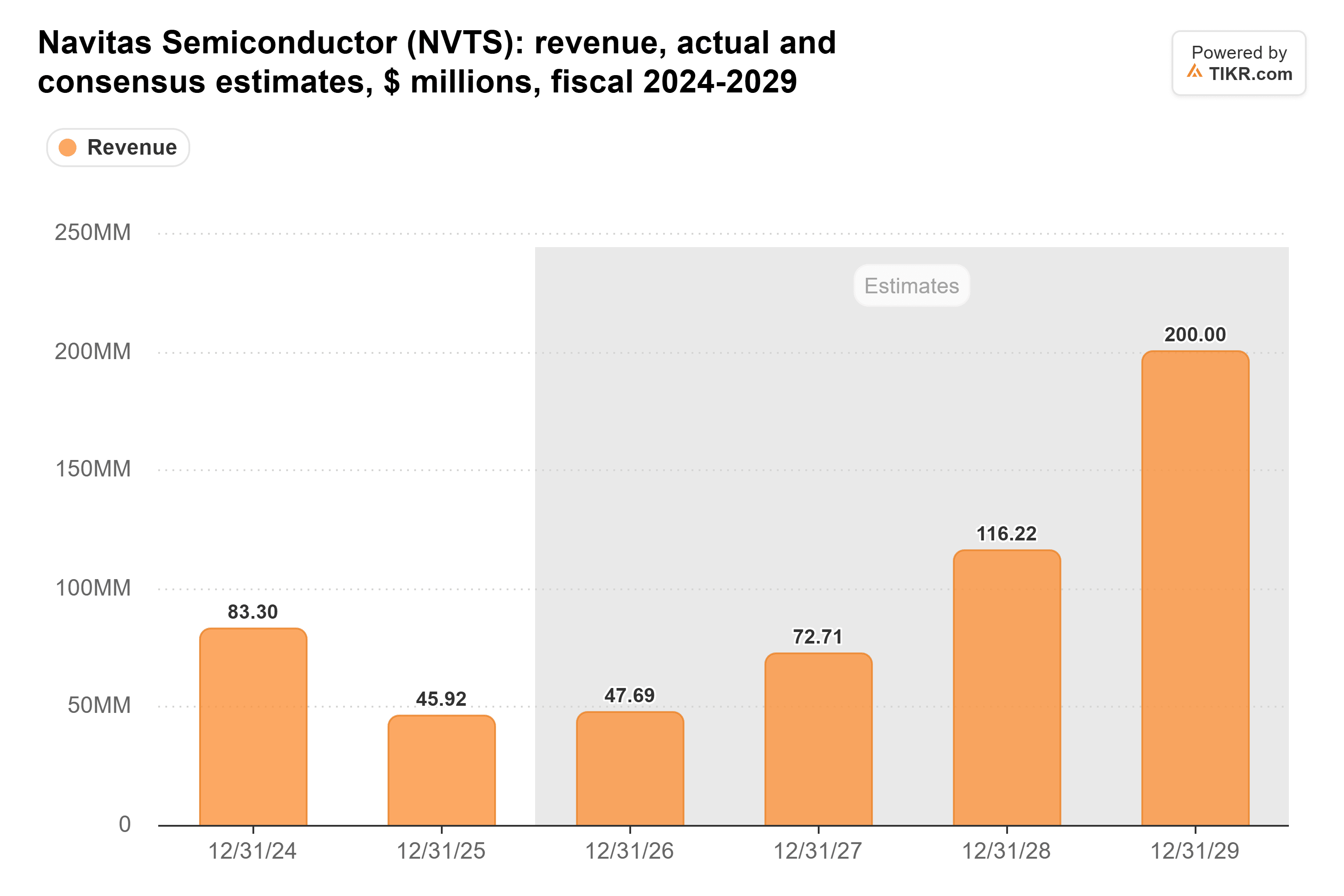
Navitas subsequently guided for approximately $49.1 million in full-year 2026 revenue, exceeding those earlier expectations.
Nevertheless, profitability remains challenging.
Fourth-quarter non-GAAP operating expenses are projected at approximately $25 million, including Claros, compared with expected revenue of just $16 million.
This spending gap shows why growing sales alone may not immediately translate into profitability.
Valuation adds another concern.
At the November 2 close, Navitas traded at approximately 34 times forward sales, above its three-year average of roughly 31 times, according to TIKR.
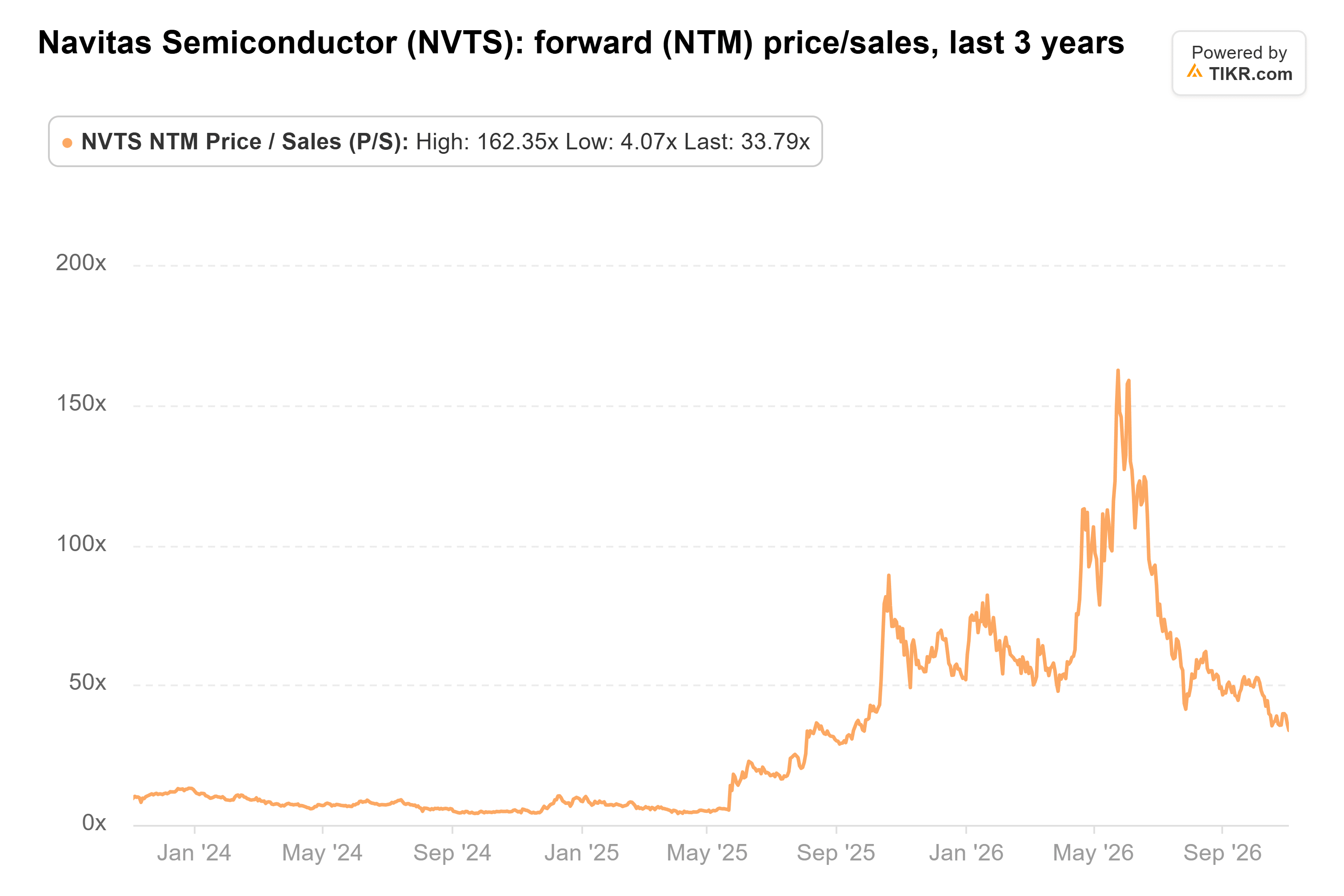
Although these historical multiples predate the subsequent stock-price recovery, they illustrate the substantial growth expectations already reflected in Navitas’s valuation before earnings.
The stock appeared expensive relative to its historical sales multiple, particularly given continued losses and uncertainty surrounding meaningful 800-volt revenue.
Over the next 12 months, accelerating AI infrastructure orders, improving gross margins, and higher-power semiconductor sales could strengthen its growth outlook.
However, operating expenses, deployment delays, and slower backlog conversion remain important risks.
Navitas has a promising opportunity in AI infrastructure, but its valuation leaves little room for disappointment. The next test is whether its growing backlog can translate into stronger revenue and meaningful progress toward profitability.
So what is Navitas Semiconductor stock actually worth?
TIKR lets you forecast the future price of any stock in less than a minute. Just enter a few assumptions into TIKR’s valuation model and see what Navitas Semiconductor could be worth. Start from Wall Street consensus estimates, or adjust the inputs to reflect your own view of the business. It’s free to use.
Value Navitas Semiconductor for free
Disclaimer:
Please note that the articles on TIKR are not intended to serve as investment or financial advice from TIKR or our content team, nor are they recommendations to buy or sell any stocks. We create our content based on TIKR Terminal’s investment data and analysts’ estimates. Our analysis might not include recent company news or important updates. TIKR has no position in any of the stocks mentioned. Thank you for reading, and happy investing!