Key Takeaways
- Navitas and Nvidia unveiled a 24 kW board that converts 800V directly to 12V, targeting 97% efficiency at full load.
- Q2 revenue was $10.5 million, down 27% year over year, and management guided Q3 to about $13.5 million.
- The stock trades at 29.9x forward EV/sales while its LTM EBIT margin sits at negative 252.3%.
- The November 3 Q3 report will show whether AI data-center demand is starting to lift sales.
Navitas Semiconductor (NVTS) wants to own the power path inside an AI data center, from the grid to the processor. That’s a big ambition for a company booking about $10 million a quarter.
Shares rose 4.8% to $9 on October 21, extending a bounce that began when Navitas showed new work with Nvidia (NVDA). The stock still sits 73% below its 52-week high of $34.
Headlines have piled up fast: an Nvidia board, a closed acquisition, a U.S. Army program and a domestic GaN production deal with GlobalFoundries (GFS). Revenue is what has to catch up.
A one-step power board for Nvidia racks
The new 24 kW board converts 800VDC to 12VDC in a single stage. It cuts out the 50V to 12V intermediate converter and feeds power straight to the voltage regulator beside the xPU.
- Target efficiency is 97% at full load.
- Power density tops 2,000 W per cubic inch.
- The board uses Nvidia’s 400mm by 60mm MGX form factor.
It builds on a 20 kW, 800V to 6V board the pair showed earlier, plus a separate reference design with Microchip Technology (MCHP). CEO Chris Allexandre said in the announcement that the collaboration is “breaking the AI infrastructure power wall.”
Navitas has company, though. STMicroelectronics (STM) and Texas Instruments (TXN) both launched 800VDC products around Nvidia’s reference design at GTC.
Here’s where the top line actually stands…

The trough looks behind it, and Q3 guidance of $13.5 million would mean 28% sequential growth.
Claros covers the last inch
Navitas closed Claros on October 6 in a deal worth up to $232.8 million in cash, stock and milestone payments. Claros builds integrated voltage regulators and vertical power delivery for AI processors.
That completes the pitch. SiC handles the grid, GaN and SiC handle 800V conversion, and Claros handles point of load. The Army also picked Navitas to develop 10 kV SiC IGBT technology.
Management is defending its IP too. In August, Navitas sued Renesas Electronics (6723.T) in Texas over GaN patents.
Margins have held up better than sales.
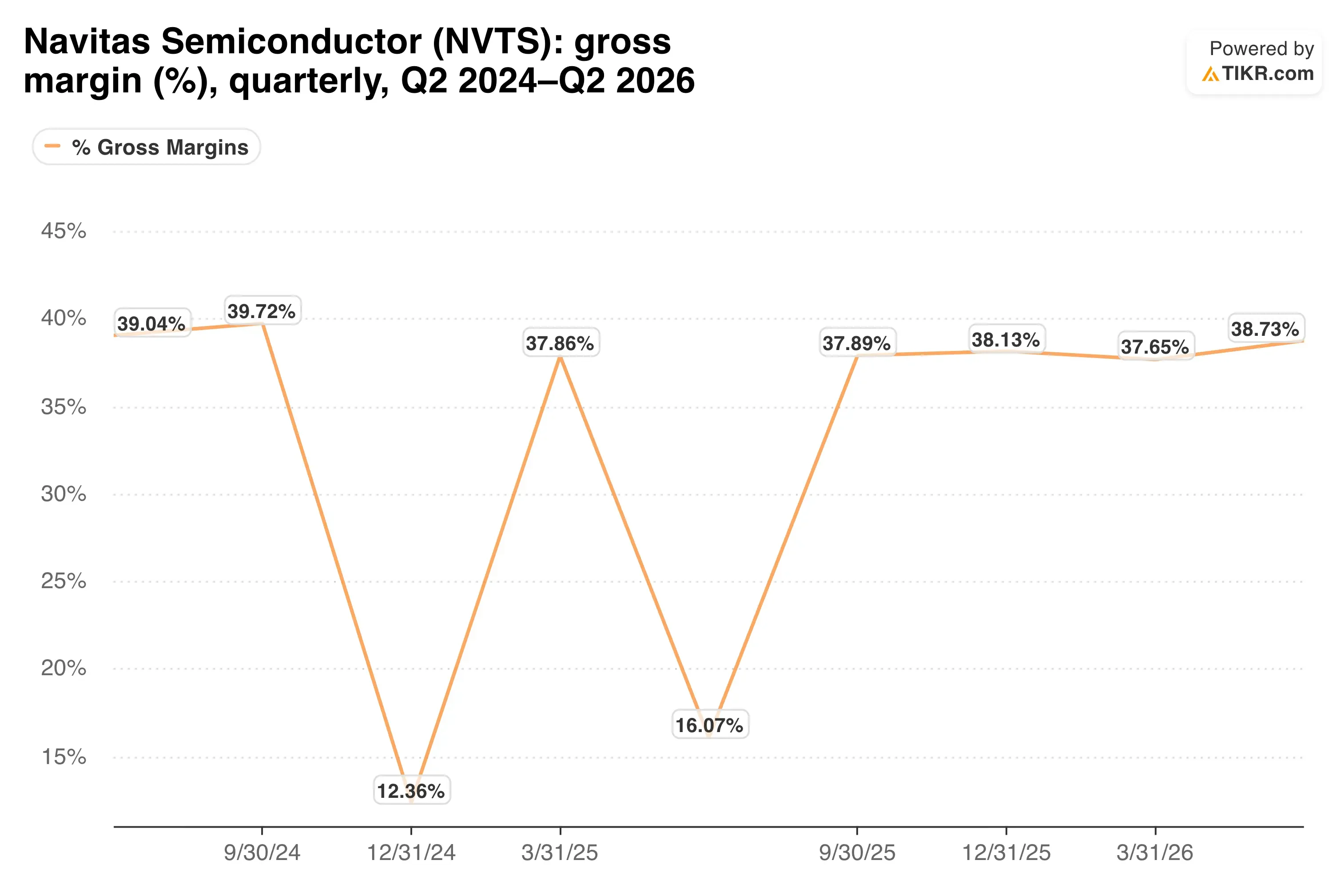
Q2 non-GAAP gross margin rose to 39.5%, so the real problem sits below the gross profit line.
TIKR tracks 8 analysts on Navitas Semiconductor. How many say “Buy”?
See the full breakdown of Buy, Hold, and Sell ratings on Navitas Semiconductor, along with Wall Street’s revenue and earnings estimates, all in one place. More than 500,000 investors use TIKR to research stocks like this one. See Navitas Semiconductor’s Analyst Ratings
Paying 30x sales for a pivot
Operating costs dwarf revenue. LTM EBIT margin is negative 252.3%, and consensus still expects negative EBITDA over the next 12 months.
Cash buys time. Navitas ended Q2 with about $557 million after filing in May to sell up to $125 million of stock, and the Claros share consideration adds more dilution.
That leaves the valuation doing the heavy lifting. Navitas trades at 29.9x forward EV/sales. Astera Labs (ALAB), which earns 75% gross margins and real profits, trades at 18.7x.
How has that gap looked over time?

The premium assumes AI design wins that haven’t shown up as revenue yet. The $14 average analyst target implies roughly 54% upside, so the Street is buying the story.
My take: The Nvidia work looks like credible engineering, and the grid to xPU strategy hangs together. But power design wins take years to reach volume, and nearly 30x sales for a business still shrinking year over year asks for a lot of faith. I’d want two quarters of data-center-driven growth before trusting the multiple.
Navitas reports Q3 on November 3. A print at or above $13.5 million, plus specifics on data-center wins, would be the first hard proof the pivot is paying off.
So what is Navitas Semiconductor stock actually worth?
TIKR lets you forecast the future price of any stock in less than a minute. Just enter a few assumptions into TIKR’s valuation model and see what Navitas Semiconductor could be worth. Start from Wall Street consensus estimates, or adjust the inputs to reflect your own view of the business. It’s free to use.
Disclaimer:
Please note that the articles on TIKR are not intended to serve as investment or financial advice from TIKR or our content team, nor are they recommendations to buy or sell any stocks. We create our content based on TIKR Terminal’s investment data and analysts’ estimates. Our analysis might not include recent company news or important updates. TIKR has no position in any stocks mentioned. Thank you for reading, and happy investing!