Key Takeaways
- Elon Musk posted on Nov. 22 that Tesla’s real-world AI will get smarter by “about an order of magnitude per year.”
- There’s no agreed way to measure a driving AI’s “intelligence,” so investors have to judge the claim by spending, miles and revenue.
- Tesla’s spending is rising fast, but Alphabet’s Waymo still leads on paid driverless rides, a race that matters to Uber.
- Analysts expect Tesla’s normalized EPS to reach $3.24 in 2028, only slightly above 2023’s $3.12, so the AI payoff isn’t in the estimates yet.
Elon Musk just put a number on how fast Tesla (TSLA) says its AI is improving, and it’s a big one.
A post on X said “Tesla is winning real-world AI. It’s not even close.” Musk replied on Nov. 22: “Tesla real-world AI will increase in intelligence by about an order of magnitude per year.”
That means tenfold, every year. Earlier, he explained where he thinks the gains come from: “Tesla has Niagara Falls amounts of data. So much, that we will keep much less than a millionth of it.”
Investors can’t check that directly. They can check the money behind it, and whether Tesla is pulling ahead of Waymo, owned by Alphabet (GOOGL). That race also matters to Uber (UBER), which gets its driverless cars from partners.
Analysts aren’t counting on it yet
If Tesla’s AI really got 10x better every year, you’d expect to see it in the earnings estimates. This is what analysts expect Tesla to earn:
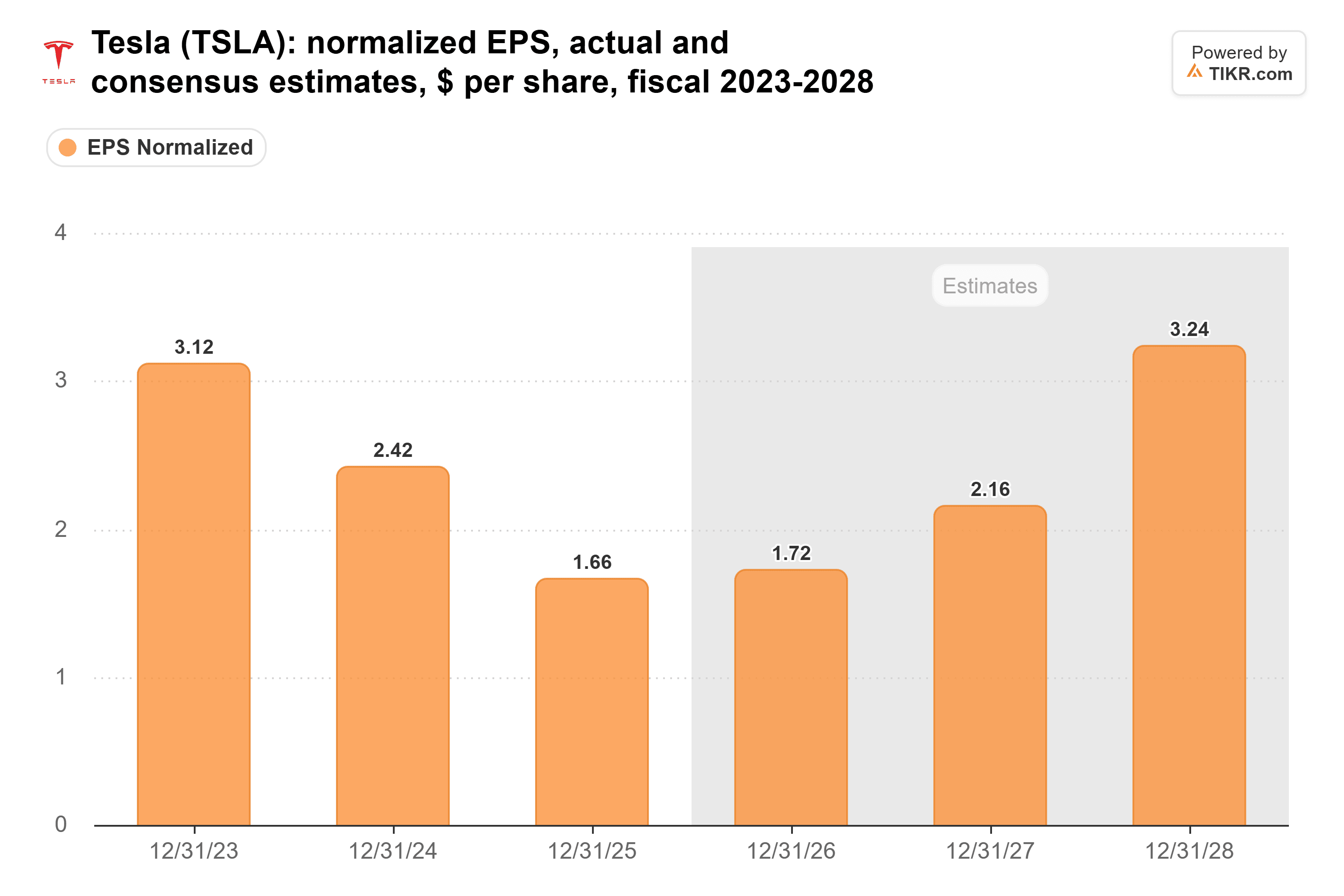
Consensus has normalized EPS rising to $3.24 in 2028, only slightly above the $3.12 Tesla earned in 2023. So analysts haven’t built much of Musk’s AI case into the next three years.
TIKR tracks 46 analysts on Tesla. How many say “Buy”?
See the full breakdown of Buy, Hold, and Sell ratings on Tesla, along with Wall Street’s revenue and earnings estimates, all in one place. More than 500,000 investors use TIKR to research stocks like this one. See Tesla’s Analyst Ratings
Tesla is spending like it believes it
The spending is where the claim does show up. Tesla’s R&D has climbed every year since 2021:
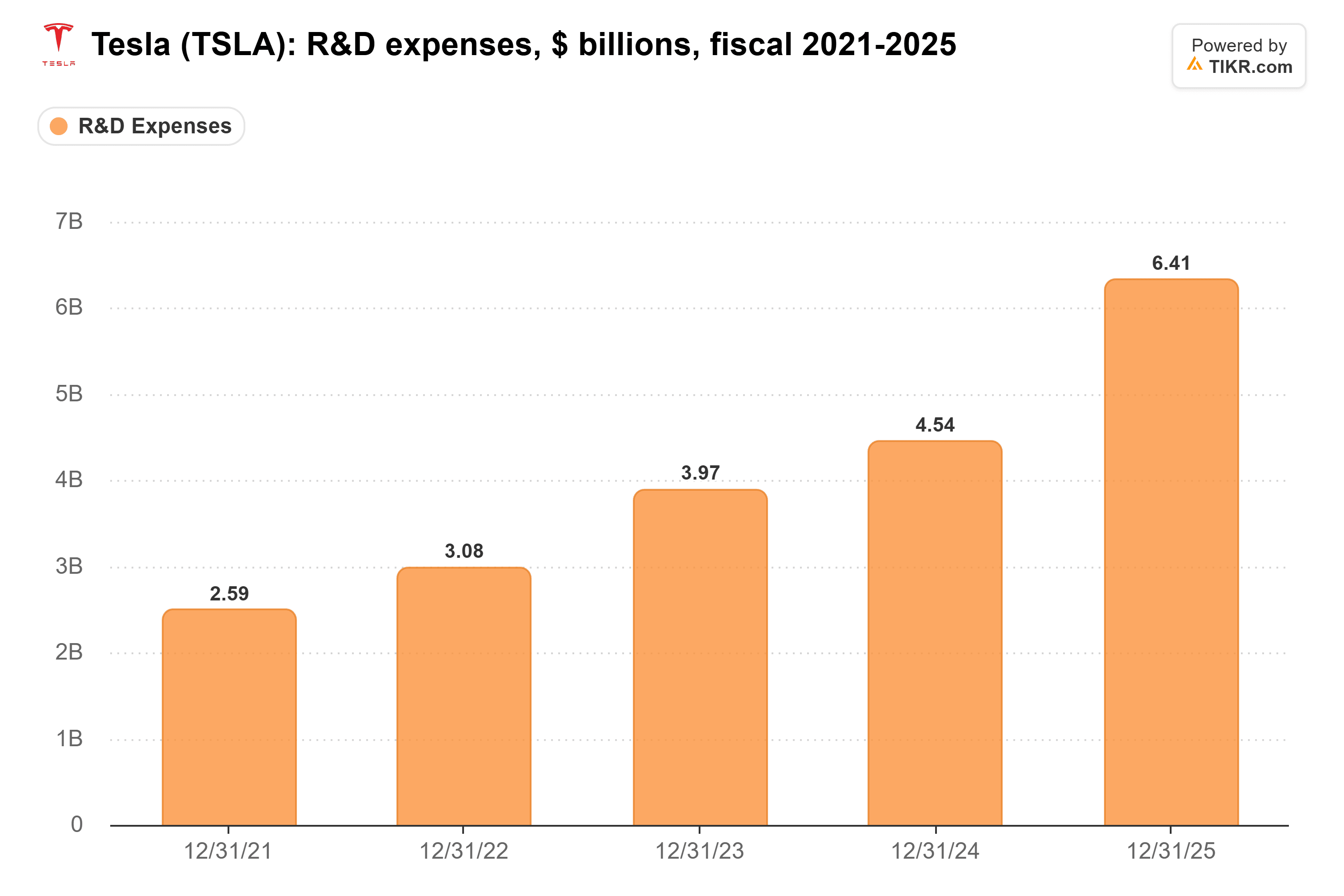
Tesla spent $7.1 billion on R&D in the first nine months of 2026, more than in all of 2025. Capital spending dipped last year, but it’s heading sharply higher:
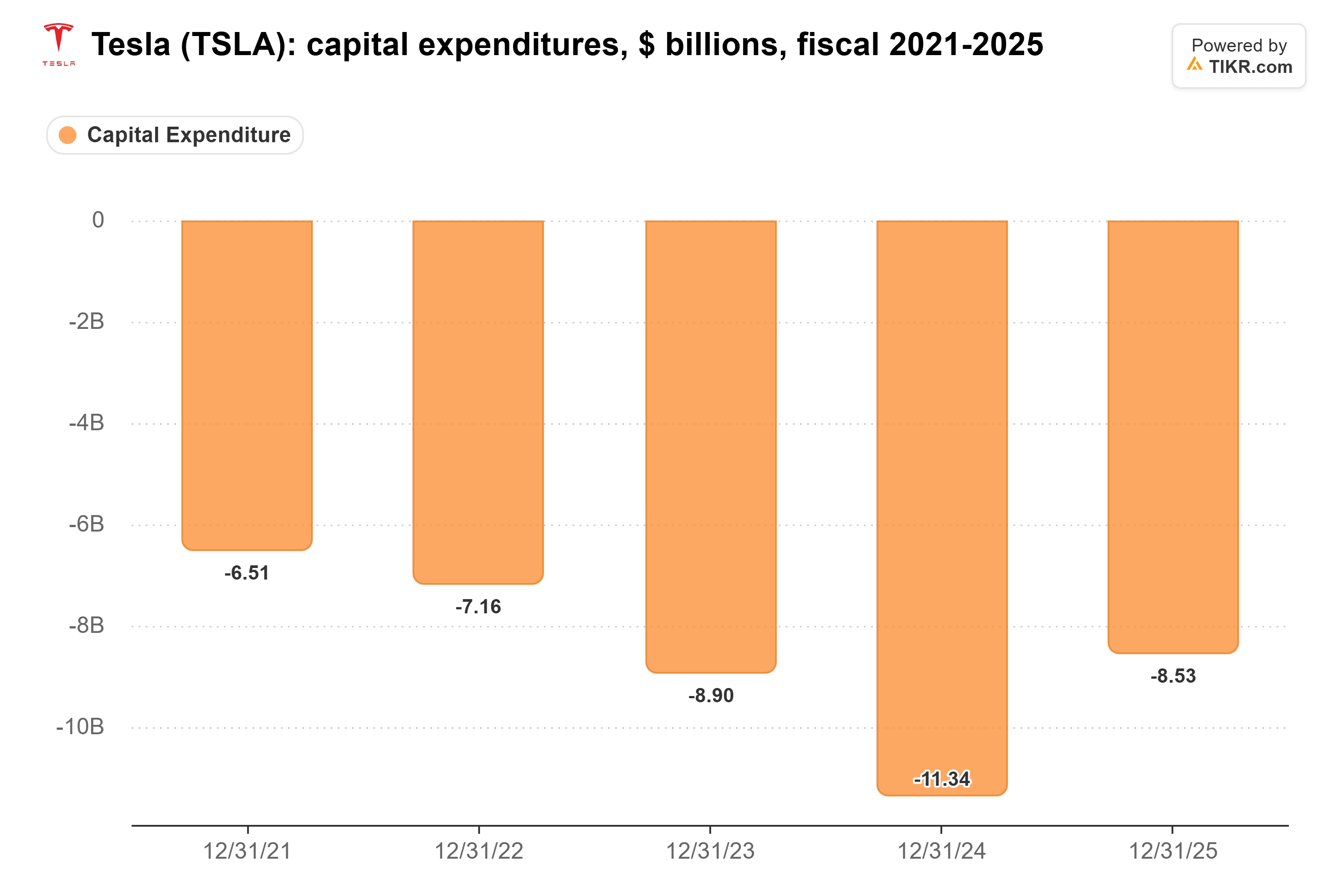
Management guides about $20 billion of capital spending for 2026, more than twice 2025’s $8.5 billion. Spending is roughly doubling, which is far short of tenfold. So if Musk is right, most of the gain has to come from better models and better data.
The fleet helps most with rare events
The data comes from the fleet. Tesla had delivered 10.2 million cars by Sept. 30, and active FSD subscriptions rose 67% in a year to 1.74 million.
The release notes for FSD V15 complicate that story a bit. Their biggest number comes from an upgraded vision encoder that is “trained on millions of internet videos for improved generalization and data efficiency, improving the critical intervention rate by 25x.” Any rival can train on internet video. And by Musk’s own account, almost all of the fleet’s data is “irrelevant” unless it’s “of a super weird, long tail event.” A 10-million-car fleet is very good at catching those rare events, and that’s where Tesla’s data edge lies.
Waymo still leads on paid rides
A data edge should eventually show up as paid driverless rides, and Waymo is well ahead there. Waymo said in March it was giving 500,000 paid rides a week across 10 U.S. cities. Tesla’s Robotaxi had logged nearly 2 million unsupervised miles in total by Sept. 30, and management cited six cities on its October call. That lead costs Alphabet money: Other Bets, the segment that holds Waymo, lost more than $2 billion in the third quarter on $372 million of revenue.
That race matters for Uber too. Tesla’s Cybercab launched this month in Dallas, where Uber partner Avride already runs. If Tesla’s AI improves anywhere near as fast as Musk says, Tesla would run driverless rides on its own app and compete for Uber’s Mobility business. Those bookings were $29.5 billion in the third quarter, up 18%.
Bottom line: Tesla’s data edge is real, but Waymo is the one getting paid for driverless rides today. I’d judge Musk’s claim on two numbers: the 2027 capital spending guidance with fourth-quarter results in late January, against the $23.8 billion analysts expect, and Tesla’s first separately reported Robotaxi revenue, which Musk told investors on the third-quarter call should be noticeable by the second quarter of 2027.
So what is Tesla stock actually worth?
TIKR lets you forecast the future price of any stock in less than a minute. Just enter a few assumptions into TIKR’s valuation model and see what Tesla could be worth. Start from Wall Street consensus estimates, or adjust the inputs to reflect your own view of the business. It’s free to use.
Disclaimer:
Please note that the articles on TIKR are not intended to serve as investment or financial advice from TIKR or our content team, nor are they recommendations to buy or sell any stocks. We create our content based on TIKR Terminal’s investment data and analysts’ estimates. Our analysis might not include recent company news or important updates. TIKR has no position in any of the stocks mentioned. Thank you for reading, and happy investing!