Key Takeaways
- Elon Musk said at the DealBook Summit that Tesla plans an autonomous Model Y with no steering wheel or pedals, built for groups of six or seven riders.
- Building robotaxis from Tesla’s most popular car could get it to volume faster than the two-seat Cybercab alone. It also goes after the group rides one rival plans to serve with six-seat Lucid SUVs.
- Regulators are the main risk: Amazon’s Zoox needed a federal exemption capped at 2,500 vehicles a year, and California just pulled Alphabet’s Waymo off its freeways.
- Tesla’s 2027 spending plan, expected with fourth-quarter results in late January, is the next thing to watch.
Tesla (TSLA) CEO Elon Musk told Andrew Ross Sorkin at The New York Times’ DealBook Summit on Nov. 18 that “the average number of people in a car is like 1.2,” so “Cybercab, being a two-seater, covers about 90% of all passenger miles driven.”
The other 10% is the family trip. For that, he said, “what we plan to do is have an autonomous version of Model Y that wouldn’t have steering wheels and pedals, and would be, you know, good for transporting groups of six or seven people.”
It may be the most practical robotaxi plan Musk has laid out in a while.
No one has locked up the bigger-group ride yet. Alphabet (GOOG)‘s Waymo has a roomier Ojai that fits up to four people. Uber (UBER) plans to launch robotaxis in Lucid’s Gravity SUV, which it says seats six. And Amazon (AMZN)‘s Zoox runs a four-seat pod with no steering wheel at all.
The Model Y is the shortcut
The Cybercab is a new car on a new line. The Model Y is “certainly our most popular car,” as Musk told Sorkin, and Model Ys, still fitted with steering wheels, already run in Tesla’s Robotaxi fleet.
A wheel-less version could come off lines Tesla already runs. That would add autonomous cars much faster than waiting for one new product to ramp. Musk didn’t say where it would be built, though, and gave no date.
Analysts already expect Tesla’s revenue to grow again, from $94.8 billion in 2025 to about $146 billion in 2028:
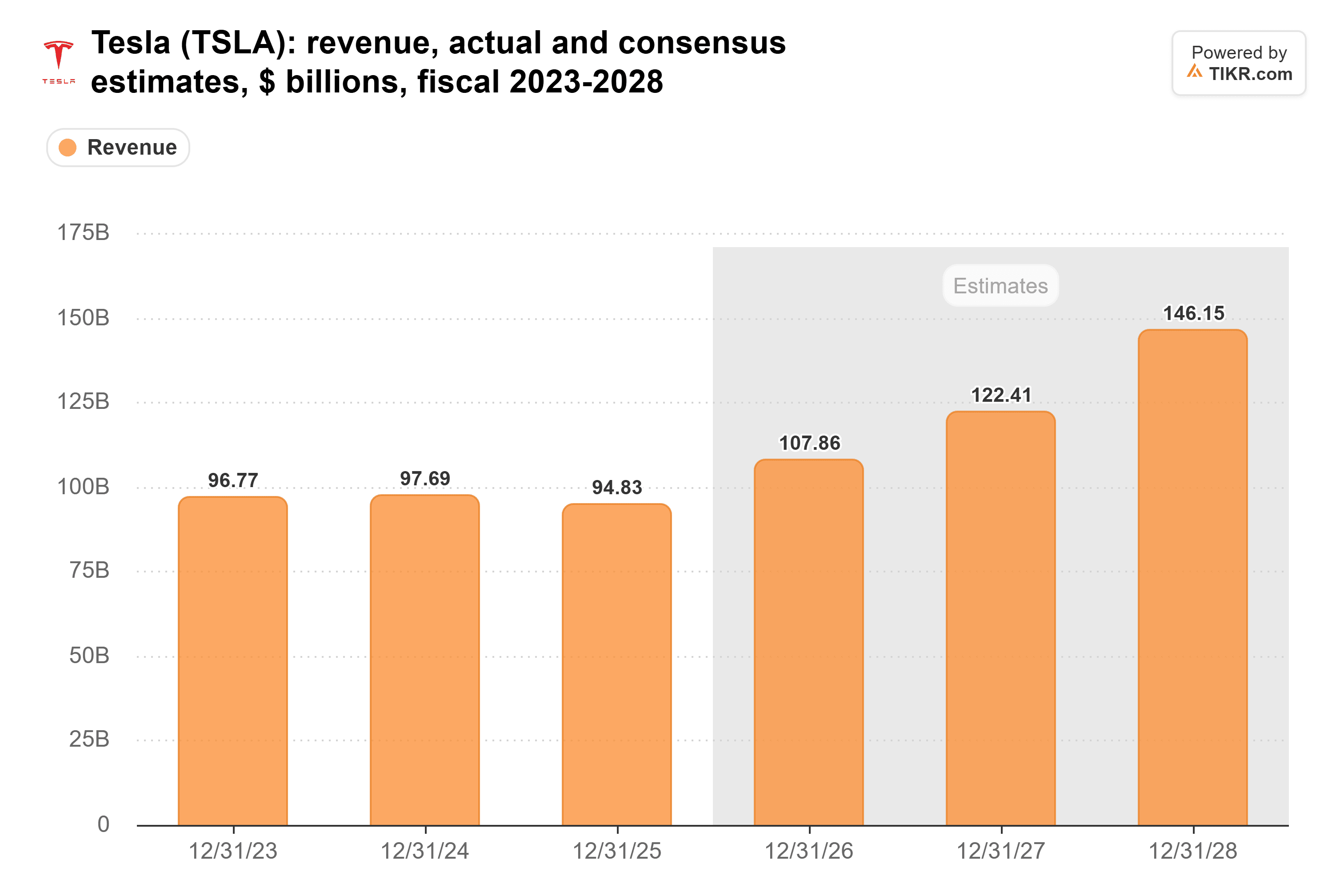
Those estimates were set before DealBook, and a plan with no date gives little reason to change them. JPMorgan’s Rajat Gupta expects Cybercab revenue to inflect only in 2028.
TIKR tracks 44 analysts on Tesla. How many say “Buy”?
See the full breakdown of Buy, Hold, and Sell ratings on Tesla, along with Wall Street’s revenue and earnings estimates, all in one place. More than 500,000 investors use TIKR to research stocks like this one. See Tesla’s Analyst Ratings
Tesla needs the cheap option
Tesla’s spending is jumping, so reusing a line it already has matters. Capital expenditures peaked at $11.3 billion in 2024 and came in at $8.5 billion in 2025:
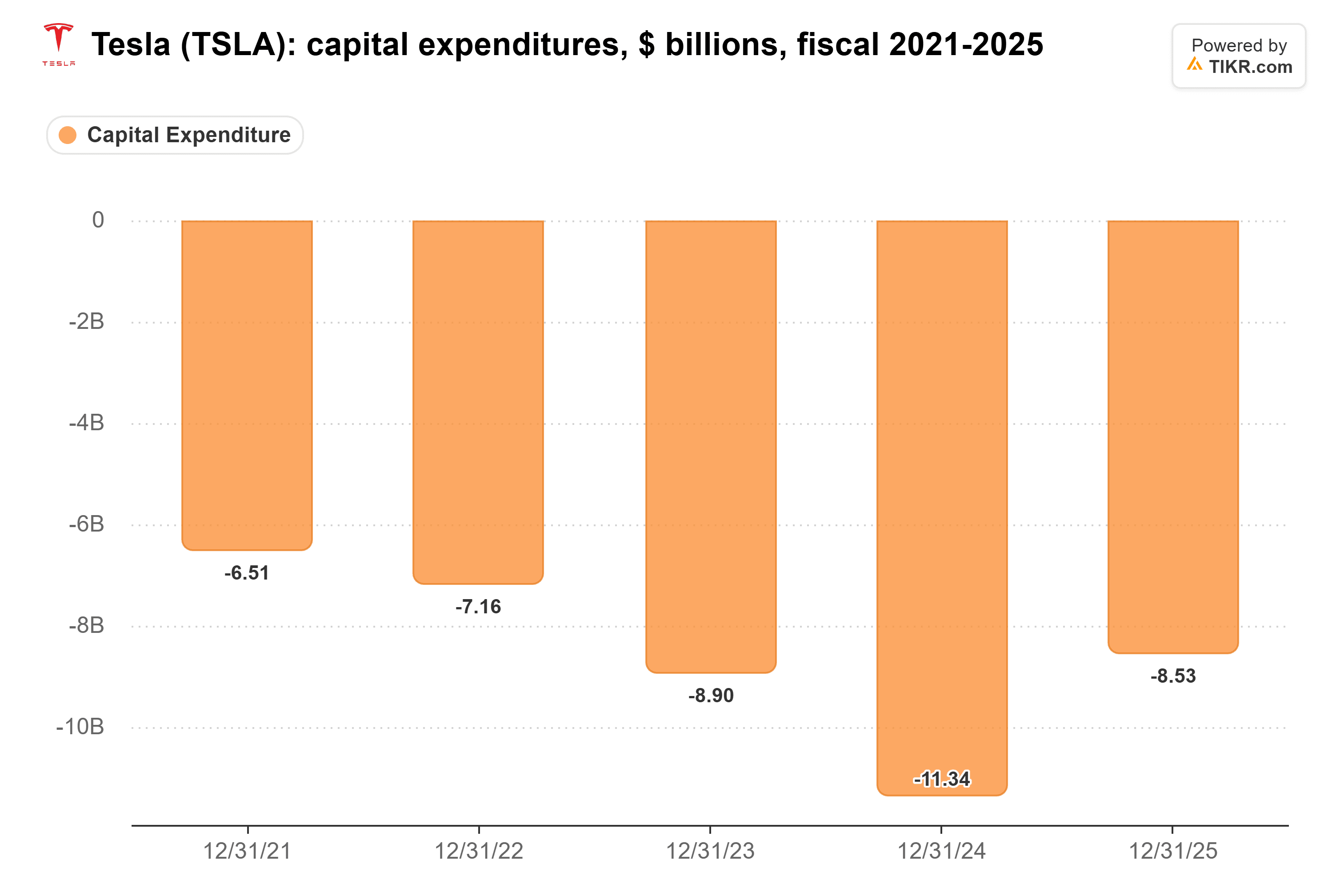
Management now guides about $20 billion for 2026, down from $25 billion before October, and it isn’t clear how much of Musk’s chip plans that figure includes. A TIKR analysis found those plans are more than Tesla’s cash flow can cover.
Tesla also keeps less of each sales dollar than it used to. Gross margin fell from 25.6% in 2022 to 18.0% in 2025:
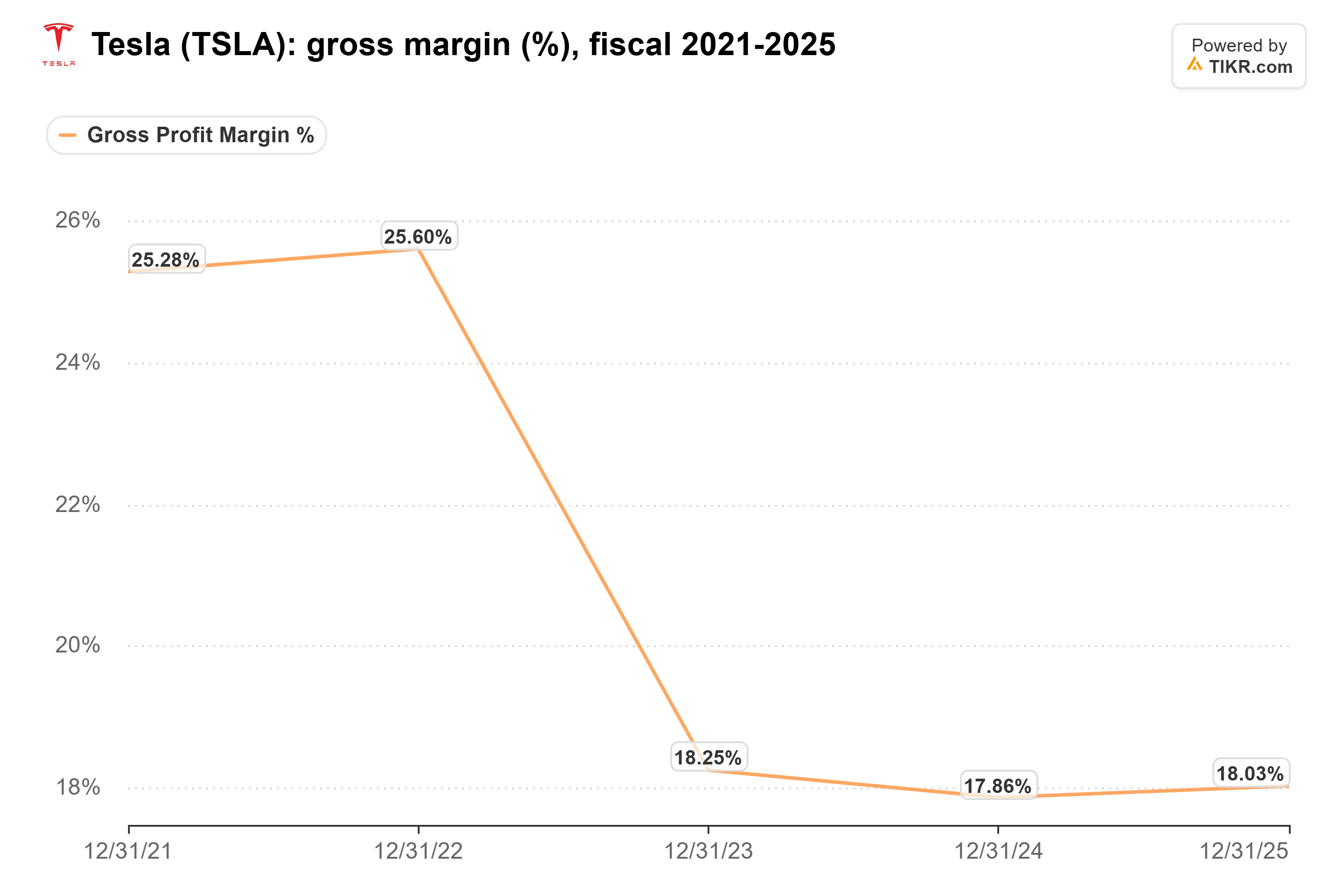
GAAP operating margin was just 2.6% in the third quarter of 2026. Building Model Ys for its own robotaxi fleet would give those lines a second customer, and Tesla could use one.
Uber’s six-seat plan has company
Uber expects over 2,000 fully driverless vehicles on its network in 2027, all from partners such as Lucid. A wheel-less Model Y would put a six- or seven-seat option on Tesla’s own app instead. The question for Uber’s fourth-quarter report, expected in early February, is whether its partner fleets grow fast enough to keep group rides on its network.
Regulators set the pace
A car with no steering wheel or pedals needs federal sign-off. In late July, Amazon’s Zoox won the first exemption to charge for rides in one, good for two years and up to 2,500 vehicles a year. That cap applies to Zoox, not Tesla, but it shows the scale regulators started with: Tesla delivered 486,532 cars in the third quarter alone.
States can take permission away, too. California’s DMV ordered Alphabet’s Waymo off the state’s freeways on Nov. 11 after its cars drove into active construction zones. NHTSA is also reviewing a defect petition, covering about 1,000 Tesla Robotaxis, that alleges they speed through active school zones.
A wheel-less Model Y looks like Tesla’s most realistic path to real robotaxi volume. Tesla’s fourth-quarter report, expected in late January, is where to look for a date and for 2027 capital spending guidance near the $23.8 billion analysts expect. Musk’s robotaxi timelines have slipped before: in January, he said he expected fully autonomous vehicles in a quarter to half of the U.S. by year-end, and as of Nov. 9, Tesla’s unsupervised service ran in eight cities in Texas and Florida.
So what is Tesla stock actually worth?
TIKR lets you forecast the future price of any stock in less than a minute. Just enter a few assumptions into TIKR’s valuation model and see what Tesla could be worth. Start from Wall Street consensus estimates, or adjust the inputs to reflect your own view of the business. It’s free to use.
Disclaimer:
Please note that the articles on TIKR are not intended to serve as investment or financial advice from TIKR or our content team, nor are they recommendations to buy or sell any stocks. We create our content based on TIKR Terminal’s investment data and analysts’ estimates. Our analysis might not include recent company news or important updates. TIKR has no position in any of the stocks mentioned. Thank you for reading, and happy investing!