Key Takeaways
- Tesla began rolling out its FSD v15 software, which it says handles safety-critical interventions 25x better, and LightShed analyst Walter Piecyk came away from a ride worried about Uber.
- Tesla has its own cars and its own app, so it never has to share a fare with Uber.
- Uber’s own driverless program with Nuro and Lucid only began testing without safety drivers on Tuesday.
- At about 16x forward earnings, near its lowest in three years, Uber stock already prices in a lot of that worry.
Tesla (TSLA) began rolling out its Full Self-Driving (FSD) v15 software to owners over the weekend. One of the first Wall Street analysts to ride it came away worried about a different company: Uber Technologies (UBER).
On Monday, LightShed Partners analyst Walter Piecyk wrote up his drive under the title “We Rode Tesla’s FSD v15 And Came Away Worried About Uber.”
The timing makes it hurt more. On Tuesday, Uber’s own robotaxi program, which runs Nuro’s self-driving software on Lucid Group (LCID) Gravity SUVs, began testing in the Bay Area with no safety driver aboard.
Tesla is showing off the hard stuff
Tesla says v15 delivers a 25x improvement in handling safety-critical interventions, and the update targets potholes, road signs and standing water. On X, Tesla has been sharing clips of v15 “navigating around a tree in the road.”
v15 is still supervised, so the owner has to keep watching the road. Tesla has said it may turn on unsupervised driving around the second quarter of 2027, so owners can add their cars to its robotaxi network.
That’s the part that should worry Uber.
TIKR tracks 44 analysts on Tesla. How many say “Buy”?
See the full breakdown of Buy, Hold, and Sell ratings on Tesla, along with Wall Street’s revenue and earnings estimates, all in one place. More than 500,000 investors use TIKR to research stocks like this one. See Tesla’s Analyst Ratings
Uber’s cut is what’s at stake
In 2025, Uber kept 30.4% of every Mobility gross booking dollar as revenue and 8.1% as segment adjusted EBITDA. Most of the rest of the fare went to the driver. A Tesla robotaxi has no driver to pay, and Tesla has its own app, so it doesn’t need Uber to find riders. If v15 holds up on the edge cases, I suspect Tesla could charge less per ride than Uber’s drivers can afford to accept, and Uber would have to shrink its own cut to keep up.
That cut is what Wall Street’s estimates rest on. Analysts expect Uber’s normalized EPS to more than double, from $2.45 in 2025 to $5.55 in 2028:
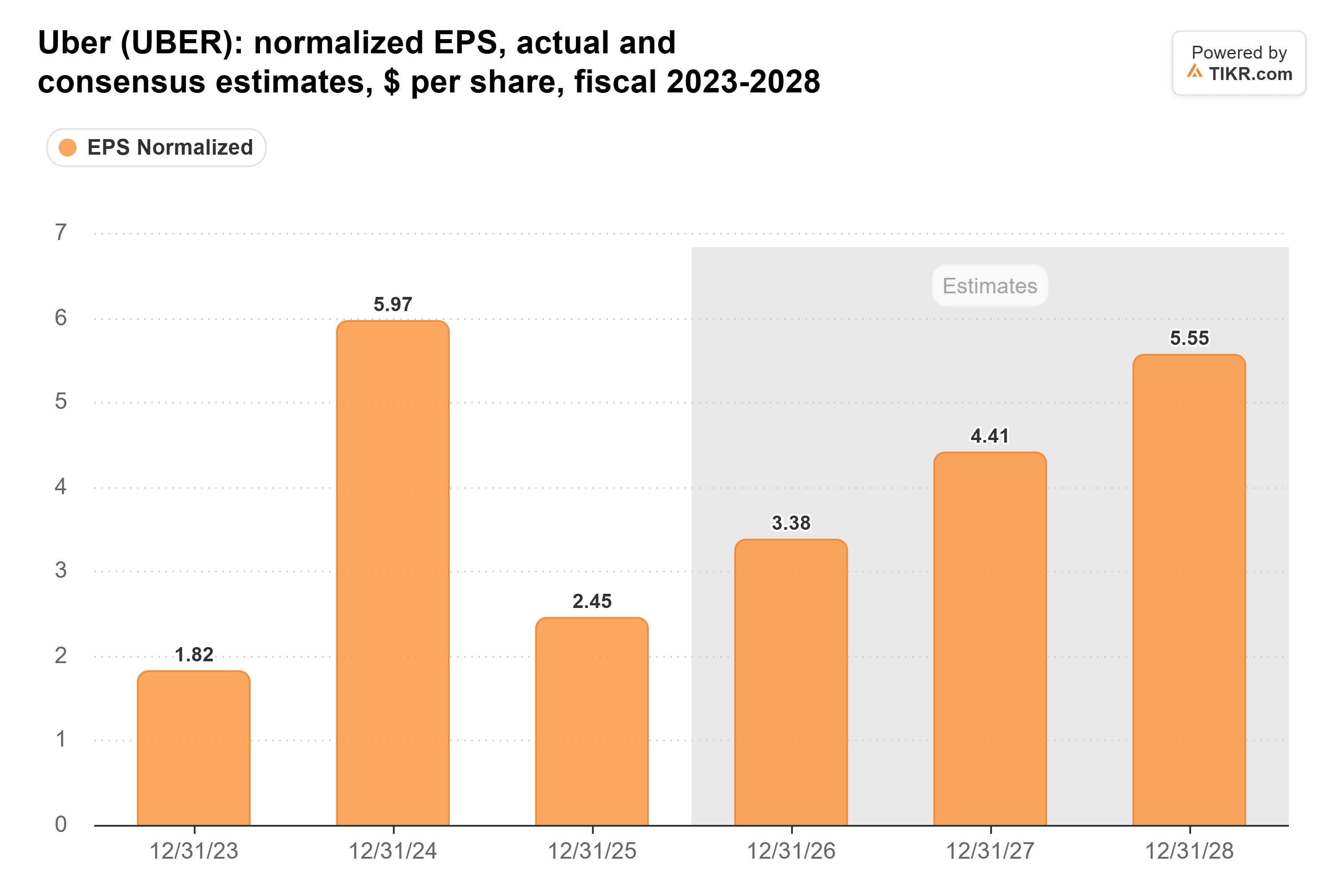
A supervised software update shouldn’t move those numbers yet. A driverless Tesla network in Uber’s biggest US cities would.
Uber’s profits are also fairly new. Its operating margin only turned positive in 2023, and it reached a still-modest 10.7% in 2025:

Uber’s best defense is everyone else’s robotaxis
Uber doesn’t need any one robotaxi maker to win. It says it has more than 30 autonomous vehicle partners, and management says those vehicles run 30% more trips per day on Uber than on standalone networks. Management also says the top 20 US cities, where robotaxis are starting out, produce only 25% of its US profit.
The Bay Area program is the closest test of that defense. Uber has committed to buy at least 35,000 Lucid vehicles fitted with the Nuro Driver, with a public launch due in the first quarter of 2027. That’s a huge order for Lucid, which reported $350 million of third-quarter revenue.
Uber stock already looks worried
The market seems to share some of Piecyk’s concern. Uber trades at about 16x forward earnings, near its lowest in three years and well below its 25x average over that stretch:
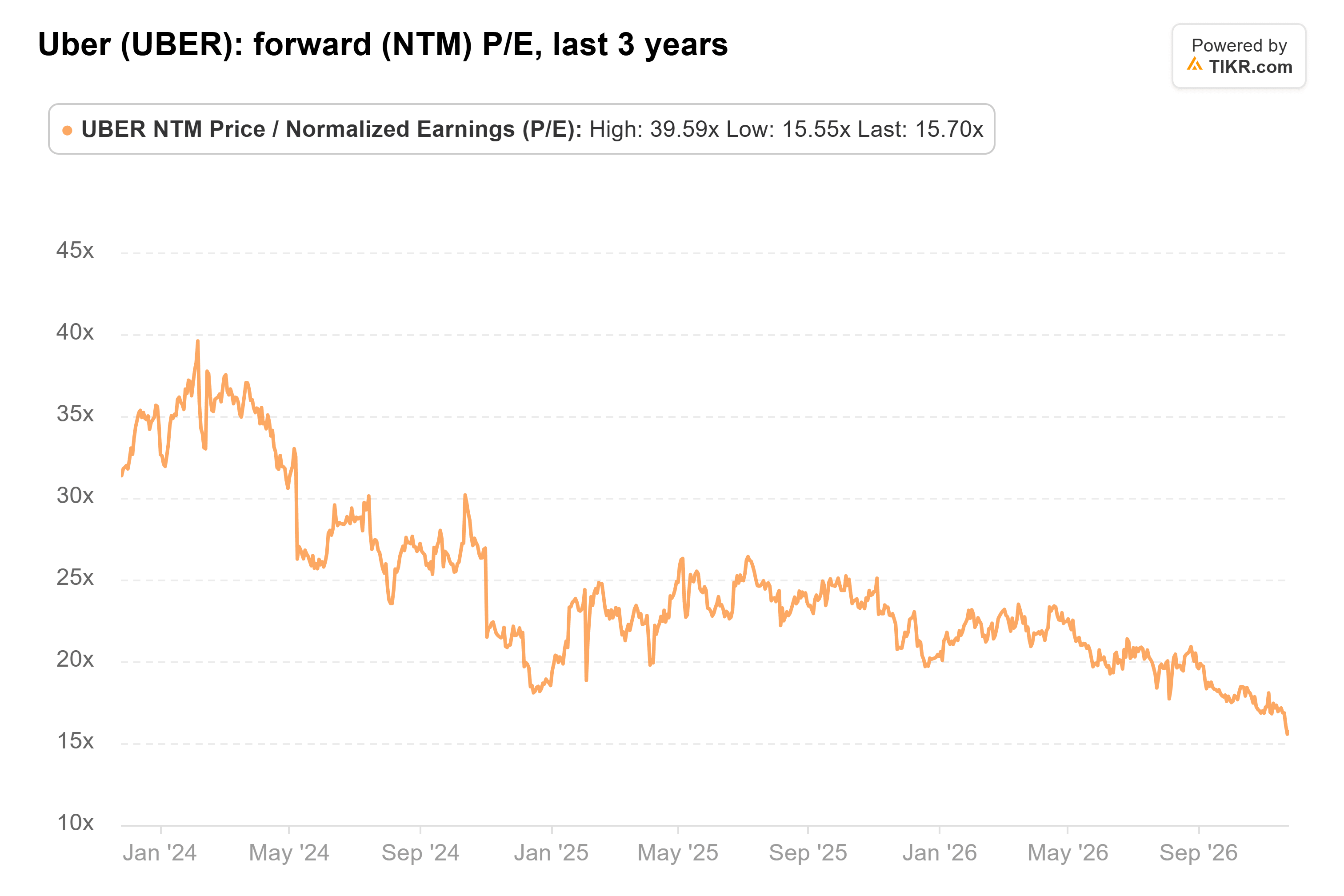
I think Piecyk is worried about the right company. Tesla is the rival with a fleet of owner cars, its own app and no reason to share a fare with Uber. Still, at 16x earnings that analysts expect to keep climbing, a lot of that fear is already in the price.
The tests come quickly. Uber aims to be live in 15 autonomous cities by year-end, up from seven in August. If Tesla turns on unsupervised driving around the second quarter, we’ll see whether Piecyk was early or just right.
So what is Uber stock actually worth?
TIKR lets you forecast the future price of any stock in less than a minute. Just enter a few assumptions into TIKR’s valuation model and see what Uber could be worth. Start from Wall Street consensus estimates, or adjust the inputs to reflect your own view of the business. It’s free to use.
Disclaimer:
Please note that the articles on TIKR are not intended to serve as investment or financial advice from TIKR or our content team, nor are they recommendations to buy or sell any stocks. We create our content based on TIKR Terminal’s investment data and analysts’ estimates. Our analysis might not include recent company news or important updates. TIKR has no position in any of the stocks mentioned. Thank you for reading, and happy investing!