Key Takeaways
- Lam Research (LRCX) fell approximately 16% during the week ended November 6, while Applied Materials (AMAT) declined roughly 15% as concerns about semiconductor spending pressured equipment stocks.
- Lam announced a $25 billion share repurchase authorization following the November 5 selloff, equivalent to approximately 10% of its market capitalization at the time.
- Lam expects industrywide wafer fabrication equipment spending to exceed $200 billion in 2027, while earlier analyst estimates projected significant earnings growth.
- Lam’s valuation fell below its five-year average, suggesting potential upside if equipment demand remains strong, although its subsequent rebound has reduced the apparent discount.
What Happened?
Lam Research (LRCX) stock fell approximately 16% during the week ended November 6, closing at $200.44 as concerns about AI infrastructure spending pressured semiconductor equipment stocks.
Applied Materials (AMAT) declined approximately 15% over the same period, reflecting broader uncertainty about chipmakers’ future capital spending.
Lam suffered its steepest decline on November 5, when shares plunged approximately 16% in a single session.
The selloff reflected concerns about whether semiconductor manufacturers could sustain rapid spending growth as investors reassessed the outlook for AI infrastructure investment.
Meanwhile, Qualcomm’s weaker smartphone chip sales added to industry uncertainty, although its overall revenue guidance exceeded Wall Street expectations.
Lam did not announce a company-specific operational setback that explained the sudden decline.
Following Thursday’s selloff, Lam announced a $25 billion share repurchase authorization and declared a quarterly dividend of $0.33 per share.
The authorization represented approximately 10% of Lam’s market capitalization at the time, giving management greater flexibility to return capital through future repurchases.
Doug Bettinger, Lam’s executive vice president and chief financial officer, highlighted the company’s strong technology positioning and cash generation, expressing confidence in achieving its capital return objectives “over time.”
The authorization supplements Lam’s existing repurchase program without requiring immediate purchases, giving management flexibility to repurchase shares when it considers valuations attractive.
Shares subsequently rebounded approximately 8% on November 6, recovering part of the previous session’s losses.
Meanwhile, Lam’s longer-term growth outlook remains encouraging.
During its November 3 annual meeting, CEO Tim Archer reiterated that industrywide wafer fabrication equipment spending could exceed $200 billion in 2027, approximately 30% above expected 2026 levels.
According to TIKR’s October 27 consensus estimates, Lam’s normalized earnings per share were projected to increase from $5.82 in fiscal 2026 to $9.65 in fiscal 2027.
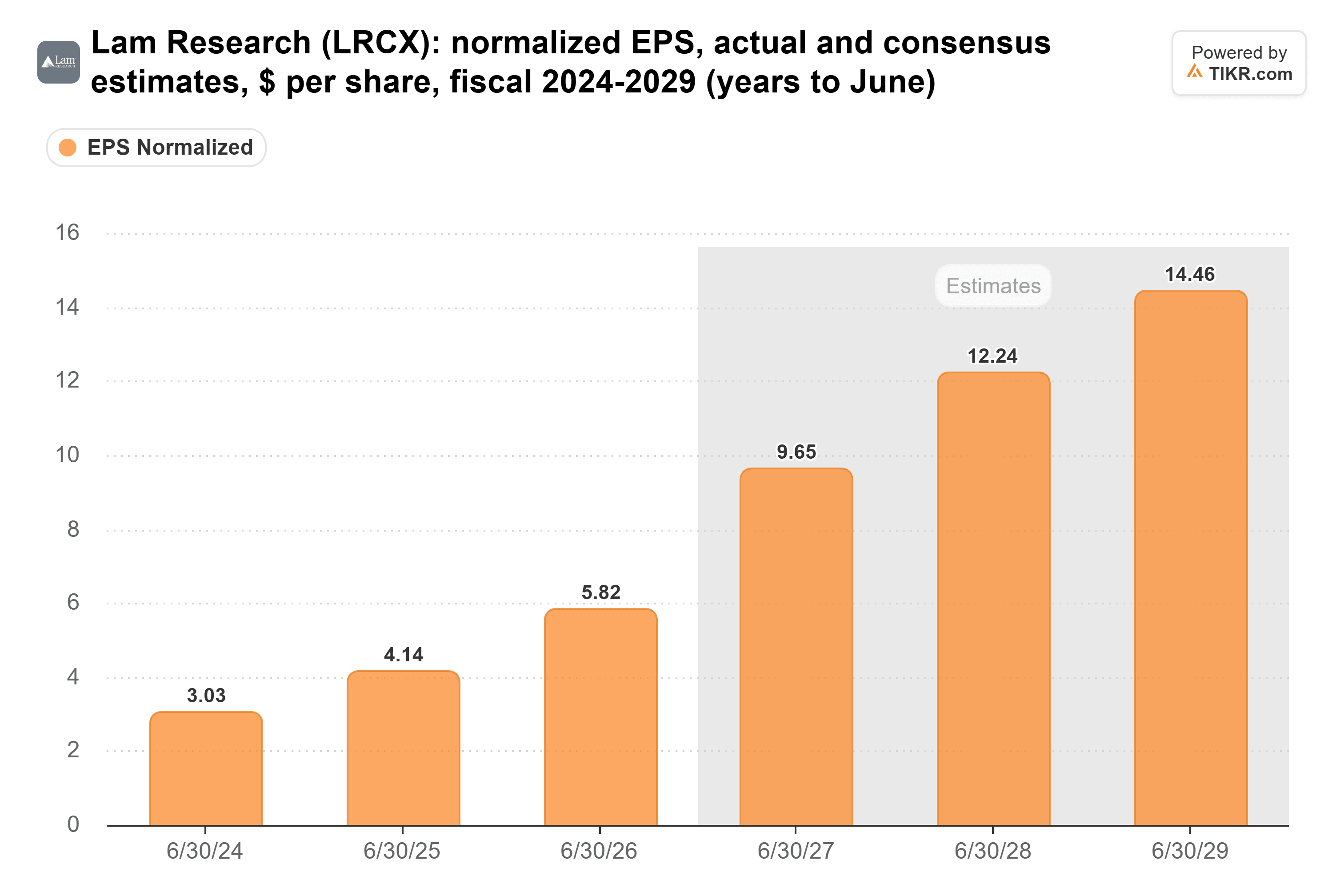
These forecasts reflect expectations for stronger semiconductor equipment demand, although the estimates predate November’s market volatility.
Applied Materials provides another indicator of underlying industry conditions.
According to its fiscal third-quarter earnings release, revenue reached a record $9.12 billion, up 25% year over year.
The company also guided to approximately $10.25 billion in fiscal fourth-quarter revenue, plus or minus $500 million.
Applied Materials is scheduled to report fiscal fourth-quarter earnings on November 12, providing another important test of semiconductor equipment demand.
Is Lam Research Stock Undervalued or Overvalued?
Lam Research appears potentially undervalued relative to its historical valuation, although the subsequent rebound makes updated earnings forecasts and share prices essential.
According to TIKR, Lam traded at approximately 22.1 times forward earnings on November 2, below its five-year average of 24.4 times and substantially below its June 2026 peak of 57.4 times.
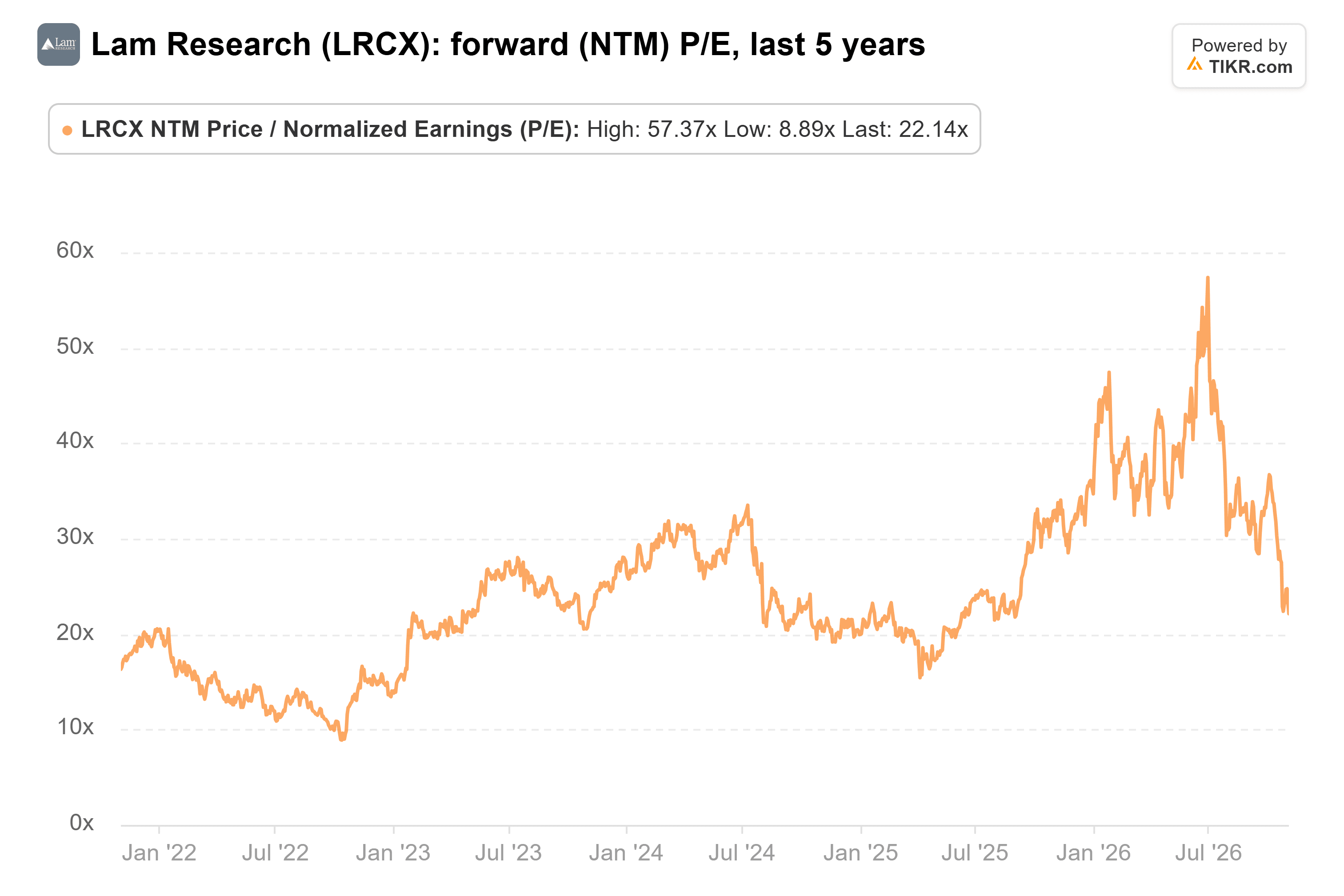
The subsequent selloff pushed Lam’s valuation lower before shares recovered, so the historical multiple should not be mistaken for its current valuation.
Earlier TIKR data showed an average analyst price target of approximately $364, about 82% above Lam’s November 6 closing price. However, the subsequent recovery has reduced that historical upside, making updated analyst targets and earnings forecasts important when assessing the stock’s current valuation.
Over the next 12 months, Lam’s performance will depend on semiconductor manufacturing investment, advanced memory demand, and whether AI infrastructure expansion supports stronger equipment orders.
The $25 billion repurchase authorization could also support future earnings per share if management executes purchases at attractive valuations.
However, slower data center spending, delayed factory expansions, or downward earnings revisions could pressure profitability and valuation multiples.
Overall, Lam’s earnings outlook and capital return plans support a potentially attractive long-term investment case, but whether shares remain undervalued depends on sustained semiconductor spending and the valuation investors pay following the rebound.
So what is Lam Research stock actually worth?
TIKR lets you forecast the future price of any stock in less than a minute. Just enter a few assumptions into TIKR’s valuation model and see what Lam Research could be worth. Start from Wall Street consensus estimates, or adjust the inputs to reflect your own view of the business. It’s free to use.
Disclaimer:
Please note that the articles on TIKR are not intended to serve as investment or financial advice from TIKR or our content team, nor are they recommendations to buy or sell any stocks. We create our content based on TIKR Terminal’s investment data and analysts’ estimates. Our analysis might not include recent company news or important updates. TIKR has no position in any of the stocks mentioned. Thank you for reading, and happy investing!