Key Takeaways
- AMD shares fell 10% on Tuesday after Nvidia reinstated Jensen Huang as CEO, 12 days after he resigned.
- Author Stephen Witt says Huang’s return is “not great for AMD,” since rivals had hoped to hire away Nvidia’s engineers.
- What AMD loses is upside that was never in its numbers: analysts’ $95.8 billion revenue forecast for 2027 rests on Helios deals signed before Huang left.
- The longer-term risk for AMD and Intel is a Huang-led Nvidia pushing into CPUs, and AMD’s fourth-quarter report in early February is the next test.
Advanced Micro Devices (AMD) fell 10% on Tuesday, and the news behind the drop came out of another company’s boardroom.
Nvidia (NVDA) reinstated founder Jensen Huang as CEO on Monday, just 12 days after he resigned amid a personal scandal and federal chip-export probes. Nvidia stock soared 31% on the news.
Stephen Witt, author of The Thinking Machine, a book about Huang and Nvidia, said what that means for AMD on the Hard Fork podcast:
“I suspect it’s not great for AMD that Jensen has been reinstated.”
He’s right, though I think AMD loses less than it looked like on Tuesday.
Nvidia’s turmoil had its perks
Witt’s case starts with people. As he put it, “NVIDIA’s competitors all went up initially when Jensen was fired because there was a view that maybe they can start poaching some of these top engineers from within.”
Then there are customers. ARK Invest CEO Cathie Wood said on the Money Rehab podcast that the upheaval at Nvidia “emboldened more and more people probably to look at Google’s TPUs, AMD’s GPUs and CPUs.”
Huang’s return closes both openings, and not just for AMD: Intel (INTC) loses the same chance for its own AI accelerators, and its inference GPU, the D-series, is still on the way.
TIKR tracks 61 analysts on Nvidia. How many say “Buy”?
See the full breakdown of Buy, Hold, and Sell ratings on Nvidia, along with Wall Street’s revenue and earnings estimates, all in one place. More than 500,000 investors use TIKR to research stocks like this one. See Nvidia’s Analyst Ratings
Analysts never counted on it
AMD’s growth plan was in place long before Huang left. OpenAI and Meta each plan up to 6 gigawatts of AMD’s Helios rack systems, and Anthropic plans up to 2 gigawatts starting in the first half of 2027. With third-quarter results, CEO Lisa Su guided to revenue growth of more than 80% in 2027.
Analysts expect AMD’s revenue to climb from $34.6 billion in 2025 to $95.8 billion in 2027 and $135 billion in 2028:
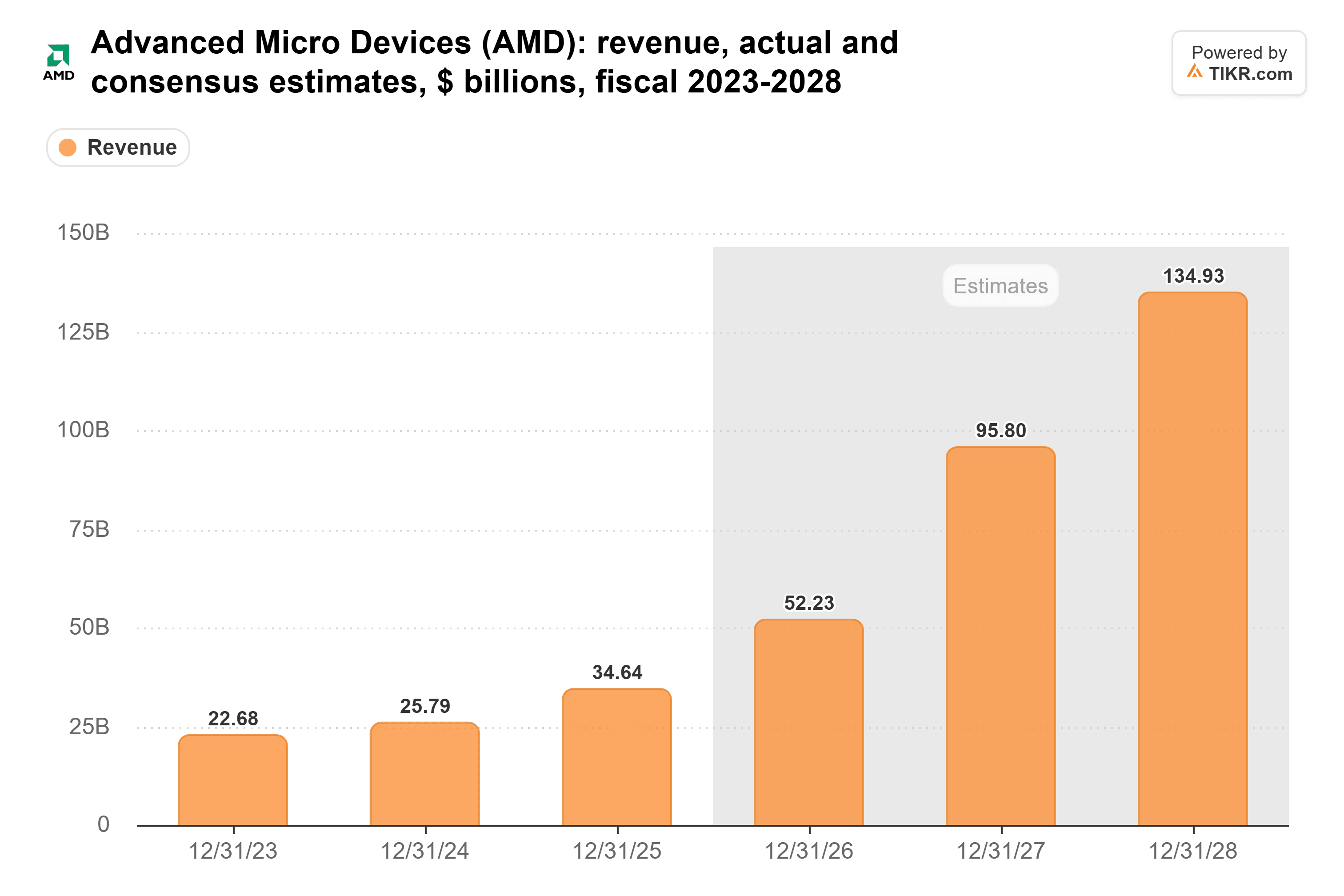
That 2027 figure is about 84% growth, right in line with Su’s guide. And consensus normalized EPS for 2027 barely moved while Huang was gone, holding at about $17.6 a share.
Nor is the stock priced for a leaderless Nvidia. AMD went into Tuesday at 30x forward earnings. That’s well below its three-year average of 39x and less than half its June peak of 67x:

Tuesday’s drop took it lower still. Much of it was the whole group cooling off after Monday’s rally, when AMD itself rose 6%, and Nvidia fell 8% on Tuesday.
The real cost comes later
What AMD really gives up is the chance that Nvidia, without Huang, would fumble a chip generation or two. Witt doesn’t expect that from Huang, who he says can “play a very, very long game.”
That long game now reaches CPUs too. Nvidia’s Vera CPU won agent-hosting work at AI cloud Modal in October, Reuters reported. Before that, Modal had run its agents only on Intel and AMD chips. That threatens AMD’s server business, which Su expects to double next year, and Intel’s, where Data Center and AI revenue rose 78% to $7.3 billion in the third quarter.
A windfall AMD never banked
None of that windfall was in the estimates or the multiple. The way I see it, AMD is priced for the plan it already has, and that plan never needed Huang gone.
The risk is in the plan itself. Helios is only now ramping, and management says 2027 depends on customers bringing their data centers online in time.
The next test is AMD’s fourth-quarter report in early February. The 2026 consensus implies about $17 billion of revenue in the fourth quarter alone, up from $13.38 billion in the third, and it’s the first quarter with real Helios volume. If AMD hits that, Su’s 2027 guidance looks solid.
So what is AMD stock actually worth?
TIKR lets you forecast the future price of any stock in less than a minute. Just enter a few assumptions into TIKR’s valuation model and see what AMD could be worth. Start from Wall Street consensus estimates, or adjust the inputs to reflect your own view of the business. It’s free to use.
Disclaimer:
Please note that the articles on TIKR are not intended to serve as investment or financial advice from TIKR or our content team, nor are they recommendations to buy or sell any stocks. We create our content based on TIKR Terminal’s investment data and analysts’ estimates. Our analysis might not include recent company news or important updates. TIKR has no position in any of the stocks mentioned. Thank you for reading, and happy investing!