Key Takeaways
- The cost of insuring CoreWeave’s debt against default hit a record on Nov. 25, implying about a 68% chance of default within five years.
- Applied Digital’s $11.0 billion CoreWeave lease is about a quarter of its backlog, but it covers 250 of the 275 MW of AI capacity Applied Digital has ready for service today.
- That rent backs Applied Digital’s 9.25% and 7.00% notes, and its financing costs ran at about 2.6x its base rent in the quarter to Aug. 31.
- Until hyperscaler buildings come online, Applied Digital investors should watch CoreWeave’s bonds as closely as their own stock.
The bond market is losing patience with CoreWeave (CRWV), and Applied Digital (APLD) shareholders have a lot riding on how that plays out.
On Nov. 24, CoreWeave’s 9.625% notes due 2032 fell as low as 74.9 cents on the dollar, Bloomberg reported, and its stock closed down 11.9%. Applied Digital fell 11.6% to $12.22 the same day as AI data center stocks sold off, one day after jumping on a new hyperscaler lease.
By Nov. 25, CoreWeave’s five-year credit default swap spread had hit a record 1,314 basis points, which implies about a 68% chance of default within five years. Applied Digital touched a 52-week low of $10.78 that day before closing at $12.29.
Guy Adami, co-founder of RiskReversal Media, put it bluntly on the Nov. 25 RiskReversal Pod:
“Some of that unsecured debt is trading at 15 plus percent yield. It’s dead.”
“Dead” overstates it: the swap market is pricing a high chance of default, not a certain one. But CoreWeave doesn’t have to fail for Applied Digital to feel this.
TIKR tracks 16 analysts on Applied Digital. How many say “Buy”?
See the full breakdown of Buy, Hold, and Sell ratings on Applied Digital, along with Wall Street’s revenue and earnings estimates, all in one place. More than 500,000 investors use TIKR to research stocks like this one. See Applied Digital’s Analyst Ratings
Almost every live megawatt is CoreWeave’s
CoreWeave holds Applied Digital’s 15-year, 400 MW lease at Polaris Forge 1, worth about $11.0 billion over its base term. On Nov. 23, a new 18-year hyperscaler lease lifted the backlog above $41 billion and cut CoreWeave’s share to about a quarter.
The rent coming in today looks different. Polaris Forge 1 had 250 MW live by Oct. 1, all of it CoreWeave’s. The first 25 MW hall at Polaris Forge 2 in Harwood, North Dakota, only became ready for its hyperscaler tenant on Nov. 24, so CoreWeave still accounts for about 90% of the capacity in service.
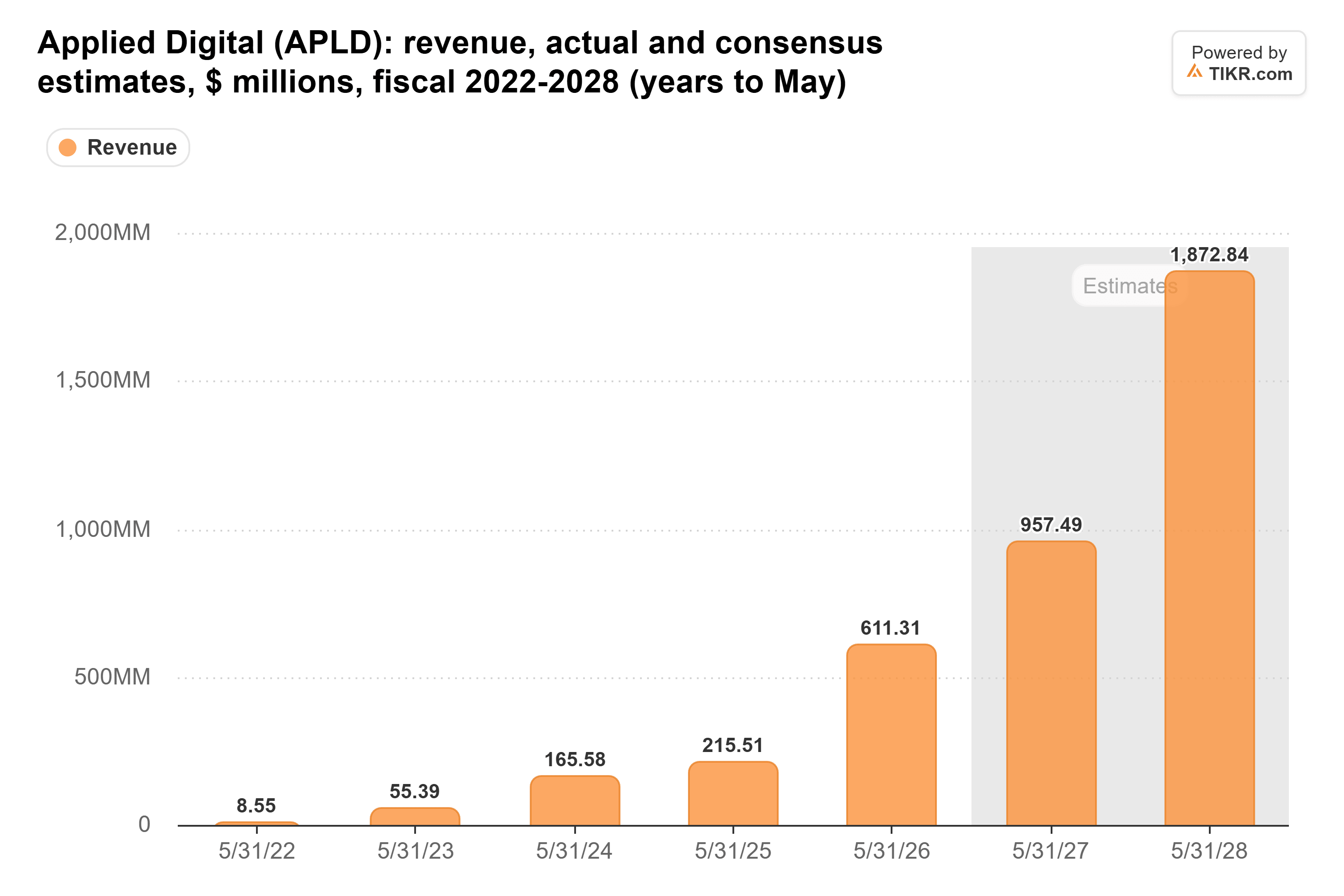
Analysts expect revenue to roughly triple over the next two fiscal years as the other leases start paying:
The notes ride on the same rent
CoreWeave’s leases also back Applied Digital’s $2.35 billion of 9.25% notes due 2030 and its $1.59 billion of 7.00% notes due 2031. Interest expense rose to $78.9 million in the quarter to Aug. 31, from $9.6 million a year earlier:
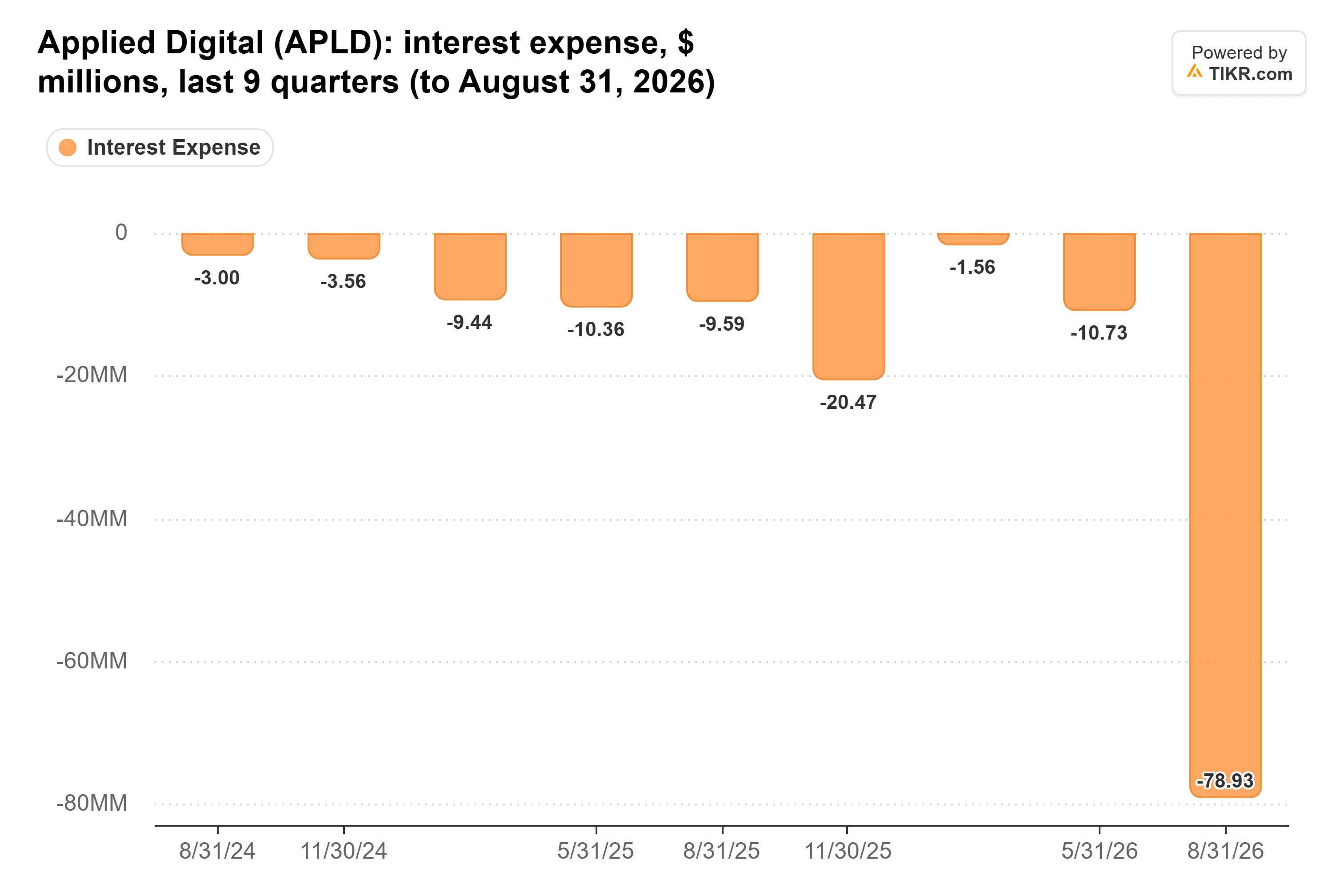
Counting interest capitalized into buildings under construction, Applied Digital incurred $113.1 million of interest in the quarter, and Macquarie’s preferred equity took another $60.1 million in kind. All in, financing ran at about 2.6x the $65.8 million of base rent, and much of that cost funds buildings that don’t pay rent yet.
Principal payments on the 9.25% notes start in December 2027, and the tenant whose rent backs them is the one the swap market prices at record default odds.
The debt is the problem
CoreWeave’s total debt, including lease obligations, is more than five times what it was in March 2025: $66.2 billion at the end of September, against $4.2 billion of cash and short-term investments. About $46.9 billion of that is borrowings, and the rest is mostly data center leases:
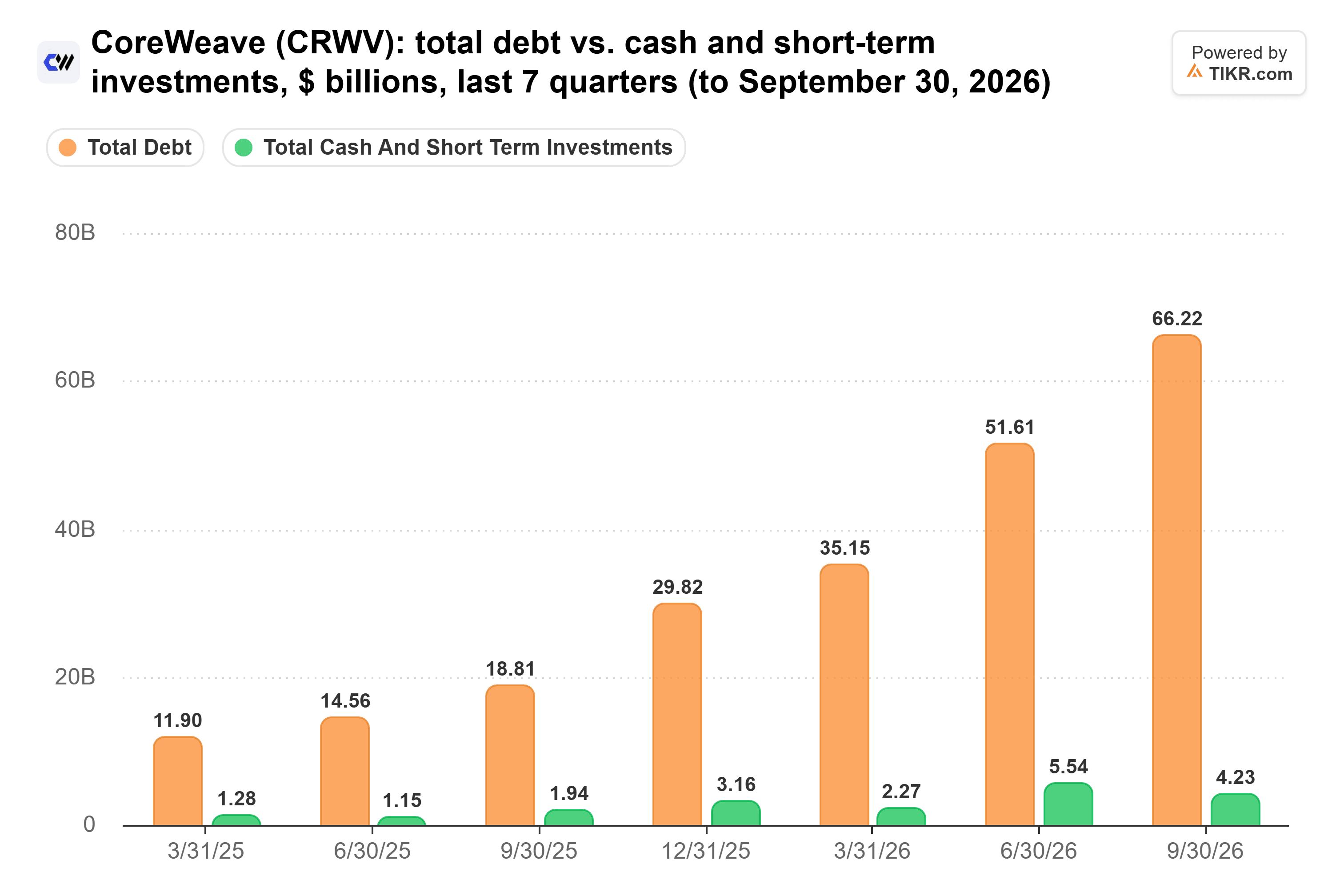
The business is still growing fast: third-quarter revenue rose 168% to $3.66 billion, and CoreWeave raised its 2026 revenue guidance to $13.0 billion to $13.3 billion. But CFO Nitin Agrawal has said the company won’t issue new parent-level unsecured debt through 2027 at current yields, so it is leaning on customer prepayments and loans secured by specific contracts. With its unsecured bonds near 75 cents, that market is effectively closed to it for now.
The protections are real, up to a point
Applied Digital’s leases are take-or-pay and non-cancellable. In March, CoreWeave moved one Polaris Forge 1 lease, and half of another, to a subsidiary whose debt is rated A3. The parent added a guarantee that kicks in under set conditions, plus a $50 million letter of credit.
Still, a take-or-pay contract only pays out if the tenant can pay, and the lease on the 150 MW building still under construction stays with the CoreWeave parent for now. Under a memorandum of understanding, it moves to a CoreWeave subsidiary only once that subsidiary wins an investment-grade rating. Management expects to put more than 600 MW into service over the next 12 months, and every hyperscaler building that comes online makes Applied Digital less dependent on CoreWeave.
For the next year, though, CoreWeave’s credit is Applied Digital’s credit. The first check is the fiscal second-quarter report in January, where base rent needs to come in well above $65.8 million. If CoreWeave’s 2032 notes keep sliding before then, Applied Digital shareholders will be paying for it too.
So what is Applied Digital stock actually worth?
TIKR lets you forecast the future price of any stock in less than a minute. Just enter a few assumptions into TIKR’s valuation model and see what Applied Digital could be worth. Start from Wall Street consensus estimates, or adjust the inputs to reflect your own view of the business. It’s free to use.
Value Applied Digital for free
Disclaimer:
Please note that the articles on TIKR are not intended to serve as investment or financial advice from TIKR or our content team, nor are they recommendations to buy or sell any stocks. We create our content based on TIKR Terminal’s investment data and analysts’ estimates. Our analysis might not include recent company news or important updates. TIKR has no position in any of the stocks mentioned. Thank you for reading, and happy investing!