
Key Takeaways
- Intuit raised its quarterly dividend 15% to $1.38 a share on Nov. 19, and IBM kept its own at $1.69 a share in October.
- IBM yields 3.0% and Intuit 2.1%, but over the past five fiscal years Intuit’s dividend has grown 15% a year and IBM’s less than 1%.
- Intuit’s dividend takes 15% of its free cash flow and IBM’s takes 43%, and IBM carries far more debt.
- Intuit cut its revenue outlook on weaker Credit Karma results, and IBM’s free cash flow in fiscal 2025 was below its fiscal 2016 level.
Intuit (INTU) raised its quarterly dividend 15% to $1.38 a share on Nov. 19. The next day, its stock fell more than 10% after it cut its revenue outlook and agreed to sell Mailchimp.
IBM (IBM) took the steadier route a month earlier. On Oct. 21, its board kept the quarterly dividend at $1.69 a share, and the company noted that “With payment of the December 10, 2026 dividend, IBM will have paid consecutive quarterly dividends every year since 1916.”
One pays the bigger check, and the other raises its check far faster. If I could hold only one for the next 10 years, which would it be? Here’s how the two compare:
| Metric | IBM | Intuit |
|---|---|---|
| Dividend yield | 3.0% | 2.1% |
| Annual dividend | $6.76 a share | $5.52 a share |
| Dividend growth, 5 years | 0.6% a year | 15.3% a year |
| Cash dividend payout ratio, TTM | 43% | 15% |
| Cash dividend payout ratio, forward | 40% | 18% |
| Net debt / EBITDA | 3.13x | 0.32x |
Source: TIKR, at today’s prices. Dividend growth covers fiscal 2020-2025 for IBM and fiscal 2021-2026 for Intuit, whose fiscal year ends in July. The forward ratios are consensus for IBM’s fiscal 2026 and Intuit’s fiscal 2027.
6 safe dividend stocks paying retirees 6%+ yields
There are over 100 stocks paying 6%+ annual dividends today.
But after an extensive investment review leveraging TIKR’s proprietary data, we now believe only six of them are truly safe for retirees.
They’re all yours as part of our new investment report. Learn more about how to get access right here.
IBM: a safe check that barely grows
IBM’s business is picking up. In the third quarter of 2026, revenue rose 5% to $17.1 billion, with software up 8%. Management now expects free cash flow to grow by more than $1 billion in 2026.
That leaves the dividend well-covered. Dividends took 43% of free cash flow over the 12 months to Sept. 30, and consensus has 40% for fiscal 2026.
The longer record is flatter. Free cash flow was $12.1 billion in fiscal 2025, below fiscal 2016’s $13.5 billion, while dividends paid rose to $6.26 billion from $5.26 billion:
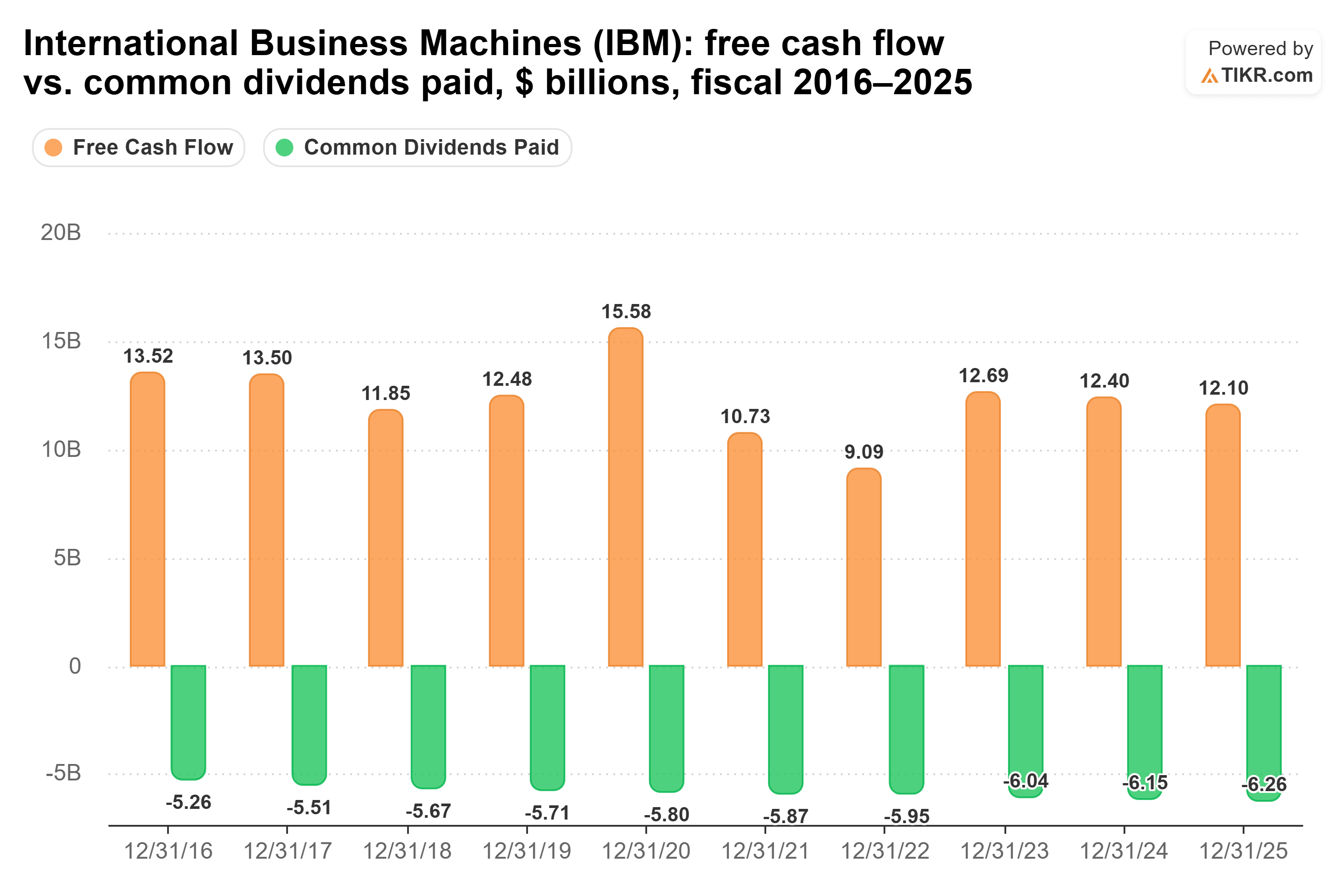
That’s why the dividend has crept up just 0.6% a year, from $6.51 a share in fiscal 2020 to $6.71 in fiscal 2025.
The main risk is the balance sheet. Net debt is 3.13x EBITDA, and total debt reached $63.8 billion at the end of September.
Intuit: a smaller check with room to run
Intuit’s dividend has grown at the pace IBM’s hasn’t. It rose from $2.36 a share in fiscal 2021 to $4.80 in fiscal 2026, a rate of 15.3% a year.
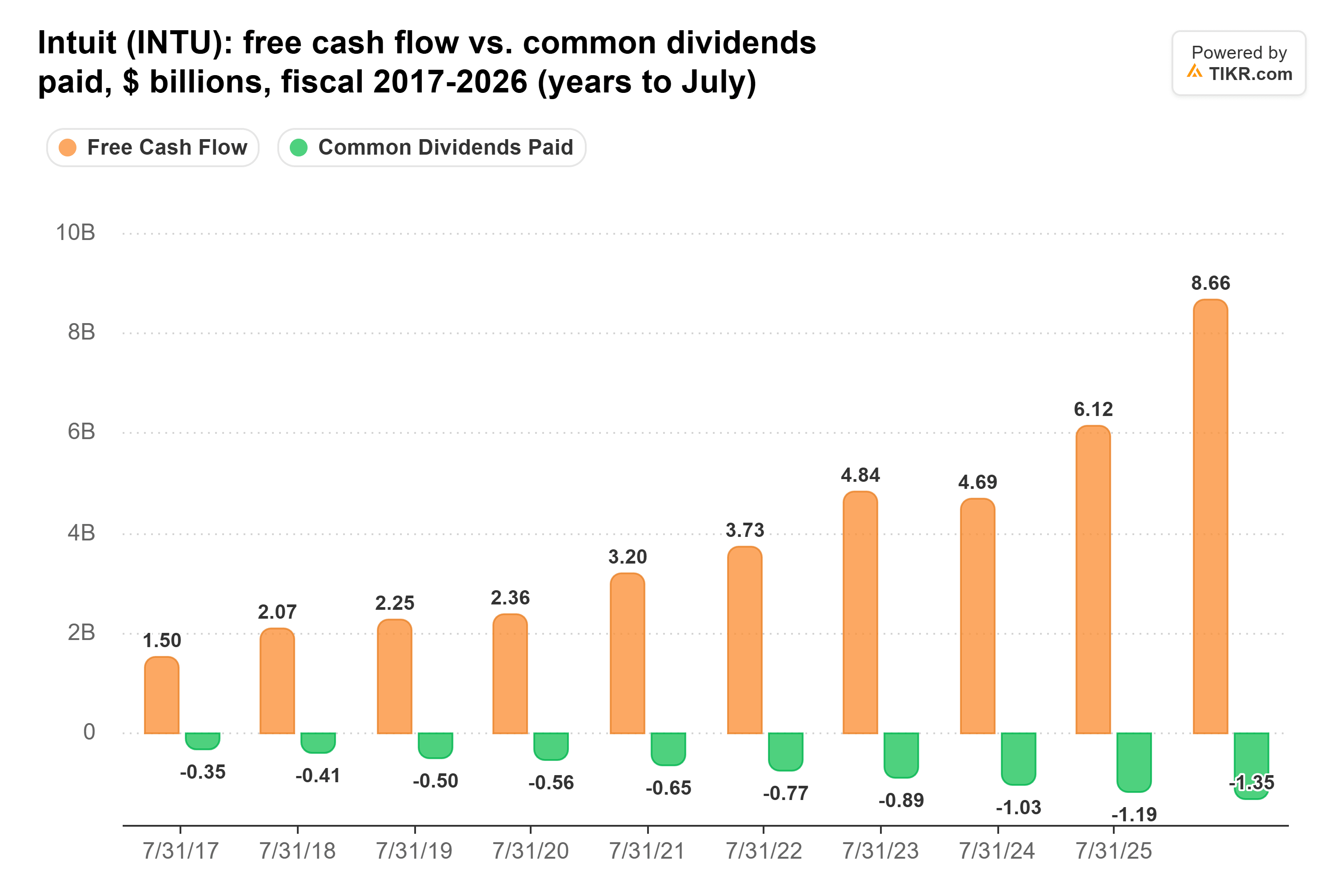
The dividend took 15% of free cash flow over the 12 months to Oct. 31, and consensus has 18% for fiscal 2027. Free cash flow grew from $1.50 billion in fiscal 2017 to $8.66 billion in fiscal 2026, while dividends paid grew from $350 million to $1.35 billion:
In the first quarter of fiscal 2027, revenue rose 12% to $4.4 billion, led by a 15% gain in Global Business Solutions.
The main risk is Credit Karma. Its results came in below expectations, and management blamed higher interest rates and a faster shift by consumers to AI-powered search. Intuit cut its fiscal 2027 revenue guidance to $23.08 billion-$23.37 billion, but it kept its non-GAAP EPS guidance of $22.88-$23.12.
Intuit is also selling Mailchimp to Bending Spoons for about $3.68 billion. CFO Sandeep Aujla said, “Our intent is to use the entirety of the cash proceeds from the sale to do buybacks in fiscal 2027 upon the close of the transaction.” With fewer shares outstanding, each future raise costs Intuit less.
So which dividend wins?
Intuit is the one I’d hold for the next 10 years. If each dividend keeps growing at its five-year rate, $10,000 in Intuit pays about $4,318 over the decade and $10,000 in IBM pays about $3,083, and Intuit’s yearly payout passes IBM’s around 2029.
A 15% raise every year is hard to sustain. Still, Intuit pays out only 15% of its free cash flow and carries net debt of just 0.32x EBITDA, so it has room to keep raising even if growth slows.
The sell-off has also made Intuit cheap. The stock trades at 11x forward earnings, against a 10-year average of 33x:
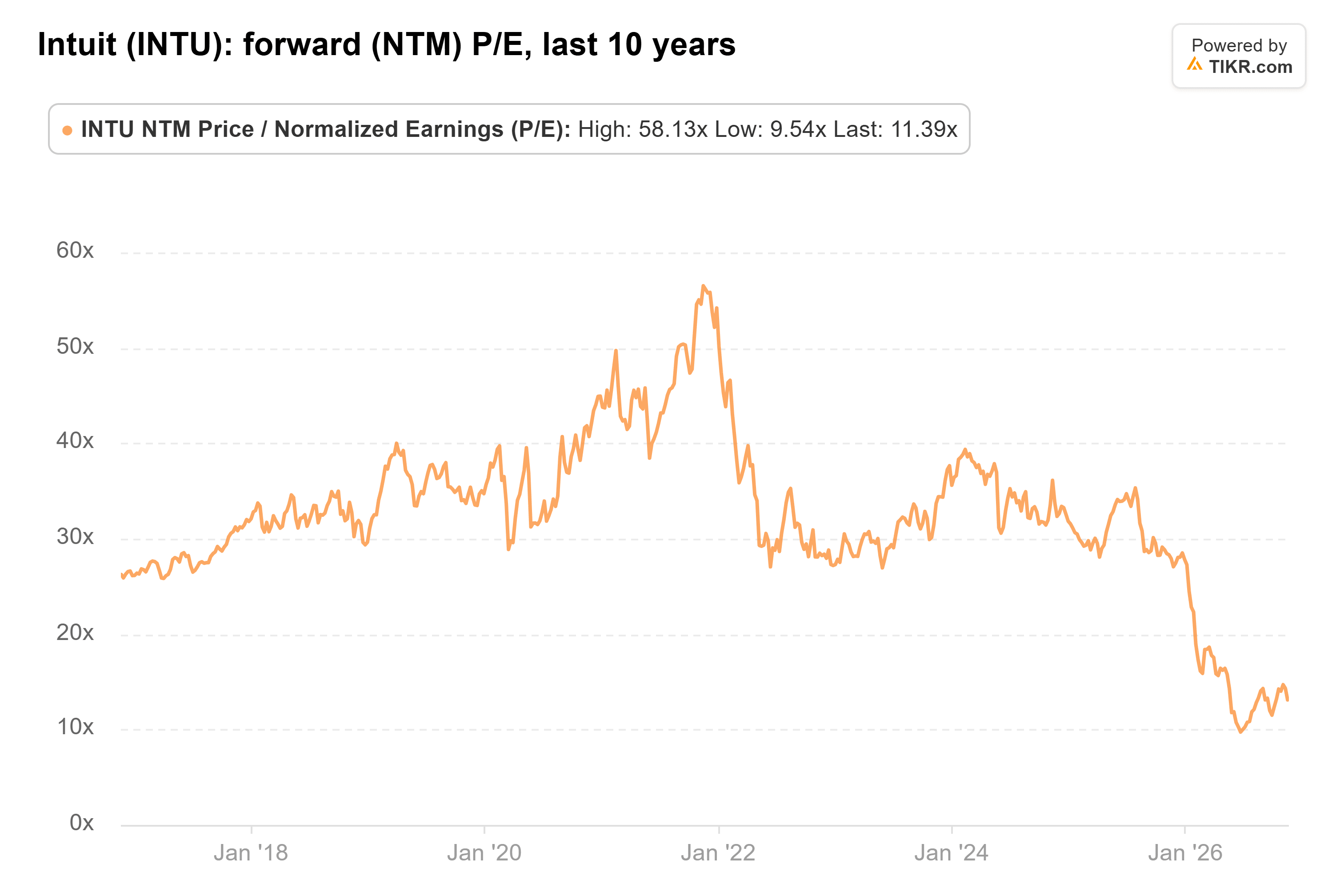
That’s close to the 9.5x low it hit in June, and below IBM’s 17x.
IBM has a real case. It pays the bigger dividend today and covers it comfortably, and a company that has paid dividends every year since 1916 is unlikely to stop. For a retiree who needs the most income from day one, that matters. But over a decade, I’d rather own the dividend that uses 15% of free cash flow and has grown 15% a year.
Intuit still has to show that Credit Karma’s slump is contained. Its next report covers the quarter ending in January, and revenue needs to reach at least $4.93 billion, the bottom of its guidance range.
Forget Intuit: 6 safe 6%+ dividend yields you can buy right now
Dividends can hold the key to enormous wealth. But only if you buy the right ones.
Picking the right high-yield dividend stock can be the difference between a dream retirement…and scraping by every month, waiting for the next Social Security check to clear.
We’ve identified six stocks yielding 6%+ that we believe every retiree should know about right now. (And Intuit isn’t one of them.)
Disclaimer:
Please note that the articles on TIKR are not intended to serve as investment or financial advice from TIKR or our content team, nor are they recommendations to buy or sell any stocks. We create our content based on TIKR Terminal’s investment data and analysts’ estimates. Our analysis might not include recent company news or important updates. TIKR has no position in any of the stocks mentioned. Thank you for reading, and happy investing!