
Key Takeaways
- DraftKings co-founder and director Matthew Kalish bought 55,000 shares for $1 million on Nov. 17, with the stock 51% below its 52-week high.
- He bought less than two weeks after DraftKings more than doubled its 2026 spending on prediction markets and cut its profit guidance. Kalish has said publicly that he loves prediction markets.
- The buy adds only about 1% to his stake, and analysts’ earnings estimates for 2026 and 2027 are still falling.
- The numbers support his buy if DraftKings’ 2027 guidance holds. The fourth-quarter report in February is the next test.
DraftKings (DKNG) just got a $1 million vote of confidence from one of the people who built it.
Co-founder and director Matthew Kalish bought 55,000 shares on Nov. 17 at an average $18.22, according to his Form 4. At the close, the stock was 51% below its 52-week intraday high of $36.98 from Jan. 6. He bought less than two weeks after DraftKings more than doubled its bet on prediction markets.
A much bigger bill for Predictions
Prediction markets selling sports contracts across the U.S. have weighed on licensed sportsbooks all year. On Nov. 5, DraftKings reported third-quarter revenue up 16% to $1.33 billion, but raised its 2026 Predictions investment to $650 million-$700 million from $200 million-$300 million and cut its adjusted EBITDA guidance to $175 million-$275 million from $700 million-$900 million. Shares closed down 21% the next day.
On the call, CEO Jason Robins said this year’s Predictions customers should pay back in about 20 months, adding: “Even if sports contracts were to end in July 2028, we estimate our 2026 cohort would be fully paid back by that date.”
TIKR tracks 37 analysts on DraftKings. How many say “Buy”?
See the full breakdown of Buy, Hold, and Sell ratings on DraftKings, along with Wall Street’s revenue and earnings estimates, all in one place. More than 500,000 investors use TIKR to research stocks like this one. See DraftKings’ Analyst Ratings
A small add from a big believer
The buy lifted Kalish’s direct holding to 5,689,845 shares, about 1% more than before: a small add to a stake worth about $102 million at the Nov. 17 close of $18.00. It also comes a year after he set up a prepaid forward sale on 1,391,574 shares, which paid him about $27.1 million up front and settles after Nov. 17, 2028.
In an interview published June 1, Front Office Sports asked Kalish whether his sportsbook background and his stake in DraftKings made him wary of prediction markets. “Hell no,” he said. “I love prediction markets. I think it’s one of the most exciting things going on in gambling right now.”
And he isn’t the only insider buying: CFO Alan Ellingson bought about $350,000 of stock on Nov. 9, and director Gregory Wendt added 5,000 shares two days later. (Here are five free tools to track insider buys.)
Cheap on 2027, if 2027 shows up
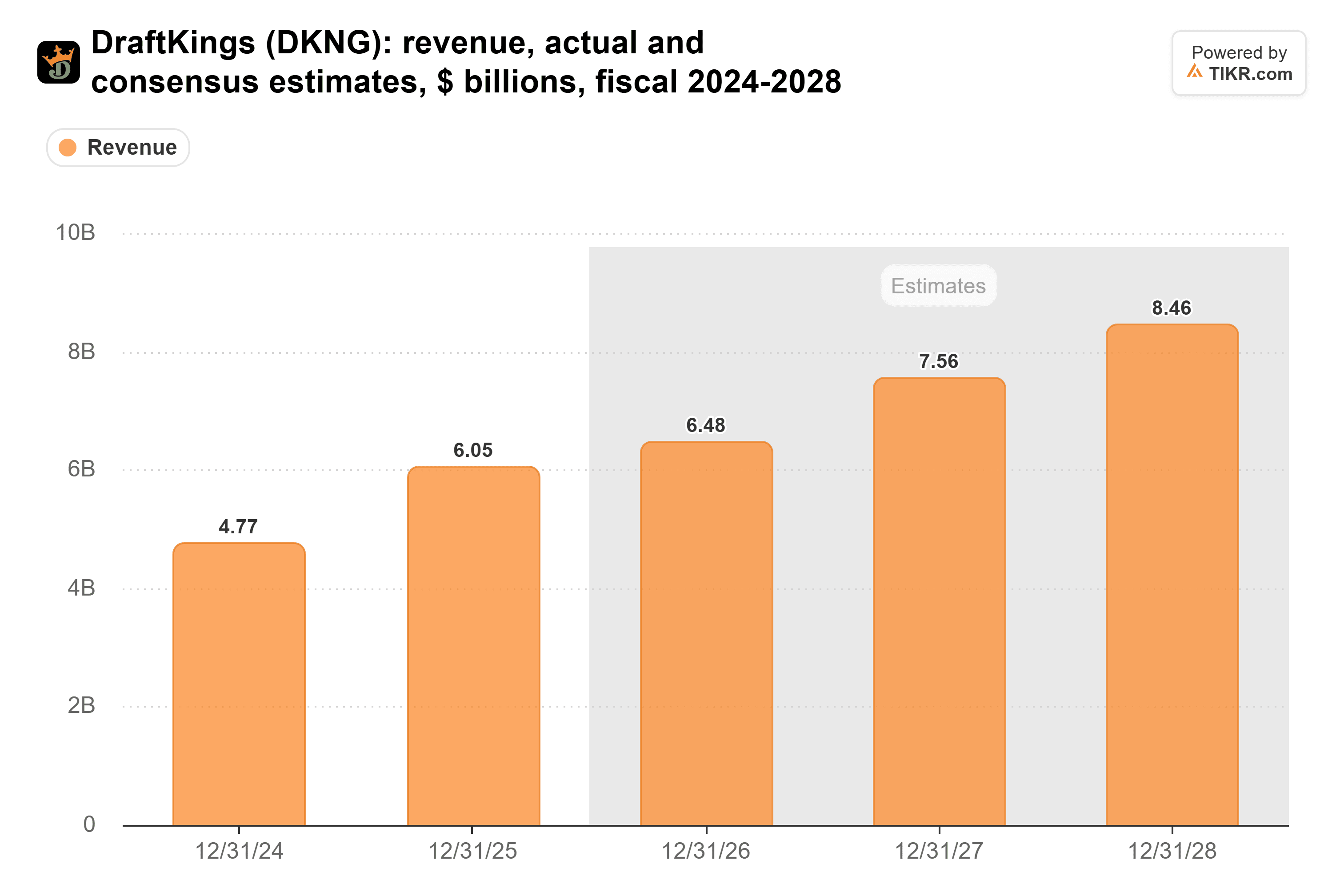
Revenue has held up better than profit. Analysts expect $6.48 billion for 2026, inside the $6.35 billion-$6.55 billion guide, and $7.56 billion for 2027, at the midpoint of its $7.35 billion-7.75 billion guide:
Earnings estimates are another story. Consensus adjusted EPS for 2026 has fallen to $0.50 from $0.89 three months ago, and 2027’s to $1.37 from $1.62. Even on that lower 2027 figure, the stock trades at about 13x earnings, well below the roughly 22x its forward P/E averaged over the past year.
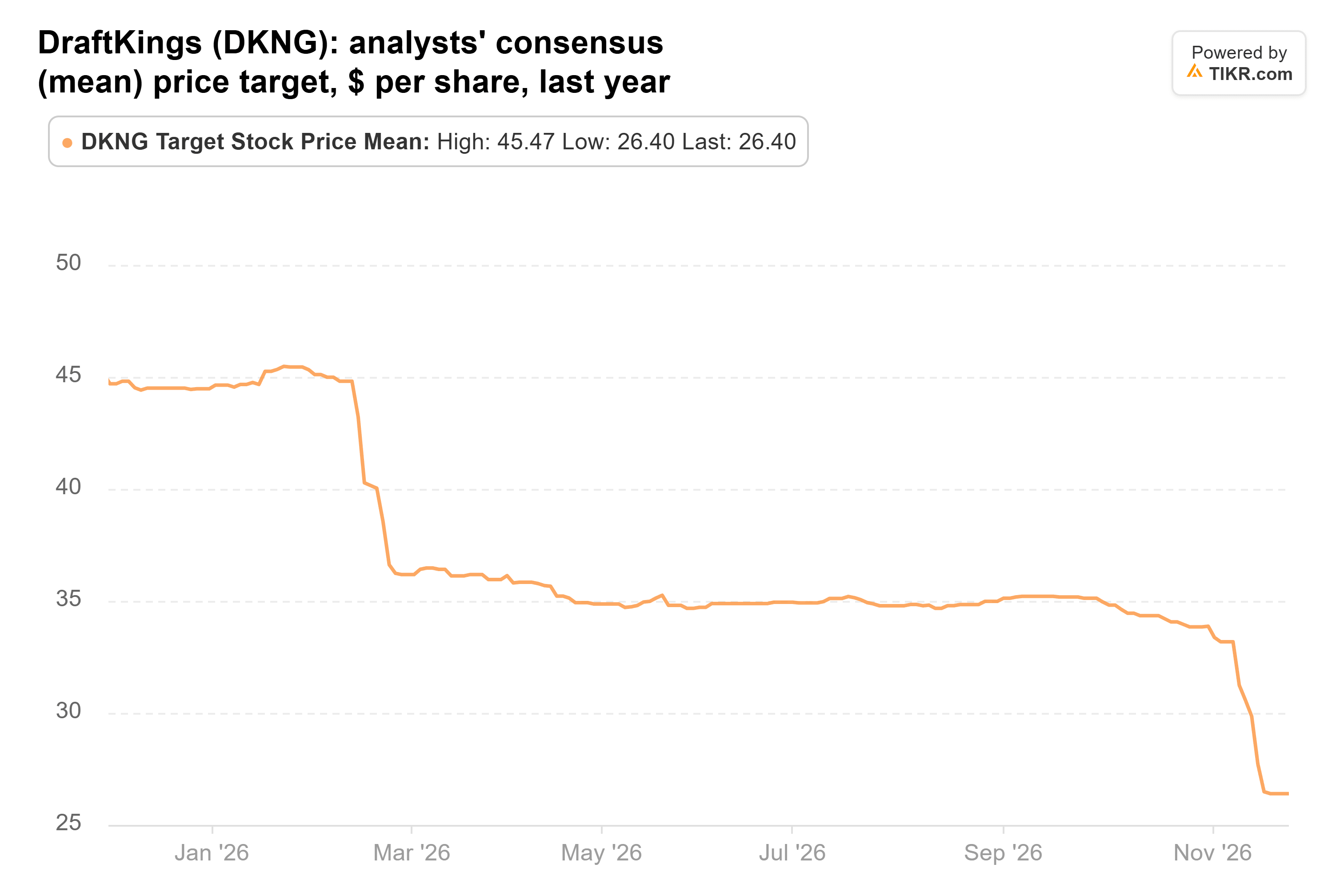
The consensus price target has fallen to $26.40 from $44.69 a year ago, though it still sits 47% above the Nov. 17 close:
And the cuts kept coming: on Nov. 10, Wells Fargo and Berenberg both downgraded the stock, with targets cut to $21 from $30 and to $20 from $27.50.
The court is the wild card
The biggest risk is the Supreme Court, where three pending petitions ask whether sports event contracts are federal swaps. The Court has not yet agreed to hear any of them. Robins’ base case is a ruling in mid-2028, though he allowed it could come sooner, which would cut the payback window short.
The numbers back Kalish at $18.22. Still, one director’s $1 million is a signal at most, and it pays off only if 2027 estimates stop falling.
The next test is the fourth-quarter report, likely in February: the 2027 guide of $800 million to $1.0 billion in adjusted EBITDA has to hold, with Predictions spending stepping down to $250 million-$350 million.
So what is DraftKings stock actually worth?
TIKR lets you forecast the future price of any stock in less than a minute. Just enter a few assumptions into TIKR’s valuation model and see what DraftKings could be worth. Start from Wall Street consensus estimates, or adjust the inputs to reflect your own view of the business. It’s free to use.
Disclaimer:
Please note that the articles on TIKR are not intended to serve as investment or financial advice from TIKR or our content team, nor are they recommendations to buy or sell any stocks. We create our content based on TIKR Terminal’s investment data and analysts’ estimates. Our analysis might not include recent company news or important updates. TIKR has no position in any of the stocks mentioned. Thank you for reading, and happy investing!