Key Takeaways
- Hyperscaler free cash flow turned negative in the third quarter for the first time, and Microsoft is the only one of Microsoft, Alphabet, Amazon, Meta Platforms and Oracle with positive free cash flow.
- Prof G Markets co-host Ed Elson expects the five companies to spend more than $2 trillion on capex over the next two years, against nearly $600 billion of cash on hand.
- His $1.5 trillion figure leaves out the cash these companies’ operations still bring in, but spending is growing much faster than that cash, and Meta and Alphabet are already turning to stock and bond buyers.
- Microsoft still pays for its buildout from operations, so it’s the best placed of the five if investors get less willing to fund the rest.
Microsoft (MSFT), Alphabet (GOOG), Amazon (AMZN), Meta Platforms (META) and Oracle (ORCL) are spending so much on AI data centers that, as a group, they can no longer pay for it out of their own cash flow.
Carson Group’s Ryan Detrick flagged it on X on Monday, citing his colleague Sonu Varghese: “Hyperscaler free cash flow turned negative for the first time ever in Q3.”
On Monday’s episode of Prof G Markets, co-host Ed Elson put a dollar figure on what that means. He expects the five companies’ capex over the next two years to be more than $2 trillion. He counts nearly $600 billion of cash and short-term investments among them, including more than $120 billion at Amazon and more than $250 billion at Alphabet. That leaves, in his words, “a one and a half trillion dollar gap between how much money they’re going to spend and how much money they actually have.”
That’s a lot of money to ask investors for.
TIKR tracks 57 analysts on Microsoft. How many say “Buy”?
See the full breakdown of Buy, Hold, and Sell ratings on Microsoft, along with Wall Street’s revenue and earnings estimates, all in one place. More than 500,000 investors use TIKR to research stocks like this one. See Microsoft’s Analyst Ratings
Smaller than $1.5 trillion, and growing fast
Elson’s math leaves out one big thing: the cash these businesses still bring in from operations, which pays for most of the spending today. Negative free cash flow means the spending has moved ahead of that cash. The cash is still coming in.
Meta shows it clearly. Its capex has climbed until, in the September quarter, it was more than the cash its operations brought in:
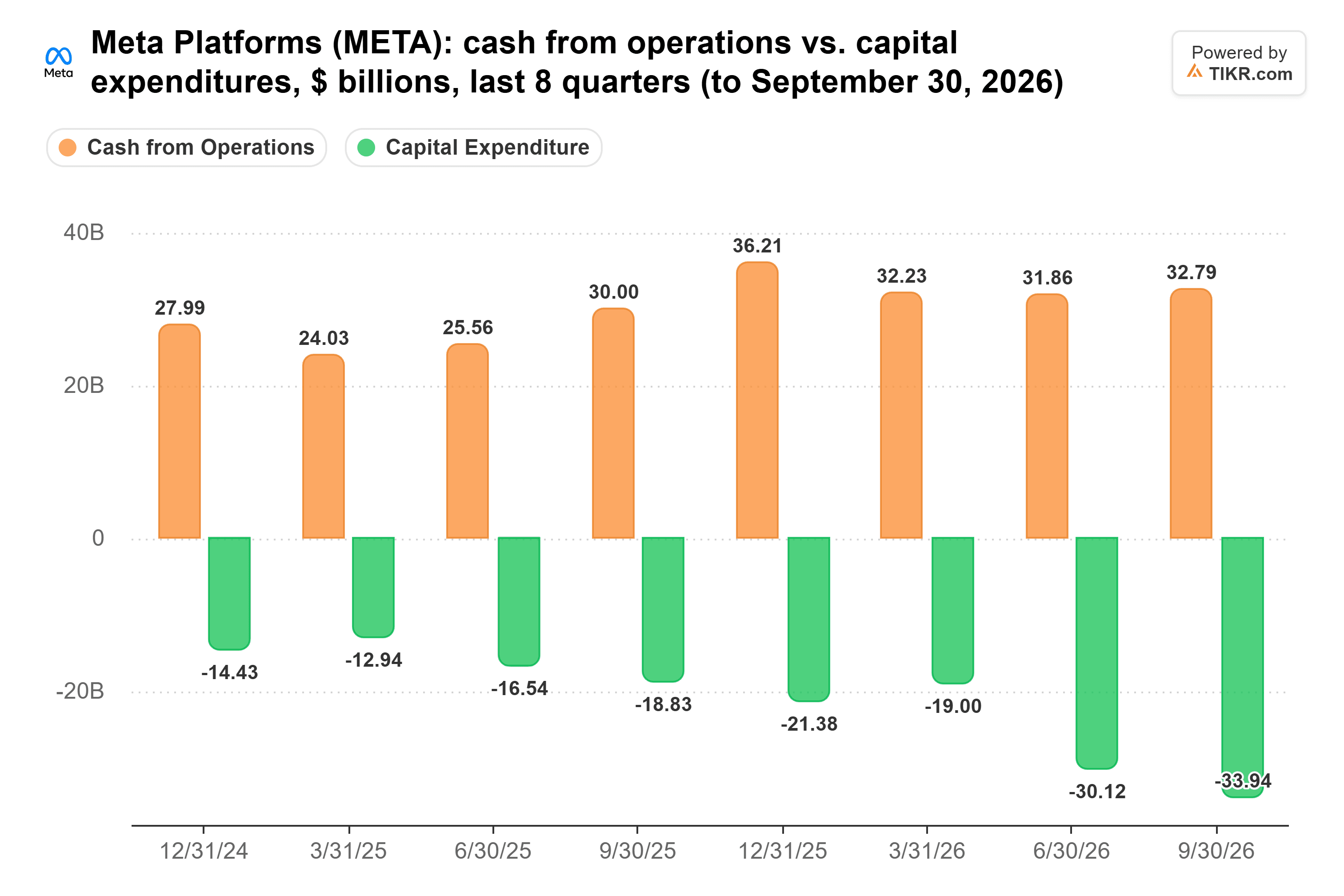
Meta’s capex rose 80% from a year earlier, to $33.9 billion, while its operating cash rose 9%, to $32.8 billion. That’s the real gap, and it grows every quarter that spending rises faster than cash. Elson expects capex to keep rising next year and the year after, so the gap could get big quickly. By his count, Oracle, Amazon and Alphabet are already in negative free cash flow too.
Investors are footing the bill now
The money is already coming from outside. On Oct. 26, Meta said it plans to raise $95 billion by selling stock: $35 billion through offerings launched that day, and $60 billion more through an at-the-market program starting early next year. And Microsoft sold $25 billion of bonds a day after reporting earnings, its first US investment-grade bond sale since 2017.
Alphabet has leaned on debt the hardest. Its total debt more than tripled in a year, to $150 billion at Sept. 30:

Elson argues that this changes how these companies operate. For years they didn’t need anyone’s money. Now they need investors to keep funding them, and if investors stop, they’re in a far weaker spot.
Borrowing is easy, but it isn’t free
These are still some of the strongest balance sheets in the world, and they can raise money whenever they want. But Microsoft’s new notes pay coupons of 4.85% to 6.35%, and Meta’s stock sale dilutes its shareholders.
Investors have noticed. Hyperscaler stocks had fallen roughly a quarter from early May by late October, on worries about how the buildout gets paid for.
Microsoft still pays its own way
Microsoft is the only one of the five still paying for its buildout from operations. Its free cash flow has stayed positive every quarter, at $18.6 billion in the latest quarter, though that’s down from $25.7 billion a year earlier:

That figure also leaves out finance leases, which added $28.1 billion of data center spending in fiscal 2026 (the year ended June 2026) outside free cash flow.
The way I see it, Elson’s dollar figure is too high, but the trend he’s pointing to is real. If investors get choosier about funding AI, I’d want to own the one hyperscaler that doesn’t need their money to keep building, and that’s Microsoft.
Of course, Microsoft expects capex of more than $50 billion in the December quarter, including finance leases. Analysts expect its free cash flow to fall to $34.6 billion in fiscal 2027, about half of fiscal 2026’s $67.0 billion. Its next report, in late January, will show how much room it has left.
So what is Microsoft stock actually worth?
TIKR lets you forecast the future price of any stock in less than a minute. Just enter a few assumptions into TIKR’s valuation model and see what Microsoft could be worth. Start from Wall Street consensus estimates, or adjust the inputs to reflect your own view of the business. It’s free to use.
Disclaimer:
Please note that the articles on TIKR are not intended to serve as investment or financial advice from TIKR or our content team, nor are they recommendations to buy or sell any stocks. We create our content based on TIKR Terminal’s investment data and analysts’ estimates. Our analysis might not include recent company news or important updates. TIKR has no position in any of the stocks mentioned. Thank you for reading, and happy investing!