

Key Takeaways
- At today’s prices, a $1,000 monthly dividend check takes about $299,700 of Bristol Myers Squibb stock, about $509,900 of Merck or about $632,600 of Johnson & Johnson.
- Bristol Myers Squibb’s 4.0% yield costs about $333,000 less than Johnson & Johnson’s 1.9%, and its dividend has the best coverage of the three, at 55% of free cash flow.
- Merck’s dividend is the least covered, at 66% of free cash flow, but management says it’s committed to raising it over time.
- Bristol Myers Squibb looks like the best check for the money, as long as its newer drugs keep making up for the older ones going generic.
A $1,000 dividend check every month is a pretty great thing to have in retirement. And Johnson & Johnson (JNJ), Bristol Myers Squibb (BMY) and Merck (MRK) can each get you there on their own.
The price tags are wildly different, though. Take a hypothetical retiree who wants $12,000 a year from just one of them. At today’s prices, that takes 2,239 shares of J&J (about $632,600), 3,530 of Merck (about $509,900) or 4,762 of Bristol Myers Squibb (about $299,700).
That’s a gap of about $333,000 for the same check, so it all comes down to which check you can count on:
| Stock | Dividend a share, a year | Yield | Shares for $1,000 a month | Cost | Cash dividend payout ratio (TTM) |
|---|---|---|---|---|---|
| Johnson & Johnson (JNJ) | $5.36 | 1.9% | 2,239 | $632,629 | 62% |
| Bristol Myers Squibb (BMY) | $2.52 | 4.0% | 4,762 | $299,673 | 55% |
| Merck (MRK) | $3.40 | 2.4% | 3,530 | $509,944 | 66% |
Sources: TIKR and StockAnalysis, at today’s prices. Payout ratios are for the 12 months to late September.
6 safe dividend stocks paying retirees 6%+ yields
There are over 100 stocks paying 6%+ annual dividends today.
But after an extensive investment review leveraging TIKR’s proprietary data, we now believe only six of them are truly safe for retirees.
They’re all yours as part of our new investment report. Learn more about how to get access right here.
J&J’s check costs the most, and it’s the steadiest
J&J’s dividend took up 62% of free cash flow over the 12 months to Sept. 27. Analysts’ consensus has that easing to 56% for fiscal 2026, and management guides to about $21 billion of free cash flow this year, up from $19.7 billion in fiscal 2025.
That fits a steady record. Free cash flow has stayed between $17.5 billion and $20.2 billion every year since fiscal 2018, while dividends paid rose from $10.5 billion in fiscal 2020 to $12.4 billion in fiscal 2025.

The business behind that cash is growing. Third-quarter sales rose 5.9% to $25.4 billion, led by cancer drugs like Darzalex and Carvykti. A roughly $7 billion charge, mostly for a proposed $5.5 billion resolution of its ovarian talc lawsuits, cut third-quarter net earnings to $210 million from $5.15 billion a year earlier. J&J still raised its 2026 sales and adjusted earnings guidance on Oct. 13.
Bristol Myers Squibb is cheap for a reason
Bristol Myers Squibb’s dividend took up 55% of free cash flow over the 12 months to Sept. 30, the best coverage of the three. That’s up from 39.3% in fiscal 2025, though, as free cash flow went from $12.9 billion that year to $9.29 billion over the latest 12 months.
Before that, the cushion was even wider. The payout ran between 28.9% and 39.3% in every fiscal year from 2021 to 2025.

The catch is the drugs going generic. In the third quarter, Revlimid sales fell 47% and Pomalyst’s fell 81%. Management also expects Eliquis revenue to step down $1.5 billion to $2 billion in 2027.
No wonder the market prices the stock at just 9.8x forward earnings.
Newer drugs are picking up the slack: Bristol’s Growth Portfolio rose 12% to $7.7 billion in the third quarter, and on Oct. 29, the company raised its 2026 revenue guidance to $49.75 billion-$50.25 billion. On Nov. 13, Bristol said chief research officer Robert Plenge is leaving, a shakeup for the pipeline it’s counting on.
Merck’s check has the thinnest cushion
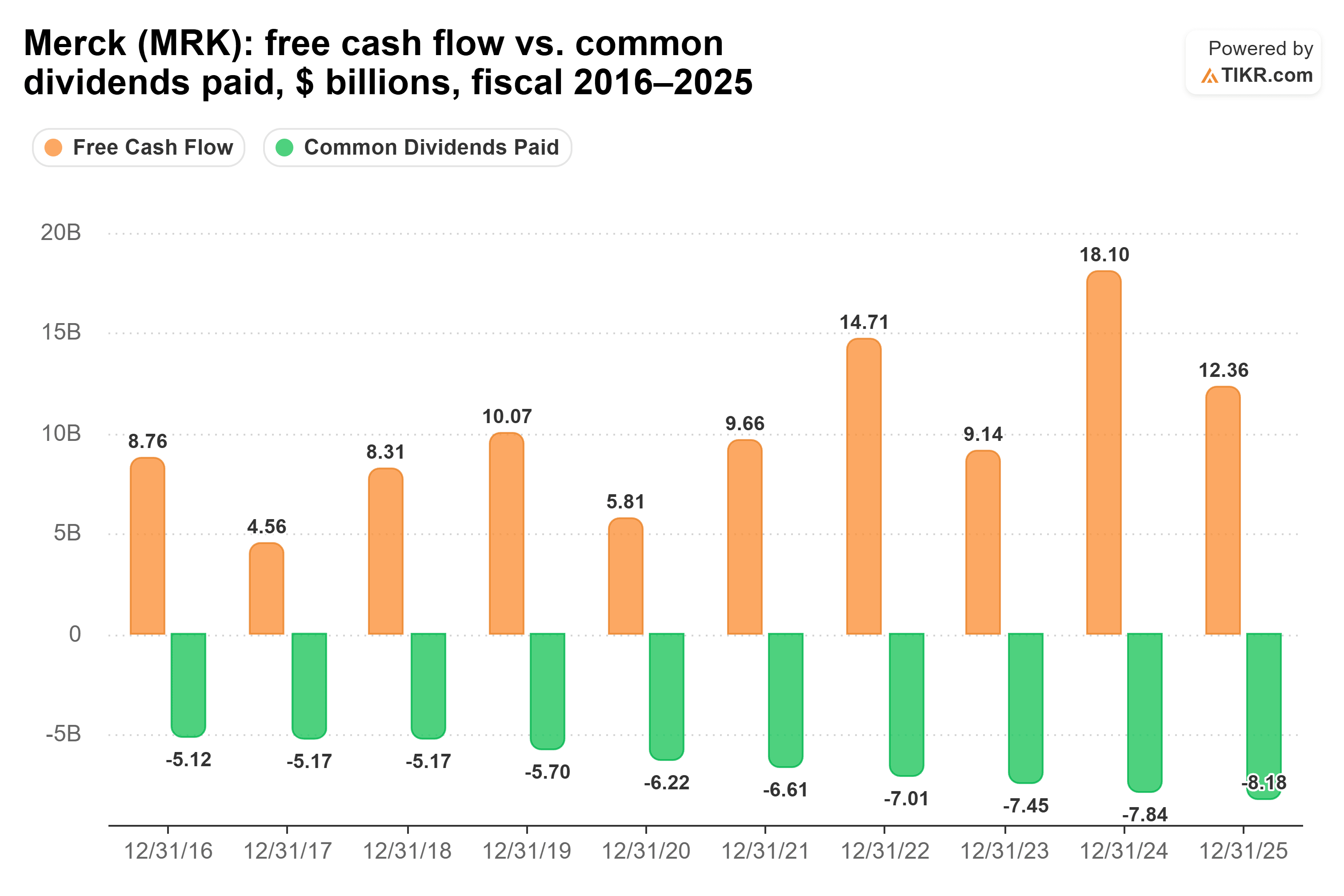
Merck’s dividend is the least covered of the three: it took up 66% of free cash flow over the 12 months to Sept. 30. Its record also swings more than the others’ do, with the payout going from 81.4% in fiscal 2023 to 43.3% in fiscal 2024, then back to 66.1% in fiscal 2025.
Keytruda is still the engine. Its third-quarter sales rose 6% to $8.6 billion, out of $18.1 billion for Merck as a whole, and Merck raised its 2026 earnings guidance on Oct. 29.
A government-set price for Janumet starts Jan. 1, 2027, and one for Keytruda starts Jan. 1, 2029. CFO Caroline Litchfield calls Keytruda’s coming loss of exclusivity “really more of a hill on the overall revenues of our company as we will, in short order, then return to strong growth.”
So which check should a retiree want?
Merck is the one to test for a cut, since its coverage is the thinnest. But “most at risk” doesn’t mean truly risky here. Merck is on track for about $3 billion of buybacks this year, and Litchfield said on the third-quarter call, “We remain committed to the dividend with the goal of increasing it over time.” I’d expect a deeper Keytruda hill to show up in its guidance well before any cut.
If I could only pick one check, I’d take Bristol Myers Squibb’s. It’s the cheapest by far, it’s the best covered of the three today, and its dividend grew the fastest: 6.2% a year from fiscal 2020 to fiscal 2025 ($1.84 to $2.49 a share).
J&J is the one I’d trust most to never surprise me. It has the steadiest free cash flow of the three, and analysts expect its payout ratio to ease. Plenty of retirees would happily pay up for that. I just wouldn’t pay that much more.
Of course, Bristol still has to show its newer drugs can carry it through the Eliquis step-down. The first big test is its milvexian readout in atrial fibrillation, expected in the first quarter of 2027.
Forget Bristol Myers Squibb: 6 safe 6%+ dividend yields you can buy right now
Dividends can hold the key to enormous wealth. But only if you buy the right ones.
Picking the right high-yield dividend stock can be the difference between a dream retirement…and scraping by every month, waiting for the next Social Security check to clear.
We’ve identified six stocks yielding 6%+ that we believe every retiree should know about right now. (And Bristol Myers Squibb isn’t one of them.)
Disclaimer:
Please note that the articles on TIKR are not intended to serve as investment or financial advice from TIKR or our content team, nor are they recommendations to buy or sell any stocks. We create our content based on TIKR Terminal’s investment data and analysts’ estimates. Our analysis might not include recent company news or important updates. TIKR has no position in any of the stocks mentioned. Thank you for reading, and happy investing!


