Key Takeaways
- Starbucks’ fiscal 2027 dividend, a buyback of about $1 billion and capital spending of about 5% of revenue add up to about $5.8 billion, against $5.0 billion of operating cash flow in fiscal 2026.
- Starbucks can close the gap if it hits its guided 13.5%-14.0% non-GAAP operating margin, and analysts’ $4.11 billion free cash flow estimate for fiscal 2027 covers both the dividend and the buyback.
- Fiscal 2026’s free cash flow covered the dividend mainly because capital spending fell by nearly half, and that spending is now going back up.
- The first-quarter report in late January will be the first check on whether the margin, and the U.S. traffic behind it, are on track.
Starbucks (SBUX) will start buying back its own stock again in fiscal 2027, and one investor has added up what that does to its cash.
Posting in the r/dividends subreddit, they put the coming year’s dividend, buyback and capital spending at about $5.8 billion, against $5.0 billion of operating cash flow in fiscal 2026. Then they asked: “How does it close the gap?”
Fair question. Starbucks’ answer is its margin guidance, and the company is already running close to it.
The $5.8 billion adds up
The post’s figures match the fiscal 2027 guidance Starbucks gave with its fourth-quarter results on Oct. 29, and the annual report it filed on Nov. 12. For fiscal 2027, Starbucks plans to spend:
- About $2.9 billion on the dividend, at $0.63 a quarter on about 1.14 billion shares
- About $1 billion on buybacks, which restart after a pause
- About $1.9 billion on capital spending, guided at about 5% of revenue
Capital spending is the other big jump. It fell to $1.26 billion in fiscal 2026 from $2.31 billion the year before, and the 5% guide takes it back up as Starbucks keeps remodeling stores. Revenue won’t help much either: Starbucks guides it down about 1% in fiscal 2027, with China running as a licensed joint venture for the full year, even with about $700 million from an extra 53rd week.
TIKR tracks 36 analysts on Starbucks. How many say “Buy”?
See the full breakdown of Buy, Hold, and Sell ratings on Starbucks, along with Wall Street’s revenue and earnings estimates, all in one place. More than 500,000 investors use TIKR to research stocks like this one. See Starbucks’ Analyst Ratings
Margins have to carry it
To pay the dividend and the buyback out of what’s left after capital spending, Starbucks needs about $3.9 billion of free cash flow. Analysts expect $4.11 billion for fiscal 2027, up from $3.72 billion in fiscal 2026, and $4.54 billion for fiscal 2028:
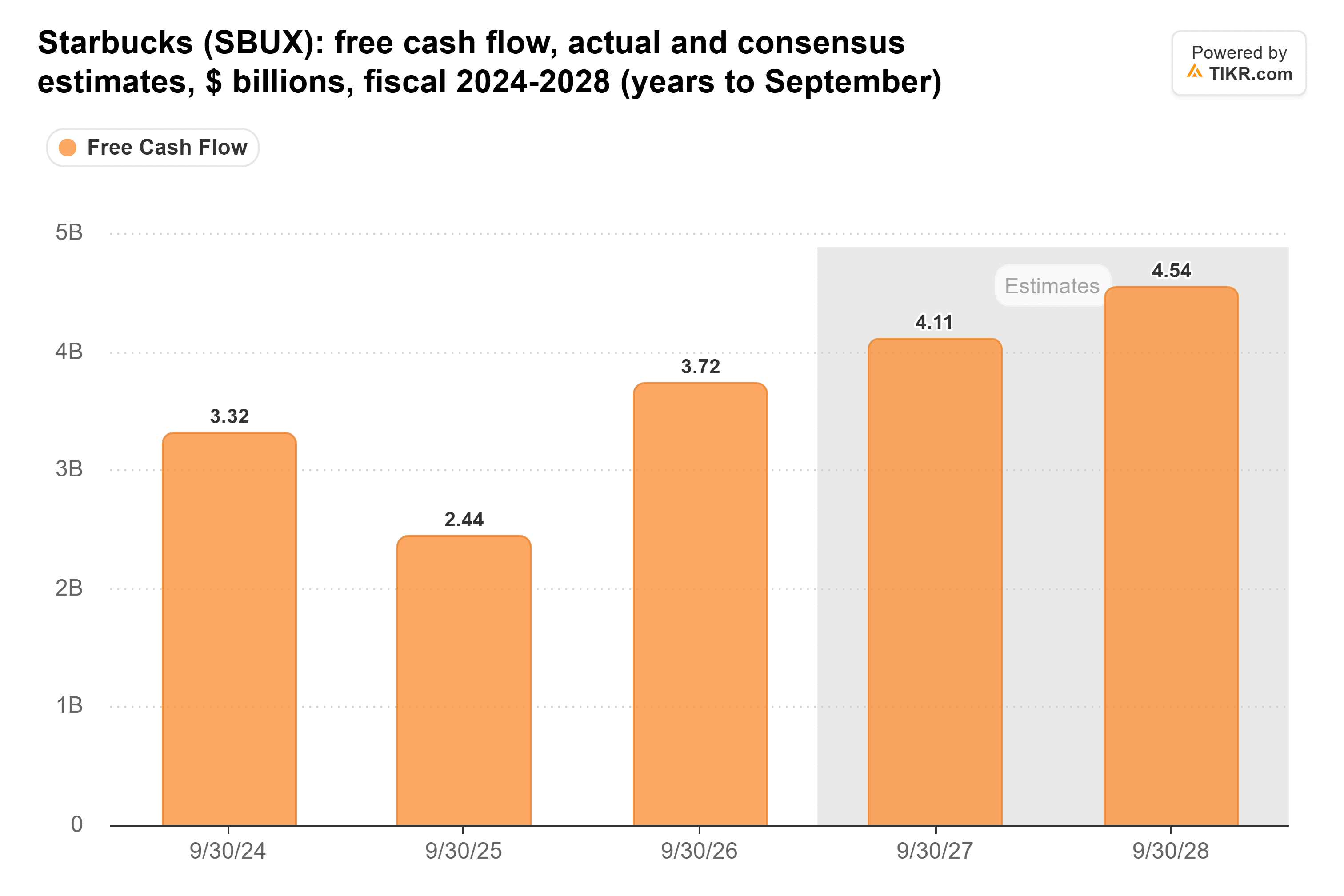
That leaves about $200 million to spare in fiscal 2027, so there’s little room for a miss.
Analysts are counting on the margin. Starbucks guides to a non-GAAP operating margin of 13.5%-14.0% in fiscal 2027, up about 190 basis points at the midpoint, on slightly lower revenue. So the extra cash has to come from earning more on each sale. It already did that for one quarter: its non-GAAP operating margin hit 14.0% in the fiscal fourth quarter, up 4.6 points from a year earlier. For fiscal 2027, Starbucks is guiding to about that level across a full year.
Fiscal 2026’s cover came from spending less
Starbucks’ free cash flow of $3.72 billion covered $2.82 billion of dividends in fiscal 2026. A year earlier, $2.44 billion of free cash flow fell short of $2.77 billion in dividends:
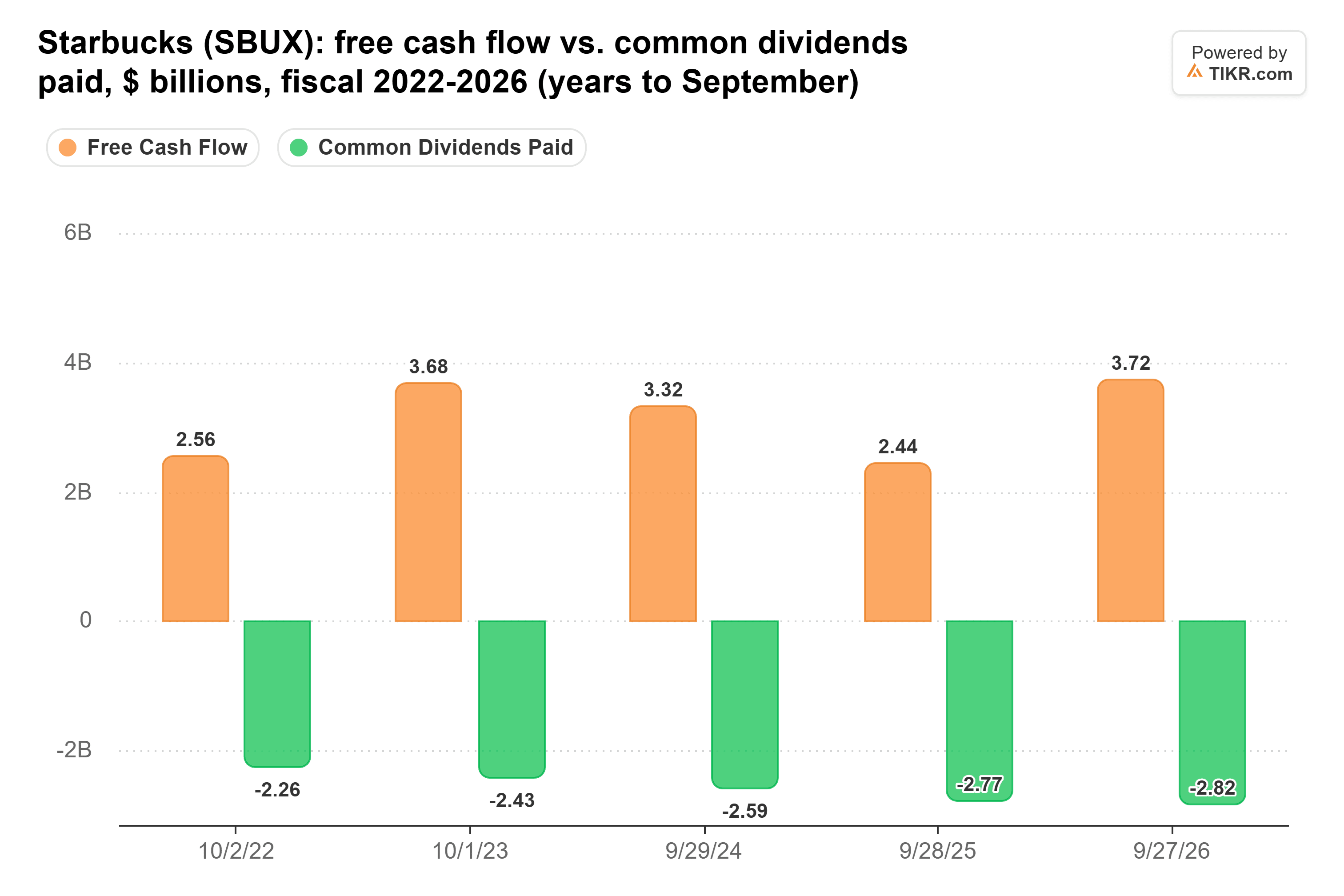
Most of the $1.28 billion rise in free cash flow came from lower capital spending, which fell by about $1.05 billion.
Take fiscal 2026’s $5.0 billion of operating cash flow and subtract next year’s capital budget of about $1.9 billion, and free cash flow drops to about $3.1 billion. That still pays the $2.9 billion dividend, but leaves only about $200 million toward a $1 billion buyback. On earnings, the dividend is covered: $2.52 a year against guided non-GAAP EPS of 3.15-3.25. The buyback is what needs the margin to come through.
The cash pile covers one year
Starbucks ended fiscal 2026 with $3.86 billion of cash and short-term investments, enough to cover an $800 million gap in fiscal 2027. The poster also notes that nothing is drawn on its $3.0 billion commercial paper program. A gap that repeats is harder, though, since that cash sits against $22.4 billion of total debt, including lease liabilities:
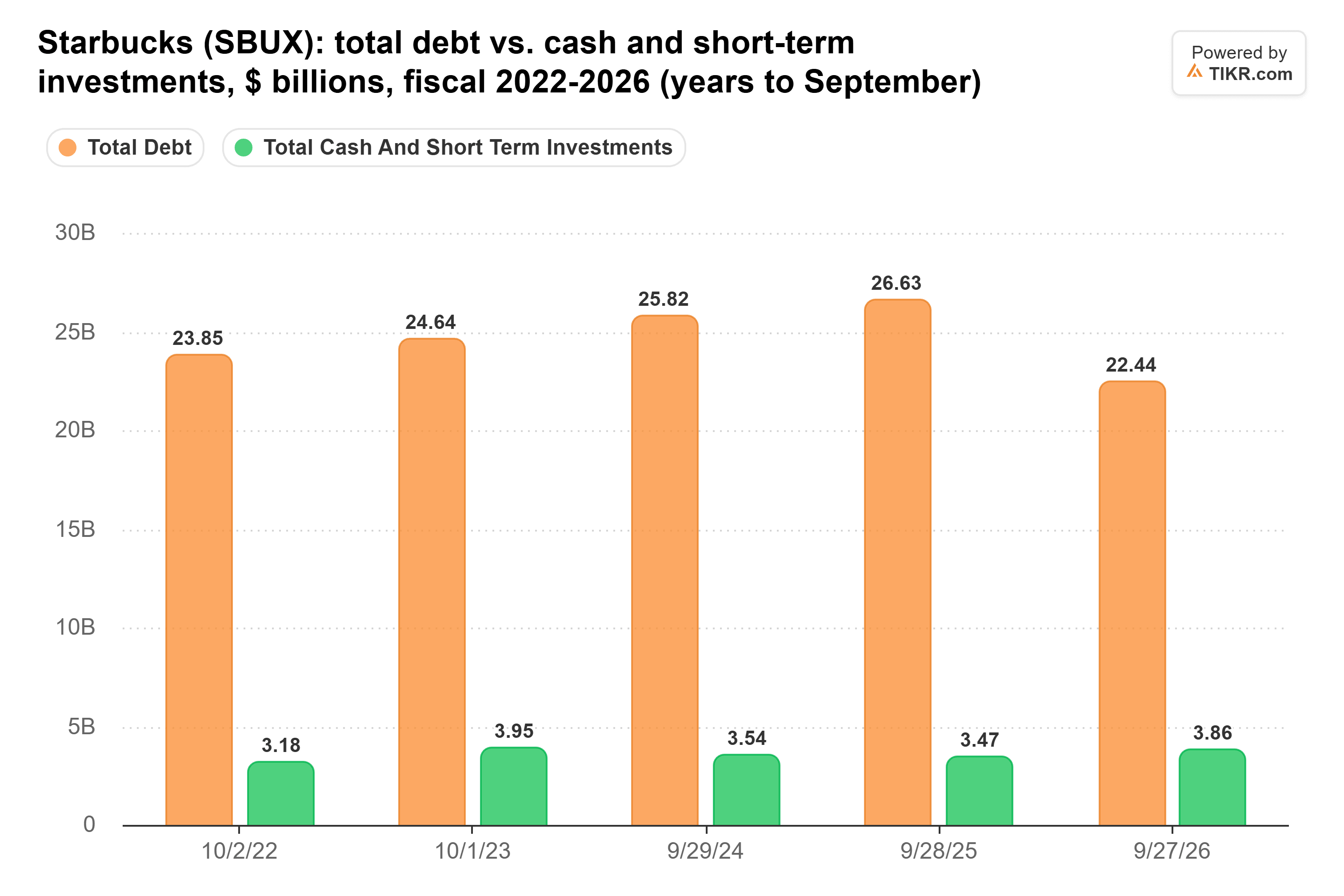
Total debt fell $4.2 billion in fiscal 2026. That was the same year Starbucks took in about $3.1 billion of gross cash for 60% of its China retail business and used part of it to repay about $1.8 billion of debt. That money doesn’t come again, and borrowing to fund buybacks would undo part of the paydown a year later. On the fourth-quarter call, Starbucks listed keeping its investment-grade balance sheet among its capital priorities, and management put leverage at 2.9x after the third-quarter paydown.
Traffic is the catch
Starbucks can close the gap without new debt by doing for a full year what it just did for one quarter. If the margin falls short, the buyback is the more likely thing to shrink, since the dividend is covered by earnings and cash on hand can absorb one year’s shortfall. The catch is traffic. In the fourth quarter, U.S. transactions rose just 2.4%, down from 4.2% in the third, while a 5.2% rise in average ticket drove most of a 7.7% U.S. comp. First-quarter results, tentatively scheduled for Jan. 27, will be compared against a 4% U.S. comp from a year earlier, so they’re the first real check on whether the fiscal 2027 margin is on track.
So what is Starbucks stock actually worth?
TIKR lets you forecast the future price of any stock in less than a minute. Just enter a few assumptions into TIKR’s valuation model and see what Starbucks could be worth. Start from Wall Street consensus estimates, or adjust the inputs to reflect your own view of the business. It’s free to use.
Disclaimer:
Please note that the articles on TIKR are not intended to serve as investment or financial advice from TIKR or our content team, nor are they recommendations to buy or sell any stocks. We create our content based on TIKR Terminal’s investment data and analysts’ estimates. Our analysis might not include recent company news or important updates. TIKR has no position in any of the stocks mentioned. Thank you for reading, and happy investing!