Key Takeaways
- Energy Transfer yields 7.3% and Hershey 3.4%, so $10,000 pays $730 a year in Energy Transfer and $340 in Hershey today.
- Hershey raised its dividend faster from fiscal 2020 to fiscal 2025, at 11.7% a year against 7.8%, but its dividend per share didn’t rise in fiscal 2025.
- Both payouts are well covered: Hershey’s takes 53% of its free cash flow over the trailing 12 months, and Energy Transfer’s distributable cash flow covered its distributions 1.8x in fiscal 2025.
- Energy Transfer carries more debt, 3.8x net debt to EBITDA against Hershey’s 1.5x, and plans about $7 billion of growth spending in 2027.
Energy Transfer (ET) raised its quarterly distribution to $0.3425 a unit on Oct. 22, its 20th straight quarterly increase by its own count. That’s a 7.3% yield at today’s price.
Hershey (HSY) yields 3.4%, and its dividend per share didn’t rise in fiscal 2025. But over five years, Hershey has raised its payout faster: 11.7% a year from fiscal 2020 to fiscal 2025, against 7.8% for Energy Transfer.
So if you’re collecting dividends for the next decade, which one actually pays you more?
| Metric | Hershey (HSY) | Energy Transfer (ET) |
|---|---|---|
| Dividend yield | 3.4% | 7.3% |
| Annual dividend | $5.81 a share | $1.37 a unit |
| Dividend growth, fiscal 2020-2025 | 11.7% a year | 7.8% a year |
| Dividend growth, fiscal 2015-2025 | 9.4% a year | 2.2% a year |
| Coverage, on its own measure | Cash dividend payout ratio: 53% (TTM) | Distributable cash flow coverage: 1.8x (fiscal 2025) |
| Net debt / EBITDA (LTM) | 1.5x | 3.8x |
| Interest coverage (LTM) | 11.7x | 3.1x |
Source: TIKR and StockAnalysis, at today’s prices.
6 safe dividend stocks paying retirees 6%+ yields
There are over 100 stocks paying 6%+ annual dividends today.
But after an extensive investment review leveraging TIKR’s proprietary data, we now believe only six of them are truly safe for retirees.
They’re all yours as part of our new investment report. Learn more about how to get access right here.
Hershey’s raises outran its cash
Hershey’s sales are barely growing on their own. Third-quarter net sales rose 3.0% from a year earlier to $3.28 billion, but just 0.8% on an organic, constant-currency basis. Salty snacks were up 22.3%, mostly from the LesserEvil acquisition, and international sales were down 7.5%.
Its raises have also outrun its free cash flow, which was $1.81 billion in fiscal 2022 and $1.82 billion in fiscal 2025, while dividends paid rose from $0.78 billion to $1.09 billion:
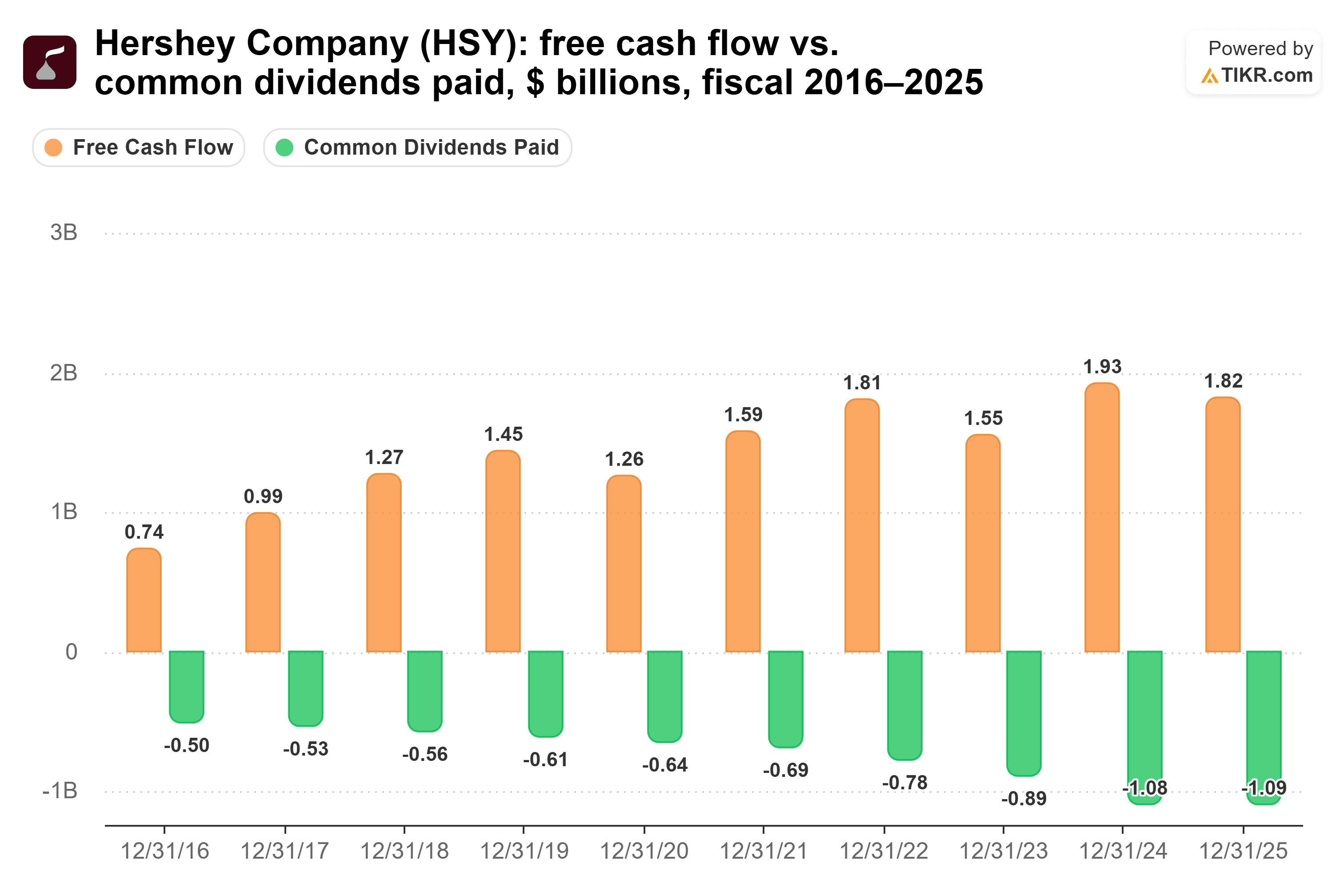
That lifted the cash dividend payout ratio from 42.9% in fiscal 2022 to 59.5% in fiscal 2025. Over the twelve months to Sept. 27, 2026, it’s a well-covered 53%, and the current rate of $5.81 a year is above fiscal 2025’s $5.48.
The risk is the shopper. On Oct. 29, Hershey narrowed its 2026 organic sales growth outlook to about 3%, and CEO Kirk Tanner said its “second-half demand creation initiatives are gaining momentum, even as consumers grow more cautious.”
Energy Transfer’s cash keeps climbing
Energy Transfer’s cash, by contrast, is still growing. Its distributable cash flow rose 33% from a year earlier to $2.52 billion in the third quarter, on record intrastate and gathered volumes. On Nov. 3, it raised its 2026 adjusted EBITDA guidance to $19.7 billion-$19.9 billion, from $18.8 billion-$19.1 billion.
As a master limited partnership, it pays distributions on units, with a K-1 at tax time. Its distributable cash flow per unit has covered those distributions every year since fiscal 2018:
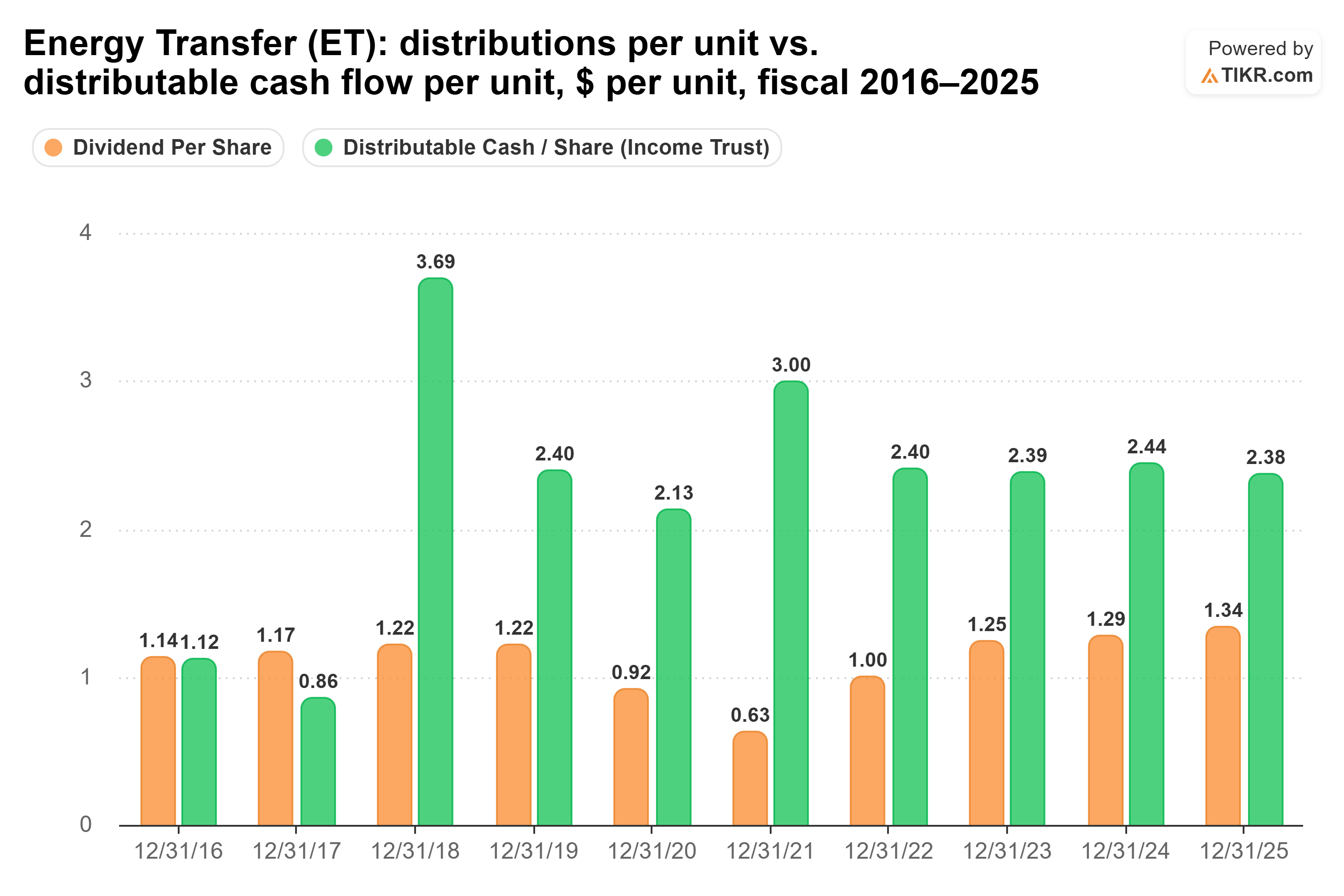
Coverage was a comfortable 1.8x in fiscal 2025. The chart also shows the cut, from $1.22 a unit in fiscal 2019 to $0.63 in fiscal 2021, which is why the payout grew just 2.2% a year from fiscal 2015 to fiscal 2025.
The risk is what growth costs. On Oct. 6, Energy Transfer agreed to buy Vaquero Midstream for about $2.63 billion, $1.95 billion of it in cash and the rest in new units. It approved the $1.6 billion South Mississippi Pipeline, which it’ll own 51% of, on Nov. 4, and priced $2.7 billion of new notes on Nov. 5.
So which dividend wins?
Energy Transfer pays you more over 10 years, by a wide margin. At each stock’s 5-year growth rate, $10,000 in Energy Transfer pays about $10,481 over the decade, against about $5,884 from Hershey. At each dividend’s pace now (Energy Transfer’s 4.7% raise in fiscal 2025, Hershey’s flat year), it’s about $9,049 against $3,400.
Neither 5-year rate is likely to hold. Energy Transfer’s starts from its cut, and management said on its second-quarter call that it targets long-term distribution growth of 3% to 5% a year. Hershey would need a lot more free cash flow to keep raising 11.7% a year. But even if Hershey does, and Energy Transfer grows at 4.7%, Energy Transfer pays about $9,049 to Hershey’s $5,884. At their 5-year rates, Hershey’s income wouldn’t pass Energy Transfer’s until around 2048.
Energy Transfer does carry more debt. Its net debt to EBITDA rose from 3.9x in fiscal 2021 to 4.5x in fiscal 2025, the top of the 4x-4.5x range management targets.
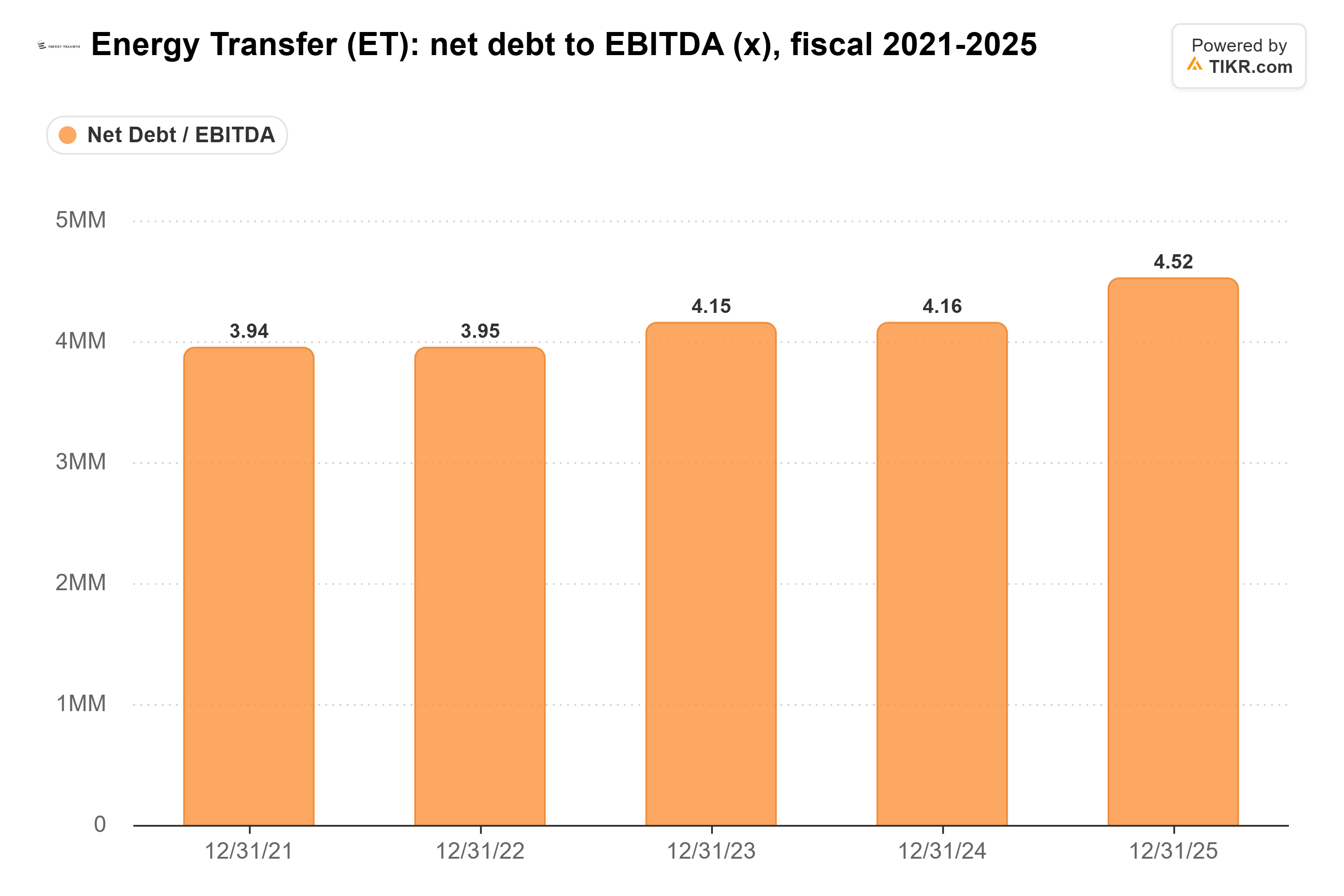
It’s 3.8x over the last twelve months, though Vaquero and the new notes will add to it.
Hershey’s best case is its balance sheet: 1.5x net debt to EBITDA and 11.7x interest coverage, against 3.1x interest coverage at Energy Transfer. That makes for a very safe check. Over 10 years, though, Energy Transfer’s head start is too big to give up, and its 1.8x coverage leaves room to keep raising.
Of course, Energy Transfer expects to spend about $7 billion of growth capital in 2027, against $5.4 billion-$5.6 billion this year. If those projects pay off, I’d expect the raises to keep coming. If leverage climbs past its target, they could slow.
Forget Energy Transfer: 6 safe 6%+ dividend yields you can buy right now
Dividends can hold the key to enormous wealth. But only if you buy the right ones.
Picking the right high-yield dividend stock can be the difference between a dream retirement…and scraping by every month, waiting for the next Social Security check to clear.
We’ve identified six stocks yielding 6%+ that we believe every retiree should know about right now. (And Energy Transfer isn’t one of them.)
Disclaimer:
Please note that the articles on TIKR are not intended to serve as investment or financial advice from TIKR or our content team, nor are they recommendations to buy or sell any stocks. We create our content based on TIKR Terminal’s investment data and analysts’ estimates. Our analysis might not include recent company news or important updates. TIKR has no position in any of the stocks mentioned. Thank you for reading, and happy investing!