Key Takeaways
- Goldman Sachs says conventional DRAM prices would have to fall more than 32% to 54% below its base case over two years before memory buyers have a real reason to default on long-term supply agreements.
- That protects the contracts behind Micron Technology’s (MU) and SK hynix’s (SKHY) record earnings, while buyers such as HP (HPQ) keep paying more for memory.
- Micron’s CEO says 75% of its 2027 output is sold, and analysts expect normalized EPS to more than double to $176.18 in fiscal 2027.
- At 3.6x forward earnings, Micron is priced as if those deals will break.
Micron Technology fell more than 12% in the last five trading sessions on TrendForce’s forecast of falling NAND prices and a broad chip selloff.
The fear is an old one: when memory booms end, customers look for a way out of their supply deals. Goldman Sachs just put a number on how bad things would have to get first:
“Conventional DRAM prices would need to fall more than 32-54% below our base case over the next two years before customers have a meaningful economic incentive to default on LTAs.”
That’s a crash.
It’s good news for SK hynix too, which has signed similar long-term agreements, and a tougher read for HP and the other buyers paying up in a market this tight.
Customers are asking for more memory
TrendForce sees DRAM contract prices rising another 10% to 15% this quarter, and it expects 5% to 10% more in the first quarter of 2027.
Micron CEO Sanjay Mehrotra said on Nov. 18: “75% of our 2027 is sold out. We are in discussions with customers now moving to 2028.” He’s also said that “customers wanted more commitment for supply than we were able to provide to them.”
Customers who wanted more supply than they got aren’t hunting for the exit.
HP shows that tightness from the buyer’s side. In its fiscal Q3, to July 31, it shipped 16% fewer Personal Systems units yet grew that segment’s revenue 18%, to $11.8 billion, at an operating margin of just 4.6%.
Its fiscal Q4 report this week should show whether its price increases are keeping up with memory costs.
TIKR tracks 51 analysts on Micron. How many say “Buy”?
See the full breakdown of Buy, Hold, and Sell ratings on Micron, along with Wall Street’s revenue and earnings estimates, all in one place. More than 500,000 investors use TIKR to research stocks like this one. See Micron’s Analyst Ratings
The estimates assume the deals hold
Analysts expect Micron’s earnings to keep climbing for two more years:
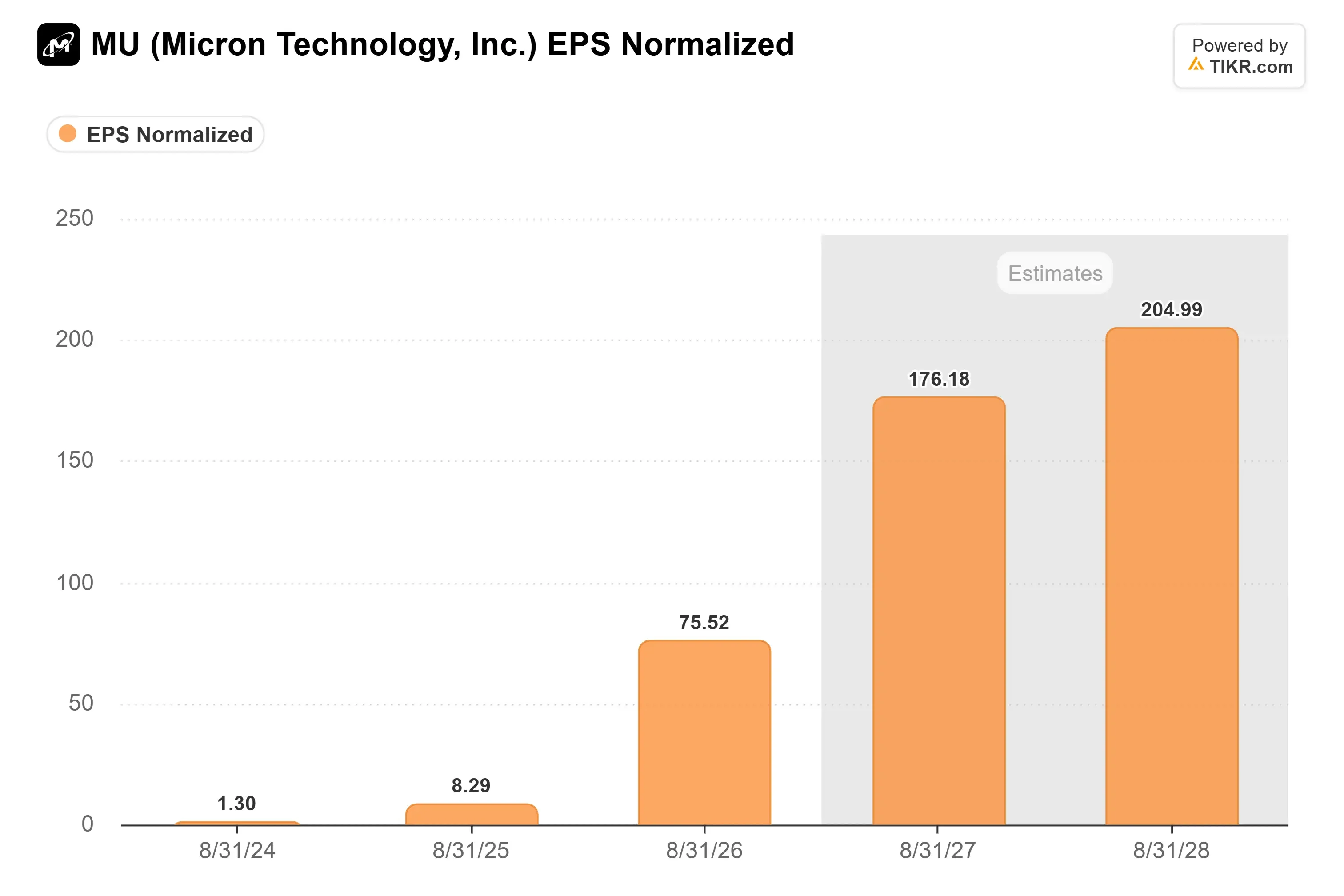
Consensus has normalized EPS going from $75.52 in fiscal 2026 to $176.18 in fiscal 2027 and $204.99 in fiscal 2028, and Goldman’s note gives analysts no reason to cut those numbers.
Falling NAND prices are the bigger risk to them, but NAND brought in $31.8 billion of Micron’s $133.2 billion of fiscal 2026 revenue.
Micron trades at 3.6x forward earnings on TIKR, below even its readings of 2017 and 2018, when the last memory cycle peaked. That’s a price for the contracts failing.
Memory booms have ended badly before
Micron’s gross margin shows how fast a downturn can hit:

GAAP gross margin fell from 45.2% in fiscal 2022 to 2.7% in fiscal 2023, so a slide the size of Goldman’s threshold is well within what past cycles have done.
The contracts this time have more teeth. Customers posted $12.75 billion of cash deposits with Micron in fiscal 2026, which it can keep in part if they miss their minimums.
The catch is coverage: Micron estimates its 26 agreements cover over 35% of revenue through 2030, so most of its sales still move with market prices.
SK hynix posted an 80% operating margin in its Q3, to Sept. 30, and its long-term agreements cover more than half of its 2027 and 2028 capacity (a share of output, where Micron’s figure is a share of revenue).
The floor looks safer than the price suggests
The way I see it, if Goldman’s right, Micron’s contracted floor holds through anything short of a crash. The stock is priced for something much worse.
Micron reports its fiscal Q1 on Dec. 17: revenue at or above the $61.5 billion midpoint of guidance, with a non-GAAP gross margin at or above 86.25%, would say prices are holding.
So what is Micron stock actually worth?
TIKR lets you forecast the future price of any stock in less than a minute. Just enter a few assumptions into TIKR’s valuation model and see what Micron could be worth. Start from Wall Street consensus estimates, or adjust the inputs to reflect your own view of the business. It’s free to use.
Disclaimer:
Please note that the articles on TIKR are not intended to serve as investment or financial advice from TIKR or our content team, nor are they recommendations to buy or sell any stocks. We create our content based on TIKR Terminal’s investment data and analysts’ estimates. Our analysis might not include recent company news or important updates. TIKR has no position in any of the stocks mentioned. Thank you for reading, and happy investing!