Key Takeaways
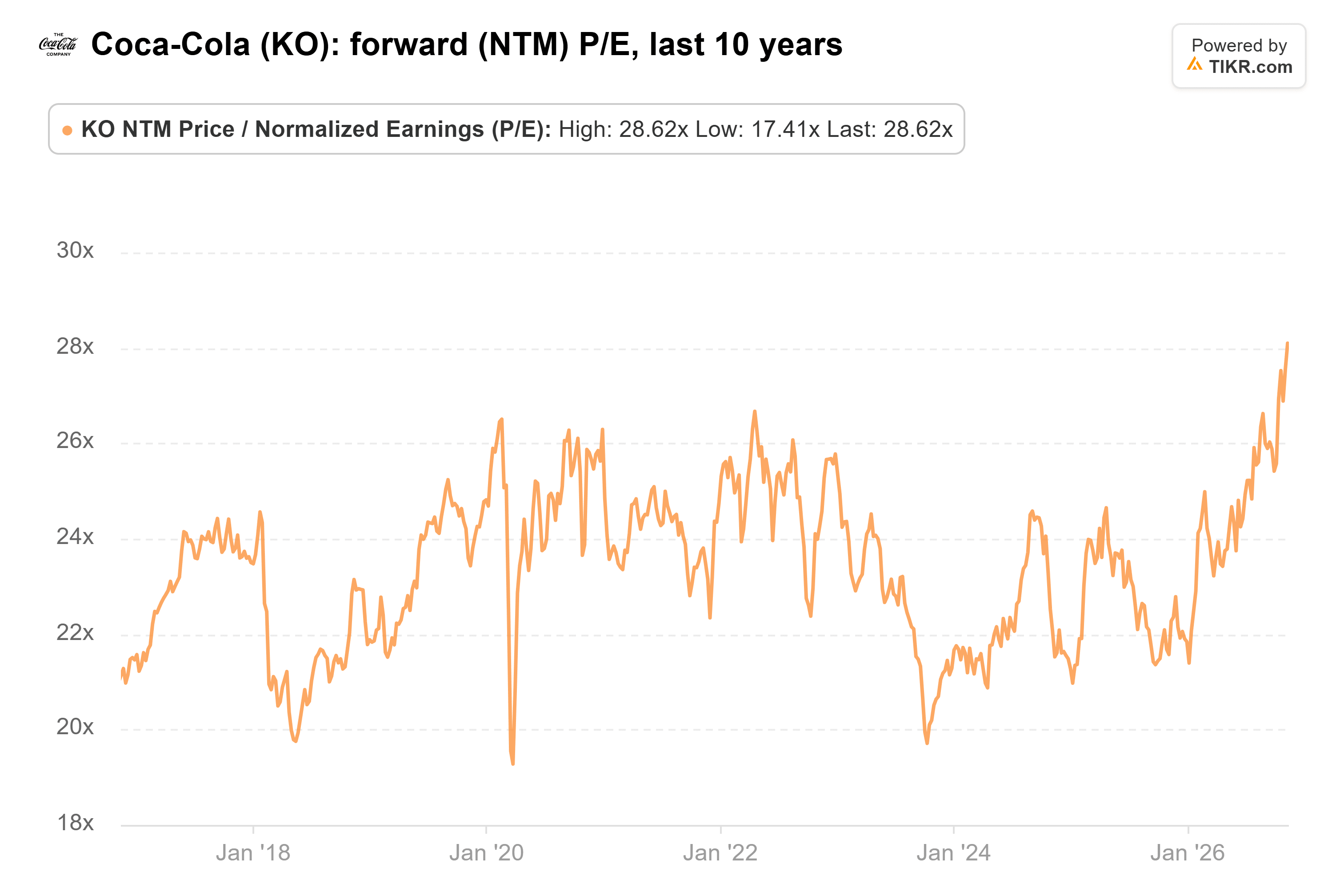
- Coca-Cola closed at a record high on Nov. 13, the day after Nvidia announced its CEO’s resignation, and it trades at 29x forward earnings, the top of its 10-year range.
- One investor says the bubble is in consumer staples. That call holds up best for Coca-Cola, whose multiple has climbed far faster than its earnings estimates.
- Walmart trades at 43x forward earnings, about two-thirds above its 10-year average, while Nvidia trades at 14x, the low of its five-year range.
- At these prices, Coca-Cola leaves no room for anything to go wrong, while Nvidia’s price already reflects a lot of bad news.
Coca-Cola (KO) closed at a record $99.25 on Nov. 13, the day after Nvidia (NVDA) announced that Jensen Huang had resigned as CEO.
It’s been that kind of year. Through Nov. 5, value stocks were up 24% in 2026 and growth stocks were down 6%, Creative Planning’s Charlie Bilello pointed out. If that holds, the gap would be a record, wider even than in 2000 when the dot-com bubble burst.
On Nov. 15, one investor in r/ValueInvesting flipped the usual worry around:
“The bubble is in consumer staple stocks not tech stocks.”
The poster pointed to the valuations of Coca-Cola and Walmart (WMT), among others, and argued that the AI selloff has gone too far.
That’s a bold take for a value-investing forum, and the numbers mostly back it.
TIKR tracks 62 analysts on Nvidia. How many say “Buy”?
See the full breakdown of Buy, Hold, and Sell ratings on Nvidia, along with Wall Street’s revenue and earnings estimates, all in one place. More than 500,000 investors use TIKR to research stocks like this one. See Nvidia’s Analyst Ratings
Investors are paying more for the same Coca-Cola
Coca-Cola has been a premium stock for years. Its forward P/E has averaged 23x over the past decade, and it hit 29x on Nov. 13, the highest of that stretch:
The business is doing well, too. Unit case volume grew 5% in the third quarter, and Coca-Cola raised its 2026 outlook for the third time, to comparable EPS growth of at least 11%. Two points of the third quarter’s 11% EPS growth came from currency, though.
After this year, growth looks a lot like the last decade’s. Analysts expect EPS to grow about 6% in 2027 and 7% in 2028. Management says the sale of its African bottler alone takes about 2 points off 2027 EPS growth. From 2015 to 2025, diluted EPS grew about 6% a year.
After the third-quarter report, analysts raised their price targets but moved their 2027 and 2028 estimates up just a penny each. At the end of September 2025, the stock traded at 21x forward earnings, so most of the gain since then has come from a higher multiple rather than higher estimates. If the multiple slipped back to its 10-year average, the stock would lose nearly a fifth of its value, even if estimates held.
Walmart is pricier still
The poster’s case is even stronger for Walmart. Its forward P/E is 43x, about two-thirds above its 10-year average of 26x:
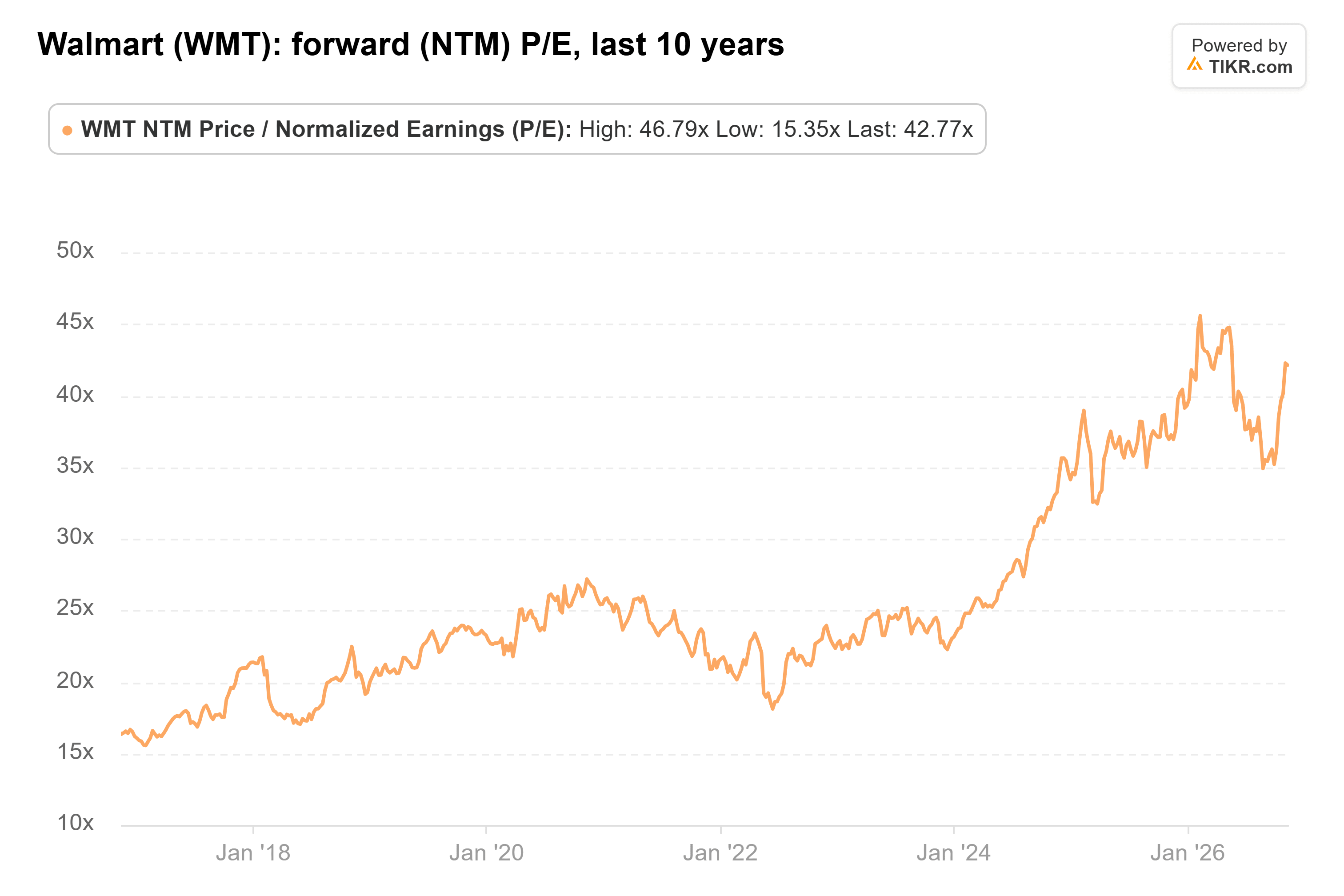
That’s down from 47x in February, but it’s still more than three times what investors now pay for Nvidia’s earnings. Few businesses are easier to forecast than Walmart’s, and that’s a big part of why investors buy it for cover. But as one reply in the thread argued, a business can be both predictable and overvalued.
Nvidia’s problems are already in the price
Nvidia’s forward P/E, meanwhile, fell to 14x on Nov. 13. That’s the low of its five-year range and well under its 36x average:
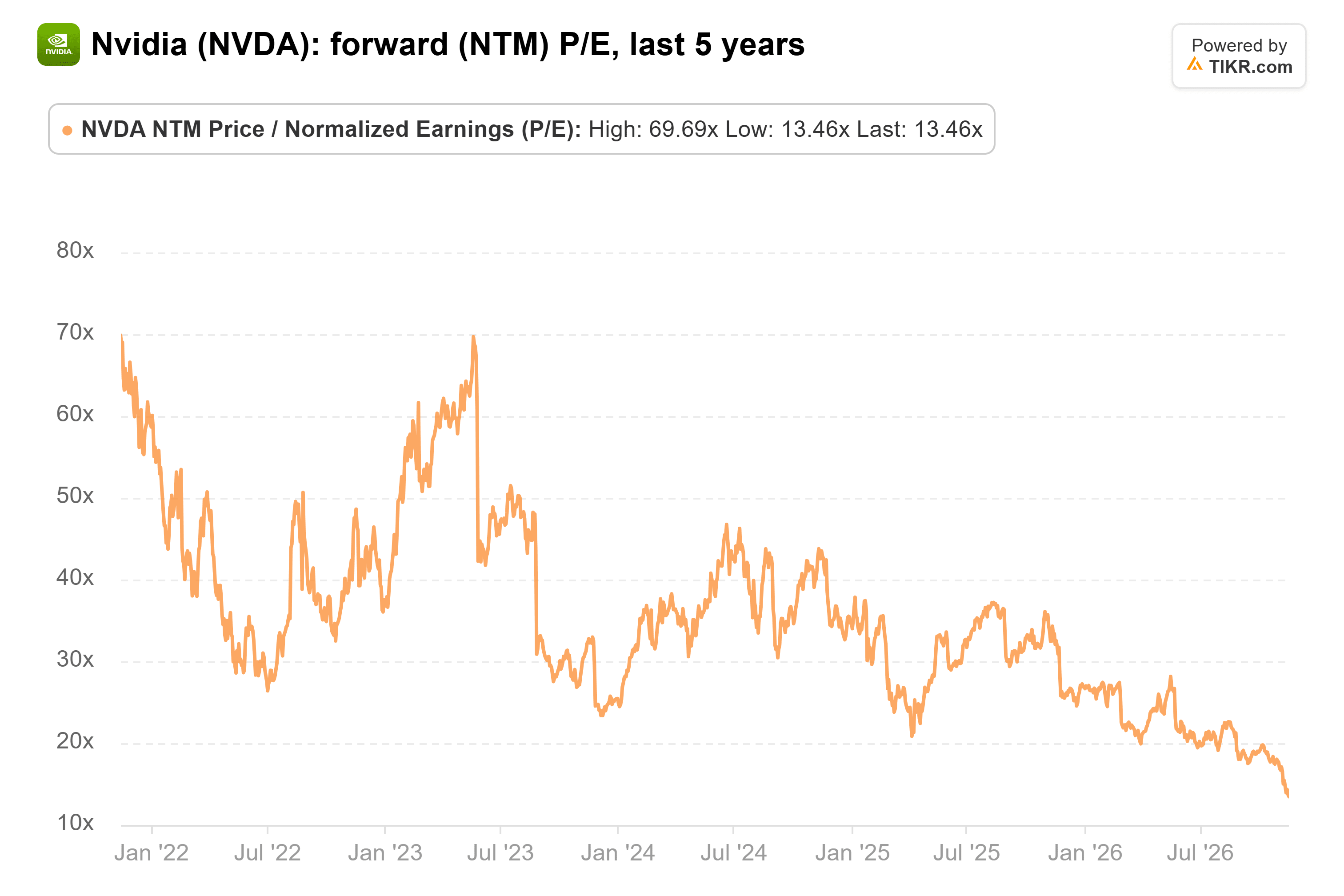
Part of that is the CEO. Nvidia announced Huang’s resignation on Nov. 12, after reports of two affairs, including one with a woman U.S. officials reportedly suspect of ties to Chinese intelligence. CFO Colette Kress is running the company until the board names a successor, and her first test comes on Nov. 17, when Nvidia reports fiscal third-quarter results after the close. As another investor in the thread argued, Nvidia also sells heavily to AI labs that still lose money, so its next five years are much harder to forecast than Coca-Cola’s.
But tech stocks were already cheap before Huang’s exit. On Nov. 11, Evercore ISI’s Julian Emanuel said on Bloomberg Surveillance that “the tech sector is trading at a valuation discount to the S&P 500 for the first time since 2010.”
Safety comes at a steep price right now
The poster is right about Coca-Cola. Investors are paying a decade-high multiple for the same mid-single-digit growth the company has delivered for 10 years. That price leaves no room for anything to go wrong. Nvidia is riskier until it names a permanent CEO, but at a five-year-low multiple, a lot of bad news is already priced in.
Bottom line: between the two at today’s prices, Nvidia offers more for the money, as long as its earnings hold up without Huang.
Coca-Cola will give its 2027 guidance with its fourth-quarter results, expected in February. Guidance for comparable EPS growth well above 7% would make today’s multiple much easier to justify.
So what is Coca-Cola stock actually worth?
TIKR lets you forecast the future price of any stock in less than a minute. Just enter a few assumptions into TIKR’s valuation model and see what Coca-Cola could be worth. Start from Wall Street consensus estimates, or adjust the inputs to reflect your own view of the business. It’s free to use.
Disclaimer:
Please note that the articles on TIKR are not intended to serve as investment or financial advice from TIKR or our content team, nor are they recommendations to buy or sell any stocks. We create our content based on TIKR Terminal’s investment data and analysts’ estimates. Our analysis might not include recent company news or important updates. TIKR has no position in any of the stocks mentioned. Thank you for reading, and happy investing!